Finance

All travel finance news

Netanyahu admits Israel backing ‘criminal’ groups, rivals of Hamas, in Gaza | Israel-Palestine conflict News

Israel’s Prime Minister Benjamin Netanyahu has said the country used armed gangs in Gaza to help fight Hamas, his admission coming after a new wave of military strikes on the besieged Gaza Strip that left at least 52 Palestinians dead.

Netanyahu said the government had “activated” powerful local clans in the enclave on the advice of “security officials”, his video statement posted to X on Thursday coming hours after former Defence Minister Avigdor Lieberman accused him of deploying the tactic.

The statement marked the government’s first public acknowledgement that it had backed the armed Palestinian groups based around powerful families, which stand accused by aid workers of carrying out criminal attacks and stealing aid from trucks as starvation stalks the entire territory due to a punishing Israeli blockade.

An Israeli official cited by news agency The Associated Press said that one of the groups Netanyahu was referring to was the so-called Popular Forces, led by Yasser Abu Shabab, a local clan leader in Rafah.

Last month, Israeli newspaper Haaretz reported on the group’s activities – though it was named the “Anti-Terror Service” in the report – saying that sources in Gaza claimed it consisted of roughly 100 armed men operating with the tacit approval of the Israeli military.

In recent weeks, the Abu Shabab group announced online that its fighters were helping protect supply shipments to new US- and Israel-backed distribution centres run by the shadowy Gaza Humanitarian Foundation (GHF).

“The Israeli opposition claims that there was no consultation within the Israeli government or the Israeli cabinet,” said Al Jazeera’s Hamdah Salhut, reporting from Jordan’s capital Amman. “Netanyahu says that these armed gangs … could essentially help the Israelis defeat Hamas in Gaza.”

“But it’s not going down well within Israel, where people are saying that these are armed criminal enterprises within the Gaza Strip. That they should not be armed and that these are Israeli weapons that are being put in their hands,” she said.

‘Human abattoir’

Netanyahu made his statement on another deadly day in Gaza, the military hitting targets throughout the besieged coastal enclave where the crippling blockade has brought the population to the brink of mass starvation.

Deadly incidents, killing more than 100 and wounding many more, at aid distribution sites run by the GHF since last week have sparked widespread condemnation, with Israeli troops opening fire on Palestinians seeking aid on four separate occasions since last week.

Chris Gunness, former spokesperson for the UN agency for Palestinian refugees (UNRWA), told Al Jazeera that the operations of the Gaza Humanitarian Foundation had turned Gaza into a “human abattoir”.

“Hundreds of civilians are herded like animals into fenced-off pens and are slaughtered like cattle in the process,” he said.

Amid growing international condemnation, GHF shuttered operations for a full day on Wednesday, saying the next day that it would reopen two aid distribution centres in the Rafah area of southern Gaza. It did not say when aid distribution would resume.

At least 52 Palestinians were killed on Thursday, according to hospital sources who spoke to Al Jazeera. The sources said 31 bodies had arrived at Nasser Hospital in Khan Younis, with 21 admitted to Gaza City’s al-Ahli Arab and al-Shifa hospitals.

Israel killed four journalists in an attack on al-Ahli Hospital itself, also known as the Baptist Hospital, in Gaza City

Gaza City local Fadi al-Hindi told Al Jazeera that he had seen one of the strikes on al-Nasser Street, near the al-Shifa Hospital, witnessing scenes of death after running outside his tent to check on his children.

“When I arrived, I saw a man in pieces; he had been riding a bicycle, and the lower half of his body was gone. Everyone in the street was injured, and we started to collect the pieces of the wounded,” he said.

At least three Palestinians were killed in the strike, reportedly including children.

The Palestinian news agency Wafa also reported five deaths in areas around Khan Younis, four west of Beit Lahiya in the north, and one south of Gaza City, as well as the injuring of a child near Bureij in central Gaza.

Wafa also reported that Israeli forces opened fire on Palestinians trying to reach an aid centre near Wadi Gaza.

In the meantime, Hamas chief Khalil al-Hayya has said in a prerecorded speech that the group did not reject a proposal for a ceasefire in Gaza put forward by US special envoy Steve Witkoff, stating that it had instead requested some changes to ensure an end to the war.

Al-Hayya added that Hamas is ready to engage in further talks and that communications with the mediators are ongoing. Israel broke off a previous truce in March to resume the war in Gaza.
Source link

Innovation In An Age of Uncertainty

Uncertainty continues to cloud the global economic horizon, with tariffs remaining a dominant con- cern in both political and financial circles. In the

United States, decisions by the Trump administration have increasingly been subject to legal scrutiny and challenged in court, and what’s legal one week may be overturned the next. As economists at BNP Paribas aptly describe it, the legal status of trade decisions moves like a yo-yo.

Meanwhile, formal and informal trade talks between sovereign nations continue moving up and down. Financial markets reflect this instability with sharp reactions. But for the corporate world, time doesn’t stop. Daily decisions must be made—regardless of the uncertainty hanging over long-term strategies. Questions abound: Will multinational infrastructure projects go ahead? Will financing for wind and alternative energy initiatives hold firm? These are difficult questions, and for many, the answers remain elusive. And yet, in this uncertainty, one sector shows remark- able resilience: innovation. In this issue, we’re proud to present our annual awards for innovation and innovators, along with a selection of some of the most dynamic innovation labs around the world. Unsurprisingly, artificial intelligence leads the way, both in concept and in real- world application. Many of the financial institutions and fintech firms recognized this year are not just adapting to the future—they are helping to shape it.

The innovations profiled by our global team of reporters and analysts are impressive on their own merits. But more striking is the broader trend they represent. Despite economic and political volatility, organizations across the financial and technology spectrum—banks, startups, consulting firms, and independent labs—are continuing to invest aggressively in R&D. Why? Because innovation is not a luxury. It’s a necessity.

This strong commitment to innovation suggests something profound: in uncertain times, looking forward becomes more important, not less. Innovation, in this context, is not merely a growth strategy—it’s a survival strategy. And in many ways, it proves to be counter-cyclical. When the present is unstable, thinking ahead becomes not just prudent, but essential.

Andrea Fiano | Editor At Large | [email protected]

June 2025

Access the digital edition.

Read now

Source link

Trump, Merz discuss trade, NATO spending and Russia’s war on Ukraine | Russia-Ukraine war News

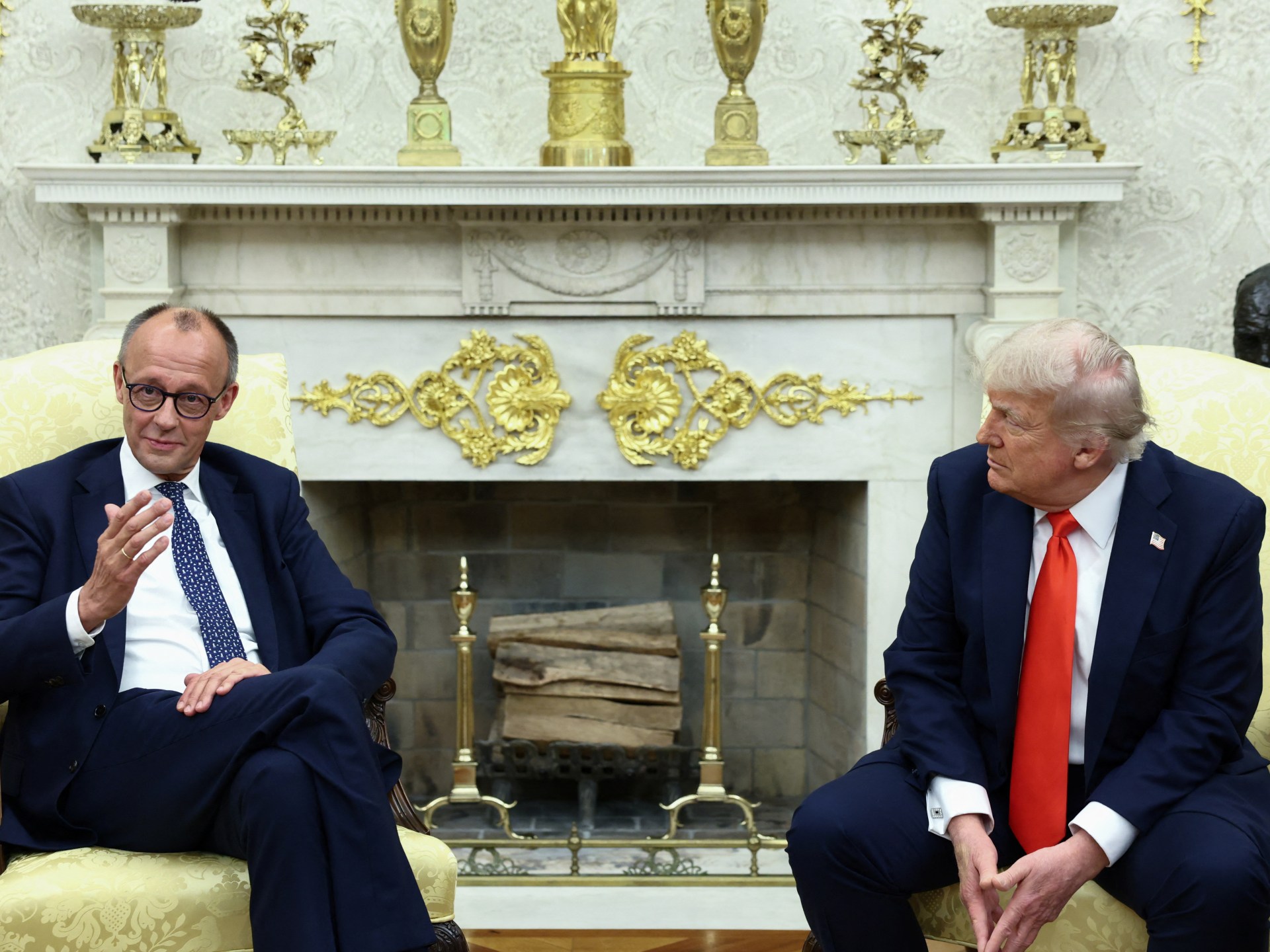
German Chancellor Friedrich Merz has called on the US to apply more pressure on Russia to end its three-year-old war on Ukraine.

“You know that we gave support to Ukraine and that we are looking for more pressure on Russia,” Merz told US President Donald Trump at the start of their meeting on Thursday at the Oval Office.

Merz emphasised that Germany “was on the side of Ukraine”, while Trump likened the war to a fight between two young children who hated each other.

“Sometimes, you’re better off letting them fight for a while and then pulling them apart,” Trump said. He added that he had relayed that analogy to Russian President Vladimir Putin in their phone conversation on Wednesday.

Asked about Trump’s comments as the two leaders sat next to each other, Merz stressed that both he and Trump agreed “on this war and how terrible this war is going on,” pointing to the US president as the “key person in the world” who would be able to stop the bloodshed.

Al Jazeera’s Kimberly Halkett said that, while the two men agreed that the war needed to end, how that happens “seems to be a point of contention”.

“What we saw there was the German chancellor suggesting and pointing out that … Russia continues to hit back at civilian targets, whereas, when it comes to Ukraine, the focus in the eyes of Germany has been strictly on military targets inside Russia,” she said from Washington, DC.

Halkett added that Trump revealed during the meeting that he “implored the Russian president not to retaliate for that attack that took place over the weekend … and Vladimir Putin said he was going to attack regardless.”

A ‘decent’ relationship

Thursday’s meeting marked the first time that the two leaders sat down in person. After exchanging pleasantries – Merz gave Trump a gold-framed birth certificate of the US president’s grandfather, Friedrich Trump, who immigrated from Germany – the two leaders were to discuss issues such as Ukraine, trade and NATO spending.

Trump and Merz have spoken several times by phone, either bilaterally or with other European leaders, since Merz took office on May 6. German officials say the two leaders have started to build a “decent” relationship, with Merz wanting to avoid the antagonism that defined Trump’s relationship with one of his predecessors, Angela Merkel, in the Republican president’s first term.

The 69-year-old Merz, who came to office with an extensive business background, is a conservative former rival of Merkel’s who took over her party after she retired from politics.

Merz has thrown himself into diplomacy on Ukraine, travelling to Kyiv with fellow European leaders days after taking office and receiving Zelenskyy in Berlin last week.

He has thanked Trump for his support for an unconditional ceasefire while rejecting the idea of “dictated peace” or the “subjugation” of Ukraine and advocating for more sanctions against Russia.

In their first phone call since Merz became chancellor, Trump said he would support the efforts of Germany and other European countries to achieve peace, according to a readout from the German government. Merz also said last month that “it is of paramount importance that the political West not let itself be divided, so I will continue to make every effort to produce the greatest possible unity between the European and American partners.”

Under Merz’s immediate predecessor, Olaf Scholz, Germany became the second-biggest supplier of military aid to Ukraine after the United States. Merz has promised to keep up the support and last week, pledged to help Ukraine develop its own long-range missile systems that would be free of any imposed range limits.

At home, Merz’s government is intensifying a drive that Scholz started to bolster the German military after Russia launched its full-scale invasion of Ukraine. In Trump’s first term, Berlin was a target of his ire for failing to meet the current NATO target of spending 2 percent of gross domestic product on defence, and Trump is now demanding at least 5 percent from allies.

The White House official said the upcoming NATO summit in the Netherlands later this month is a “good opportunity” for Germany to commit to meeting that 5 percent mark.

During their meeting on Thursday, Trump described Merz as a good representative of Germany and also “difficult,” which he suggested was a compliment. He said US troops would remain in Germany and said it was positive that Berlin was spending more money on defence.

‘Ok with tariffs’

Another top priority for Merz is to get Germany’s economy, Europe’s biggest, moving again after it shrank the past two years. He wants to make it a “locomotive of growth,” but Trump’s tariff threats are a potential obstacle for a country whose exports have been a key strength. At present, the economy is forecast to stagnate in 2025.

Germany exported $160bn worth of goods to the US last year, according to the Census Bureau. That was about $85bn more than what the US sent to Germany, a trade deficit that Trump wants to erase.

“Germany is one of the very big investors in America,” Merz told reporters Thursday morning. “Only a few countries invest more than Germany in the USA. We are in third place in terms of foreign direct investment.”

The United States and the European Union are in talks to reach a trade deal, which would be critical for Germany’s export-heavy economy, but Trump said he would be fine with an agreement or with tariffs.

“We’ll end up hopefully with a trade deal,” Trump said. “I’m OK with the tariffs, or we make a deal with the trade.”

Source link

Paul Brody, EY: How Blockchain Is Transforming Global Commerce

Paul Brody is global blockchain leader at professional services firm EY and co-author of a 2023 book, Ethereum for Business: A Plain-English Guide to the Use Cases that Generate Returns from Asset Management to Payments to Supply Chains. He speaks with Global Finance about blockchain technology’s impact on everything from routine payments to cross-border remittances to the future of banking and the CFO and treasurer roles.

Global Finance: If we look at what people are transacting on blockchains today, it’s not primarily bitcoin but stablecoin, a type of cryptocurrency designed to maintain a stable value over time. Does this surprise you?

Paul Brody: The ability of people to pay each other in dollars is hugely valuable. And to give you a sense of how big stable- coin dollars have become, last month the ethereum blockchain ecosystem did $2 trillion in stablecoin payments, over 99% of which were in US dollars.

GF: Who is actually using them?

Brody: By far the most popular initial use case for stablecoin is in emerging markets. Countries without independent central banks often experience high inflation or even hyperinflation, and so demand for US dollars is really high among the local population.

GF: And they’re being used for cross-border remittances too?

Brody: A lot of traditional cross-border systems take days to execute, and they cost a fair amount of money. If both participants have smartphones and cryptocurrency accounts, you can send dollars across borders in a matter of seconds for almost nothing.

GF: Lately, the US Treasury Department seems to be saying that the US doesn’t need a central bank digital currency [CBDC], i.e., a digital dollar. It can use stablecoin. Is that your read too?

Brody: What we need is well-regulated stablecoin. We need some regulatory safeguards to make sure that if you say there’s a dollar on-chain, there’s also a dollar in the bank account to back that up, or its equivalent in assets.

CBDCs have been flopping, mostly because central banks don’t really know why they’re doing them. I’ve talked to many central bankers, and they generally have no idea why they’re doing this other than Facebook wanted one.

GF: How will blockchain technology change things for corporate CFOs and treasurers?

Brody: CFOs and treasurers have some questions to ask themselves: Am I plugged into the crypto and blockchain system? Can I make stablecoin payments? Should I include bitcoin in my corporate treasury alongside US dollar-denominated bonds? Going further, can I automate my business contracts? My procurement? How can I run my business operations more efficiently? And if a customer wants to pay me in stablecoin, can they do so? The answer for most companies today is, no, they can’t.

GF: If you’re a stablecoin issuer, how do you make a profit on that business?

Brody: You make money with transaction fees and, potentially, your float on the interest rate. But that depends on interest rates. If rates go down really low, it’s going to be a painful business. Fees are pretty small because it’s such a competitive environment.

GF: What does all this mean for banks generally going forward? Is it going to lessen their importance?

Brody: It’s going to change banks’ role, and may diminish it. It depends on how a bank makes its money.

Banks that make their money processing credit card transac- tions are the most at risk because blockchains represent a new, more efficient way to process transactions. You swipe your credit card in a store, and you don’t see the cost of the payment, but it’s real and it’s substantial, like 3% to 4%. International wire trans- fers are usually a fixed fee, as much as $50. Stablecoin transfers cost almost nothing by comparison.

But if you’re a regional bank that does a lot of corporate finance, blockchain probably doesn’t change your business that much.

GF: What about major custody banks, such as BNY Mellon, JPMorgan, etc.? Is their business at risk?

Brody: Major custody banks are in an interesting place. They have a ton of assets, and if you’ve got assets and you control and custody those assets, you’re then in a position to help people tokenize them.

So, this new technology is certainly a threat, but it’s also potentially a substantial opportunity. At the end of the day, if you’re custodying assets and you’re now helping people tokenize them or manage them in different ecosystems, that represents the additive potential to your business.

GF: In your book Ethereum for Business, you highlight the importance of blockchain-based smart contracts. With these, one can define not only dollars but all sorts of things, even coffee mugs. Why aren’t more corporations using smart contracts?

Brody: The answer is that blockchains don’t yet have privacy built into them, and this is a huge problem. But it’s being fixed. It’s like the early days of the internet, when we didn’t have encryption. Most companies don’t feel comfortable doing business without privacy.

It’s why private blockchains have never worked. If companies had a private blockchain, they thought it ensured privacy. What they didn’t realize is that inside that walled garden there’s still no privacy. If you’re a big company and you have all your suppliers in your private blockchain, you still can’t run your procurement process there, because supplier A can see how much you’re paying supplier B, and also how much you’re ordering from them.

GF: How deep are banks going to go in providing blockchain services?

Brody: Every single bank is going to offer some kind of DLT [distributed ledger technology] service. You have stocks, you have bonds [to offer clients], and now you may add crypto. Other institutions may send cash to an ethereum address for you, instead of setting up a wire transfer to a bank address. There will be new versions of money transfer and payments, and some of them are going to be quite sophisticated.

GF: Skeptics are asking when they will see blockchain’s “killer app”: meaning an application that’s universally used, along the lines of what email did for the internet?

Brody: Stablecoins are the killer app, the one that gets everybody on-chain. The stablecoin market is about to get crazy competitive, and yield-bearing stablecoins will be widely available soon.


“CFOs and treasurers have to ask themselves: If a customer wants to pay me in stablecoin, can they do so?”


GF: All in all, is blockchain a niche innovation—useful but not earth-shattering—or is it something that can fundamentally change global finance?

Brody: It’s not only going to change global finance, but it will transform all global commerce.

Blockchain is going to become the plumbing by which all B2B transactions are done.

And the reason it’s so transformational is that historically, money, contracts, and “stuff” [i.e., goods] all were in different systems. Companies still spend huge amounts on reconciling money, stuff, and contracts. For example, it costs the average large company about $100 to pay a bill. And the reason is, somebody in procurement has to say, I’ve got this bill. Does it match the purchase order that I sent out? Do the terms on the bill and the purchase order match the terms of the contract? And so on. Imagine a future where the money, the stuff, and the terms of the contract are all in the same digital system and they all reconcile with each other. It’s done instantly. In 10, 15 years, the whole process will be universal and invisible. Back-end plumbing, right?

Source link

Netherlands still backs Israeli F-35 ‘supply chain of death’: Report | Gaza News

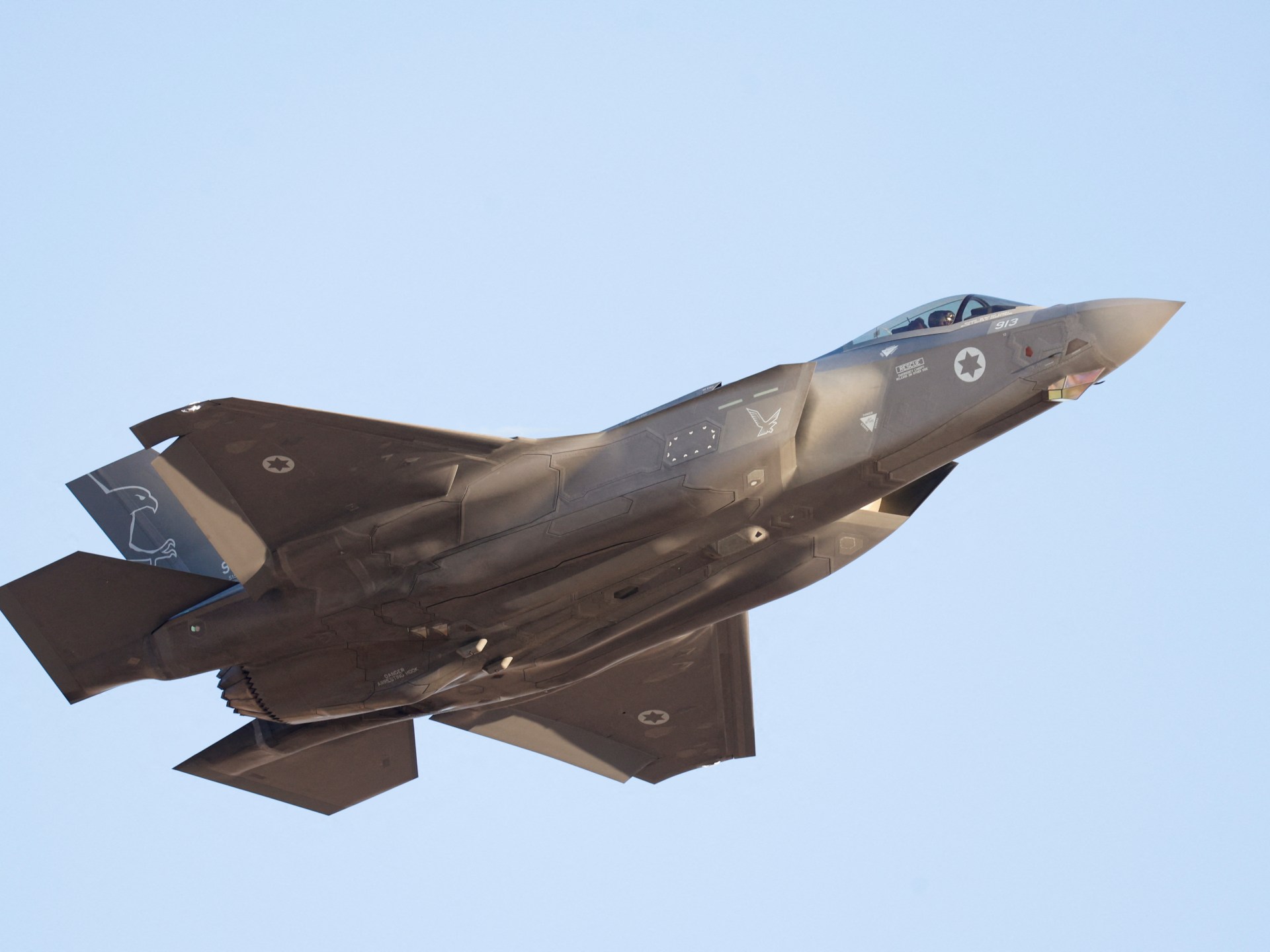
The Netherlands is still supporting the supply chain of Israel’s version of the F-35 fighter jet, more than a year after a court banned direct Dutch exports of F-35 parts to Israel, a report claims.

Research by the Palestinian Youth Movement (PYM) shared with Al Jazeera shows that the port of Rotterdam is frequented by ships carrying F-35 parts for maintenance and assembly. The ships belong to the Danish shipping giant Maersk.

By examining import data and shipping receipts of Maersk and Lockheed Martin – the United States weapons manufacturer that designed the F-35 – the group found that more than a dozen shipments from Israel travelled through the port of Rotterdam on their way to the US from April 2023 until early 2025.

The F-35 fighter jet has been used by Israel to bomb Gaza from the air with devastating effect. Much of the Strip, where more than 50,000 people have been killed since October 2023, is in ruins.

“Maersk now operates a recurring shipping cycle between Lockheed Martin’s Fort Worth facility in Texas and Israel Aerospace Industries in Israel, routed through Rotterdam,” the report stated. “In this cycle, Maersk transports pairs of empty F-35 wing containers from Houston to Ashdod, Israel, where they are loaded with completed F-35 wings. The filled containers are then shipped back to the US for final assembly or repair.”

The researchers noted that Rotterdam is a “key stopover point in this process, and shipments for this cycle have occurred beyond February of 2024”.

Then, a judge at a Dutch appeals court ordered the Netherlands to stop exporting and transiting F-35 parts to Israel, saying there was a “clear risk” they were being used in “serious violations of international humanitarian law”.

The Dutch state immediately lodged an appeal at the Supreme Court, but until a decision is made, it is still bound by the lower court’s ruling.

“The findings in the report show that the port of Rotterdam plays an important role in sustaining the operational capacities of Israel’s F-35 fighter jets. This way, the port of Rotterdam is complicit to international law violations in Gaza,” Gerard Jonkman, director of a Dutch NGO, The Rights Forum, told Al Jazeera.

The Dutch Foreign Ministry told Al Jazeera that the court had subsequently confirmed that the judgement in February 2024 applied only to the export or transit of F-35 parts from the Netherlands to Israel and that the Dutch state had implemented the judgement accordingly.

A spokesperson for the port of Rotterdam told Al Jazeera that the Dutch Ministry of Foreign Affairs was responsible for issuing permits for the transhipment of military goods. Port officials check vessel compliance with environmental and safety regulations for shipping on behalf of the government and municipality of Rotterdam, they said.

“The harbour master receives only limited information regarding vessel cargo. The information received mainly pertains to whether the vessel is carrying hazardous substances. Other aspects of vessel cargo are monitored by various other public authorities, such as customs.”

They said they were “aware” of the February 2024 court ruling.

“All activities in the port must comply with international laws and regulations and the permits issued by the government. If we see any indication that this is not the case, the Port of Rotterdam Authority alerts the competent authority.”

‘The Netherlands is still part of the supply chain’

The Rights Forum was one of three parties, together with the Dutch affiliate of Oxfam and PAX for Peace, the largest peace organisation in the Netherlands, that sued the Dutch state over its export of F-35 parts to Israel.

“In this case, there is no direct export from the Netherlands to Israel, but the Netherlands is still part of the supply chain for the Israeli F-35 programme,” Gerard Jonkman, head of the Rights Forum, said of the Palestinian Youth Movement’s findings. “This way the Netherlands facilitates the Israeli F-35 programme and might breach its obligations under international law.”

PAX for Peace project leader Frank Slijper told Al Jazeera: “This indeed shows that the Netherlands is part of the F-35 supply chain.”

A grassroots organisation, the Palestinian Youth Movement believes that targeting Maersk directly disrupts the flow of weapons in the “supply chain of death used to genocide Palestinians”.

According to the group, Maersk has shipped the wings for every Israeli F-35 since March 2022.

In November 2024, following a decision by Spain to deny docking permission to two ships carrying weapons bound for Israel, Maersk adjusted its routes. The company’s fleet now avoids Spain in favour of Rotterdam and the port of Tangier in Morocco

“Maersk has, for years, knowingly supplied the Israeli military with key weapons components used to carry out genocide in Gaza,” Aisha Nizar of the Palestinian Youth Movement told Al Jazeera. “The company has done so without hesitation, potentially violating multiple arms embargo policies across Europe.”

The F-35 is considered a top-of-the-line fighter jet. The aircraft designed by Lockheed Martin costs at least $80m in its most basic configuration.

Currently, 12 countries operate the jet. F-35 parts are made in the United States and several participating partner countries, giving the project the moniker Joint Strike Fighter.

“It is very sad to see that Maersk is not distancing itself from Israel’s crimes against humanity in Gaza and more broadly continues lending itself to the crucial replenishment of Israel’s armed forces,” Slijper said. “Shipping military supplies for the benefit of Israel’s arms industry and the [Israeli army] risks Maersk being complicit in Israel’s crimes.”

The use of the jet by Israel, the only country with its unique version of the F-35, has been scrutinised since the start of the onslaught in Gaza.

Recently, campaign groups took the United Kingdom government to court in a bid to halt the exports of British-made F-35 parts to Israel.

In a statement to Al Jazeera, Lockheed Martin said: “Foreign military sales are government-to-government transactions, and we closely adhere to US government policy with regard to conducting business with international partners.”

Regarding F-35 shipments, Maersk told Al Jazeera that it upholds a strict policy of not shipping weapons or ammunition to active conflict zones and that it conducted due diligence, particularly in regions affected by active conflicts, including Israel and Gaza, and adapts this due diligence to the changing context. It confirmed, however, that its US subsidiary Maersk Line Limited was one of “many companies supporting the global F-35 supply chain” with transport services.

The F-35 programme includes several coalition countries, including Israel.

“As part of the coalition-building of the F-35, Maersk Line Limited regularly transports parts between participating countries, including Israel, where F-35 wings are manufactured,” it said.

Source link

Myanmar’s chinlone ball sport threatened by conflict and rattan shortages | In Pictures

Mastering control of the ever rising and falling rattan chinlone ball instils patience, a veteran of Myanmar’s traditional sport says.

“Once you get into playing the game, you forget everything,” 74-year-old Win Tint says.

“You concentrate only on your touch, and you concentrate only on your style.”

Chinlone, Myanmar’s national game, traces its roots back centuries. Described as a fusion of sport and art, it is often accompanied by music and typically sees men and women playing in distinct ways.

Teams of men form a circle, passing the ball among themselves using stylised movements of their feet, knees and heads in a game of “keepy-uppy” with a scoring system that remains inscrutable to outsiders.

Women, meanwhile, play solo in a fashion reminiscent of circus acts – kicking the ball tens of thousands of times per session while walking tightropes, spinning umbrellas and balancing on chairs placed atop beer bottles.

Participation has declined in recent years with the onset of the COVID-19 pandemic, followed by the 2021 military coup and subsequent civil conflict.

Poverty is on the rise, and artisans face mounting challenges in sourcing materials to craft the balls.

Variants of the hands-free sport, colloquially known as caneball, are played widely across Southeast Asia.

In Thailand, Malaysia and Indonesia, participants use their feet and heads to send the ball over a net in the volleyball-style game “sepak takraw”.

In Laos, it is known as “kataw” while Filipinos play “sipa”, meaning kick.

In China, it is common to see people kicking weighted shuttlecocks in parks.

Myanmar’s version is believed to date back 1,500 years.

Evidence for its longevity is seen in a French archaeologist’s discovery of a replica silver chinlone ball at a pagoda built during the Pyu era, which stretched from 200 BC to 900 AD.

Originally, the sport was played as a casual pastime, a form of exercise and for royal amusement.

In 1953, however, the game was codified with formal rules and a scoring system, part of efforts to define Myanmar’s national culture after independence from Britain.

“No one else will preserve Myanmar’s traditional heritage unless the Myanmar people do it,” player Min Naing, 42, says.

Despite ongoing conflict, players continue to congregate beneath motorway flyovers, around street lamps dimmed by wartime blackouts and on purpose-made chinlone courts – often open-sided metal sheds with concrete floors.

“I worry about this sport disappearing,” master chinlone ball maker Pe Thein says while labouring in a sweltering workshop in Hinthada, 110km (68 miles) northwest of Yangon.

“That’s the reason we are passing it on through our handiwork.”

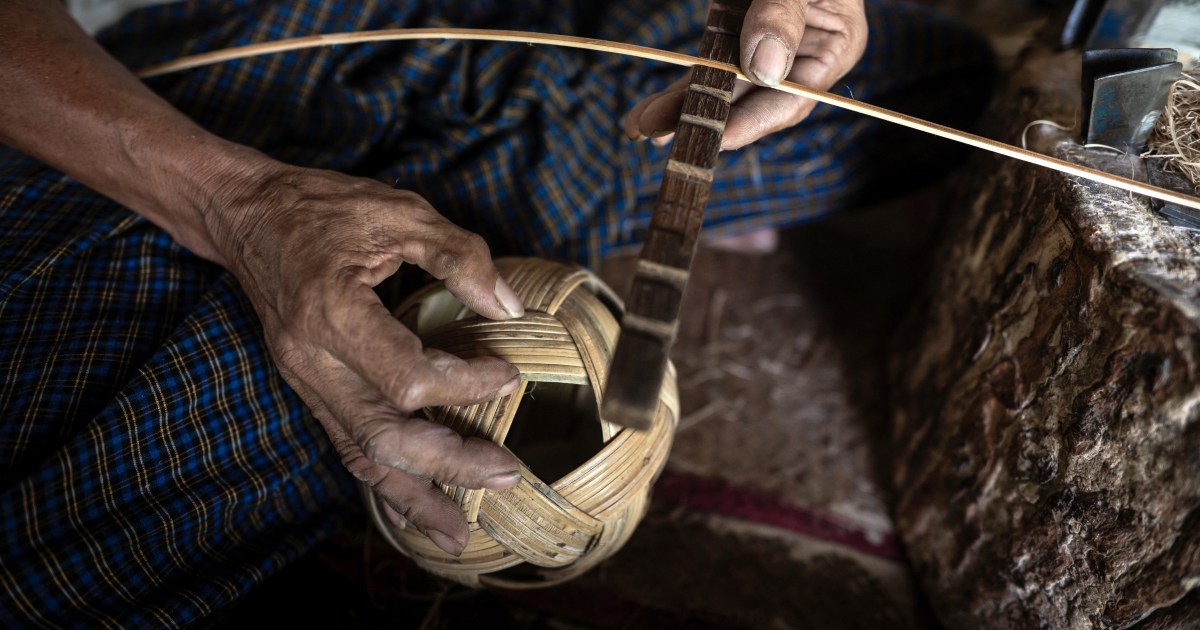
Seated cross-legged, men shave cane into strips, curve them with a hand crank and deftly weave them into melon-sized balls with pentagonal holes before boiling them in vats of water to enhance their durability.

“We check our chinlone’s quality as if we’re checking diamonds or gemstones,” the 64-year-old Pe Thein says.

“As we respect the chinlone, it respects us back.”

Each ball takes about two hours to produce and brings business-owner Maung Kaw $2.40.

But supplies of the premium rattan he seeks from Rakhine state in western Myanmar are becoming scarce.

Fierce fighting between military forces and opposition groups that now control nearly all of the state has made supplies precarious.

Farmers are too frightened to venture into the jungle battlegrounds to cut cane, Maung Kaw says, which jeopardises his livelihood.

Source link

Russian drone strike kills 5 as Moscow pledges response to Ukraine attacks | Russia-Ukraine war News

Kremlin spokesperson Dmitry Peskov says Russia will respond to recent Ukrainian attacks when its military sees fit.

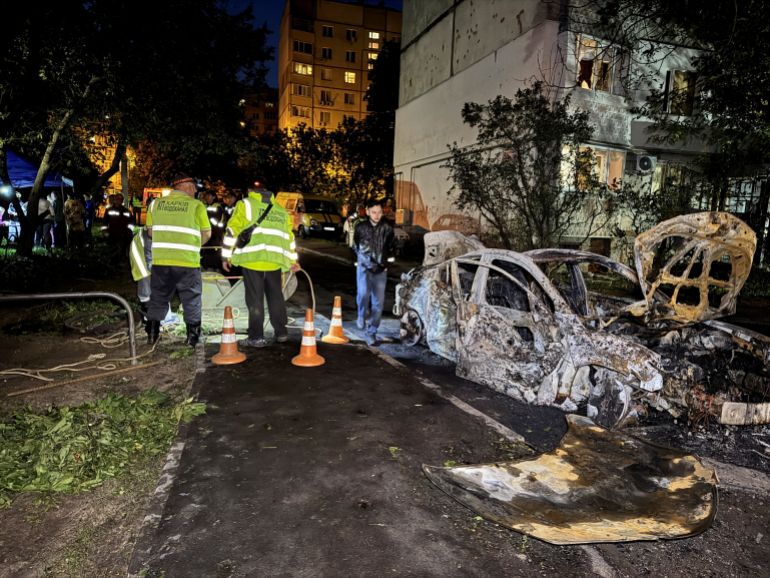
A Russian drone strike has killed five people in the northern town of Pryluky in Chernihiv region, including three members of one family, Ukrainian authorities said.

Interior Minister Ihor Klymenko said on Thursday morning that a local first responder’s wife, daughter and one-year-old grandson were killed in the attack.

Regional Governor Viacheslav Chaus said the family was among five people killed when Russia launched six drones to attack the town overnight.

Six others were admitted to hospital, he said.

Ukrainian President Volodymyr Zelenskyy slammed the attacks and accused Moscow of “constantly trying to buy time for itself to continue killing.

“When it does not feel strong enough condemnation and pressure from the world – it kills again,” he wrote on X.

A view shows the site of the Russian drone strike, amid Russia's attack on Ukraine, in Kharkiv,
A view shows the site of the Russian drone strike, amid Russia’s attack on Ukraine, in Kharkiv, Ukraine [Vitalii Hnidyi/Reuters]

Zelenskyy said Russia launched 103 drones and one ballistic missile overnight targeting the Donetsk, Kharkiv, Odesa, Sumy, Chernihiv, Dnipro and Kherson regions.

“This is yet another reason to impose maximum sanctions and put pressure together. We expect action from the United States, Europe, and everyone in the world who can really help change these terrible circumstances,” he urged.

In the northeastern city of Kharkiv, 18 people were injured, including four children, in a Russian drone attack, Klymenko said.

Resident Anastasiia Meleshchenk told the Reuters news agency that the overnight strike had flown into her neighbour’s apartment, and she managed to run out into the hallway with her child.

“Yesterday, workers had just finished repair work in my apartment after the previous attack,” she said.

There was no immediate comment from Russia.

In Russia, Ukraine’s military said it struck missile systems in the Bryansk region, which it said were preparing to attack Ukraine.

Russia pledges response

The attacks come days after Ukraine targeted four of Russia’s military airfields in Siberia and the far north in an operation using 117 unmanned aerial vehicles launched from containers close to the targets, codenamed “Spider’s Web”.

Russia also accused it of blowing up rail bridges in the south of the country, killing seven people.

Kremlin spokesperson Dmitry Peskov said on Thursday that Russia will respond to the attacks as and when its military sees fit.

Russian Deputy Foreign Minister Sergei Ryabkov said on Thursday that the warplanes that were held in the facilities were damaged and would be restored.

Two US officials told Reuters that Washington assesses that up to 20 warplanes were hit and about 10 were destroyed.

In recent weeks, fighting and aerial attacks have escalated despite the two warring sides holding direct talks in Turkiye aimed at ending the conflict.

Reporting from Kyiv, Al Jazeera’s John Hendren said, the “US embassy has warned US citizens here in Ukraine that major strikes are to come.

“Donald Trump, the US president, said in a conversation with [Russian President] Vladimir Putin that lasted about an hour and 15 minutes that Putin was going to have to retaliate for the strikes on Russian airfields,” Hendren said.

Source link

Russia’s war on Ukraine intensifies as peace talks appear at dead end | Russia-Ukraine war News

Ukraine has destroyed Russian strategic bombers in an unprecedented undercover drone operation while Russia launched its biggest-yet air raid on Ukraine’s cities and intensified attacks on its northern region of Sumy, when the two sides met for peace talks in Istanbul.

The two respective drone operations were emblematic of how direct peace talks, which began on May 15, have not abated the intensity of the conflict and may have deepened it.

Russian President Vladimir Putin has reportedly pledged a response.

Russia’s drone-and-missile attack on Saturday night involved 472 Shahed kamikaze drones, four cruise missiles and three ballistic missiles. Ukraine neutralised 385 aerial targets, its air force said, including three of the cruise missiles.

Ukraine’s operation Spiderweb came a day later, and hit the types of planes Russia has used to launch those cruise missiles – Tupolev-22M3, Tupolev-95 and Tupolev-160, among others.

Spiderweb involved 117 drones smuggled into Russia and launched simultaneously near Russian airfields where the bombers were parked.

Video released by Ukraine showed Tu-95s exploding in orange flames as the drones passed over them, demonstrating that their fuel tanks were full and they were in service.

Ukraine’s State Security Service (SBU), which carried out the operation, told Ukrainian media 41 planes were hit, which, Ukrainian President Volodymyr Zelenskyy said, amounted to “34 percent of the strategic cruise missile carriers stationed at air bases”. The SBU estimated the damage at $7bn.

Western military analysts and open-source media had not fully corroborated Ukraine’s story by Wednesday, but fires and explosions were reported at five Russian bases.

For the first time, Ukraine claimed to have hit the Olenya airbase in the Russian Arctic, almost 2,000km (1,240 miles) from Ukraine, where all Tu-95 bombers were reported destroyed.

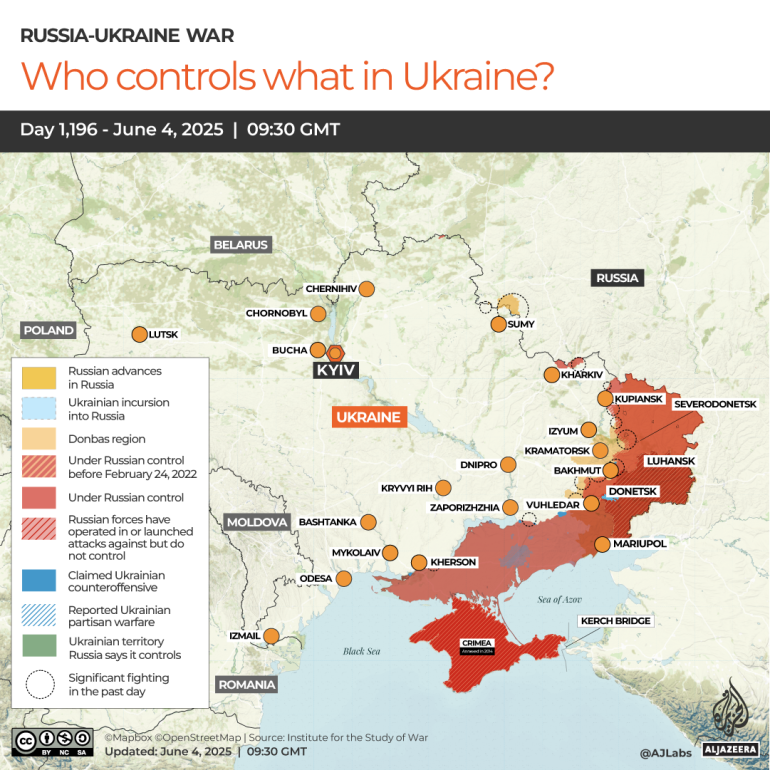
INTERACTIVE-WHO CONTROLS WHAT IN UKRAINE-1749039557
(Al Jazeera)

Also reportedly struck were the Belaya airbase in Irkutsk, more than 4,000km (2,500 miles) from Ukraine, where three Tu-95 strategic bombers were reported destroyed; the Dyagilevo airbase in Ryazan, only 175km (110 miles) from downtown Moscow; and the Ivanovo airfield, 250km (155 miles) northeast of the Russian capital, where at least one A-50 was destroyed – a $500m airborne radar Russia uses to identify Ukrainian air defence systems and coordinate Russian fighter jet targeting. Fire was reported at a fifth airfield, also near Moscow.

Zelenskyy called it “an absolutely brilliant result, an independent result of Ukraine”, and said it had been “a year, six months and nine days from the start of planning”.

Russia’s Ministry of Defence admitted that “in Murmansk and Irkutsk Regions, as a result of [First Person View] drones launched from an area in close proximity to airfields, several aircraft caught fire,” but that similar attacks were repelled in Ivanovo, Ryazan and Amur.

Russia also said “some participants of the terrorist attacks were detained,” although Zelenskyy said “our people who prepared the operation were withdrawn from Russian territory on time.”

“Russia regularly deploys Tu-95 and Tu-22M3 to launch … cruise missiles against Ukraine,” wrote the Institute for the Study of War (ISW), a Washington-based think tank, adding, “The downing of Russian A-50 aircraft has previously temporarily constrained Russian aviation activities over Ukraine.”

Russian pro-Kremlin Telegram channel Rybar and Ukrainian military observer Tatarigami said Russia no longer builds chassis for Tu-95s and Tu-22s, making them impossible to replace. Bloomberg reported that Russia’s reliance on sanctioned Western components will keep it from putting even damaged aircraft back into service.

The New York Times estimated Ukraine may have destroyed or damaged 20 aircraft, but it is possible that not all strike video has yet been posted on open-source media.

“If even half the total claim of 41 aircraft damaged/destroyed is confirmed, it will have a significant impact on the capacity of the Russian Long Range Aviation force to keep up its regular large scale cruise missile salvoes against Ukrainian cities and infrastructure,” aviation expert Justin Bronk of the Royal United Services Institute told The New York Times.

The operation “will force Russian officials to consider redistributing Russia’s air defence systems to cover a much wider range of territory”, said the ISW.

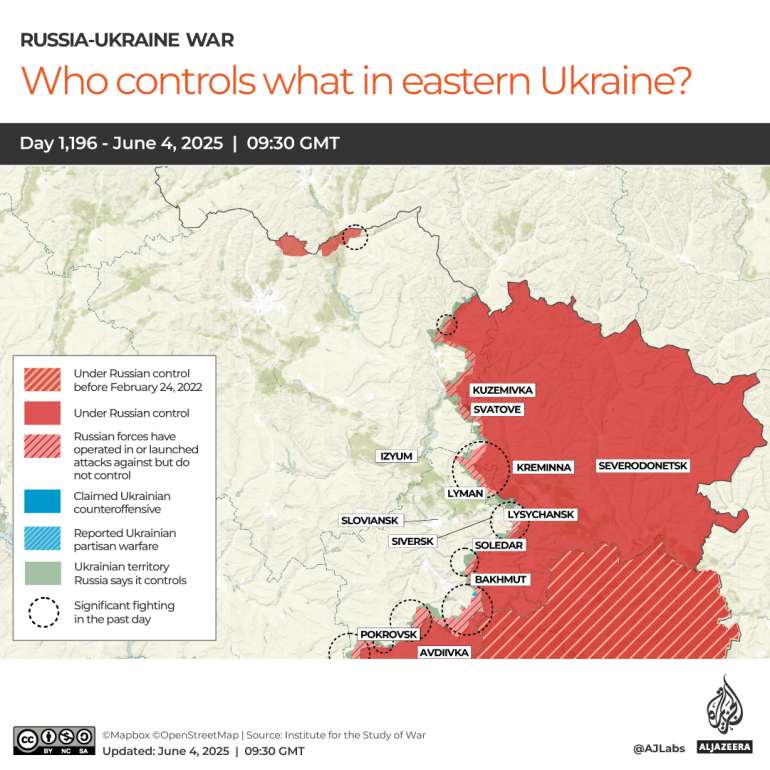
INTERACTIVE-WHO CONTROLS WHAT IN EASTERN UKRAINE copy-1749039540
(Al Jazeera)

Ukraine’s SBU struck again on June 3, damaging the Kerch Bridge, a vital Russian supply line to Crimea, for the third time during the war. Video showed an underwater explosion against one of the bridge’s stanchions, suggesting Ukraine had used an underwater unmanned vehicle.

Moscow denied there was any real damage.

Russia creeps forward

Marring Ukraine’s success was the news of persistent Russian advances.

The most alarming were near the northern city of Sumy, only 30km (20 miles) from the Russian border.

Geolocated footage showed that Russian troops took the villages of Konstyantynivka on the border and Oleksiivka, 4km (2.5 miles) from the border, on Sunday.

By Tuesday, Russian forces were close enough to launch rocket artillery into the city of Sumy, reportedly killing four people and wounding 30.

“Rocket artillery against an ordinary city – the Russians struck right on the street, hitting ordinary residential buildings. Sleazebags,” said Zelenskyy.

On Sunday, Russian troops also appeared to have seized the settlements of Dyliivka and Zorya, north and west of Toretsk in Ukraine’s east.

Geolocated footage indicated that Russian troops had also advanced towards Lyman and Kurakhove, two other key targets in Ukraine’s east.

These gains were part of a slow advance that has gone on for more than a year, but they were signs of Putin’s determination to complete his conquest of Ukraine’s east.

Talks secure another POW exchange

That determination was on display in Istanbul, where Ukrainian and Russian negotiators met on Monday for a second round of peace talks.

Russia presented a ceasefire memorandum that demanded Ukraine formally cede all the territory Russia has taken in Luhansk, Donetsk, Zaporizhia and Kherson, plus the parts of those regions it has not yet seized, which could take years to conquer and come at great cost.

Syrskii said Russian casualties this year alone passed the 200,000 mark on Tuesday – a figure Al Jazeera is unable to independently verify.

Russia’s memorandum also demanded a limit to the size of Ukraine’s armed forces, and a commitment that Ukraine will neither join foreign military alliances nor allow foreign troops on its soil.

It also demanded a Ukrainian election within 100 days of signing the ceasefire agreement, underlining Moscow’s desire to replace the pro-Western Zelenskyy in Kyiv.

These demands are consistent with the terms Putin laid out in a speech in June 2024, and Ukrainian negotiators, who had not seen Russia’s memorandum before arriving at the talks at 1pm on Monday, departed after little more than an hour.

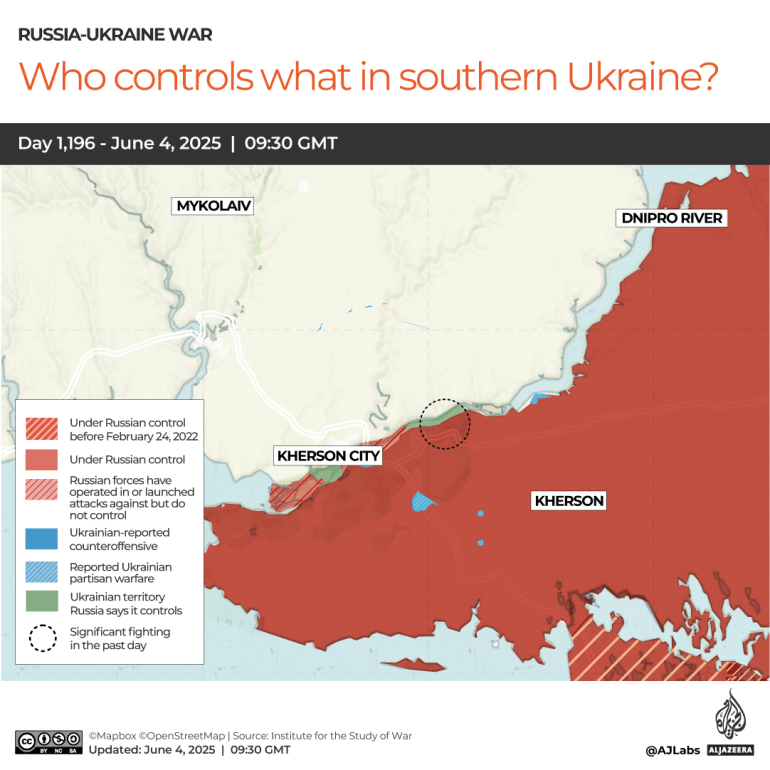
INTERACTIVE-WHO CONTROLS WHAT IN SOUTHERN UKRAINE-1749039547
(Al Jazeera)

The two sides did agree to an exchange of at least 1,000 prisoners of war, and possibly as many as 1,200, prioritising the young (18-25) and wounded. They also agreed to an exchange of 6,000 bodies a side.

They agreed to hold a third round of talks in the last 10 days of June, with Ukraine’s defence minister, Rustem Umerov, suggesting it involve Putin and Zelenskyy, “because decisions can only be made by those who really make decisions”.

Some observers thought it was possible that the two leaders would meet at the first round of talks on May 15, but only Zelenskyy showed up.

“The Istanbul talks are not for striking a compromise peace on someone else’s delusional terms but for ensuring our swift victory and the complete destruction of the neo-Nazi regime,” explained Dmitry Medvedev, the deputy chairman of Russia’s Security Council, on his Telegram channel.

“Our army is pushing forward and will continue to advance. Everything that needs to be blown up will be blown up, and those who must be eliminated will be,” he concluded.

More sanctions for Russia?

United States President Donald Trump has refrained from imposing new sanctions on Moscow, but his stance is now losing supporters in the US Congress.

Sidney Blumenthal, a former presidential adviser, and Lindsey Graham said they would this week table legislation imposing 500 percent tariffs on any country that imports oil, gas and uranium from Russia. Graham called it “the most draconian bill I’ve ever seen in my life in the Senate.”

They made the announcement after a weekend trip to Kyiv and a meeting with French President Emmanuel Macron in Paris.

“What I learned on this trip was he’s preparing for more war,” Graham said of Putin.

The bill would target China and India, which account for the bulk of Russian energy exports, totalling 233bn euros ($266bn) last year, according to a BBC investigation.

But it could theoretically include European Union members, who spent a reported 23bn euros ($26bn) on Russian oil and gas last year.

A number of EU members sought exceptions from Russian oil bans in early 2023, and the EU has never banned Russian gas, though it has almost completely stopped importing it.

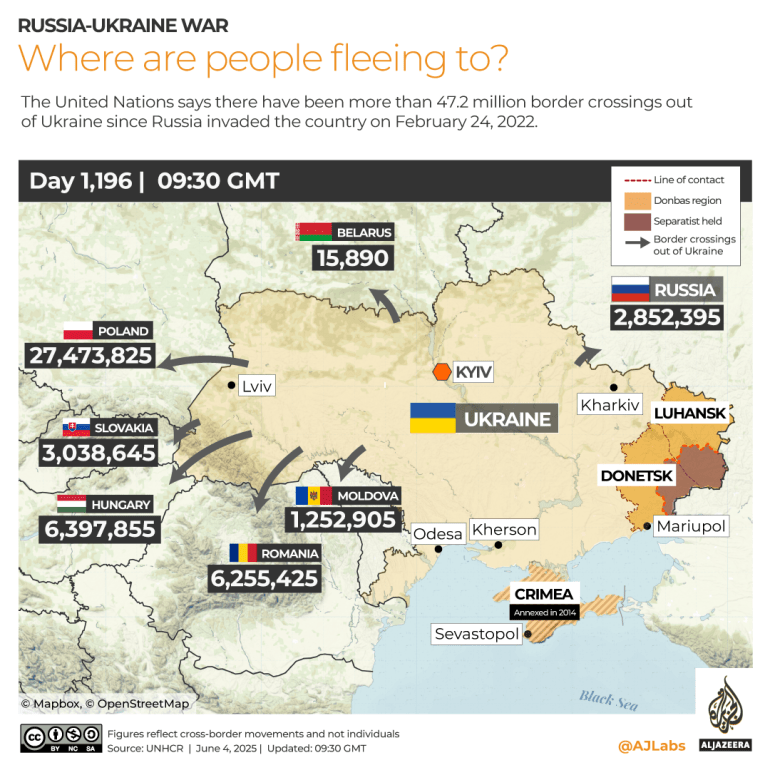
INTERACTIVE Ukraine Refugees-1749039523
(Al Jazeera)

Source link

New Zealand parliament suspends Maori MPs who performed protest haka | News

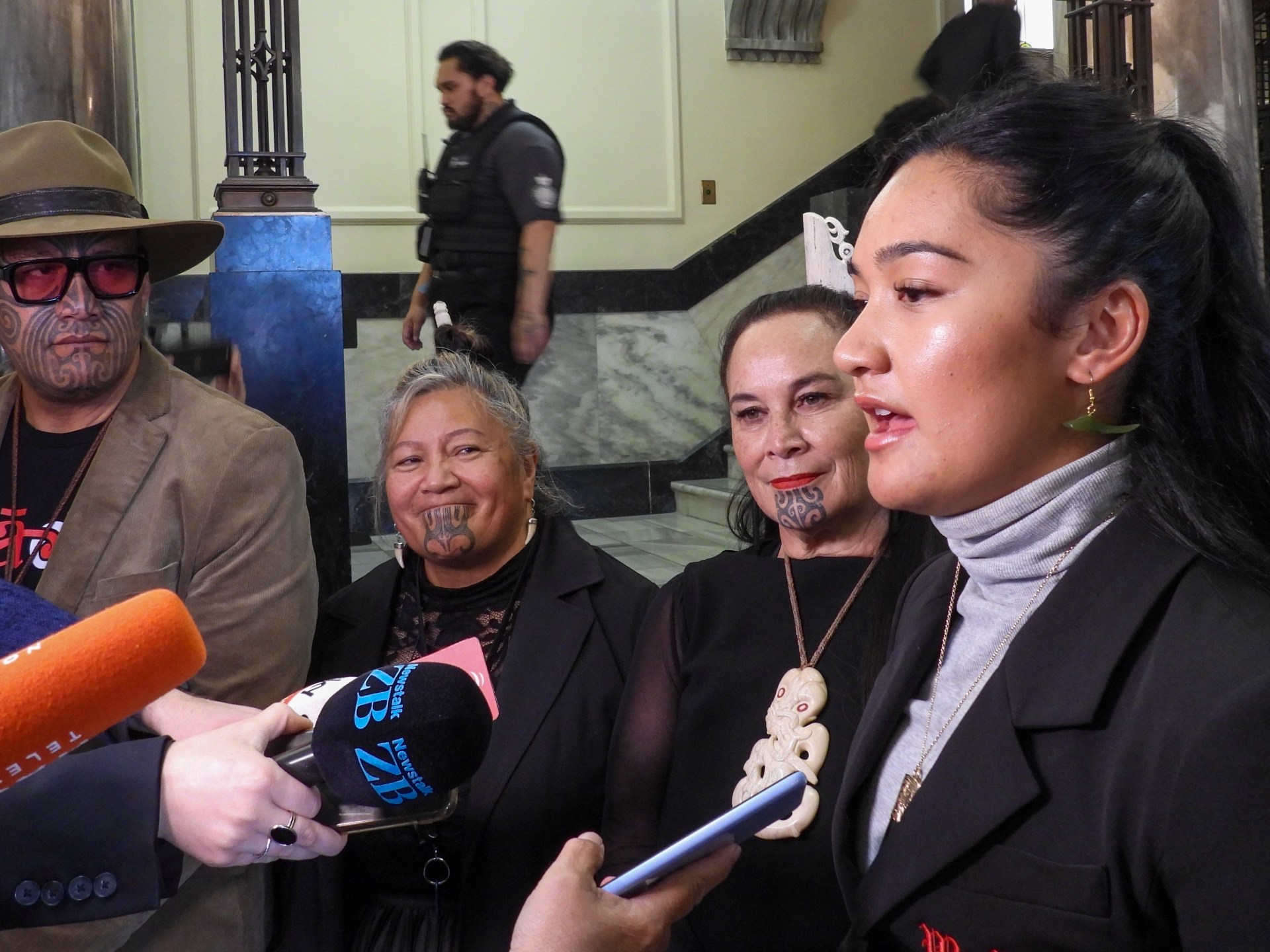
Parliament voted to impose record suspensions on the trio of legislators for their protest haka.

New Zealand legislators have voted to suspend three MPs who performed a Maori haka in the House to protest against a controversial bill.

The MPs from Te Pati Maori – the Maori Party – were handed the toughest sanctions ever imposed on legislators by New Zealand’s parliament on Thursday.

Te Pati Maori co-leaders Rawiri Waititi and Debbie Ngarewa-Packer were both suspended from parliament for 21 days.

Hana-Rawhiti Maipi-Clarke, New Zealand’s youngest legislator, 22, was suspended for seven days.

The length of the bans was recommended by parliament’s privileges committee, which advised the trio should be suspended for acting in “a manner that could have the effect of intimidating a member of the House”.

It recommended Maipi-Clarke be given a shorter sanction because she had written a letter of “contrition” to the parliament.

Previously, the longest suspension imposed on an MP had been a three-day ban.

Prior to Thursday’s vote, Maipi-Clarke told legislators that the suspension was an effort to stop Maori from making themselves heard in parliament.

“Are our voices too loud for this house? Is that the reason why we are being silenced?” she said. “We will never be silenced and we will never be lost.”

The legislators had performed the haka in parliament in November. Their protest interrupted voting during the first reading of a proposed bill to legally define the principles of the Treaty of Waitangi, the 1840 pact between the British Crown and Indigenous Maori leaders signed during New Zealand’s colonisation.

The proposed law prompted widespread protests amid concerns it would erode Maori rights. It was later scrapped.

Maipi-Clarke had begun the protest by ripping a copy of the legislation, before she and fellow MPs approached the leader of the right-wing party that had backed the proposed law.

Their actions prompted complaints from fellow MPs to the parliament’s speaker that their protest was disorderly, and the matter was sent to parliament’s privileges committee, prompting months of debate.

A report from the privileges committee said that while both haka and Maori ceremonial dance and song are not uncommon in parliament, members were aware that permission was needed from the speaker beforehand.

Source link

Russia-Ukraine war: List of key events, day 1,197 | Russia-Ukraine war News

These are the key events on day 1,197 of Russia’s war on Ukraine.

Here’s where things stand on Thursday, June 5:

Fighting

  • Russian drones have struck apartment buildings in Ukraine’s second-largest city, Kharkiv, triggering fires and injuring at least nine people, the city’s mayor said early on Thursday.
  • New Ukrainian drone attacks hit energy infrastructure in Russian-occupied parts of the Zaporizhia and Kherson regions in southern Ukraine, Russian-installed officials said. The Russian-appointed governor of the Kherson region, Vladimir Saldo, said the attacks left 97 settlements, with some 68,000 residents, without power.
  • Russian forces have taken control of the settlements of Ridkodub in eastern Ukraine and Kindrativka in Ukraine’s Sumy region, the Russian Ministry of Defence said.
  • Commenting on Ukraine’s attack on the Crimean bridge – a major Russian-built road and rail bridge linking Russia and the Russian-annexed Crimean Peninsula – the Kremlin said that while there was an explosion, the bridge was undamaged.

Ceasefire talks

  • Russian President Vladimir Putin said he does not think Ukraine’s leaders want peace after accusing them of ordering a bomb attack in Western Russia on Saturday, which killed seven people and injured 115.
  • Putin described the attack, which struck a highway bridge over a railway line carrying passenger trains, as a “terrorist” action aimed at wrecking the peace talks.
  • Putin also told United States President Donald Trump during a phone call that he would have to respond to Ukraine’s Sunday drone attacks, which targeted Russia’s nuclear-capable bomber fleet deep in Siberia and Russia’s far north.
  • Yuri Ushakov, a foreign policy aide to Putin, said the Russian leader told Trump on the call that ceasefire talks “on the whole were useful”, despite attempts by Ukraine to “disrupt” them.
  • Two unnamed US officials have told the Reuters news agency that Ukraine’s drone attack in Siberia hit about 20 Russian warplanes, destroying about 10 of them, a figure that is about half the number estimated by Ukrainian President Volodymyr Zelenskyy.
  • Trump’s Ukraine envoy, Keith Kellogg, said the risk of escalation from the war in Ukraine was “going way up” after Ukraine’s drone attack over the weekend.
  • Zelenskyy has proposed implementing a ceasefire until a meeting can be arranged with Putin. “My proposal, which I believe our partners can support, is that we agree a ceasefire with the Russians until the leaders meet,” he told a briefing in Kyiv.
  • Pope Leo urged Russia to take steps towards ending its war on Ukraine when he spoke to Putin for the first time over the phone, the Vatican has said.

International diplomacy

  • North Korean leader Kim Jong Un has met Russia’s Security Council secretary, Sergei Shoigu, as he pledged unconditional support for Moscow’s position on Ukraine.
  • Ukraine is invited to the NATO summit in The Hague, which will take place in a few weeks, Mark Rutte, the military bloc’s chief, said.
  • German Chancellor Friedrich Merz will tell Trump on his upcoming visit that Europe is firmly on Ukraine’s side and that no chance for peace must be passed up, Germany’s foreign minister, Johann Wadephul, has said.
  • Wadephul also said that Germany is pushing for new sanctions against Moscow, which should be coordinated with the US, as he accused Russia of not seriously engaging in peace talks.
  • Ukraine has discussed with the US how to make a minerals fund operational by the end of the year. The fund’s first meeting is expected in July, Ukraine’s economy minister, Yulia Svyrydenko, who is also a deputy prime minister, said during her visit to Washington, DC.
  • Zelenskyy’s chief of staff, Andriy Yermak, met US Secretary of State Marco Rubio in Washington, DC, during his visit there.
  • Kyiv’s allies have voiced a willingness to pay for defence manufacturing by Ukrainian companies in allied countries, Ukrainian Minister of Defence Rustem Umerov said after meeting Western counterparts at the Ukraine Defence Contact Group.
  • United Kingdom Defence Secretary John Healey said the UK will increase tenfold the number of drones it will deliver to Ukraine, aiming to ship 100,000 of the devices.

Source link

Trump announces travel ban on people from 12 countries | Donald Trump News

Trump signed a proclamation which also restricts the travel of people from an additional seven countries.

United States President Donald Trump has signed a proclamation imposing a full travel ban on people from 12 countries and restricting the citizens of seven other countries, The Associated Press news agency reports.

The banned countries include Afghanistan, Myanmar, Chad, Congo, Equatorial Guinea, Eritrea, Haiti, Iran, Libya, Somalia, Sudan and Yemen.

In addition to the ban, which takes effect on Monday, there will be heightened restrictions on people from Burundi, Cuba, Laos, Sierra Leone, Togo, Turkmenistan and Venezuela.

“I must act to protect the national security and national interest of the United States and its people,” Trump said in his proclamation.

During his first term in 2017, Trump issued an executive order banning travel to the US by citizens of seven predominantly Muslim countries: Iraq, Syria, Iran, Sudan, Libya, Somalia and Yemen.

People from the named countries were either barred from getting on their flights to the US or detained at US airports after they landed. Those affected included tourists, people visiting friends and family, as well as students and faculty in the US and businesspeople.

The order, often referred to as the “Muslim ban” or the “travel ban”, was reworked amid legal challenges, until a version was upheld by the Supreme Court in 2018 which banned categories of travellers and immigrants from Iran, Somalia, Yemen, Syria and Libya, plus North Korean and some Venezuelan government officials and their families.

Trump defended his initial travel ban on national security grounds, arguing it was aimed at protecting the US and claimed it was not anti-Muslim. However, Trump had called for a travel ban on Muslims during his first campaign for the White House.

This is a breaking news story. More to follow shortly.

Source link

White House makes misleading claims about Democratic opposition to tax bill | Donald Trump News

In a news statement this week, the White House cherry-picked personal income tax-related elements in the “big, beautiful bill”, the wide-ranging tax and spending bill being pushed by United States President Donald Trump, and claimed that, in opposing the legislation as a whole, the Democratic Party was opposed to every individual item contained within it.

Such a tactic is misleading, particularly since the White House cited measures in the bill that have been championed by Democrats to improve the lives of Americans and are not the reasons the Democrats have given for opposing the “big beautiful bill”.

Here’s a fact-check of what the White House claims Democrats oppose:

“They’re opposing the largest tax cut in history, which will put an extra $5,000 in their pockets with a double-digit percent decrease to their tax bills. In fact, Americans earning between $30,000 and $80,000 will pay around 15% less in taxes.”

The specifics of the tax bill have not been finalised. In its current form, it would cut taxes by an average of 2.4 percent, for middle-income households, according to analysis by the Tax Policy Center.

While it is a significant tax cut, it is not the biggest in history. That was under Ronald Reagan in 1981 at 2.9 percent.

It is accurate that there will be a double-digit percentage decrease in tax bills, at least in the immediate term, at a little more than 11 percent across all tax brackets. It is also true that people earning between $30,000 and $80,000 will pay 15 percent less, according to the Non-Partisan Joint Committee on Taxation.

“They’re opposing NO TAX ON TIPS for the millions of Americans who work in the service industry and NO TAX ON OVERTIME for law enforcement, nurses, and more.”

This is true only in their opposition to Trump’s tax and spending bill.

Democrats and Republicans have supported the concept of no tax on tips. Both Donald Trump and the Democratic presidential nominee Kamala Harris pledged to do so on the campaign trail. Senate Democrats backed the No Tax on Tips Act, passed by the US Senate on May 20. The bill, authored by Republican Senator Ted Cruz of Texas, was co-sponsored by notable Democrats, including Jacky Rosen of Nevada and passed unanimously.

“They’re opposing historic tax cuts for senior citizens”

Outside of the “big beautiful bill”, Democrats have generally not opposed tax cuts for seniors. Many Democrats have championed legislation that would expand tax cuts for seniors. California Democrat Jimmy Panetta co-sponsored a Republican led bill that would increase the standard deduction for adults over the age of 65 by $4,000.

In 2024, House Democrats introduced the “You Earned It, You Keep It Act”, which would effectively eliminate taxes on social security benefits. The bill, however, has never made it past committee.

“They’re opposing a boost to the child tax credit.”

Again, they are opposing Trump’s “big beautiful bill”, not objecting to the child tax credit.

In fact, Democrats have long pushed to expand the child tax credit. In April, Senate Democrats, including Georgia’s Raphael Warnock and Colorado’s Michael Bennett, introduced legislation that would expand the child tax credit. The bill would increase the tax credit, from $2,000 where it currently stands, to $6,360 for newborns, $4,320 for children ages one to six and $3,600 for children six to 17, permanently.

While the “big beautiful bill” would also increase the child tax credit, it would do so only by $500, and that would kick in in 2028.

“They’re opposing new savings accounts for newborns and the chance for children across America to experience the miracle of compounded growth.” 

In the “big beautiful bill”, House Republicans introduced new savings accounts for children. The accounts would include a $1,000 handout for every child born between January 1, 2025 and January 1, 2029.

Democrats have not only been supporters of the idea for savings accounts for newborns, but prominent Democrats actually championed it.

In 2018, Cory Booker of New Jersey introduced the American Opportunity Accounts Act, which would also give $1,000 to newborns and up to $2000 in annual contributions. He reintroduced the bill again in 2023.

“They’re opposing expanded access to childcare for hardworking American families.”

This appears to be false. The White House link refers to the Paid Family and Medical Leave Credit, not child care access. Trump’s bill offers up to 12 weeks of paid leave for employees who have worked a year and earn $57,600 or less.

While that gives parents more time at home, Democrats have focused on expanding access to child care, including universal pre-K. In 2023, Republicans opposed a Democratic plan to keep child care centres open that struggled in the early days of the COVID-19 pandemic.

“They’re opposing historic border security to keep their communities safe.”

Last year, Trump pressured Republicans to vote against a bipartisan border security bill, a move that reportedly helped Trump’s chances of winning in November 2024. Democrats have opposed Republican plans to use US military bases for migrant detention, arguing that it misuses Department of Defense resources. Democrats have long opposed border wall funding, including during Trump’s first term.

A 2018 Stanford University analysis estimated that a border wall would reduce migration by just 0.6 percent. Despite this, the “big beautiful bill” allocates more than $50bn to complete the wall and maritime crossings, $45bn for building and maintaining detention centres, and $14bn for transportation.

“They’re opposing expanded health savings accounts that give Americans greater choice and flexibility in how they spend their money.”

This is sort of true. Democrats have not been huge proponents of health savings accounts. The belief is that healthcare savings accounts do not help the socioeconomically disadvantaged, who may not have the financial resources to contribute to the accounts. Democrats have also objected to other cuts to healthcare in the bill, including the potential $880bn that could be cut from essential government programmes like Medicaid.

“They’re opposing scholarships that empower Americans to choose the education that best fits the needs of their families.”

In the bill, the White House is conflating the longstanding debate on school choice with scholarships. Under school choice, funds otherwise allocated to the public school system can be re-allocated to private institutions, which Republicans argue will allow students to have potential access to a higher quality education.

Democrats have opposed school choice because it diverts funds from public school systems, many of which are already drastically underfunded. In Texas, Senator Ted Cruz, for example, pushed legislation that would expand school choice, even as three out of four school districts in the state are underfunded, according to a Kinder Institute analysis.

Source link

New York City mayoral race: All you need to know | Elections News

In the New York City mayoral race, a young immigrant who identifies as a democratic socialist is taking on a centrist former governor from a political dynasty.

With state legislator Zohran Mamdani and ex-Governor Andrew Cuomo leading the race, the New York Democratic primary is seen as a reflection of the battle between progressive activists and the conservative old guard of the United States Democratic Party.

The Democratic candidates will meet for a debate on Wednesday night, ahead of the primary vote on June 24.

Missing from the stage will be incumbent Eric Adams who was elected as a Democrat four years ago. The current mayor is running for re-election as an independent amid dwindling popularity.

Here is a look at the elections in the Big Apple and what it could mean for the city and the country.

Why are the primaries important?

New York City is solidly Democratic, so the party’s nominee is likely to cruise to victory in November.

In 2021, then-Democratic candidate Eric Adams beat Curtis Sliwa, the Republican nominee, by nearly 40 percentage points. Adams has since garnered a national profile.

What’s at stake?

The next mayor will be the executive of the largest city in the United States – tackling numerous issues and pressing challenges, including housing, cost of living, congestion and public transport.

The implications for New Yorkers are obvious, but the outcome of the race will also affect the nearly 65 million people who visit the city every year.

New York is a major financial and cultural hub, not just for the US but for the entire world.

Politically, the primary race could serve as a bellwether for the Democratic Party and the electoral viability of left-wing candidates ahead of the congressional midterm elections next year and the presidential vote two years later.

The job comes with a national profile. The last three New York mayors ran for president.

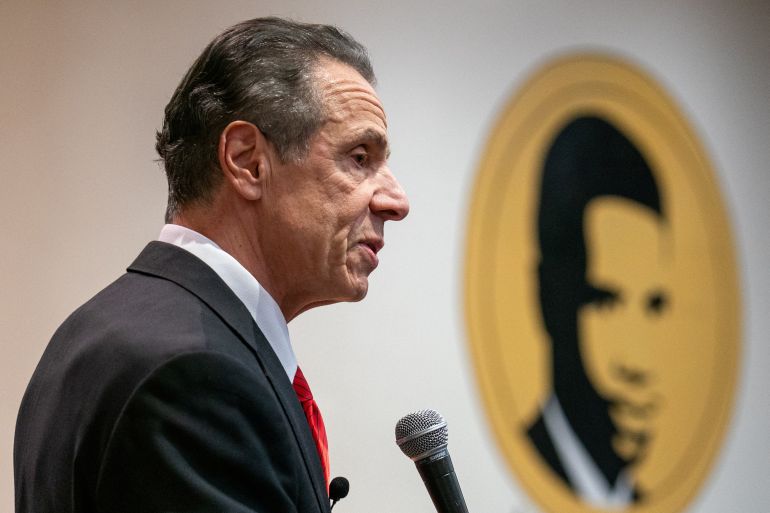
Cuomo
Mayoral candidate Andrew Cuomo speaks during a Democratic mayoral forum at Medgar Evers College in New York City, April 23 [David ‘Dee’ Delgado/Reuters]

Who are the frontrunners?

In the Democratic primaries, the two frontrunners are Cuomo, 67, and Mamdani, 33.

The son of a former governor, Cuomo has an extensive resume. He served as the US Secretary of Housing and Urban Development and New York attorney general before becoming the state’s governor in 2011.

He resigned in 2021 after a sexual harassment scandal and is now staging what was once thought to be an unlikely political comeback, rebuilding alliances with politicians who called on him to step down a few years ago.

He is running a campaign focused on improving the management of the city, addressing mental health issues and “combating anti-Semitism”.

If Cuomo is the ultimate insider, Mamdani is his foil as a political insurgent.

Born in Uganda to parents of Indian descent, Mamdani, who is endorsed by the Democratic Socialists for America (DSA), has been serving in the state assembly since 2021.

He is running on a progressive platform that includes freezing rent, eliminating fees for public buses and establishing affordable, city-owned grocery stores.

Mamdani’s rise in the polls has been fuelled by small donors and an “army” of left-wing volunteers.

Mamdani in dark jacket at subway station
Candidate for New York City mayor Zohran Mamdani waits for the subway following a campaign stop in New York City, US, April 1, 2025 [Brendan McDermid/Reuters]

Who else is running?

Also running on the Democratic side are city comptroller Brad Lander; New York City Council Speaker Adrienne Adams; former comptroller Scott Stringer; State Senator Jessica Ramos; State Senator Zellnor Myrie; Michael Blake, a political consultant and former state legislator; and Whitney Tilson, an investor.

Incumbent Mayor Eric Adams is running as an independent after the scandals and investigations that have plagued his tenure.

Conservative activist Curtis Sliwa is the sole Republican in the race.

What are the key dates?

The first Democratic debate will take place on June 4, and the second and final one is set to take place on June 12. Early voting starts on June 14, and the primary election is on June 24.

The general election will be on November 4.

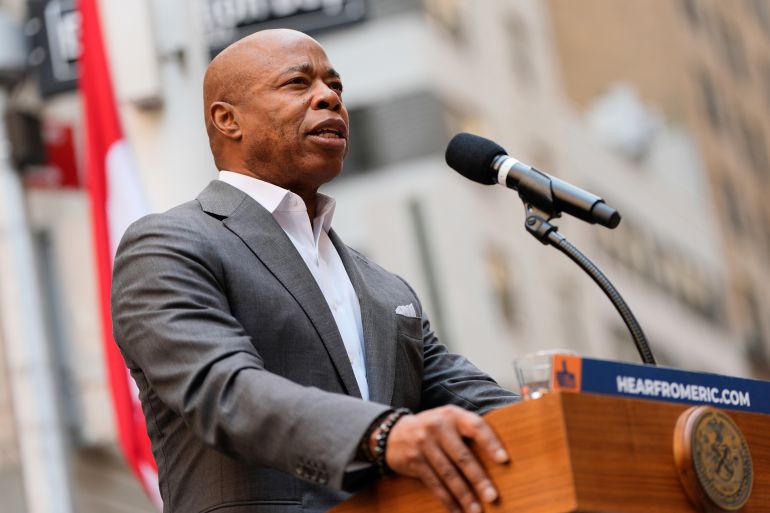
Eric Adams
Incumbent New York Mayor Eric Adams is running as an independent [File: Julia Nikhinson/AP Photo]

What is ranked choice voting?

In local elections in New York City, one can vote for as many as five candidates at once with the ranked-choice system.

Here’s how it works: Voters choose their candidates in order of favourability. In the first round of counting, the top choice votes are tallied. If no candidate gets more than 50 percent, more counting ensues with the bottom candidate removed.

With each new round, the votes of the eliminated candidate are counted by the next choice on the ballot.

What do the polls say?

Cuomo is leading the race, according to most surveys. An Emerson College poll last week showed the former governor with 35.1 percent support as a first choice – ahead of Mamdani with 22.7 and Lander with 10.5.

Mamdani may appear like a distant second, but his rise in the race has been stunning. He was polling at 1 percent in February, according to an Emerson survey.

The democratic socialist lawmaker does have a path to victory – consolidating the anti-Cuomo vote in the later rounds of counting.

People protest in solidarity with the Palestinian and Lebanese people and to condemn the Israeli airstrikes in Lebanon and Gaza, in New York
A protest in solidarity with Palestinians in New York City, September 24, 2024 [File: John Taggart/EPA]

Why has Israel-Palestine been a key issue in the race?

The next New York City mayor will not be deciding how much military aid Israel gets or how the US will vote on United Nations Security Council proposals calling for a ceasefire in Gaza.

Yet, the conflict in the Middle East has been a factor in the local elections.

Mamdani has been an outspoken supporter of Palestinian rights. He participated in a hunger strike outside the White House in November 2023 to demand an end to the war on Gaza.

His positions have sparked outrage from Israel’s backers. Although Mamdani is a citizen, Republican New York City Council member Vickie Paladino called for his deportation on Monday.

Paladino later doubled down in response to the outrage over her statement, claiming that Mamdani would not have been eligible for citizenship under the current regulations due to his involvement in pro-Palestine groups.

For his part, Cuomo has positioned himself as Israel’s top defender, accusing several of his opponents – not just Mamdani – of being too critical of the US ally.

“It’s very simple: anti-Zionism is anti-Semitism,” he said in April.

Fix the City, a pro-Cuomo political group, has received large donations from pro-Israel donors, including $250,000 from billionaire Bill Ackman, according to New York’s Campaign Finance Board.

New York City – home to Columbia University – has seen waves of protests against US support for Israel’s war in Gaza, which has killed more than 54,600 Palestinians.

The issue may sway some voters, in part because it is viewed by many Democrats as a litmus test for broader ideological leaning.

Source link

Leaders of Canada and Mexico lash out at Trump steel tariff hike | Donald Trump News

The leaders of Canada and Mexico have criticised the latest hike in steel and aluminium tariffs under United States President Donald Trump, who increased import taxes on the metal from 25 to 50 percent.

The international condemnation came just hours after the latest tariff increase went into effect early on Wednesday.

Speaking to reporters on Wednesday, Canadian Prime Minister Mark Carney said the tariff increases were “unjustified”.

“They’re illegal. They’re bad for American workers, bad for American industry and, of course, for Canadian industry,” he said.

Mexican President Claudia Sheinbaum, meanwhile, pledged to pursue countermeasures if the Trump administration refuses to grant tariff relief. She warned that the tariffs would have a “huge impact” on Mexico’s steel and aluminium industries.

“This isn’t about an eye for an eye, but rather about protecting our industry and our jobs,” she added, without specifying what steps her government might take.

Canada calls for action

Wednesday’s tariff hike had been unveiled last Friday, when Trump held a rally with steelworkers outside Pittsburgh, Pennsylvania.

That region of the US is a part of the Rust Belt, an area that has been heavily affected by the decline in US manufacturing. Trump pledged to use tariffs and other measures to bring jobs and investments back to the area.

Previously, in March, Trump set tariffs on steel and aluminium at 25 percent. But he threatened to lift that rate to 50 percent specifically for Canadian imports of the metals, a plan he later appeared to walk back.

Those threats, however, roiled relations between the US and its northern neighbour in particular. Canada is the top supplier of steel to the US, followed by Brazil and then Mexico. South Korea and China also top the list.

Canada is also responsible for about 40 percent of aluminium imports to the US, followed by the UAE, Russia and Mexico. Carney’s government has pledged to pursue retaliatory measures so long as Trump’s tariffs remain in place.

On Wednesday, one of Canada’s largest labour unions, Unifor, called on Carney to take immediate action against the latest tariff hike, including by limiting the country’s exports of critical metals to the US.

“Unifor is urging the federal government to act without delay to defend Canada’s manufacturing sector and counter the escalating trade assault,” the union said in a statement.

Premier Doug Ford — who leads the top manufacturing province in Canada, Ontario — also called for Canada to respond in kind and “slap another 25 percent” on US steel imports.

“It’s tariff for tariff, dollar for dollar. We need to tariff the steel coming into Canada an additional 25 percent, totalling 50 percent,” Ford told reporters. “Everything’s on the table right now.”

Both Canada and Mexico have been hard hit by Trump’s aggressive tariffs, which include a blanket 25-percent tax on all imports not subject to the US-Mexico-Canada free trade agreement (USMCA), as well as a separate 25-percent levy on automobile imports.

The three countries have highly integrated economies, with products like automobiles being built using supplies and factories from multiple locations.

The USMCA pact was agreed upon during Trump’s first term, from 2017 to 2021. But he has since signalled he hopes to renegotiate the free-trade deal to get more favourable terms for the US.

But the doubling of the US steel and aluminium tariffs is expected to have a global impact, well beyond North America.

The European Union is also bracing for the increase. The bloc’s trade commissioner, Maros Sefcovic, met US Trade Representative Jamieson Greer on the sidelines of a meeting for the Organisation for Economic Cooperation and Development (OECD) on Wednesday.

“We’re advancing in the right direction at pace – and staying in close contact to maintain the momentum,” Sefcovic wrote on X afterwards.

UK Trade Secretary Jonathan Reynolds also met with Greer, and he said steel and aluminium tariffs would remain at 25 percent for his country. The two countries have been in the process of forging a post-Brexit bilateral trade agreement, announcing a “breakthrough” last month.

“We’re pleased that as a result of our agreement with the US, UK steel will not be subject to these additional tariffs,” a British government spokesperson said.

‘Extremely hard to make a deal’

Trump’s latest tariff hike comes days after a federal court ruled that his so-called reciprocal tariffs — which imposed customised taxes on nearly all US trading partners — were illegal.

Trump had imposed those tariffs in April, only to pause them for 90 days. The court’s ruling was quickly paused while legal proceedings continued, and Trump’s tariffs have been allowed to remain in place for now.

One of the hardest hit countries has been China, which saw US tariffs against its exports skyrocket to 145 percent earlier this year.

The Trump administration, however, has since sought to reach a deal with China to end the trade war between the world’s two largest economies.

The White House said on Monday that Trump would speak to Chinese President Xi Jinping this week, raising hopes the duo could soothe tensions and speed up negotiations.

But on Wednesday, Trump appeared to dampen hopes for a quick deal.

“I like President XI of China, always have, and always will, but he is VERY TOUGH, AND EXTREMELY HARD TO MAKE A DEAL WITH!!!” he posted on his Truth Social platform.

When asked about the remarks during a regular news briefing, Chinese Foreign Ministry spokesperson Lin Jian said Beijing’s “principles and stance on developing Sino-US relations are consistent”.

Source link

Will Wilders’s gamble to withdraw from governing Dutch coalition pay off? | The Far Right

Party for Freedom leader hopes plan to get tough on immigration delivers election victory.

He has been dubbed the “Dutch Donald Trump”.

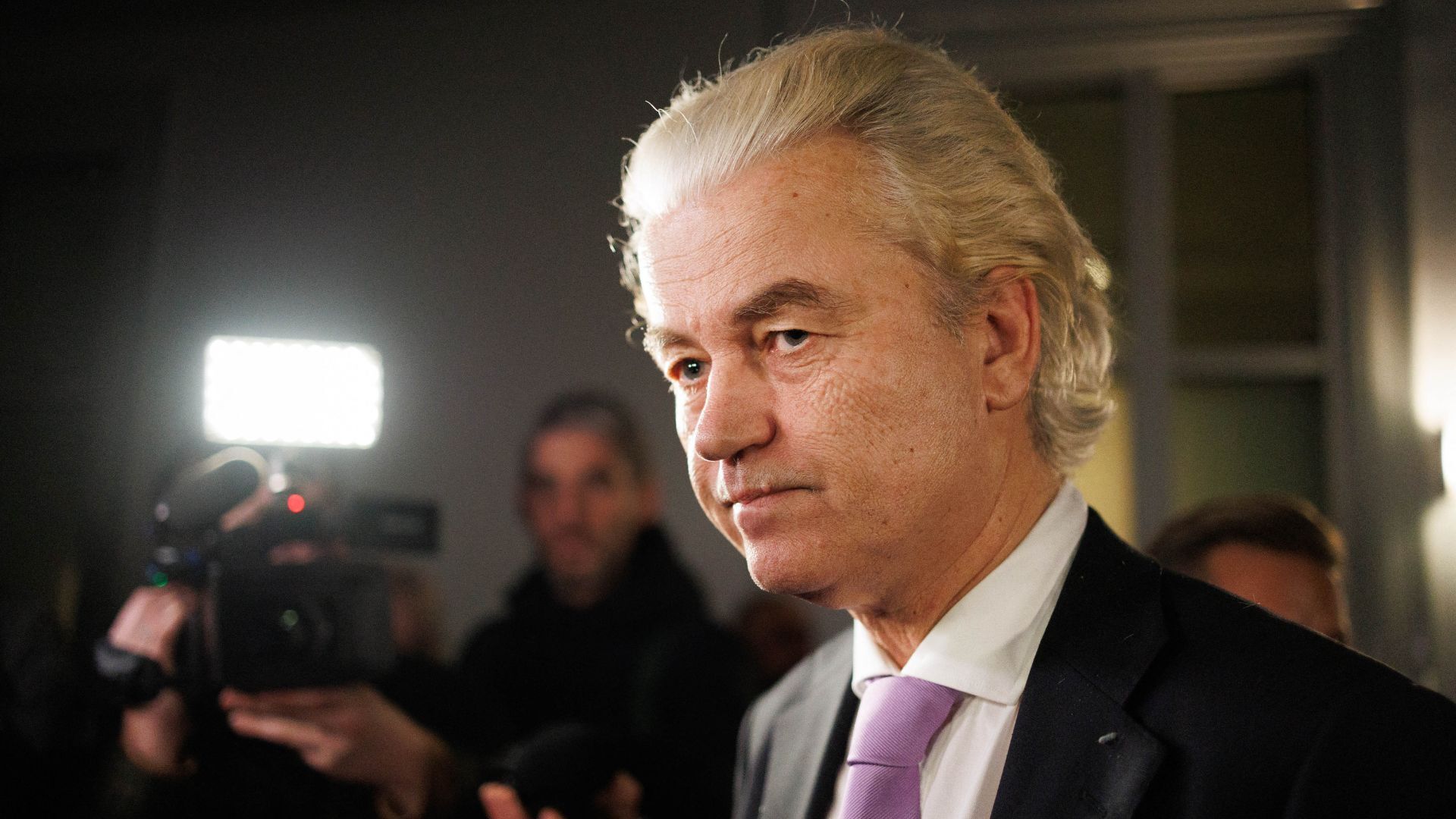
Geert Wilders has pulled his Party for Freedom (PVV) out of the coalition that governs the Netherlands in a row over immigration policy.

It has plunged the NATO ally into political turmoil and new elections.

After years in opposition, the PVV won the most votes in 2023 by tapping into rising populism in Europe with promises to reduce immigration.

Wilders has pushed for a 10-point plan that calls for the militarisation of Dutch borders as well as the repatriation of all Syrian nationals – something his coalition partners rejected.

Before resigning, Prime Minister Dick Schoof labelled Wilders’s actions “irresponsible”, coming at a critical time for Europe.

So was this a reckless or strategic move by Wilders?

And will it deepen uncertainty in the region, only weeks before a NATO summit in The Hague?

Presenter:

Tom McRae

Guests: 

Henk van der Kolk – Professor of electoral politics at the University of Amsterdam

Zoe Gardner – Independent researcher covering migration policy

Pieter Cleppe – Editor-in-chief at BrusselsReport.eu

Source link

Spain plays France in UEFA Nations League: Start time, team news, lineups | Football News

Who: Spain vs France
What: UEFA Nations League semifinal
Where: Stuttgart Arena, Stuttgart, Germany
When: Thursday, June 5, 2025 – 9pm kickoff (1900 GMT)

How to follow our coverage: We’ll have all the build-up from 6pm (16:00 GMT) on Al Jazeera Sport.

Defending champions Spain face France, the team that beat them in the 2021 final, in the second semifinal of the 2025 UEFA Nations League.

Hosts Germany or inaugural winners Portugal, who play on Wednesday, await in Sunday’s final.

Al Jazeera Sport takes a closer look at the game, which will provide the second finalist for a tournament that has replaced the ever-devaluing international friendly setup on the continent.

Who did Spain and France beat in the Nations quarterfinals?

Spain beat the Netherlands 5-4 on penalties after their quarterfinal finished 5-5 on aggregate over the two legs.

France also needed penalties to progress from their last-eight tie against Croatia after a 2-2 draw on aggregate. The Croatians had won the first leg 2-0 on home soil.

Both nations topped their League A groups.

What happened the last time Spain played France?

The sides played out a dramatic Euro 2024 semifinal, won by Spain 2-1.

Trailing after Randal Kolo Muani headed in a Kylian Mbappe cross in the ninth minute, Spain turned the match around in a rapid four-minute flurry, scoring twice against a side that had only conceded one goal in five previous games in the tournament.

The match is best remembered for 16-year-old Spain sensation Lamine Yamal, who became the youngest-ever goal scorer at a European championship when he unleashed a mesmerising strike from outside the box in the 21st minute to find the equaliser.

Spain then took the lead for good on 25 minutes when Dani Olmo expertly gathered a loose ball and fired a low shot into the net with the aid of a deflection off Jules Kounde.

Lamine Yamal in action.
Spain’s Lamine Yamal scores the second goal of the match to make it 1-1 during the Euro 2024 semifinal between Spain and France at the Allianz Arena on July 9, 2024, in Munich, Germany [Jussi Eskola/Soccrates via Getty Images]

Who did Spain beat in the 2023 Nations final?

Spain – who were defeated finalists in the 2021 edition of the tournament, which is staged over a two-year period – beat Croatia 5-4 on penalties after a goalless draw in Rotterdam, Netherlands, in June 2023.

In the 2021 final, the Spaniards were beaten 2-1 by France, who they face in Thursday’s second semifinal. Their victory in 2023 ended an 11-year search for silverware.

Is this the start of Spain’s resurgence?

Spain are aiming to become the first side to defend the Nations League trophy, with Luis de la Fuente’s side going from strength to strength on the international stage before next year’s World Cup.

Their 2023 victory proved the springboard to Euro 2024 glory. Retaining the Nations League would bode well before the 2026 World Cup in the United States, Mexico and Canada next summer, where Spain will be among the favourites.

After European Championship wins in 2008 and 2012, sandwiching their World Cup 2010 triumph in South Africa, the Spanish national team slumped.

Poor outings at the Russia and Qatar World Cups started to fade from memory, though, as De la Fuente’s side beat Italy and Croatia to win the 2023 Nations League.

Spain then beat Italy, Germany and France on the way to the Euro 2024 final, where they got the better of England to claim their first major trophy for 12 years.

The side is very much led by Barcelona’s teenage winger Lamine Yamal, who turned 17 on the eve of the Euro final, and on the opposite flank, Athletic Bilbao’s Nico Williams, 22, also has his best years ahead of him.

Spain team news

Out: Rodri, Carvajal, Laporte, Ayoze Perez, Ferran Torres

Manchester City’s Rodri, who has yet to return to action after missing most of the season injured, remains Spain’s major headache.

They are blessed with depth, however, most especially in midfield, where former Real Madrid playmaker Isco could be given additional playing time, having helped Real Betis to the UEFA Conference League final this season.

France team news

Out: Camavinga, Kounde, Saliba, Upamecano

France are without a quartet of defenders who ply their trade in Europe’s top leagues, with Real Madrid’s Eduard Camavinga, Barcelona’s Jules Kounde, Arsenal’s William Saliba and Bayern Munich’s Dayot Upamecano all sitting out the game.

The French also had nine international players feature in Paris Saint-Germain’s Champions League final victory against Inter Milan on Saturday.

Kylian Mbappe reacts.
Kylian Mbappe of France arrives at Stuttgart Airport on June 4 ahead of the UEFA Nations League 2025 semifinal match between France and Spain on June 5 at Stuttgart Arena, Germany [Christian Kaspar-Bartke/UEFA via Getty Images]

Possible lineups:

Spain: Unai Simon; Mingueza, Cubarsi, Huijsen, Cucurella; Pedri, Ruiz; Yamal, Olmo, Williams; Morata

France: Maignan; Gusto, Konate, Lucas Hernandez, Digne; Tchouameni, Kone, Rabiot; Olise, Mbappe, Kolo Muani

Form guide: Last five matches

Spain: D-D-W-W-W (Most recent match first)

France: W-L-W-D-W

Head-to-head

The nations have met on 15 occasions, with Spain emerging victorious seven times, including their Euro 2024 win, while France have won six of the encounters.

What the managers said before the semifinal?

Luis de la Fuente, Spain coach: “We have in this tournament the three previous winners of the Nations League, three previous World Cup winners and a previous Euro winner. So you certainly can’t call it a minor tournament, and we place huge importance upon it.

“I’ve always said since I arrived that this tournament is actually more difficult than the Euro in the group stage. We’ll give it everything, and we want to make history by becoming the first team to win the Nations League twice. We will keep competing at the highest level against these teams that could easily be in a World Cup final or another major final tomorrow.”

Didier Deschamps, France coach: “This Spain team have already shown their quality, and they are the best side in Europe and probably the best in the world. They also may have a few players who are fresher. But still, my team always have the ability to maintain a strong collective and technical rhythm.

“I haven’t yet seen a team that has truly found a solution to stop Yamal. Add in the likes of Nico Williams and it’s clear Spain have a lot of pace. But that doesn’t mean we’ll be approaching this match waving the white flag.”

Where will the UEFA Nations League final be staged?

The Allianz Arena in Munich, which was also picked for the first semifinal, will stage the final on Sunday.

Does Nations League success bring World Cup qualification?

The teams that finish in the top two of their World Cup qualifying groups in Europe will automatically progress to the FIFA World Cup.

The four highest-placed teams from the Nations League that did not finish in the top two of their World Cup qualifying groups are then given an extra shot at reaching the global game’s showpiece event.

It is an added incentive to all teams as a backup plan should their official World Cup qualifying campaign fall flat.

UEFA Nations League trophy.
The UEFA Nations League trophy with official match ball is seen before the UEFA Nations League Finals 2025 at the Munich Football Arena on June 3, 2025, in Munich, Germany [Maja Hitij – UEFA/UEFA via Getty Images]

Source link

Paul Brody, EY: How Blockchain Is Transforming Global Commerce

Paul Brody is global blockchain leader at professional services firm EY and co-author of a 2023 book, Ethereum for Business: A Plain-English Guide to the Use Cases that Generate Returns from Asset Management to Payments to Supply Chains. He speaks with Global Finance about blockchain technology’s impact on everything from routine payments to cross-border remittances to the future of banking and the CFO and treasurer roles.

Global Finance: If we look at what people are transacting on blockchains today, it’s not primarily bitcoin but stablecoin, a type of cryptocurrency designed to maintain a stable value over time. Does this surprise you?

Paul Brody: The ability of people to pay each other in dollars is hugely valuable. And to give you a sense of how big stable- coin dollars have become, last month the ethereum blockchain ecosystem did $2 trillion in stablecoin payments, over 99% of which were in US dollars.

GF: Who is actually using them?

Brody: By far the most popular initial use case for stablecoin is in emerging markets. Countries without independent central banks often experience high inflation or even hyperinflation, and so demand for US dollars is really high among the local population.

GF: And they’re being used for cross-border remittances too?

Brody: A lot of traditional cross-border systems take days to execute, and they cost a fair amount of money. If both participants have smartphones and cryptocurrency accounts, you can send dollars across borders in a matter of seconds for almost nothing.

GF: Lately, the US Treasury Department seems to be saying that the US doesn’t need a central bank digital currency [CBDC], i.e., a digital dollar. It can use stablecoin. Is that your read too?

Brody: What we need is well-regulated stablecoin. We need some regulatory safeguards to make sure that if you say there’s a dollar on-chain, there’s also a dollar in the bank account to back that up, or its equivalent in assets.

CBDCs have been flopping, mostly because central banks don’t really know why they’re doing them. I’ve talked to many central bankers, and they generally have no idea why they’re doing this other than Facebook wanted one.

GF: How will blockchain technology change things for corporate CFOs and treasurers?

Brody: CFOs and treasurers have some questions to ask themselves: Am I plugged into the crypto and blockchain system? Can I make stablecoin payments? Should I include bitcoin in my corporate treasury alongside US dollar-denominated bonds? Going further, can I automate my business contracts? My procurement? How can I run my business operations more efficiently? And if a customer wants to pay me in stablecoin, can they do so? The answer for most companies today is, no, they can’t.

GF: If you’re a stablecoin issuer, how do you make a profit on that business?

Brody: You make money with transaction fees and, potentially, your float on the interest rate. But that depends on interest rates. If rates go down really low, it’s going to be a painful business. Fees are pretty small because it’s such a competitive environment.

GF: What does all this mean for banks generally going forward? Is it going to lessen their importance?

Brody: It’s going to change banks’ role, and may diminish it. It depends on how a bank makes its money.

Banks that make their money processing credit card transac- tions are the most at risk because blockchains represent a new, more efficient way to process transactions. You swipe your credit card in a store, and you don’t see the cost of the payment, but it’s real and it’s substantial, like 3% to 4%. International wire trans- fers are usually a fixed fee, as much as $50. Stablecoin transfers cost almost nothing by comparison.

But if you’re a regional bank that does a lot of corporate finance, blockchain probably doesn’t change your business that much.

GF: What about major custody banks, such as BNY Mellon, JPMorgan, etc.? Is their business at risk?

Brody: Major custody banks are in an interesting place. They have a ton of assets, and if you’ve got assets and you control and custody those assets, you’re then in a position to help people tokenize them.

So, this new technology is certainly a threat, but it’s also potentially a substantial opportunity. At the end of the day, if you’re custodying assets and you’re now helping people tokenize them or manage them in different ecosystems, that represents the additive potential to your business.

GF: In your book Ethereum for Business, you highlight the importance of blockchain-based smart contracts. With these, one can define not only dollars but all sorts of things, even coffee mugs. Why aren’t more corporations using smart contracts?

Brody: The answer is that blockchains don’t yet have privacy built into them, and this is a huge problem. But it’s being fixed. It’s like the early days of the internet, when we didn’t have encryption. Most companies don’t feel comfortable doing business without privacy.

It’s why private blockchains have never worked. If companies had a private blockchain, they thought it ensured privacy. What they didn’t realize is that inside that walled garden there’s still no privacy. If you’re a big company and you have all your suppliers in your private blockchain, you still can’t run your procurement process there, because supplier A can see how much you’re paying supplier B, and also how much you’re ordering from them.

GF: How deep are banks going to go in providing blockchain services?

Brody: Every single bank is going to offer some kind of DLT [distributed ledger technology] service. You have stocks, you have bonds [to offer clients], and now you may add crypto. Other institutions may send cash to an ethereum address for you, instead of setting up a wire transfer to a bank address. There will be new versions of money transfer and payments, and some of them are going to be quite sophisticated.

GF: Skeptics are asking when they will see blockchain’s “killer app”: meaning an application that’s universally used, along the lines of what email did for the internet?

Brody: Stablecoins are the killer app, the one that gets everybody on-chain. The stablecoin market is about to get crazy competitive, and yield-bearing stablecoins will be widely available soon.


“CFOs and treasurers have to ask themselves: If a customer wants to pay me in stablecoin, can they do so?”


GF: All in all, is blockchain a niche innovation—useful but not earth-shattering—or is it something that can fundamentally change global finance?

Brody: It’s not only going to change global finance, but it will transform all global commerce.

Blockchain is going to become the plumbing by which all B2B transactions are done.

And the reason it’s so transformational is that historically, money, contracts, and “stuff” [i.e., goods] all were in different systems. Companies still spend huge amounts on reconciling money, stuff, and contracts. For example, it costs the average large company about $100 to pay a bill. And the reason is, somebody in procurement has to say, I’ve got this bill. Does it match the purchase order that I sent out? Do the terms on the bill and the purchase order match the terms of the contract? And so on. Imagine a future where the money, the stuff, and the terms of the contract are all in the same digital system and they all reconcile with each other. It’s done instantly. In 10, 15 years, the whole process will be universal and invisible. Back-end plumbing, right?

Source link

Romania: New President Promises Moderate Course

A collective sigh of relief rippled through EU capitals on May 18 when former Bucharest Mayor Nicuşor Dan secured an unexpectedly strong mandate in round two
of Romania’s presidential elections, besting far-right opponent George Simion with 53.6% of the vote against 46.4%.

Dan, a 55-year-old mathematician with a sober, low-key demeanor and a reputation for competence, had underper- formed in round one; but his commitment to the EU, NATO, and supporting Ukraine convinced doubters. Voters were also put off by Simion’s pro-Russian views—Romania has a history of antagonism with Russia—and his endorsement by Hungarian Prime Minister Viktor Orbán, who argues that Transylvania, incorporated into Romania by the 1920 Treaty of Trianon, should revert to Budapest.

Dan will have little time to relish his victory. Strong support for the nationalist right will remain a concern as the new government tackles major economic problems including the EU’s highest bud- get deficit at around 9% of GDP and falling living standards.

Political instability in recent months has damaged Romania’s profile in international capital markets—Fitch Ratings assigns it a BBB- with a negative outlook—and fiscal reform will be tougher given Dan’s commitment to eventually raise defense spending to 3.5% of GDP.

In his inauguration speech on May 26, Dan spoke of the need for change, arguing that the state was spending too much, and that inequalities within Romania—Southeast Europe’s largest economy with some 19 million people—needed to be tackled and institutions reformed. The new president said he wants to look to the future rather than the past and restore faith in democracy.

“It is in the national interest to send a message of stability to financial markets,” he emphasized. “It is in the national interest to send a signal of openness and predictability to the investment environment.”

Dan’s first priority will be to assemble a government out of Romania’s deeply fractured political scene. “The most likely outcome is a moderate coalition … with the potential addition of the Save Romania Union,” says Orsolya Ráczová, associate fellow for the Center for Global Europe at GLOBSEC. “This would provide fresh impetus to implement reforms agreed with the EU.”

Source link

UK prepares for war: How much will it cost? | Government News

The United Kingdom has announced a major investment in defence in response to a “new era of threats” driven by “growing Russian aggression”.

The UK’s Strategic Defence Review (SDR), unveiled on Monday, includes new investments in nuclear warheads, a fleet of new submarines and new munitions factories. Prime Minister Keir Starmer said the SDR would bring the country to “war-fighting readiness”.

“The threat we now face is more serious, more immediate and more unpredictable than at any time since the Cold War,” Starmer said as he delivered the review in Glasgow, Scotland.

The SDR described Russia as an “immediate and pressing” threat, and referred to China as a “sophisticated and persistent challenge”.

European nations have rushed to strengthen their armed forces in recent months, following Trump’s repeated demands that Europe must shoulder more responsibility for its security.

What are the key features of the UK’s Strategic Defence Review?

The defence review, the UK’s first since 2021, was led by former NATO Secretary-General George Robertson. Among the 62 recommendations in the SDR, all have been accepted by the government.

Starmer said the measures recommended in the review would bring “fundamental changes” to the armed forces, including “moving to war-fighting readiness”, re-centring a “NATO first” defence posture and accelerating innovation.

“Every part of society, every citizen of this country, has a role to play because we have to recognise that things have changed in the world of today,” he said. “The front line, if you like, is here.”

Boosting weapons production and stockpiles

Based on the recommendations in the review, the government said it would boost stockpiles and weapons production capacity, which could be scaled up if needed.

A total of 1.5 billion pounds ($2bn) will be dedicated to building “at least six munitions and energetics factories”, with plans to produce 7,000 long-range weapons.

In turn, UK ammunitions spending – just one component of overall military spending – is expected to hit 6 billion pounds ($8.1bn) over the current parliamentary term, which ends in 2029.

New attack submarines

There are also plans to build up to 12 new attack submarines by the late 2030s as part of the AUKUS military alliance with Australia and the United States – equivalent to a new submarine every 18 months.

This accounts for nearly half the projected spending outlined in the SDR.

Meanwhile, the Ministry of Defence (MoD) also said it would invest 15 billion pounds ($20.3bn) in its own nuclear warhead programme.

New F-35 fighter jets

The SDR recommended procuring new F-35 fighter jets and the Global Combat Aircraft Programme, a sixth-generation fighter produced jointly with Japan and Italy.

Use of technology to improve the army

The target size of the army will remain roughly the same, but the SDR recommended a slight increase in the number of regular soldiers “if funding allows”. There are currently about 71,000.

Instead of a dramatic increase in troop numbers, the SDR recommends using technology, drones and software to “increase lethality tenfold”.

To do this, the MoD plans to deliver a 1 billion pound ($1.35bn) “digital targeting web”, an AI-driven software tool designed to collect battlefield data and use it to enable faster decision making.

Investment in defence companies

More details about the SDR will be provided in the upcoming Defence Industrial Strategy, expected in the coming weeks, but UK defence companies will be among the big winners from the new SDR.

Though supposedly a 10-year review, past SDRs suggest its shelf life might be more limited.

The last SDR was published in 2021 and recommended “a strategic pivot towards the Indo-Pacific region to counter China’s influence and deepen ties with allies like Australia, India, and Japan”, in line with strategic priorities of the time.

This SDR, undertaken in the wake of Russia’s full-scale invasion of Ukraine, has re-oriented the UK’s geographical priorities. In the coming years, those could change again.

Can the UK afford this defence expansion?

Proposals to prepare the UK’s armed forces to be “battle ready” will cost at least 67.6 billion pounds ($91.4bn) through to the late 2030s, according to costings and estimates provided in the SDR.

Before Monday’s announcement, the government had already pledged to increase spending on defence from 2.3 percent currently to 2.5 percent by 2027, an increase of about 6 billion pounds ($8.1bn) per year. This would raise 60 billion pounds over 10 years – a bit shy of the cost projected by the SDR.

The government has said it will cut overseas aid to fund that 0.2 percent of gross domestic product (GDP) rise in defence spending.

Critics say this will not be enough and that the measures outlined by the SDR will cost more like 3 percent of gross domestic product (GDP).

James Cartlidge, the shadow defence secretary, said the “authors of the strategic defence review were clear that 3 percent [not 2.5 percent] of GDP ‘established the affordability’ of the plan.”

In February, the Labour government said it had “an ambition” to raise defence spending to 3 percent in the next parliament (after 2029), but Cartlidge said: “That commitment cannot be guaranteed ahead of the next general election.”

According to researchers at the Institute for Fiscal Studies – an independent, London-based research organisation – raising defence spending to 3 percent of GDP by 2030 would require an extra 17 billion pounds between now and then, which the government has not yet accounted for.

But the UK could be required to raise spending even more than this. In discussions taking place in advance of the NATO summit in The Hague later this month, NATO Secretary General Mark Rutte is understood to be pushing for member nations to commit 5 percent of GDP towards defence-related spending.

Rutte has proposed that NATO’s 32 members commit to spending 3.5 percent on hard defence and 1.5 percent on broader security, such as cyber, by 2032.

“At this Ministerial, we are going to take a huge leap forward,” Rutte stated before a meeting of defence ministers in Brussels on Thursday this week. “We will strengthen our deterrence and defence by agreeing ambitious new capability targets.” He specified air and missile defence, long-range weapons, logistics, and large land manoeuvre formations as among the alliance’s top priorities, according to a briefing note from NATO on Wednesday.

“We need more resources, forces and capabilities so that we are prepared to face any threat, and to implement our collective defence plans in full,” he said, adding: “We will need significantly higher defence spending. That underpins everything.”

Will taxes have to rise in the UK?

On Monday, Starmer refused to rule out another raid on the aid budget to fund higher military spending, and signalled that he was hopeful the extra investment could be supported by a growing the economy and generating more taxes to pay for defence.

After the SDR’s announcement, Paul Johnson, director of the Institute for Fiscal Studies, warned that the prime minister will need to make “really quite chunky tax increases” to pay for the plans.

Alternatively, increased defence spending could be siphoned off from other parts of the budget – for instance, through reduced state spending on areas like transport and energy infrastructure.

Source link