Earnings Call Insights: NIKE, Inc. (NKE) Q3 fiscal 2026
Management View
“Last quarter, we said we were in the middle innings of our comeback. Since then, we have continued to take meaningful actions to improve the health, quality and foundation of our business.” (CEO, President & Director Elliott
Seeking Alpha’s Disclaimer:This article was automatically generated by an AI tool based on content available on the Seeking Alpha website, and has not been curated or reviewed by humans. Due to inherent limitations in using AI-based tools, the accuracy, completeness, or timeliness of such articles cannot be guaranteed. This article is intended for informational purposes only. Seeking Alpha does not take account of your objectives or your financial situation and does not offer any personalized investment advice. Seeking Alpha is not a licensed securities dealer, broker or US investment adviser or investment bank.
CEO Rhoniel Daguro framed demand around “the rise of deepfakes to trick existing authentication systems” and “the rise of rogue AI agents accessing systems without human accountability and without human control,” adding, “they are calling us” and “these
Newsletters for Every Investor
Get daily, sector-specific newsletters packed with expert insights, fresh ideas, and new opportunities.
Subscribe to Newsletters
Seeking Alpha’s Disclaimer:This article was automatically generated by an AI tool based on content available on the Seeking Alpha website, and has not been curated or reviewed by humans. Due to inherent limitations in using AI-based tools, the accuracy, completeness, or timeliness of such articles cannot be guaranteed. This article is intended for informational purposes only. Seeking Alpha does not take account of your objectives or your financial situation and does not offer any personalized investment advice. Seeking Alpha is not a licensed securities dealer, broker or US investment adviser or investment bank.
HomeTransaction BankingBridging Continents: The Future of Middle East-Africa Trade Alliances
Islam Zekry, Group Chief Finance & Operation Officer and Executive Board Member at CIB, explores how GCC-Africa partnerships are driving economic growth, resilience and a transformative era of South-South cooperation, and how Egypt’s strategic location and financial expertise position it as a key player in emerging trade corridors.
Global Finance: How can new trade alliances and partnerships, particularly between the GCC and African nations, drive economic growth and resilience across both regions?
Islam Zekry: The partnership between the Gulf Cooperation Council (GCC) and Africa is gaining momentum. However, what is changing is the depth and strategic intent behind these partnerships. As global supply chains fragment and capital becomes more selective, structured trade alliances between GCC nations and African economies have the potential to create one of the most significant South–South growth corridors of the next decade.
Several structural complementarities underpin this opportunity. GCC economies possess deep capital pools, sovereign investment vehicles, advanced logistics capabilities and strong global trade linkages. In addition, many African economies are rich in natural resources, arable land, renewable energy potential and rapidly growing consumer markets with favorable demographics.
When strategically aligned, partnerships can yield positive growth outcomes. For example, food security partnerships, where African agricultural production meets Gulf demand, demonstrate this potential. Moreover, investments in energy and transition, particularly in renewables and green hydrogen, support the transition towards cleaner energy resources. Such partnerships can also drive the development of the infrastructure and logistics sector—strengthening ports, industrial zones and transport corridors. Ultimately, financial sector integration enhances capital flows and trade finance capacity.
“Egypt is not just a transit point for global trade—it is becoming a focal point in a more integrated Afro-Arab economic architecture.”
Islam Zekry, Group Chief Finance & Operation Officer and Executive Board Member at CIB
Beyond capital deployment, what differentiates the next phase of GCC–Africa engagement is the development of capacity for resilience. Global shocks—whether pandemic disruptions, geopolitical tensions or commodity volatility—have demonstrated the importance of diversified trade relationships. GCC–Africa alliances reduce overdependence on traditional West–East corridors, creating balanced, multipolar trade flows.
Therefore, for these partnerships to reach their full potential, financial architecture must evolve in tandem with physical infrastructure. Efficient cross-border payment systems, local currency settlement mechanisms, risk-sharing frameworks and strong banking partnerships determine how seamlessly goods, services,and capital move between the two regions. This is where banks with both regional understanding and international connectivity play a transformative role, not merely as financial intermediaries, but as enablers of structured trade ecosystems.
GF: What makes Egypt uniquely positioned to serve as a trade and investment hub between the Middle East and Africa, and how can this role evolve in the context of emerging trade corridors?
Zekry: Strategically positioned at the convergence of Africa, the Middle East and Europe, Egypt controls one of the world’s crucial maritime arteries through the Suez Canal. The country boasts one of Africa’s largest and most diversified economies and hosts one of the region’s leading banking sectors.
However, Egypt’s strategic relevance goes beyond geography. The country serves as a natural logistical bridge. It connects Mediterranean trade routes with Red Sea and Gulf shipping lanes while maintaining deep commercial ties across Sub-Saharan Africa. This dual orientation—northward to Europe and southward into Africa—positions Egypt as a balancing hub within emerging trade corridors.
The country has also built significant industrial and export capacity. Its robust manufacturing base, expanding energy sector,and growing role in Liquefied Natural Gas (LNG) and renewable energy markets position it as a credible anchor economy within regional value chains. Egypt’s financial institutions support cross-border expansion and structured trade finance. Egyptian banks have developed strong capital bases, regional expertise and global correspondent networks, enabling them to intermediate complex trade flows across Africa and the Middle East.
As new trade corridors emerge, from Red Sea logistics networks to Gulf-backed infrastructure investments in East Africa, alongside the African Continental Free Trade Area (AfCFTA) driven continental integration, Egypt’s role is set to evolve across three key areas. The country functions as a gateway for capital deployment into Africa, serving as a strategic hub for GCC and international investors seeking structured entry into African markets. It also has the potential to serve as a regional trade finance hub, facilitating corridor-based financing between North Africa, East Africa,and the Gulf. Finally, Egypt can act as a connector of payment ecosystems, enabling interoperability between African financial systems and Middle Eastern capital markets.
The next phase of Egypt’s development hinges on deepening this integration, aligning customs frameworks, digitizing trade documentation, strengthening regional payment systems and encouraging bilateral currency arrangements. If strategically executed, Egypt will not simply remain a transit point for global trade, but will become a focal point in a more integrated Afro-Arab economic architecture.
The future of Middle East–Africa trade alliances will not be defined solely by infrastructure announcements or headline investments. It will depend on how effectively capital, policy and financial systems converge to support real economic exchange. In this context, Egypt stands out as both a geographic and financial bridge. Therefore, strengthening GCC–Africa partnerships represents not just an opportunity, but a structural shift toward greater regional resilience and South–South cooperation.
Investment Promotion Agencies: Ministry of Economic Affairs (MOEA), Department of Investment Promotion (DOIP), Bureau of Industrial Parks (BIP)
Investment incentives: Streamlined approvals; dedicated project managers for projects over NT$500 million ($15 million); R&D tax credits; investment tax credits up to 25% on investment in key supply chains or advanced processes; location-based incentives in science parks, industrial parks, and free-trade zones; relaxed visas for talent attraction, including the Employment Gold Card program for skilled talent
Corruption Perceptions Index rank (2024): 25/180, where 180 is most corrupt
Political risks: The administration of President Lai Ching-te faces an opposition-controlled legislature that often blocks budget proposals, risking policy paralysis or destabilization in the face of Chinese interference
Security risks: Potential for naval blockade, military attack, or full-scale invasion by China
No other developed market has demonstrated the impact of AI and high-performance computing booms more dramatically than Taiwan. And the data suggests that these booms are not about to turn to bust anytime soon, despite fears of overheating and a decline in external demand for Taiwan’s exports.
A forced unification with China might render it a no-go area for numerous investors. But ignoring that wildcard scenario, there is no escaping the fact that Taiwan is now a lynchpin of the global supply chain and, by extension, the global economy, as well as a significant destination for investment and trade: the latter being a position on which the island’s economy and its 23.2 million population depend.
Taiwan sits at the center of the global hi-tech supply chain thanks to its pre-eminence in semiconductor manufacturing, AI, and 5G telecommunications. Thanks to investment incentives and an environment fully open to growth and cooperative opportunities, the island is a magnet for foreign direct investment (FDI), led by the Netherlands and followed by the US, which held $19.3 billion in FDI as of 2023.
FDI is critical, given Taiwan’s self-imposed debt ceiling and the cap it imposes on public spending. The Department of Investment Promotion provides streamlined services to foreign investors in a bid to boost FDI, making dedicated project managers available for investments above $15 million and R&D subsidies.
Still, some international investors worry about the dominance of Taiwan’s state-owned enterprises, claiming they distort fair-market practice and lack regulatory transparency.
That said, Taiwan stunned with full-year 2025 GDP growth of 7.71%, an upward revision from the initial 7.63% estimate in January by the Department of Statistics and a figure that wrongfooted all but a handful of economic forecasters.
That result marked Taiwan’s fastest pace of economic expansion in 15 years and smashed forecasts from the likes of the International Monetary Fund and the Asian Development Bank, which ranged from 2.9% to 5.1% for 2025 when the year kicked off.
Last year’s economic performance was superlative across the board, boosted by a tidal wave of global demand for the AI-related exports that power Taiwan’s economy, notably semiconductor manufacturing capacity that has propelled the island from developing to developed status in less than a generation.
Exports surged by 35%, quarterly growth in the last three months of the year was an eye-popping 12.68% year-on-year—the highest in 38 years—and stocks advanced strongly, pushing the TAIEX into the global top 10 by market capitalization early this year as the index hit a 100 billion New Taiwanese dollars ($32 billion) valuation for the first time.
Excessive Concentration?
PROS
Preeminence in global semiconductor supply chain
Foreign investor-friendly policies, including numerous incentives
Low domestic interest rate and inflation
Strong correlation of growth and investment with the global AI boom
Political stability
Strong official institutions
“We have upgraded our GDP growth forecast for this year to 6%, which is a totally crazy rate for a developed economy,” says Alicia Garcia-Herrera, chief economist for Asia Pacific at French finance giant Natixis in Hong Kong and a senior fellow at the Brussels-based economic think tank the Bruegel Group.
“Bear in mind Japan grew last year by just 1.1%,” she added. “A milestone indicator of the country’s economic success has been its overtaking both Japan and South Korea in terms of GDP per capita, which hit $39,477 last year.”
The fly in the ointment, Garcia-Herrera notes, is that growth is concentrated in the semiconductor sector “and its ancillary industries such as packaging, which are all dependent on demand from that one single sector.”
Taiwan’s focus on exports, particularly semiconductors, has provoked grumbles that the basic stance of the Central Bank of the Republic of China is to keep the Taiwan dollar artificially low, crowding out other domestic industries and exposing the economy to concentration risk via dependence on tech-related exports.
CONS
Geopolitical tensions with China
Overexposure to the global AI boom
Risk from excessive capex spending related to AI
The currency dramatically strengthened against the dollar in May, down to 28.85% as the result of inbound investment flows and generalized the dollar’s weakness versus other Asian currencies.
The new Taiwan dollar subsequently weakened as the result of reported central bank intervention, to stand in late January at 31.7 to the dollar and renewing the view that the currency is artificially undervalued. Rates are ultra-low across the yield curve for government bonds, which range from 1.21% for two-year to 1.43% for 10-year issues, anchored by a 2% policy rate.
In this context, a remarkable feature of last year’s growth was the absence of overheating in the economy, with the CPI at just 1.66%, allowing the central bank to hold the policy rate steady: a stance it is expected to maintain this year.
“The strong concentration on exports leaves the economy vulnerable to a slowdown in its key trading partners and reduced global AI demand,” cautions Sagarika Chandra, director of APAC sovereigns at Fitch Ratings in Hong Kong. “Taiwan’s electrical equipment exports as a share of total exports are relatively large, at around 43%, and weaker demand for such exports is likely to have a substantial negative impact on growth through lower exports.”
FDI Surges
Inbound and outbound FDI has played a significant role in Taiwan’s economic trajectory. The former surged 44% last year, to $11.39 billion, driven by technology and services, including semiconductor manufacturing, AI, renewable energy, and financial services. Investment incentives available for inbound FDI include special tax treatment and set-up support from Invest Taiwan, a government agency.
Mainland China has dominated inbound FDI recent years, but as Taipei seeks to strengthen economic ties beyond its neighbor into Southeast Asia and the US, inbound FDI from the mainland shrank by 65.4% last year.
As Taiwan shudders at the prospect of the Trump administration slapping tariffs on its semiconductors the island has committed to its biggest-ever outbound FDI undertaking, the construction of a $250 billion semiconductor manufacturing plant in the US by Taiwan Semiconductor Manufacturing Corporation (TSMC). In return, Taiwan is to receive a tariff exemption on microchips and a reduction in overall tariffs on other products.
Observers doubt the manufacturing shift will prove a significant liability.
“The offshoring of semiconductors, in my opinion, is not a big problem for the country,” says Garcia-Herrera, “because if Taiwan continues to serve all that global demand from Taiwan, all the resources will only go to the semiconductor industry, whether it’s green energy, water, the best talent, you name it. So offshoring is a good idea, because it frees up domestic resources.”
In 2026, Fitch expects the economy will continue to benefit from the increased production and investment by some advanced AI chip producers, even if there is some moderation in demand, according to China. We expect the US–Taiwan trade agreement, which reduced tariffs to 15% from 20% previously, could offer near-term relief for Taiwan’s semiconductor export-driven economy, creating a more level playing field for key export sectors.”
More concerning, Taiwan is extremely dependent on energy imports: almost 98%, according to data from the US Energy Information Administration. That’s an alarming figure given the needs of the island’s energy-intensive tech sector and its vulnerability to a potential naval blockade. Renewable energy is therefore expected to be a more significant variable in Taiwan’s economic trajectory.
It has a long way to go. Just 12% of the 288 terawatt hours the island generated in 2024 came from renewables, with the bulk coming from natural gas (42%) and the rest from coal (39%) and nuclear power (4%). But this could present an opportunity for further FDI.
“Renewable energy will be vital for Taiwan’s economic development regarding the decarbonization trend and compliance requirements from the international value chain, especially the semiconductor industry,” points out Ching-Wen Huang, director for renewables and sustainability advisory at sustainability consultancy NIRAS. “Taiwan has a relatively open renewable energy market for foreign companies,” he says, “and the government is truly welcoming foreign investment and corporations in the development and supply chain.
As climate change threatens insurability, adaptation finance has become a mechanism for capturing value.
When Neptune Insurance, the largest private flood insurance provider in the US, went public last October, it quickly achieved a multibillion-dollar valuation. For investors, it signaled that climate adaptation can be both profitable and scalable and that markets are becoming willing to reward business models built around adaptation rather than avoidance.
Built on AI-powered underwriting that integrates satellite imagery and forward-looking climate data, Neptune operates on the assumption that accurately pricing climate risk can restore insurability rather than signaling a retreat from it. During Hurricane Helene, the St. Petersburg, Florida-based company posted an 18% loss ratio—dramatically outperforming the federal government’s National Flood Insurance Program—while offering premiums 30% to 40% lower than alternatives.
“What we’re seeing in real time is that properties once considered uninsurable become insurable again when they’re rebuilt to modern codes and elevated,” says CEO Trevor Burgess. “That’s climate adaptation in practice.”
The potential is significant. The global investment opportunity for climate adaptation solutions is projected to grow from $2 trillion today to $9 trillion by 2050, according to a report from GIC, the Singapore sovereign wealth fund. The 2025 report, conducted with consultancy Bain, forecasts annual revenues from climate adaptation solutions—including weather intelligence systems, wind-resistant building components, flood protection infrastructure, and water conservation technologies—growing from approximately $1 trillion today to $4 trillion by 2050.
P&C Innovation
That potential is one reason the insurance industry is exploring new ways to help clients manage their risk.
“The change in insurers’ mindset to adopt innovative and transformative solutions is much higher than I have ever seen, especially in P&C insurance, where carriers are leading with AI-led solutions to study and manage climate risk,” observes Adil Ilyas, who heads the insurance group at Genpact, a professional services and technology consultancy specializing in digital transformation and AI. He points to AXA, Zurich, Allianz, and others that have launched parametric insurance solutions that give organizations fast-acting liquidity and cash flow following a disruptive event.
The acceleration of climate change adds urgency to opportunity. On LinkedIn, Allianz board member Günther Thallinger wrote in March 2025 that climate change is on the way to transforming life as we know it: “We are fast approaching temperature levels—1.5°C, 2°C, 3°C—where insurers will no longer be able to offer coverage for many of these risks. The math breaks down; the premiums required exceed what people or companies can pay. This is already happening. Entire regions are becoming uninsurable.”
A 2025 Allianz report, “Climate Risk and Corporate Valuations,” looks at industries facing accelerating risk, disrupted coverage, and fundamental questions about the future insurability of assets.
“We’re seeing a massive repricing event that’s going to unfold over the next couple of decades,” says Lead Investment Strategist and co-author Jordi Basco Carrera. “The question is whether it happens in an orderly way or whether we see a disorderly transition that creates much more volatility and destruction of value.”
The report examined how different climate scenarios would affect corporate valuations across 10 sectors in the US and Europe, using discounted cash flow models and interest coverage ratios.
Under the Net Zero 2050 scenario, representing aggressive climate policy with ambitious carbon-reduction targets, European real estate faces a staggering 40% correction in valuations. Telecommunications and consumer staples also see major setbacks. In the US, the healthcare and consumer discretionary sectors would each drop by roughly 16% while energy and basic resources face smaller declines of 6% to 7%, reflecting partial adaptation through renewables and critical materials demand.
The alternative—a delayed transition scenario where policy intervention is postponed—creates even more dangerous dynamics.
“A delayed transition is not a soft landing,” Basco Carrera observes. “It’s storing up energy for a much more violent adjustment later. The sectors that look like they’re benefiting in the short term are accumulating hidden risks.”
For CFOs managing enterprise risk, either scenario creates a new urgency. Traditional insurance would not be able to adequately protect against the systematic repricing of asset values driven by climate transition policies. Coverage typically compensates for discrete physical losses—a flooded warehouse, a storm-damaged facility—but offers no protection against the gradual or sudden devaluation of entire portfolios as carbon-intensive business models become economically unviable.
From Valuation Risk To Investment Opportunity
This is where adaptation finance enters as not just risk management, but a mechanism for capturing value during the transition.
Sectors that invest early in climate adaptation show remarkable resilience across all scenarios, according to Allianz’s research. Technology and healthcare demonstrate strength under every climate pathway analyzed while energy sectors that diversify into renewables and utilities and upgrade infrastructure face smaller corrections than those maintaining status quo operations.
Allianz’s research methodology was innovative, Basco Carrera notes, using data from the Network for Greening the Financial System (NGFS), a voluntary, international group of central banks and others launched in 2017 to manage climate-related risks in the financial sector.
“We integrated three NGFS transition scenarios into traditional financial valuation methods,” he explains. “This lets us see not just which sectors face risk, but specifically how much value is at stake and over what timeframe. That granularity is what CFOs need to make capital allocation decisions.”
The analysis introduced the concept of “Climate Elasticity of Demand,” measuring how global warming affects demand for goods and services. What emerged is a sophisticated view of how climate change will reshape entire markets, not just damage individual assets. Companies producing flood-resistant construction materials, for instance, don’t simply benefit from replacing damaged components after disasters. They capture sustained market share as building codes tighten, insurance companies mandate resilience standards, and property developers recognize that climate-resilient buildings command premium valuations.
Carter Brandon, WRI senior fellow
Commercial real estate provides an example of adaptation intelligence in practice.
Munich Re’s Location Risk Intelligence tool helps users determine their climate-related expected annual losses, according to Thomas Walter, Munich Re product marketing manager. A US-based real estate investment company using the tool to evaluate a multimillion-dollar building purchase found that the building sat in a highly flood-prone area, which led the company to walk away. Within months, a severe flood hit the building.
“They avoided both losses and depreciation,” Walter says.
Returns Beyond Avoided Losses
The investment case for adaptation strengthens when the full spectrum of value creation—not just avoided disaster costs—enters the picture.
The World Resources Institute, a global research nonprofit based in Washington, DC, analyzed 320 adaptation and resilience projects across agriculture, water, health, and infrastructure. Its research found that cumulatively, the analyzed investments cost over $133 billion and were expected to generate $1.4 trillion in benefits over 10 years. Individual investments generated an average return of 27%.
These figures are likely too low, says WRI senior fellow Carter Brandon: “We found that only 8% of investment appraisals estimated the full monetized values of these dividends, suggesting that the $1.4 trillion and the average rate of return are likely substantial underestimates.”
In a recent WRI report, Brandon and colleagues put forth a “Triple Dividend of Resilience” framework that addresses avoided losses from climate events, induced economic development, and additional benefits.
“By positioning portfolios to respond swiftly to emerging climate policies and market dynamics, investors not only limit potential losses but also capitalize on opportunities presented by the growing green economy,” Brandon contends.
The company’s annual disclosure unveils its Value Plan 2030+
THIS CONTENT IS RESERVED FOR SUBSCRIBERS ONLY
Subscribe now to read the latest news in your city and across Canada.
Exclusive articles from Barbara Shecter, Joe O’Connor, Gabriel Friedman, and others.
Daily content from Financial Times, the world’s leading global business publication.
Unlimited online access to read articles from Financial Post, National Post and 15 news sites across Canada with one account.
National Post ePaper, an electronic replica of the print edition to view on any device, share and comment on.
Daily puzzles, including the New York Times Crossword.
SUBSCRIBE TO UNLOCK MORE ARTICLES
Subscribe now to read the latest news in your city and across Canada.
Exclusive articles from Barbara Shecter, Joe O’Connor, Gabriel Friedman and others.
Daily content from Financial Times, the world’s leading global business publication.
Unlimited online access to read articles from Financial Post, National Post and 15 news sites across Canada with one account.
National Post ePaper, an electronic replica of the print edition to view on any device, share and comment on.
Daily puzzles, including the New York Times Crossword.
REGISTER / SIGN IN TO UNLOCK MORE ARTICLES
Create an account or sign in to continue with your reading experience.
Access articles from across Canada with one account.
Share your thoughts and join the conversation in the comments.
Enjoy additional articles per month.
Get email updates from your favourite authors.
THIS ARTICLE IS FREE TO READ REGISTER TO UNLOCK.
Create an account or sign in to continue with your reading experience.
Access articles from across Canada with one account
Share your thoughts and join the conversation in the comments
Enjoy additional articles per month
Get email updates from your favourite authors
Sign In or Create an Account
or
Article content
STAMFORD, CT — Philip Morris International (NYSE: PM) today released its Value Report 2025, offering a holistic perspective on the company’s approach to sustainable value creation. The report marks the completion of PMI’s 2025 Roadmap, communicating achievements for each aspiration introduced by the company in 2020, and introduces its Value Plan 2030+, set to guide the company’s continued path to sustainable growth.
Article content
Article content
Article content
“
Article content
Top Stories
Get the latest headlines, breaking news and columns.
By signing up you consent to receive the above newsletter from Postmedia Network Inc.
Thanks for signing up!
A welcome email is on its way. If you don’t see it, please check your junk folder.
The next issue of Top Stories will soon be in your inbox.
We encountered an issue signing you up. Please try again
Article content
For more than a decade, PMI has pursued an industry-leading shift away from cigarettes—a transformation that goes far beyond product innovation to encompass how we allocate capital, engage stakeholders, and measure success
Article content
,” said Jacek Olczak, Group Chief Executive Officer.
Article content
“‘change in motion’ captures the reality that transformation is not a project with a defined end date, it is the continuous work of improvement, innovation, and adaptation that keeps us relevant and resilient. We transform continuously because markets evolve, science advances, stakeholder expectations rise, and new opportunities emerge. This is who we are: a company perpetually in motion toward a better future, refusing to stand still even as we celebrate how far we have come
Article content
Article content
Built on the progress that PMI has made over the past decade, the report explains how the company is securing the resources, capabilities, and stakeholder trust that will sustain its business for decades to come. The sustainability of the business is PMI’s strategy; it is how it secures resources, manages risk, meets stakeholder expectations, and future-proofs a business built to deliver results today, while securing the ability to deliver tomorrow.
Article content
“
Article content
Our approach to value creation is anchored in a simple conviction: long-term financial success depends on the health of the resources and relationships that make it possible.
Article content
By investing in natural, human, social, intellectual, and manufactured capital—what we define as non-financial capitals—we strengthen the very foundations on which long-term financial success depends,
Article content
” said Emmanuel Babeau, Group Chief Financial Officer. “
Article content
This is fundamental to our growth, resilience, and identity as a forward-thinking organization.
Article content
Article content
PMI achieved meaningful progress across both product and operational impact in 2025, as it closed its 2025 Roadmap.
Article content
PMI’s Business Transformation Metrics (BTMs) have provided stakeholders with clear, comparable indicators of our progress toward a smoke-free future. These metrics go beyond traditional reporting frameworks to capture aspects unique to PMI’s change of motion. They include the following:
Article content
Around 43.5 million adult consumers of smoke-free products worldwide.i
PMI’s smoke-free products were available for sale in 106 markets.ii
PMI’s smoke-free business net revenues reached USD 16.9 billion and represented 41.5% of total annual net revenues.iii
Article content
Article content
In addition, PMI celebrated progress on:
Article content
98% coverage of shipment volume with youth access prevention programs in its indirect retail channels.iv
91% coverage of shipment volumes with PMI’s anti-littering programs for cigarette butts.v
76% of PMI employees globally had access to structured lifelong learning opportunities. vi
99.6% of contracted farmers supplying tobacco to PMI made a living income by year-end 2025. This was achieved through initiatives aimed at boosting farm productivity and encouraging income diversification.vii
99.3% of tobacco purchased at no risk of net deforestation of managed natural forest and no conversion of natural ecosystems.viii
46% decrease versus 2019 on absolute Scope 1 and 2 greenhouse gas (GHG) emissions, with the company achieving carbon neutrality in its direct operationsix, and PMI’s absolute Scope 3 Forest, Land, and Agriculture (FLAG) GHG emissions decreased by 31% versus 2010.x
Article content
“We have identified six strategic priorities that reflect what matters most to our stakeholders and our business: consumers and product health impact, circularity, climate change, nature and biodiversity, our own workforce, and workers throughout our value chain, which are consolidated in our Value Plan 2030+. This plan identifies where our actions intersect most significantly with business imperatives, ensuring our initiatives drive tangible outcomes across various forms of capital, creating a strategy that is comprehensive yet focused, ambitious yet pragmatic, and deeply integrated into how we operate and grow,”
Article content
said Jennifer Motles, Chief Sustainability Officer.
Article content
“Our plan is explicit about what we control directly and what requires the action of, and partnership with others, setting a strong foundation for effective action. That is the spirit with which we present our Value Plan 2030+, as an invitation to dialogue, a platform for collaboration, and a roadmap for the next chapter: turning sustainability into lasting business value.”
Article content
PMI’s Value Plan 2030+ sets the course for the company’s next chapter—a continuation of the change in motion that has defined PMI’s evolution over the past decade. It focuses on accelerating the growth of its smoke-free product portfolio, working to make cigarettes obsolete, and exploring adjacent avenues of growth in wellness, while maintaining responsible sales and marketing practices, investing in human and natural capital, and strengthening the operational resilience that underpins long-term, sustainable value creation.
Investors remain wary, as the Wall Street Journal report came on the same day the US president threatened to destroy Iran’s key oil export hub and desalination plants unless it accepts a deal, while also suggesting that diplomacy was making progress.
ADVERTISEMENT
ADVERTISEMENT
The news comes as governments around the world scramble to implement measures to ease the burden of surging fuel prices while also seeking to conserve energy, with around one-fifth of global crude oil and gas passing through the waterway.
The Wall Street Journal, citing administration officials, said Trump and his aides had concluded that a mission to reopen the waterway would extend beyond his four- to six-week timeline. It added that he had decided to focus on targeting Iran’s missiles and navy, before seeking to pressure the country diplomatically to reopen the Strait.
Further fuelling concerns, a drone struck a Kuwaiti oil tanker in Dubai waters, causing a fire on Tuesday morning. Dubai authorities said the blaze had already been extinguished, but concerns about a potential oil spill remain.
Maritime traffic disruptions in the Strait of Hormuz, through which roughly a fifth of the world’s oil normally passes, remain a key pressure point for global energy supplies. US Secretary of State Marco Rubio said Trump has “options available” in response to Tehran’s threats to control the strait, after Iran was reported to have effectively created a “toll booth” there.
Both major oil benchmarks fell on Tuesday, though West Texas Intermediate and Brent crude remained well above $100 a barrel. At 7 a.m. CET, the international benchmark Brent was trading at nearly $113, while WTI crude was above $102 a barrel.
Most equity markets in Asia rose briefly, but by this point Tokyo’s Nikkei 225 was down 1.3%, South Korea’s Kospi had fallen 3.3%, Hong Kong’s Hang Seng had shed 0.5%, and the Shanghai Composite index was down 0.4%.
US futures were up between 0.6% and 0.8%.
In other early Tuesday trading, gold and silver prices rose. Gold was up 0.7% at $4,587.80 an ounce, while silver climbed 2.4% to $72.25 per ounce.
The US dollar stood at 159.61 Japanese yen, down from 159.71 yen. The euro was trading at $1.1472, up from $1.1465.
Caliber (CWD) said that an institutional investor converted about $15.9M of its Series B perpetual convertible preferred equity into common stock.
The investor converted 15,868 preferred shares, originally issued at $1,000 each, into 63,472 common shares at a $250 per share conversion price.
The company said the move removes $15.9M of preferred equity from its balance sheet and replaces it with common equity, thereby reducing capital senior to common shareholders and streamlining its capitalization, while overall shareholder equity remains unchanged.
A broker for U.S. Defense Secretary Pete Hegseth sought to make a large investment in major defense firms in the lead-up to the Iran war, according to the Financial Times. The Pentagon has dismissed the report.
Earnings Call Insights: Innventure, Inc. (INV) Q4 2025
Management View
Roland Austrup, Chief Growth Officer, stated, “This is the earnings call we have been building toward…for the first time in Innventure’s history, every part of this platform is firing at the same time, and the
Newsletters for Every Investor
Get daily, sector-specific newsletters packed with expert insights, fresh ideas, and new opportunities.
Subscribe to Newsletters
Seeking Alpha’s Disclaimer:This article was automatically generated by an AI tool based on content available on the Seeking Alpha website, and has not been curated or reviewed by humans. Due to inherent limitations in using AI-based tools, the accuracy, completeness, or timeliness of such articles cannot be guaranteed. This article is intended for informational purposes only. Seeking Alpha does not take account of your objectives or your financial situation and does not offer any personalized investment advice. Seeking Alpha is not a licensed securities dealer, broker or US investment adviser or investment bank.
Subscribe now to read the latest news in your city and across Canada.
Exclusive articles from Barbara Shecter, Joe O’Connor, Gabriel Friedman, and others.
Daily content from Financial Times, the world’s leading global business publication.
Unlimited online access to read articles from Financial Post, National Post and 15 news sites across Canada with one account.
National Post ePaper, an electronic replica of the print edition to view on any device, share and comment on.
Daily puzzles, including the New York Times Crossword.
SUBSCRIBE TO UNLOCK MORE ARTICLES
Subscribe now to read the latest news in your city and across Canada.
Exclusive articles from Barbara Shecter, Joe O’Connor, Gabriel Friedman and others.
Daily content from Financial Times, the world’s leading global business publication.
Unlimited online access to read articles from Financial Post, National Post and 15 news sites across Canada with one account.
National Post ePaper, an electronic replica of the print edition to view on any device, share and comment on.
Daily puzzles, including the New York Times Crossword.
REGISTER / SIGN IN TO UNLOCK MORE ARTICLES
Create an account or sign in to continue with your reading experience.
Access articles from across Canada with one account.
Share your thoughts and join the conversation in the comments.
Enjoy additional articles per month.
Get email updates from your favourite authors.
THIS ARTICLE IS FREE TO READ REGISTER TO UNLOCK.
Create an account or sign in to continue with your reading experience.
Access articles from across Canada with one account
Share your thoughts and join the conversation in the comments
Enjoy additional articles per month
Get email updates from your favourite authors
Sign In or Create an Account
or
Article content
SERVICES OR FOR DISSEMINATION IN THE UNITED STATES
Article content
Article content
TORONTO — Sherritt International Corporation (“Sherritt” or the “Corporation”) (TSX:S) today announced that it has agreed with certain new and existing shareholders of the Corporation to complete a non‑brokered private placement of common shares of Sherritt (“Common Shares”) for aggregate gross proceeds of up to $50 million (collectively, the “Private Placement“). As part of the Private Placement, Seymour Schulich, through a corporation controlled by him, has agreed to subscribe for up to 68,600,000 Common Shares for aggregate gross proceeds of up to $14,406,000.
Article content
Article content
Pursuant to the Private Placement, the Corporation will issue up to 238,095,238 Common Shares from treasury at a price of $0.21 per Common Share. The Private Placement is expected to close on or about April 7, 2026, subject to customary closing conditions and the receipt of required regulatory approvals, including approval of the Toronto Stock Exchange.
Article content
Top Stories
Get the latest headlines, breaking news and columns.
By signing up you consent to receive the above newsletter from Postmedia Network Inc.
Thanks for signing up!
A welcome email is on its way. If you don’t see it, please check your junk folder.
The next issue of Top Stories will soon be in your inbox.
We encountered an issue signing you up. Please try again
Article content
The net proceeds from the Private Placement are expected to be used for general corporate purposes and to support the Corporation’s operations and strategic initiatives.
Article content
An existing shareholder of the Corporation holding approximately 13.5% of the outstanding Common Shares is expected to participate in the Private Placement. Such participation constitutes a “related party transaction” within the meaning of Multilateral Instrument 61‑101 – Protection of Minority Security Holders in Special Transactions (“MI 61‑101”). The Corporation expects to rely on exemptions from the formal valuation and minority shareholder approval requirements of MI 61‑101 on the basis that the fair market value of the securities issued to the related party does not exceed 25% of the Corporation’s market capitalization. The Private Placement will not result in a change of control of the Corporation.
Article content
The securities offered have not been, and will not be, registered under the United States Securities Act of 1933, as amended, or any U.S. state securities laws, and may not be offered or sold in the United States absent registration or an applicable exemption from the registration requirements. This news release shall not constitute an offer to sell or the solicitation of an offer to buy nor shall there be any sale of the securities in any jurisdiction in which such offer, solicitation or sale would be unlawful.
Article content
Commenting on the Private Placement, Brian Imrie, Chair of Sherritt’s board of directors (the “Board”) said, “This private placement marks a significant development for Sherritt as we continue to navigate through a challenging operating environment. We appreciate the strong support shown by both new and existing shareholders, which reflects their confidence in Sherritt’s future prospects.”
Article content
Board of Directors Update
Article content
In addition, Sherritt announces that Louise Blais has stepped down from its Board effective today, to focus on her commitments at her strategic advisory firm Blais Global.
Article content
“On behalf of the Board, I would like to thank Louise for her invaluable contributions and dedication during her tenure,” said Mr. Imrie. “Her insights and leadership have helped guide Sherritt through an important period, and we wish her continued success in her future endeavors.”
Article content
Article content
About Sherritt
Article content
Sherritt is a world leader in using hydrometallurgical processes to mine and refine nickel and cobalt – metals deemed critical for the energy transition. Leveraging its technical expertise and decades of experience in critical minerals processing, Sherritt is committed to expanding domestic refining capacity and reducing reliance on foreign sources. The Corporation operates a strategically important refinery in Alberta, Canada, recognized as the only significant cobalt refinery and one of just three nickel refineries in North America. Sherritt’s Moa Joint Venture produces cost competitive critical minerals while maintaining high sustainability standards and has an estimated mine life of approximately 25 years.
Article content
The Corporation’s Power division, through its ownership in Energas, is the largest independent energy producer in Cuba, processing domestically sourced raw natural gas to generate electricity for sale to the Cuban national electrical grid. Sherritt’s common shares are listed on the Toronto Stock Exchange under the symbol “S”.
Article content
Forward-Looking Statements
Article content
This press release contains certain forward-looking statements. Forward-looking statements can generally be identified by the use of statements that include such words as “believe”, “expect”, “anticipate”, “intend”, “plan”, “forecast”, “likely”, “may”, “will”, “could”, “should”, “suspect”, “outlook”, “potential”, “projected”, “continue” or other similar words or phrases. Specifically, forward-looking statements in this press release include, but are not limited to, statements regarding the Private Placement, including the intended use of proceeds therefrom.
Article content
Forward-looking statements are not based on historical facts, but rather on current expectations, assumptions and projections about future events, including commodity and product prices and demand; the level of liquidity and access to funding; share price volatility; production results; realized prices for production; earnings and revenues; global demand for electric vehicles and the anticipated corresponding demand for cobalt and nickel; the commercialization of certain proprietary technologies and services; advancements in environmental and greenhouse gas (GHG) reduction technology; GHG emissions reduction goals and the anticipated timing of achieving such goals, if at all; statistics and metrics relating to Environmental, Social and Governance (ESG) matters which are based on assumptions or developing standards; environmental rehabilitation provisions; environmental risks and liabilities; compliance with applicable environmental laws and regulations; risks related to the U.S. government policy toward Cuba; and certain corporate objectives, goals and plans for 2026. By their nature, forward-looking statements require the Corporation to make assumptions and are subject to inherent risks and uncertainties. There is significant risk that predictions, forecasts, conclusions or projections will not prove to be accurate, that the assumptions may not be correct and that actual results may differ materially from such predictions, forecasts, conclusions or projections.
Digital asset investment products saw outflows for the first time in five weeks, recording ~$414M, with total AuM falling to ~$129B. This flip from inflows to outflows reflected growing caution among investors due to the ongoing Iran conflict, as it could lead to higher inflation, reported by
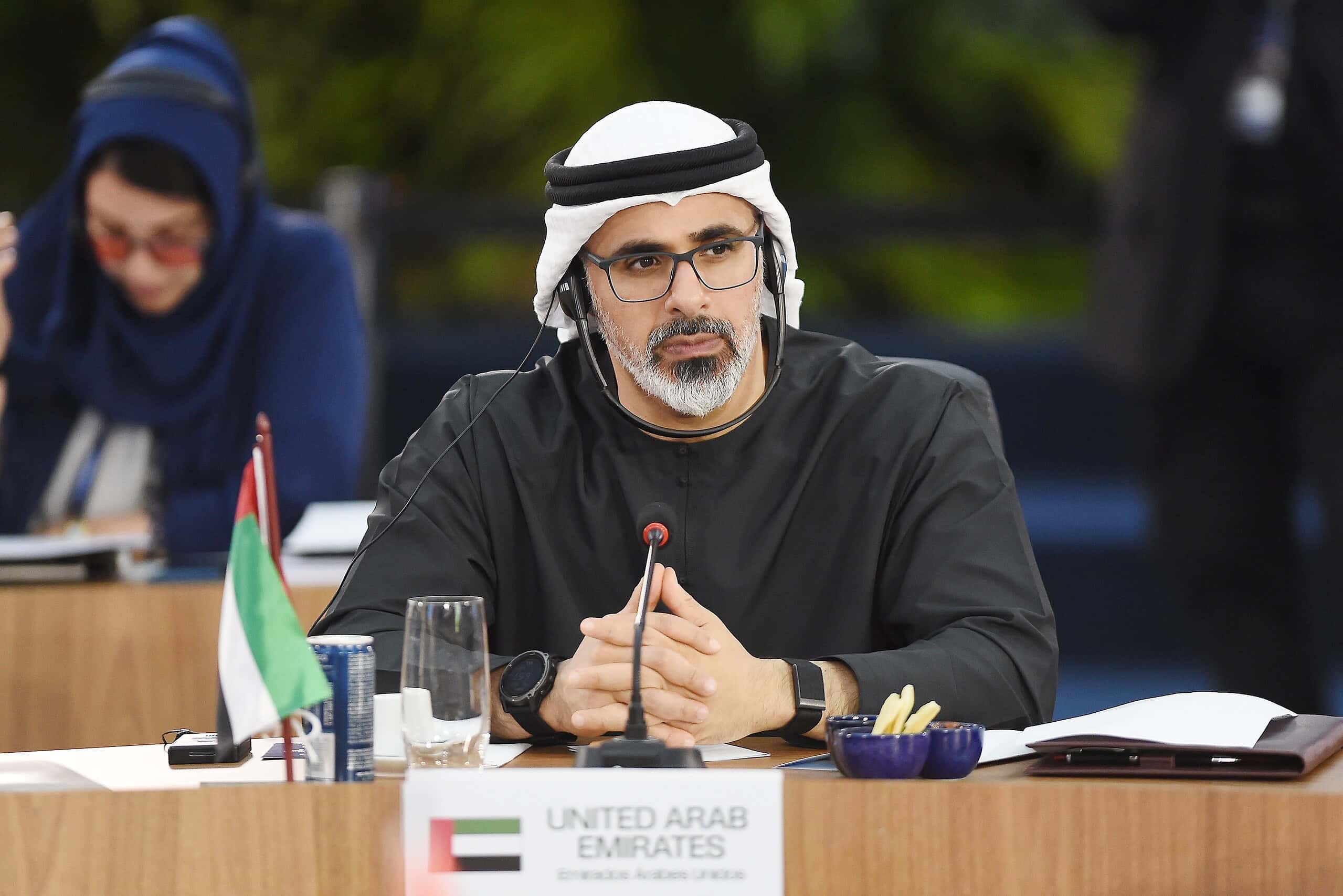
Abu Dhabi consolidates ADQ into L’Imad, creating $300 billion sovereign powerhouse under crown prince as emirate centralizes control over strategic investments.
L’Imad, Abu Dhabi’s newest sovereign wealth fund, took over the assets of rival state-owned fund ADQ, a development that sees a greater role in the emirate’s investment strategy by the emirate’s crown prince Sheikh Khaled bin Mohammed bin Zayed, son of the UAE president Mohammed bin Zayed.
The consolidation signals Abu Dhabi’s intentions to leverage capital for adaptability and power projection. And placing L’Imad under the direct supervision of the Crown Prince is significant. According to Dubai brokerage firm Century Financial, “Abu Dhabi is treating its investment platform as a long-term project managed by top government leaders.”
Prior to the merger, ADQ held assets of $263 billion with major investments spanning airlines, energy, infrastructure, and healthcare. Following the transfer of ADQ’s assets, L’Imad will have around $300 billion in assets under management, according to data from Global SWF, a platform focusing on central banks, sovereign wealth funds and public pension funds.
ADQ was previously chaired by Sheikh Tahnoon bin Zayed, the UAE’s influential national security adviser. He chairs the emirate’s principal wealth fund Adia (Abu Dhabi Investment Authority) that oversees $1.18 trillion in assets under management.
L’Imad’s rapid ascendancy—formed last year—looks set to become an important investment vehicle under the chairmanship of the 44-year-old crown prince. In January, the Abu Dhabi media office said the emirate’s Supreme Council for Financial and Economic Affairs had passed a resolution consolidating the assets of L’Imad and ADQ “to create a sovereign investment powerhouse with a diversified asset base.”
The new entity includes 25 investment companies and platforms and over 250 group subsidiaries. Jassem Al-Zaabi—who is also chairman the emirate’s department of finance and vice chairman of the UAE central bank—was appointed managing director and chief executive. Meanwhile Mohamed al Suwaidi, ADQ’s first chief executive, has left to become executive chair of Abu Dhabi investment manager, Lunate.
It is an old market saying, but it has never felt more apt: when people are worried about the future, they buy gold — when they are worried about the present, they sell it.
ADVERTISEMENT
ADVERTISEMENT
While the Iran war has raised longer-term concerns over energy security and global stability, the immediate fallout, in the form of surging oil prices and renewed inflation fears, has forced investors to prioritise liquidity and higher-yielding assets over metals.
Gold hit an all-time high of $5,602 (€4,873) at the end of January and looked to be heading higher still in early March, but has since dropped nearly 25% to a low of $4,100 (€3,567), trading around $4,500 (€3,915) at the time of writing.
The decline marks a dramatic pullback from gold’s extraordinary performance last year.
In 2025, the metal delivered one of its best annual gains in decades, rising more than 60% to record levels as central banks accumulated reserves and investors sought protection amid economic uncertainty.
The drop in 2026 has triggered a swift unwinding of leveraged positions in futures and exchange-traded funds which were riding last year’s tremendous rise.
This sharp reversal defies the traditional role of the metal as a refuge during geopolitical turmoil, with a stronger US dollar and rising bond yields proving far more influential.
Macroeconomic forces override safe-haven appeal
Rising US Treasury yields and a firmer US dollar have been the dominant headwinds for precious metals.
Higher oil prices stemming from the Iran war have lifted inflation expectations, prompting markets to price in fewer Federal Reserve rate cuts or even the possibility of tighter policy for longer, including potential hikes that were previously unexpected.
This has increased the opportunity cost of holding non-yielding gold, while the US dollar’s strength has made it more expensive for international buyers.
The result has been a classic “flight to liquidity” rather than the expected flight to quality risk assets, as leveraged traders facing margin calls accelerated the sell-off.
The correction for metals has been one of the sharpest in recent memory.
Silver shares in gold’s downturn
Silver, which often amplifies gold’s moves, followed with an even bigger drop.
The white metal reached an all time high of $121 just one day after gold, on 29 January, but it has since dropped roughly 50% to as low as $61.
At the time of writing, it is trading at around $70.
Silver enjoyed an even more spectacular rally than gold in 2025, surging roughly 145% thanks to robust industrial demand from solar panels, electronics and electric vehicles, combined with investment buying.
In 2026, however, it has also declined sharply amid the same pressures of US dollar strength and higher yields, although its industrial fundamentals continue to offer longer-term support.