arise

Reeves poised to break 50-year tax ‘taboo’ and ‘Arise, Sir Becks’

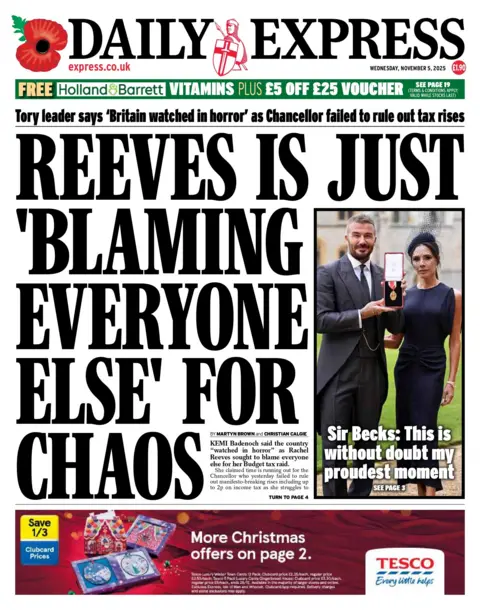
The headline on the front page of Daily Express reads: "Reeves is just 'blaming everyone else' for chaos".

Several papers lead on the aftermath of a speech by the Chancellor Rachel Reeves, in which she did not rule out a U-turn on Labour’s manifesto general election pledge not to hike income tax. Despite the chancellor saying she will make “necessary choices” in the Budget, Conservative leader Kemi Badenoch says Britain watched the speech “in horror” and that Reeves is “blaming every else” for chaos, according to the Daily Express.

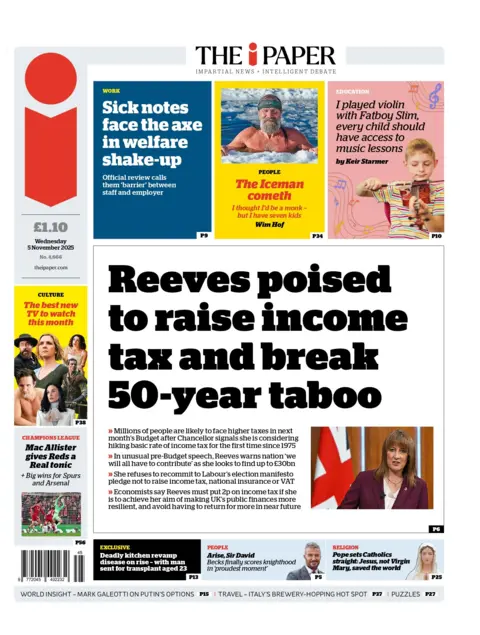
The headline on the front page of the i Paper reads: "Reeves poised to raise income tax and break 50-year taboo".

A hike in income tax would be the first since 1975, and break a “50-year taboo” against the policy, the i Paper reports. Economists cited by the paper say Reeves must add 2p on income tax if she wants to make the UK’s public finances “more resilient, and avoid having to return for more” in the near future.

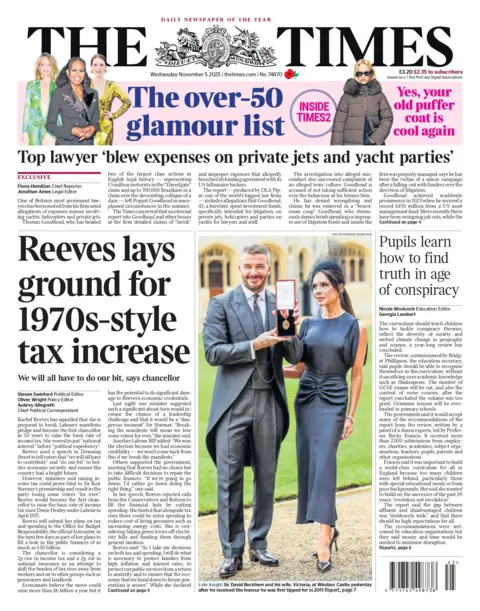
The headline on the front page of Times reads: "Reeves lays ground for 1970s-style tax increase".

“We will all have to do our bit” is the chancellor’s quote featured in the Times. The paper reports more lines from Reeves’ speech where she vowed to put “national interests” before “political expediency”. Elsewhere, a photo of Sir David Beckham receiving his knighthood at Windsor Castle is front and centre.

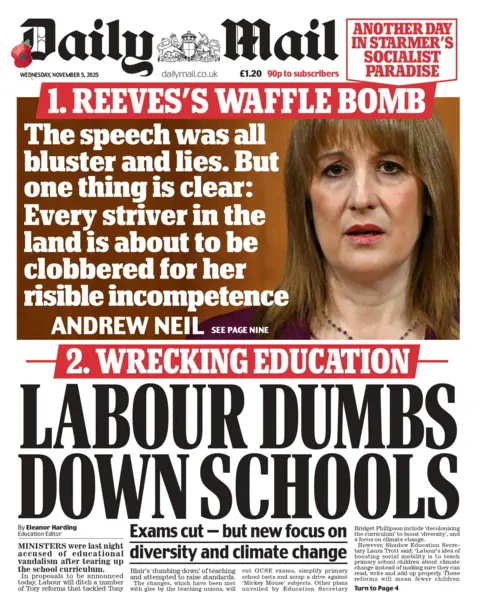
The headline on the front page of the Daily Mail reads: "Labour dumbs down schools".

“Reeves’s waffle bomb” is the Daily Mail’s take. The paper also reports that Labour has been accused of “educational vandalism” after ministers announced they would scrap a number of Tory reforms on education. The changes will include cutting GCSE exams and simplify primary school tests. “Labour dumbs down schools” is the headline.

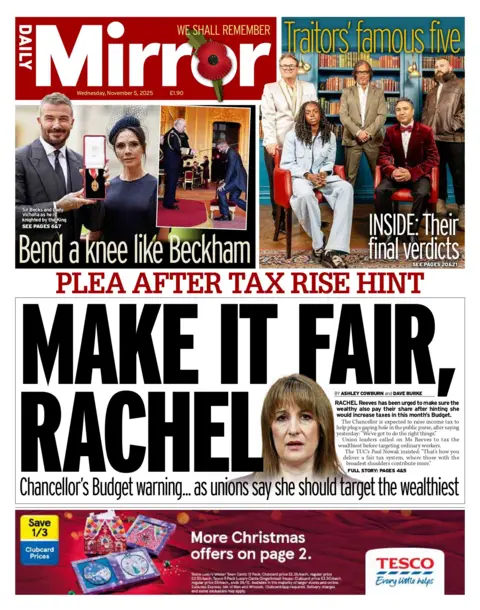
The headline on the front page of the Daily Mirror reads: "Make it fair, Rachel".

“Make it fair, Rachel” is the Daily Mirror’s headline as it leads with a plea from trade unions to the chancellor, calling on her to tax the wealthiest before targeting ordinary workers. Sharing the top spot, “bend a knee like Beckham” is the paper’s take on Sir David Beckham’s knighthood.

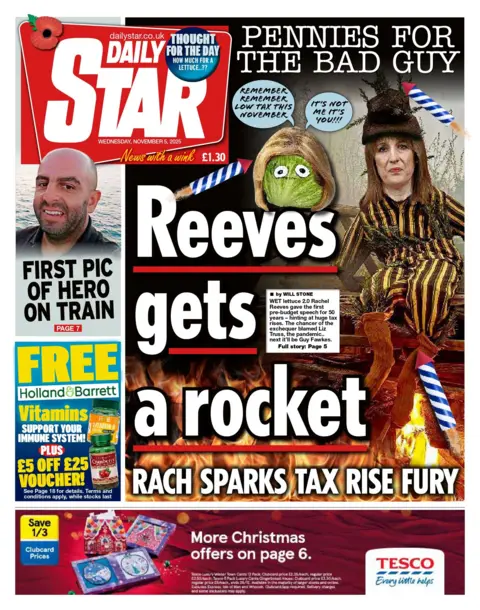
The headline on the front page of the Daily Star reads: "Reeves gets a rocket".

The Daily Star’s headline is “Rach sparks tax rise fury”, as it reports on the chancellor’s “first pre-Budget speech for 50 years – hinting at huge tax rises”.

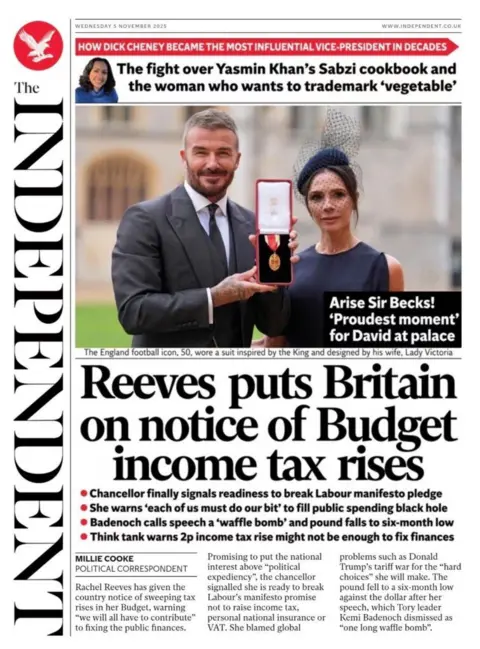
The headline on the front page of the Independent reads: "Reeves put Britain on notice of Budget income tax rises".

“Reeves puts Britain on notice,” says the Independent. The paper reports that a think tank has warned that a 2p income tax rise might not be enough to fix the country’s finances. A smiling Sir David Beckham holding his knighthood medal also fills the front page as the paper declares: “Arise Sir Becks!”

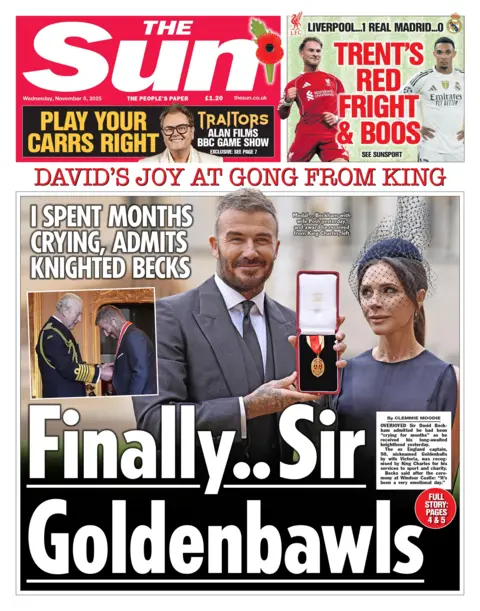
The headline on the front page of the Sun reads: "Finally... Sir Goldenbawls".

“Finally… Sir Goldenbawls” follows the Sun, as it reports that Sir David Beckham admitted he was “crying for months” after learning of his long-awaited knighthood. “It’s been been a very emotional day,” he said after the ceremony at Windsor.

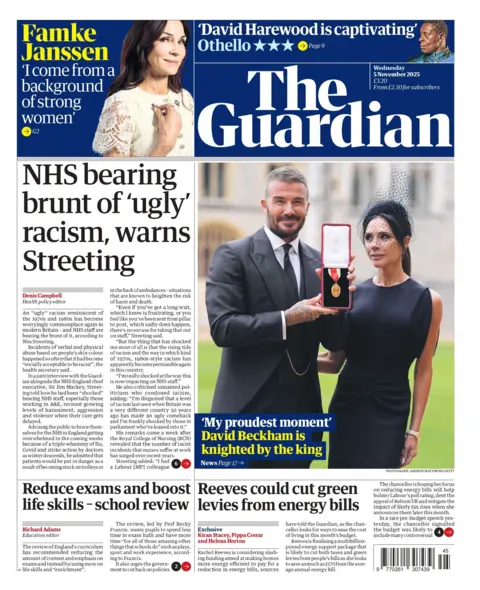
The headline on the front page of the Guardian reads: "NHS bearing brunt of 'ugly' racism, warns Streeting".

The Guardian’s front page spotlight’s Sir David calling his knighthood “my proudest moment”. Also prominent, the paper reports on Health Secretary Wes Streeting’s warning that NHS staff are bearing the brunt of “ugly” racism. In an interview with the paper, Streeting says incidents of verbal and physical abuse based on people’s skin colour are happening so often that it has become “socially acceptable to be racist”.

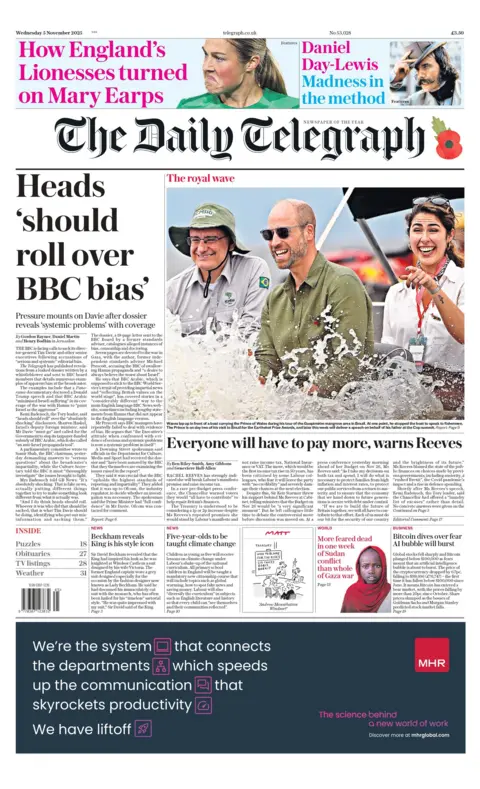
The headline on the front page of the Daily Telegraph reads: "Heads 'should roll over BBC bias'".

The Telegraph says that pressure is mounting on the BBC’s senior executives after a leaked dossier revealed “serious and systemic” editorial bias. The paper says Conservative leader Kemi Badenoch has called for “heads to roll” over the allegations. A BBC spokesperson said: “While we don’t comment on leaked documents, when the BBC receives feedback it takes it seriously and considers it carefully.”

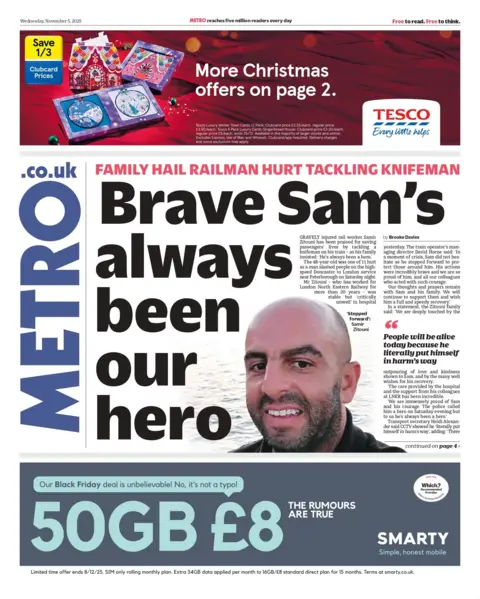
The headline on the front page of the Metro reads: "Brave Sam's always been our hero".

Finally, the Metro celebrates the story of the LNER rail staff worker who has been praised as a “hero” for saving passengers’ lives during the Cambridgeshire train attack. The paper quotes Samir Zitouni’s family who say: “He’s always been a hero.”

Chancellor Rachel Reeves features on many of the front pages after she warned voters about the “necessary” choices to be made at this month’s Budget to balance the books.

The Financial Times says she has “opened the door” for a “manifesto-breaking income tax rise”.

The i Paper highlights that such a hike would be the first since 1975, and break what the paper calls a “50-year taboo” against the policy.

The Daily Mail labels the chancellor’s Downing Street speech on Tuesday as “all bluster” and a “waffle bomb”.

According to the Daily Telegraph, some within Labour have been left fearing the worst. An unnamed Labour MP tells the paper they believe putting up taxes will “scotch whatever limited chances” the party has of being re-elected, and that breaking the manifesto pledge could leave them with “no credibility”.

The Times says ministers have raised concerns that an increase in income tax could see them lose some voters “forever”.

The front page of the Metro has a photograph of the rail worker, Samir Zitouni, who protected passengers during the knife attack on a train in Cambridgeshire on Saturday. More details were released about him yesterday. The paper quotes his family who say “he’s always been a hero”.

The Daily Telegraph reports that Sir Keir Starmer’s deal to hand over sovereignty of the Chagos Islands to Mauritius has been delayed. The paper says it is because a Conservative peer submitted an amendment to the legislation, to try to make the government consult the Chagossians before going ahead.

A Foreign Office spokesman said there had been a lack of notice given regarding the amendment, and a Lords vote to confirm the Bill would be moved to a later date.

And most of the papers feature photographs of Sir David Beckham receiving his knighthood at Windsor Castle yesterday. “Bend a knee like Beckham” says the Daily Mirror while the Daily Mail goes for: “Arise Sir Becks.”

News Daily banner
News Daily banner

Source link

After a reference to Trump’s impeachments is removed from Smithsonian, questions arise

It would seem the most straightforward of notions: A thing takes place, and it goes into the history books or is added to museum exhibits. But whether something even gets remembered and how — particularly when it comes to the history of a country and its leader — can become complex, especially when the leader is Donald Trump.

The latest example of that came Friday, when the Smithsonian Institution said it had removed a reference to Trump’s 2019 and 2021 impeachments from a panel in an exhibition about the American presidency. Trump has pressed institutions and agencies under federal oversight, often through the pressure of funding, to focus on the country’s achievements and progress and away from things he terms “divisive.”

The Smithsonian on Saturday denied getting pressure from the Trump administration to remove the reference, which had been installed as part of a temporary addition in 2021. The exhibit “will be updated in the coming weeks to reflect all impeachment proceedings in our nation’s history,” the museum said in a statement.

In a statement that did not directly address the impeachment references, White House spokesperson Davis Ingle said: “We are fully supportive of updating displays to highlight American greatness.”

But is history intended to highlight or to document — to report what happened, or to serve a desired narrative? The answer, as with most things about the past, can be complicated.

American stories

The Smithsonian’s move comes as the Trump administration has asserted its dominion over many American institutions, such as removing the name of a gay rights activist from a Navy ship, pushing for Republican supporters in Congress to defund the Corp. for Public Broadcasting — prompting its elimination — and getting rid of the leadership at the Kennedy Center.

“Based on what we have been seeing, this is part of a broader effort by the president to influence and shape how history is depicted at museums, national parks and schools,” said Julian E. Zelizer, a professor of history and public affairs at Princeton University. “Not only is he pushing a specific narrative of the United States but, in this case, trying to influence how Americans learn about his own role in history.”

It’s not a new struggle, in the world generally and the political world particularly. There is power in being able to shape how things are remembered, if they are remembered at all — who was there, who took part, who was responsible, what happened to lead up to that point in history. And the human beings who run things have often extended their authority to the stories told about them.

In China, for example, references to the June 1989 crackdown on pro-democracy demonstrators in Beijing’s Tiananmen Square are forbidden and meticulously regulated by the ruling Communist Party government. In Soviet-era Russia, officials who ran afoul of leaders such as Josef Stalin disappeared not only from the government itself but from photographs and history books where they once appeared.

Jason Stanley, an expert on authoritarianism, said controlling what and how people learn of their past has long been used as a vital tool to maintain power. Stanley has made his views about the Trump administration clear; he recently left Yale University to join the University of Toronto, citing concerns over the U.S. political situation.

“If they don’t control the historical narrative,” he said, “then they can’t create the kind of fake history that props up their politics.”

Framing history

In the United States, presidents and their families have used their power to shape history and calibrate their own images. Jackie Kennedy insisted on cuts in William Manchester’s book on her husband’s 1963 assassination, “The Death of a President.” Ronald Reagan and his wife got a cable TV channel to release a carefully calibrated documentary about him. Those around Franklin D. Roosevelt, including journalists of the era, took pains to mask the effects of paralysis on his body and his mobility.

Trump, though, has asserted far greater control — a sitting president encouraging an atmosphere where institutions can feel compelled to choose between him and the facts, whether he calls for it directly or not.

“We are constantly trying to position ourselves in history as citizens — as citizens of the country, citizens of the world,” said Robin Wagner-Pacifici, professor emerita of sociology at the New School for Social Research. “So part of these exhibits and monuments are also about situating us in time. And without it, it’s very hard for us to situate ourselves in history because it seems like we just kind of burst forth from the Earth.”

Timothy Naftali, director of the Richard M. Nixon Presidential Library and Museum in Yorba Linda from 2007 to 2011, presided over its overhaul to offer a more objective presentation of Watergate — one not beholden to the president’s loyalists. In an interview Friday, he said he was “concerned and disappointed” about the Smithsonian decision. Naftali, now a senior researcher at Columbia University, said that museum directors “should have red lines” and that he considered one of them to be the removal of the Trump impeachment panel.

While it might seem inconsequential for someone in power to care about a museum’s offerings, Wagner-Pacifici says Trump’s outlook on history and his role in it — earlier this year, he said the Smithsonian had “come under the influence of a divisive, race-centered ideology” — shows how important those matters are to people in authority.

“You might say about that person, whoever that person is, their power is so immense and their legitimacy is so stable and so sort of monumental that why would they bother with things like this … why would they bother to waste their energy and effort on that?” Wagner-Pacifici said. Her conclusion: “The legitimacy of those in power has to be reconstituted constantly. They can never rest on their laurels.”

Hajela and Italie write for the Associated Press.

Source link

‘Reform civil war’ and ‘arise Sir Becks’

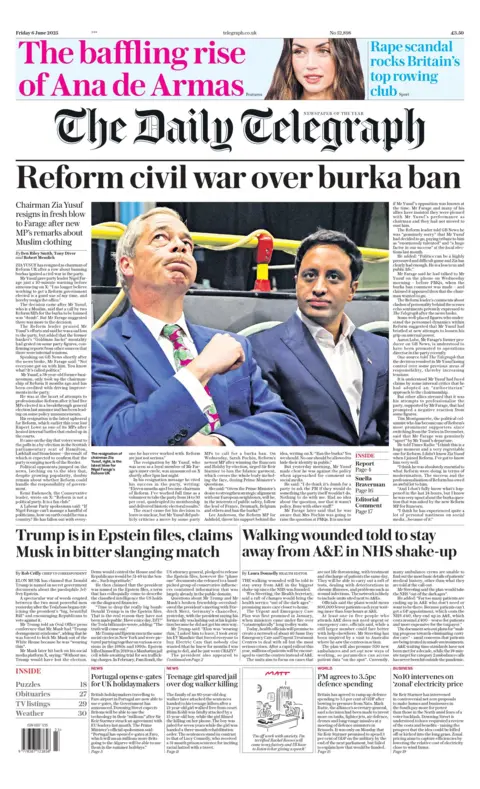
"Arise Sir Becks" reads the headline on the front page of The Telegraph.

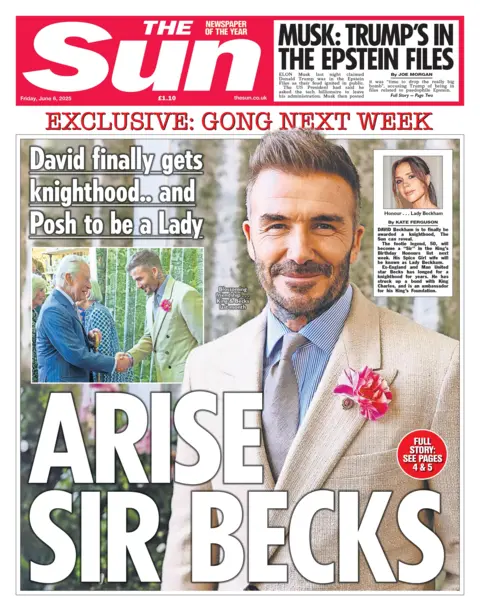
“David finally gets a knighthood… and Posh to be a Lady” writes The Sun in an exclusive, heralding the footballer’s supposed new title “Sir Becks”. It reports he will get the “gong next week” in the Birthday Honours List of King Charles III. The BBC has not verified the report.

"Reform civil war over burka ban"

It’s “civil war” for Reform UK as the party’s chair Zia Yusuf quits the party, writes the Daily Telegraph. Reform leader Nigel Farage was given “just a 10-minute warning” before Yusuf posted his resignation on X after he called a question by the party’s MPs over banning burkas “dumb”. A “bitter slanging match” between Elon Musk and US President Donald Trump also makes the front page after the tech billionaire wrote “without me, Trump would have lost the election”.

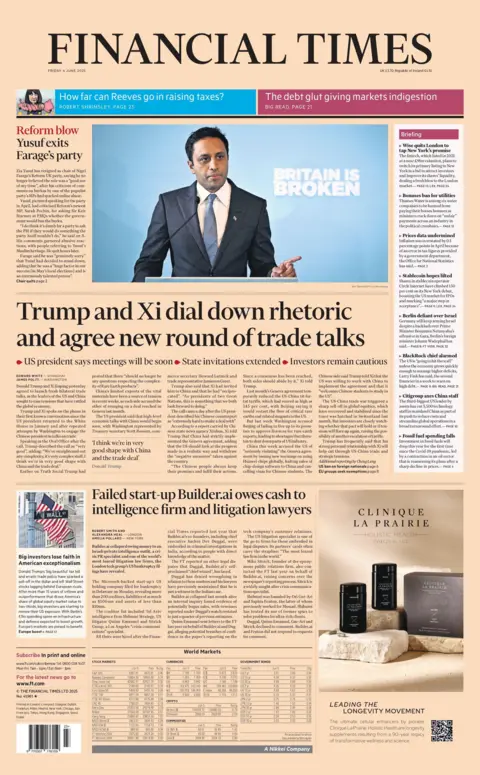
"Trump and Xi dial down rhetoric and agree to new round of trade talks" reads the headline on the front page of the Financial Times.

The FT also leads with Yusuf’s resignation, with the former Reform chair saying he didn’t think the position was a “good use of my time”. Nigel Farage has called him “enormously talented” and said he was “genuinely sorry” he had stepped down. On the world stage, “Trump and Xi dial down rhetoric and agree to new round of trade talks”.

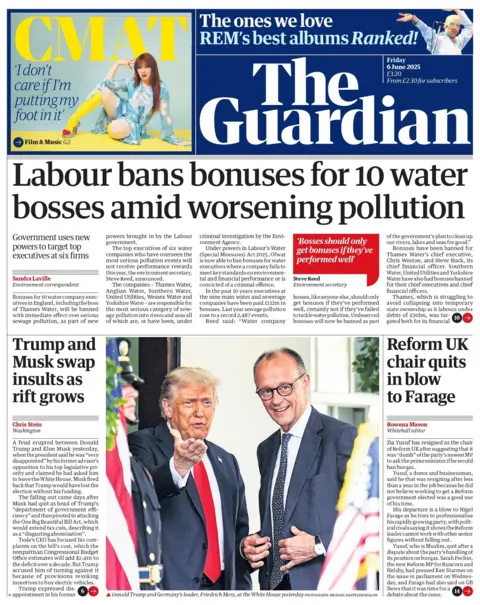
"Labour bans bonuses for 10 water bosses amid worsening pollution" reads the headline on the front page of The Guardian.

Labour has banned the bosses of 10 water companies from receiving bonuses “with immediate effect” over “serious sewage pollution” reports The Guardian. In the past decade, they have been paid £112m in bonuses. Last year, sewage pollution “rose to a record 2,487 events”, according to the paper. “Bosses should only get bonuses if they’ve performed well” the paper quotes Environment Secretary Steven Reed.

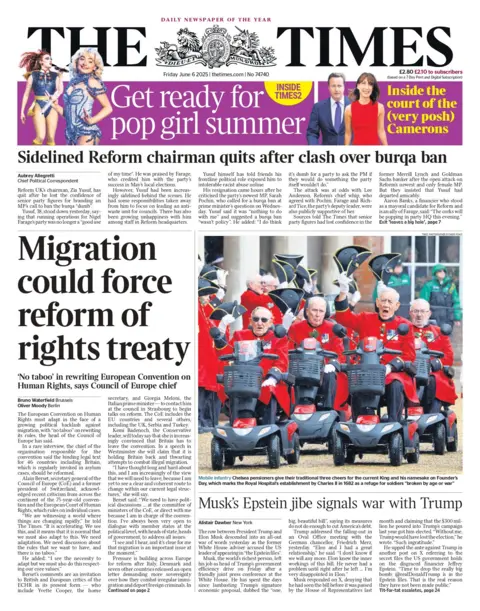
"Migration could force reform of rights treaty" reads the headline on the front page of The Times.

The Times covers Musk and Trump’s disagreement too, highlighting the X founder’s comment that the president had appeared “in the Epstein files” as a barb that “signals war”. Trump was named in one document released by a judge last year regarding a connection with the disgraced financier – but this carries no inference of wrongdoing. The BBC has contacted the White House for comment on the allegations. Also on the front page an image of four Chelsea pensioners doffing their hats atop mobility scooters.

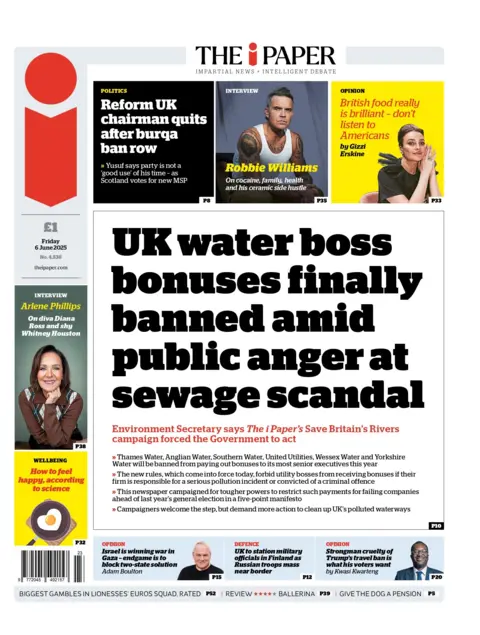
"UK water boss bonuses finally banned amid public anger at sewage scandal" reads the headline on the front page of The i Paper.

The i Paper’s front page is mostly taken up by the news of the UK water bosses “finally” receiving a bonus ban “amid public anger at sewage scandal”. The paper draws attention to how it had “campaigned for tougher powers to restrict such payments”.

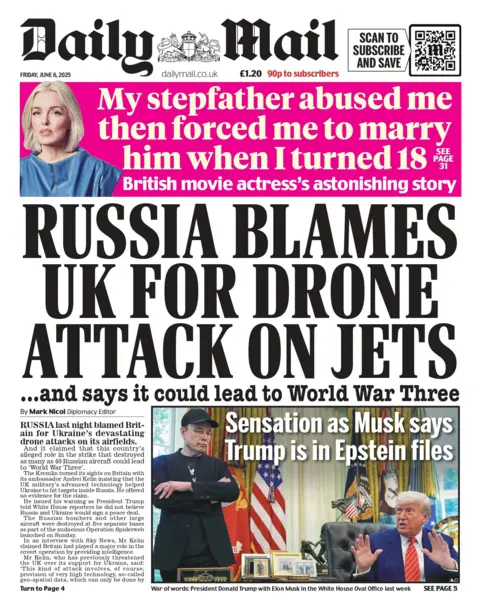
"Russia blames UK for drone attack on jets" reads the headline on the front page of the Daily Mail.

“Russia blames UK for drone attack on jets” and “says it could lead to World War Three” reads the top headline of the Daily Mail. Kremlin ambassador to the UK Andrei Kelin said the UK military’s tech had helped Ukraine hit the targets inside Russia, the tabloid reports. It also picks up Trump and Musk’s argument calling it a “war of words”.

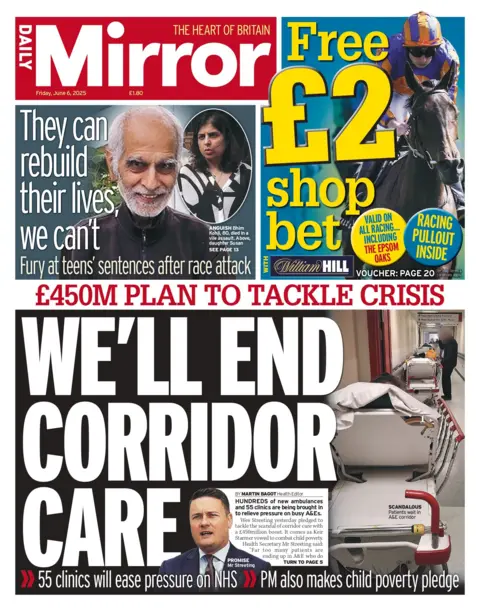
"We'll end corridor care" reads the headline on the front page of the Daily Mirror.

The Daily Mirror headlines on a promise by Health Secretary Wes Streeting to “end corridor care”, as he says £450m will go towards tackling the issue. The Mirror also runs the story of the race attack on Bhim Kohli on its front page that resulted in his death as his teen attackers have now received their sentences. “They can rebuild their lives, we can’t” writes the paper, describing the “anguish” of Kohli’s family.

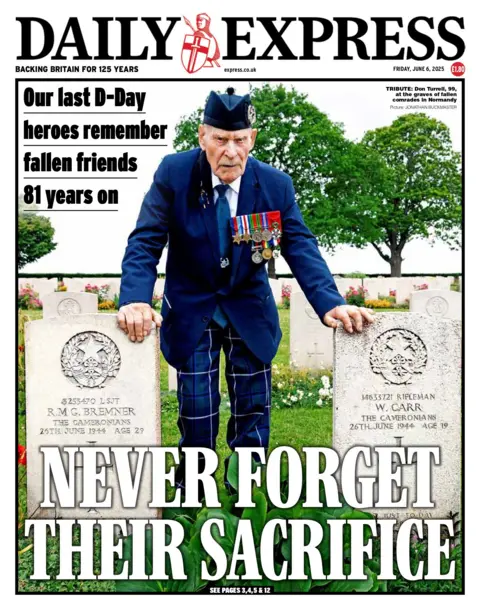
"Never forget their sacrifice" reads the headline on the front page of the Daily Express.

A veteran standing by two tombstones appears on the front page of the Daily Express as “our last D-Day heroes remember fallen friends 81 years on”. “Never forget their sacrifice”, the paper writes.

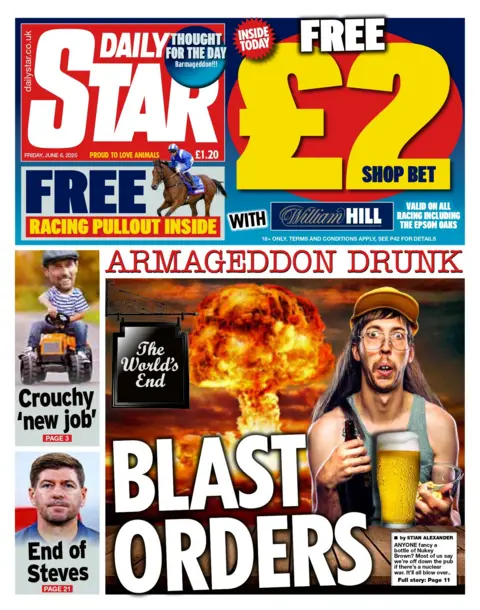
"Blast orders" reads the headline on the front page of the Daily Star.

For the Daily Star, it’s “blast orders” as it writes “most of us say we’re off down the pub if there’s a nuclear war”.

News Daily banner
News Daily banner

Source link