top news

Hegseth lifts Army suspension of Kid Rock flyby pilots

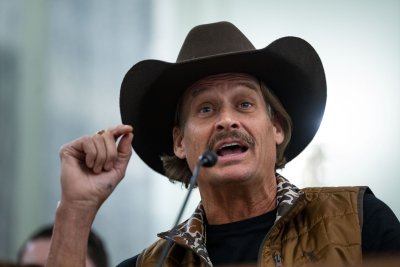
March 31 (UPI) — Secretary of Defense Pete Hegseth announced Tuesday that helicopter pilots who conducted a flyby of musician Kid Rock‘s Nashville estate over the weekend would not be punished, an abrupt reversal of the U.S. Army’s decision to suspend the Apache helicopter crews amid review of their conduct.

“@USArmy pilots suspension LIFTED,” Hegseth said on X. “No punishment. No investigation.

“Carry on, patriots,” he said.

He also thanked Rock, whose real name is Robert James Ritchie, a vocal ally of President Donald Trump.

“You’re a disgrace,” Adam Kinzinger, a former Republican House of Representative from Illinois and a retired U.S. Air Force and Air National Guard officer, said in an expletive-laced statement responding to Hegseth’s announcement, in which he called the defense secretary an “unqualified clown.”

Rock published a pair of videos to social media on Saturday showing him cheering on a pair of Apache helicopters flying by and hovering near his Nashville estate, which he has called “The Southern White House.”

“This is a level of respect that [expletive] for brains Governor of California will never know,” Rock wrote in the caption to the videos. “God bless America and all those who have made the ultimate sacrifice to defend her.”

After the videos went viral, the U.S. Army announced Monday that it was conducting an administrative review of the incident.

Army spokesman Maj. Montrell Russell confirmed Tuesday that two Apache helicopters from the 101st Combat Aviation Brigade at Fort Campbell, Ky., located about 60 miles north of Nashville, had conducted a flight in the Nashville area that has attracted media and the public’s attention.

“The personnel involved have been suspended from flight duties while the Army reviews the circumstances surrounding the mission, including compliance with relevant [Federal Aviation Administration] regulations, aviation safety protocols and approval requirements,” Russell said in a statement.

Hegseth offered no explanation for the reversal, which came not long after Trump told reporters at the White House that he had not seen the video.

Asked what he thought of the crews’ suspension, Trump said, “Well, they probably shouldn’t have been doing it.”

“Yes, you’re not supposed to be playing games, right? I’d take a look at it,” he said.

“They like Kid Rock. I like Kid Rock. Maybe they were trying to defend him. I don’t know.”

Rock has long been a vocal supporter of Trump and has appeared at the White House and in a recent Health and Human Services Department promotional video where he is seen working out bare-chested with HHS Secretary Robert F. Kennedy.

He has also lashed out at Trump’s critics, notably California Gov. Gavin Newsom.

Source link

South Korea proposes $7.1B relief budget amid inflation, oil shock

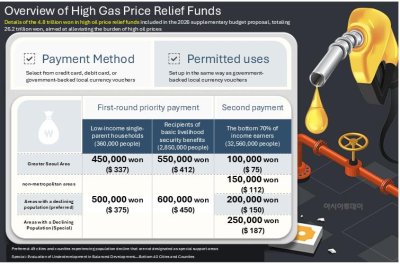
Data provided by the Ministry of Economy and Finance. Graphic by Asia Today and translated by UPI

March 31 (Asia Today) — South Korea’s Ministry of the Interior and Safety proposed a 9.52 trillion won ($7.1 billion) supplementary budget on Monday to ease the impact of high oil prices and inflation driven by instability in the Middle East.

The plan includes direct cash payments ranging from 100,000 won to 600,000 won ($75 to $450) per person for low- and middle-income households, along with increased funding for local governments and youth employment programs.

The proposal was approved at a Cabinet meeting and will be submitted to the National Assembly for review.

At the center of the package is a 4.82 trillion won ($3.6 billion) relief program targeting the bottom 70% of income earners. Payments will vary depending on region and socioeconomic status.

Residents in the Seoul metropolitan area would receive 100,000 won ($75), while those outside the capital region would receive 150,000 won ($112). People living in areas facing population decline would receive between 200,000 won and 250,000 won ($150 to $187).

Additional support is aimed at vulnerable groups. Single-parent households and those in the near-poor category would receive 450,000 won ($337), rising to as much as 500,000 won ($375) for those outside the capital region. Recipients of basic livelihood assistance would receive 550,000 won ($412), or up to 600,000 won ($450) with regional adjustments.

The government estimates the program will cover about 32.56 million people in the bottom 70% income bracket, along with 360,000 near-poor and single-parent households and 2.85 million recipients of basic livelihood benefits.

Details such as eligibility criteria, payment timing and methods will be finalized through interagency consultations and announced separately.

The ministry also set aside 19.5 billion won ($14.5 million) for youth work experience programs, focusing on sectors such as caregiving, culture and environmental services. Officials said the initiative is designed to support young people facing increased employment uncertainty amid global economic volatility.

An additional 4.67 trillion won ($3.5 billion) in local government grants is included to help regional authorities respond quickly to local economic conditions and fund projects aimed at stabilizing livelihoods and boosting economic activity.

Interior and Safety Minister Yoon Ho-joong said the relief payments were structured to provide greater support to regions and populations facing deeper economic hardship.

“With growing external uncertainties, including the conflict in the Middle East, we will work closely with the National Assembly to ensure this budget serves as a stabilizing force for people affected by rising fuel costs and inflation,” Yoon said.

— Reported by Asia Today; translated by UPI

© Asia Today. Unauthorized reproduction or redistribution prohibited.

Original Korean report: https://www.asiatoday.co.kr/kn/view.php?key=20260331010009533

Source link

Judge temporarily halts Trump’s $400m White House ballroom project | Donald Trump News

District Judge Richard Leon says construction has to stop until Congress provides statutory authorisation.

A judge has ruled that US President Donald Trump cannot proceed with his planned $400m ballroom on the site of the White House’s demolished East Wing without approval from Congress.

District Judge Richard Leon on Tuesday granted a request for a preliminary injunction filed by the National Trust for Historic Preservation, which sued after alleging Trump had exceeded his authority by razing the historic East Wing and launching construction on the new building.

Recommended Stories

list of 2 itemsend of list

“I have concluded that the National Trust is likely to succeed on the merits because no statute comes close to giving the President the authority he claims to have,” Leon, an appointee of former Republican President George W Bush, wrote in the ruling.

“The President of the United States is the steward of the White House for future generations of First Families. He is not, however, the owner!” he said. “Unless and until Congress blesses this project through statutory authorization, construction has to stop!”

Leon said the order does not affect “construction necessary to ensure the safety and security of the White House”.

His ruling keeps the 90,000 square-foot (8,360 square-metre) ballroom project on hold while the lawsuit continues.

The judge said he was pausing his order for 14 days to allow the ⁠Trump administration to appeal. Hours later, the Justice Department filed an appeal at the Washington, DC-based US Court of Appeals for the District of Columbia Circuit.

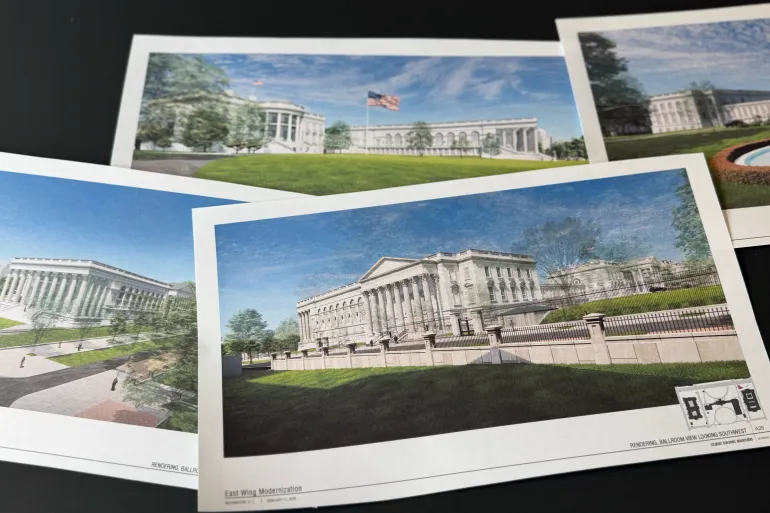
Artist renderings of the new White House East Wing and Ballroom
Artist renderings of the new White House East Wing and Ballroom [Jon Elswick/AP]

Carol Quillen, president and CEO of the National Trust, welcomed Leon’s ruling.

“This is a win for the American people on a project that forever impacts one of the most beloved and iconic places in our nation,” Quillen said in a statement.

In a social media post, Trump called the National Trust a group of left-wing “lunatics” and said his ballroom is “under budget, ahead of schedule, being built at no cost to the Taxpayer, and will be the finest Building of its kind anywhere in the World”.

The Republican has championed the ballroom as a defining addition to the White House and a lasting symbol of his presidency.

Source link

South Korea passes currency stabilization bill amid economic strain

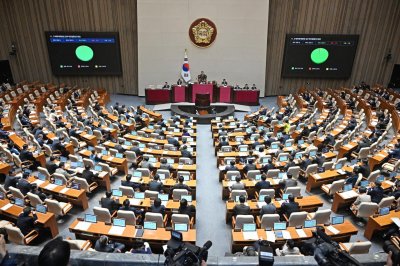
Lawmakers pass a revision to the Restriction of Special Taxation Act during a plenary session at the National Assembly in Seoul, with 206 votes in favor, 2 against and 2 abstentions out of 210 members present. Photo by Asia Today

March 31 (Asia Today) — South Korea’s ruling and opposition parties agreed Tuesday to pass a package of economic measures, including a currency stabilization bill, as the won weakened sharply amid prolonged conflict in the Middle East.

The legislation was approved during a plenary session alongside more than 60 bills aimed at stabilizing the economy and supporting livelihoods.

The currency measure includes tax incentives designed to encourage domestic investment by individuals who have invested in overseas markets, often referred to in South Korea as retail investors in foreign stocks. Officials said the goal is to increase demand for the Korean won and reduce volatility in foreign exchange markets.

The won traded at 1,530.1 per U.S. dollar on Tuesday, well above the psychologically significant 1,500 level, adding to inflationary pressure.

Floor leader Han Byung-do said the worsening Middle East crisis had begun to affect everyday life, emphasizing the need to contain exchange rate volatility and shield the economy from external shocks.

Lawmakers also approved additional economic legislation tied to the crisis. These include a measure to support corporate restructuring, allowing companies to streamline mergers and spin-offs and receive tax benefits as they respond to industrial challenges and shift into new sectors.

Other bills passed include revisions to trade-related laws aimed at helping businesses adapt to changes in the global trade environment.

Separately, lawmakers voted to fill several vacant leadership posts in National Assembly committees. The Democratic Party nominated Rep. Seo Young-kyo as chair of the Legislation and Judiciary Committee, along with Rep. Kwon Chil-seung and Rep. So Byung-hoon for other committee leadership roles. Their terms will run through May.

The votes were conducted by secret ballot and passed with support from the Democratic Party, while the People Power Party is believed to have opposed the selections.

The People Power Party had argued that the judiciary committee chair should be held by the opposition to ensure checks and balances, noting that the Democratic Party already holds the position of National Assembly speaker.

— Reported by Asia Today; translated by UPI

© Asia Today. Unauthorized reproduction or redistribution prohibited.

Original Korean report: https://www.asiatoday.co.kr/kn/view.php?key=20260401010009707

Source link

S. Korea intelligence agency says drone case was ‘personal misconduct’

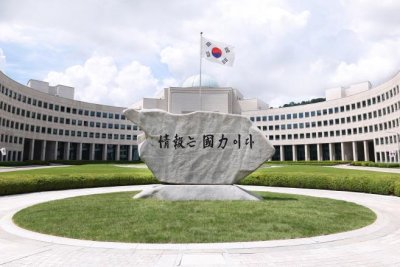
Exterior of the National Intelligence Service headquarters in Seoul. Photo by Asia Today

March 31 (Asia Today) — South Korea’s National Intelligence Service said Tuesday that an employee accused of involvement in a North Korea drone incident acted independently, describing the case as “personal misconduct” unrelated to official duties.

The agency said its internal inspection found the employee was an administrative staff member with no authority to collect or handle intelligence.

Officials added that the employee had known the main suspect – a graduate student in his 30s – since their college years, and that funds transferred in connection with the case were personal money, not tied to the agency.

Earlier in the day, a joint military-police task force referred the employee and two military officers to prosecutors without detention. The case involves allegations of aiding violations of national security and aviation safety laws.

The intelligence employee was sent to civilian prosecutors, while the two active-duty officers were referred to military prosecutors, all with recommendations for indictment.

Investigators said the suspects were involved in assisting the graduate student, identified only by his surname Oh, in flying a drone into North Korea.

The employee is believed to have known about the civilian suspects’ drone development activities and related business operations. Authorities said he provided about 2.9 million won ($2,200) to help cover production costs and meal expenses on the day of a test flight.

An intelligence agency official said the employee’s actions were “an individual deviation unrelated to official duties” and that the agency had cooperated fully with investigators to clarify the facts.

— Reported by Asia Today; translated by UPI

© Asia Today. Unauthorized reproduction or redistribution prohibited.

Original Korean report: https://www.asiatoday.co.kr/kn/view.php?key=20260331010009597

Source link

Judge overturns Trump’s ban on NPR, PBS funding

The headquarters for National Public Radio is seen in Washington, D.C., on May 27. A federal judge sided with NPR’s lawsuit saying Trump’s cut to federal funding was a violation of the First Amendment. File Photo by Bonnie Cash/UPI | License Photo

March 31 (UPI) — A federal judge in Washington, D.C., ruled Tuesday that President Donald Trump‘s executive order cutting funding to NPR and the PBS was a violation of their First Amendment rights.

U.S. District Judge Randolph Moss said the executive order signed in May violated the companies’ constitutional rights to a free press because Trump targeted for what he described as liberal views. He described the cut to funding as “viewpoint discrimination.”

“The message is clear: NPR and PBS need not apply for any federal benefit because the president disapproves of their ‘left-wing’ coverage of the news,” Moss said in his ruling.

“It is difficult to conceive of clearer evidence that a government action is targeted at viewpoints that the president does not like and seeks to squelch,” he added.

“To be sure, the president is entitled to criticize this or any other reporting, and he can express his own views as he sees fit. He may not, however, use his governmental power to direct federal agencies to exclude plaintiffs from receiving federal grants or other funding in retaliation for saying things that he does not like.”

Trump’s executive order, called Ending Taxpayer Subsidization of Biased Media, ordered the Corporation for Public Broadcasting to stop funding National Public Radio and the Public Broadcasting Service to the maximum extent allowed by law.

At the time, more than 70% of CPB’s congressionally approved $535 million budget went directly to public media stations through grants.

According to NPR, about 1% of its annual operating budget came in the form of grants from CPB and federal agencies and departments, excluding CPB funding for the Public Radio Satellite System. Its largest funding stream — about 36% — comes from sponsorships, donations, memberships and licensing fees.

According to PBS, federal funding covered about 15% of its revenue.

CPB was founded in 1967 as a private nonprofit corporation to fund public television and radio stations and their programs.

NPR sued the Trump administration later in the month, citing First Amendment and 1967 Public Broadcasting Act violations.

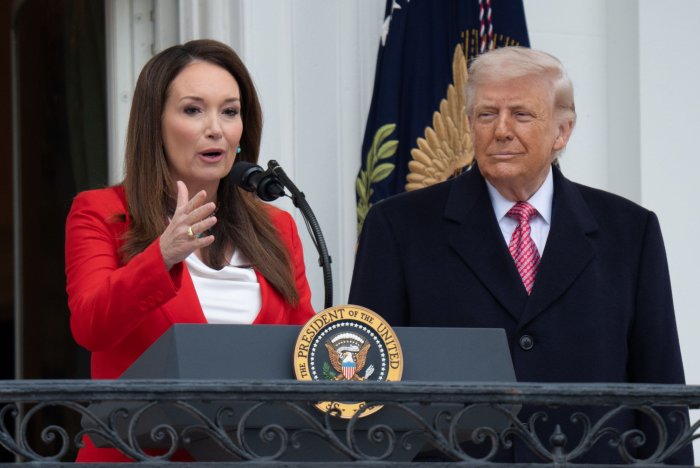
President Donald Trump stands with U.S. Secretary of Agriculture Brooke Rollins during an event celebrating farmers on the South Lawn of the White House on Friday. Photo by Aaron Schwartz/UPI | License Photo

Source link

Why UN slavery resolution won’t be enough | Slavery

Slavery declared the gravest crime against humanity.

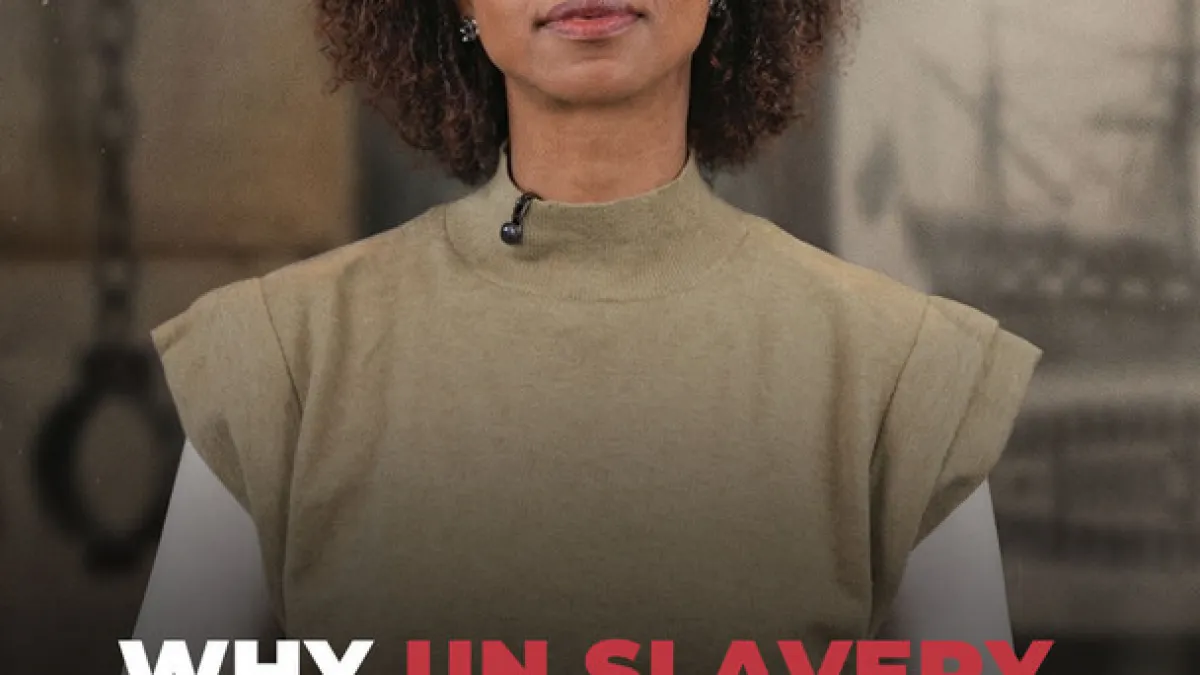
Slavery has been declared the gravest crime against humanity in a United Nations resolution. Argentina, Israel, and the United States were the only countries that voted against it, with many others abstaining. So what does this resolution mean, and why won’t the countries that built their wealth on slavery agree to a path for justice? Al Jazeera’s Marthe van der Wolf explains.

Source link

Ecuador’s narcotics traffickers paid more after U.S. anti-drug pressure

This photo shows moments before a boat suspected of carrying narcotics is struck in the Eastern Pacific on March 8. Photo by U.S. Southern Command

March 31 (UPI) — Increased military pressure by the United States on drug trafficking routes in the Pacific Ocean has forced criminal groups to sharply raise payments to those willing to transport narcotics by sea, a police official said.

In Ecuador’s coastal provinces of Manabí and Santa Elena, recruitment costs for local fishermen tasked with moving cocaine to Central America on speedboats have surged to unprecedented levels.

According to Ecuadorian outlet Primicias, in 2023 and 2024 criminal organizations paid up to $20,000 per trip to boat operators and about $5,000 to their assistants.

However, a large-scale deployment of U.S. and Ecuadorian forces under Operation Southern Spear, launched in October, has increased the risks of these journeys and driven up payments offered by traffickers.

Col. William Calle, head of Ecuador’s National Police in Zone 4, said operators piloting speedboats or semi-submersibles can now earn around $40,000 per trip. Assistants receive about $20,000, while those handling mid-sea refueling earn roughly $15,000.

Local reports, including from El Diario de Manabí, indicate payments can reach as high as $90,000 for high-risk missions or large shipments.

Since 2024, U.S. and Ecuadorian maritime authorities have conducted patrol flights and interdiction operations to monitor and intercept drug trafficking vessels in Ecuadorian waters.

President Daniel Noboa ratified two military cooperation agreements in February. The risk for traffickers has shifted from capture to potential airstrikes in international waters if vessels fail to stop.

Despite arrests and international warnings, criminal groups continue to rely on fishing vessels to transport drugs.

According to El Diario, fishermen detained after operations in Manta and Salinas on Thursday told courts that successful trips carrying one to two tons of drugs can yield payments of up to $90,000. Military intelligence has described these sums as the “price of silence” and compensation for the risk of attack.

Ecuador’s Navy said traffickers increasingly use so-called “mother ships” to extend range and cargo capacity, while smaller fiberglass boats serve as logistical support or for transfers at sea. This tactic complicates interdiction efforts, though shared intelligence has enabled several recent seizures.

Ecuador has become a primary departure point for cocaine produced in the region, with about 80% of shipments moving through the Pacific corridor.

For artisanal fishermen facing economic hardship due to declining catches and piracy targeting boat engines, a $40,000 payment can equal up to a decade of legal earnings.

However, many fishermen say participation is not voluntary but enforced under threats. Organized crime groups such as Los Lobos and Los Choneros control ports, extorting and forcibly recruiting experienced navigators whose knowledge of ocean currents helps evade detection.

The escalation of U.S. military actions under Operation Southern Spear has included at least 47 airstrikes against suspected vessels in the Caribbean Sea and Pacific Ocean. These operations, described President Donald Trump‘s administration as part of a fight against “narco-terrorism,” have resulted in at least 150 deaths.

Authorities have also reported significant seizures, including more than 2.9 tons of drugs near the Galápagos Islands and an additional 2 tons intercepted at sea in March

This month, the U.S. government also launched military and intelligence operations in Ecuadorian territory with authorization from Noboa.

The White House said the operations are aimed at dismantling Los Lobos and Los Choneros, which the U.S. State Department designated as foreign terrorist organizations in late 2025.

According to U.S. Southern Command, these groups are no longer treated solely as criminal organizations, but as threats to hemispheric national security.

Source link

Former FBI agents sue Patel, Bondi for alleged political firings

March 31 (UPI) — Three former FBI agents filed a lawsuit against FBI Director Kash Patel, Attorney General Pam Bondi and their departments Tuesday for firing them, claiming it was for political retribution.

The suit includes a proposed class-action of all FBI employees already fired or potentially fired in the future for political reasons. It was filed in the Federal District Court in Washington, D.C.

Former FBI agents Jamie Garman, Blaire Toleman and Michelle Ball served on a public corruption squad at the FBI that investigated President Donald Trump‘s efforts to overturn the 2020 election. Special counsel Jack Smith eventually took over the investigation code named Arctic Frost. He dropped the charges against Trump after he was elected in 2024.

The three agents were fired last fall.

“Our removal from federal service — without due process and based on a false perception of political bias — is a profound injustice that raises serious concerns about political interference in federal law enforcement,” they said in a statement released by their lawyer, Daniel M. Eisenberg. “We bring this lawsuit to protect the rule of law and to allow our former colleagues to do their jobs without fear of retaliation.”

A federal judge will have to decide if the case can be a class-action suit. The three agents are seeking to include more than 50 FBI employees who have been fired since Trump took office.

Since taking control of the FBI in February 2025, Patel and the other defendants “have summarily terminated members of the proposed class because of their perceived political affiliation, without legitimate investigation, finding of misconduct, pre-termination notice of charges to the employees, an opportunity for the employees to present a defense, and/or any compelling or exigent circumstances,” the suit said.

At the Conservative Political Action Conference in Texas Thursday, Deputy Attorney General Todd Blanche said in a speech that Patel had “cleaned house” at the FBI.

“There isn’t a single man or woman with a gun, federal agent, still in that organization that had anything to do with the prosecution of President Trump,” the lawsuit alleges Blanche said.

President Donald Trump stands with U.S. Secretary of Agriculture Brooke Rollins during an event celebrating farmers on the South Lawn of the White House on Friday. Photo by Aaron Schwartz/UPI | License Photo

Source link

Trump attacks NATO allies as pressure mounts over Strait of Hormuz | Donald Trump News

US President Donald Trump has released a series of posts attacking NATO countries including France, Spain and the UK over their role in securing the Strait of Hormuz. Al Jazeera’s Alan Fisher explains what Trump’s latest criticism of US allies means.

Source link

The attack on the right to protest in the UK is not just about Palestine | Protests

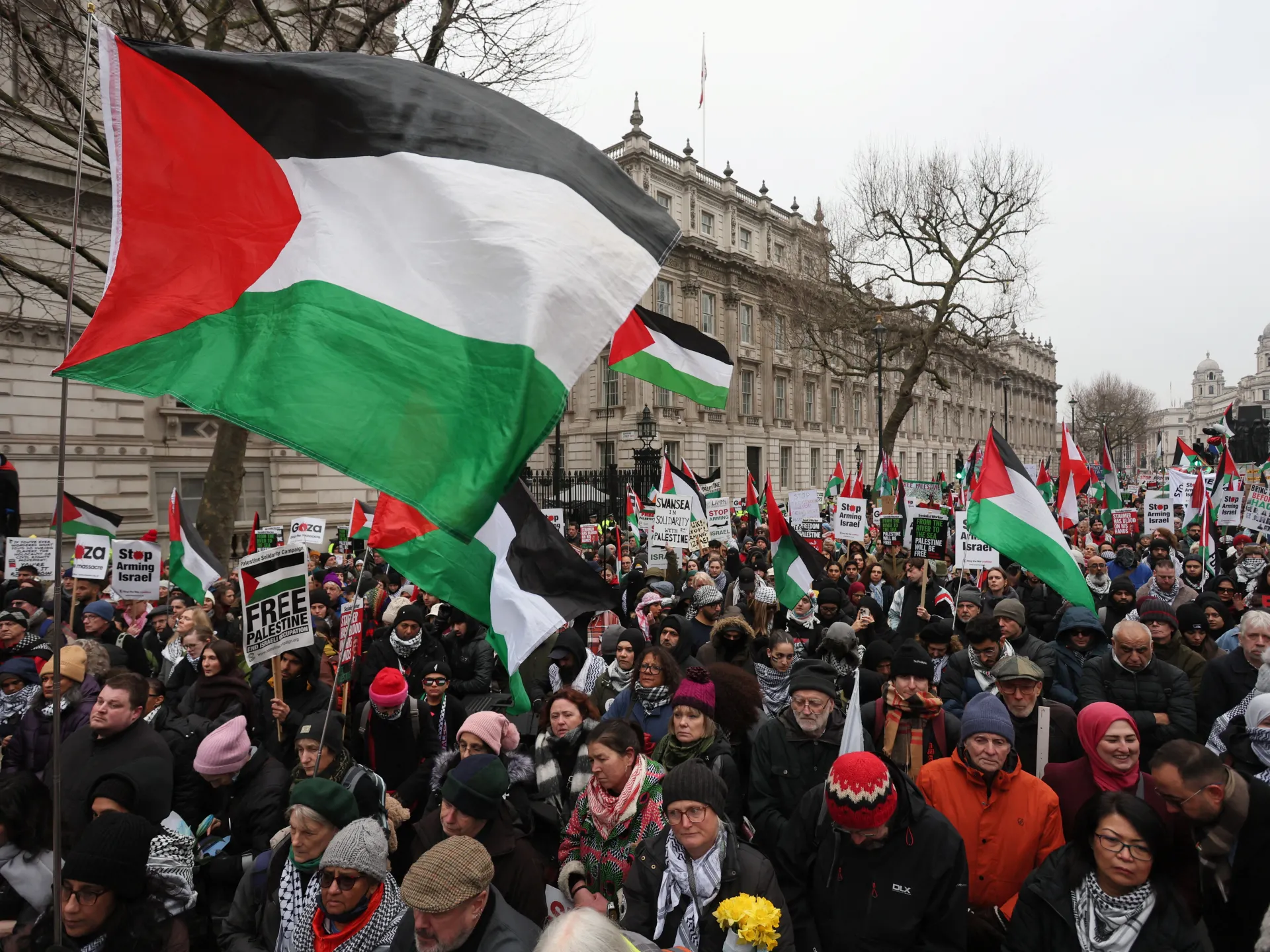
On April 1, a British court is set to rule in an important trial that could define the limits of mass protest in Britain. Ben Jamal, director of the Palestine Solidarity Campaign, and Chris Nineham, vice chair of Stop the War Coalition, were both charged with breaching the Public Order Act 1986 for organising a pro-Palestine demonstration in London on January 18, 2025, on which the police had imposed conditions.

Last week, Judge Daniel Sternberg refused to dismiss the case, despite evidence provided by defence barrister Mark Summers that protesters did not break the conditions, nor had any intention to do so. The trial is seen as yet another indication of the rapidly shrinking space for the free expression of dissent in Britain.

Politicised policing

The proceedings in the trial against Jamal and Nineham have revealed the extraordinarily close relationship between the Metropolitan Police and Zionist groups. This includes the police accepting recommendations from these groups about the Palestine movement’s demonstration routes.

In negotiations between protest leaders and the police ahead of the January 18 demonstration, the police had agreed in principle to a demonstration forming up outside the BBC headquarters in central London, which is close to the Central Synagogue. Protesters had assembled there before and were keen to do so again in order to highlight the BBC’s pro-Israel bias.

During the trial, it was revealed that police commander Adam Slonecki received a letter from the Jewish Leadership Council (JLC), which threatened a judicial review if he failed to impose conditions on the protest. Slonecki had also had a series of meetings with various pro-Israeli groups after receiving the letter.

On December 20, he met with protest organisers and explained – without offering evidence or mentioning the meetings that had taken place – that the demonstrations were producing a “cumulative impact” in the form of serious disruption to the Jewish way of life, and that protesters were to be banned from marching in the vicinity of the BBC.

Ultimately, the police allowed only a static protest on January 18, at Whitehall. In a carefully worded speech on the day, Jamal announced from the stage that a small delegation of protesters would walk towards the BBC to lay flowers in memory of those killed in Gaza. If prevented, they would lay the flowers at the feet of the police and disperse. The police allege that Jamal’s speech constituted incitement to breach the conditions.

In fact, as protesters waited for the police to decide where the flowers could be laid, Nineham was violently arrested.

The defence argued that the police were unduly influenced by pro-Israeli pressure in the run-up to the demonstration and failed to facilitate the right to protest. That the police commander did not make any effort to meet with sections of the Jewish community that are pro-Palestine validates the suggestion of police bias.

Growing restrictions on protest

The trial of Jamal and Nineham should be seen within the context of growing efforts by successive British governments to limit the rights to freedom of expression and assembly.

In 2022, the British Parliament approved the Police, Crime, Sentencing and Courts Act, which expanded police powers to impose conditions based on the location and size of protests, and noise levels. It has been considered an affront to civil liberties, in part because it follows a logic that relies on police perception of risk rather than actual harm.

In 2023, the Conservatives introduced amendments to strengthen Public Order Act 1986, which remains the primary legislation for policing protests in the country. Public Order Act 2023 provides police with greater powers to prevent protests that are deemed disruptive – with vague definitions of what constitutes disruption – and includes pre-emptive restrictions around freedoms of assembly and association.

Both acts are widely criticised for having a chilling effect on people seeking to exercise the legitimate democratic right to protest.

Also in 2023, then-Home Secretary Suella Braverman attempted to push through regulations to lower the threshold for what is considered “serious disruption”, but this was struck down by the Court of Appeal in 2025, which ruled that the government had exceeded its powers.

Now the Labour government – in lockstep with the Conservatives – is seeking to further expand police discretion over the regulation of protest through the Crime and Policing Bill, one element of which is managing “cumulative impact”.

Over 100 MPs have expressed opposition to it, in addition to campaigning groups, because it would restrict protests based on frequency, not behaviour, and make protests more conditional and subject to police discretion.

In parallel, the government is trying to push through a bill that would cut in half the number of trials that go to jury. If this legislation passes, fewer protest-related cases may reach juries, reducing resistance to unpopular laws.

This is on top of the amendments made last year to The Terrorism Act 2000 to proscribe Palestine Action, making it a criminal offence to belong to or support the organisation, punishable by up to 14 years in prison. These came after a group of Palestine Action activists – known as the Filton 24 – broke into the Elbit Systems drone factory in Bristol to protest Israel’s genocide in Gaza. They were arrested and held on remand, many for over 18 months.

Although they were recently cleared of the most serious charges, and the organisation was successful in pleading for a judicial review that ruled that the home secretary’s decision to proscribe Palestine Action as a “terrorist” organisation was unlawful, the police have already made 2,700 arrests and will continue arrests pending the outcome of an appeal.

Already, one of the Filton 24, Qesser Zuhrah, was rearrested on March 30 for a social media post calling for “direct action”.

Cumulative impact

The imposition of tougher legislation was introduced in response to climate protesters and anti-monarchy protesters. Now it is being reinforced over Palestine protest. But it is clear that it won’t stop there.

If implemented, the proposed legislation around cumulative impact could be used against any group of people exercising democratic rights, whether trade unionists or anti-war campaigners, curbing their ability to organise freely.

It could also serve to reinforce division in society, as measures are increasingly deployed at police discretion. Recently, for example, the police have not given protest organisers permission to march on their proposed route for the annual Nakba Day demonstration on May 16, while they have granted Tommy Robinson, a notorious fascist, the whole of central London to do its far-right march.

Whatever the outcome of Jamal and Nineham’s trial on April 1, there needs to be a society-wide mobilisation to defend the rights to free speech and assembly. This is no longer just about the Palestinian cause, but about British democracy.

The views expressed in this article are the author’s own and do not necessarily reflect Al Jazeera’s editorial stance.
Source link

Orgasm-based wellness company’s founder sentenced to 9 years in prison

March 30 (UPI) — The founder of the orgasm-based wellness company OneTaste, Nicole Daedone, was sentenced on Monday to nine years in jail for forced labor conspiracy.

Daedone was sentenced after being found guilty last year for grooming vulnerable women into working under the guise of helping women heal from various traumas, the New York Daily News reported.

Along with her director of sales, Rachel Cherwitz, who was sentenced to six and 1/2 years in prison on Monday, Daedone recruited women to purchase sexual wellness therapy programs — which included “orgasmic meditation” — and then turned them into “handlers” who would recruit “marks” into the program, ex-employees testified during trial.

Over the course of the decade-long sex abuse scheme, Daedone forced ex-employees to engage in sex acts under the guise of meditation sessions, often forcing them to work for free, the New York Post reported.

Daedone, and her attorneys, have maintained that the company is “rooted 100% in consent.”

“If I talk to you about the practice … you can say yes or no, and no is a perfectly acceptable answer throughout the practice itself,” she told NBC News last year. “It’s all based in consent. We had an ethics committee. This is the antithesis of what this company was.”

Although Daedone was not sentenced to the 20 years in prison that prosecutors sought, she will have to forfeit the $12 million she sold OneTaste for and pay $900,000 to ex-employees who were not paid for their work.

“Ms. Daedone exploited certain women in a calculated way and made money off of that exploitation,” Federal Court Judge Diane Gujarati said at the sentencing.

“What she was doing was not about enlightenment or operating on a different dimension,” Gujarati said. “It wasn’t a game or a show. It wasn’t ‘Harry Potter‘ or ‘The Matrix.’ It was criminal.”

OneTaste operated centers in cities across the United States that offered it’s orgasmic meditation practice, which involved sessions where one person performed a sex act on another for 15 minutes “with no goal except to feel.”

Former employees who testified during the trial called the company a sex cult that was ruled through fear and intimidation, The New York Times reported.

The women said that they were tasked with offering sexual services to clients and investors, as well as care for the company’s communal homes.

One woman testified that she was forced to receive a meditation session and prosecutors alleged that Daedone used the practice as a “means of encouraging productivity,” The Times reported.

After Daedone and Cherwitz were convicted, the Department of Justice said the jury had revealed the duo as “grifters who preyed on vulnerable victims by making empty promises of of sexual empowerment and wellness only to manipulate them into performing labor and services for the defendants’ benefit.”

People who continue to support the company, which has attempted to re-brand itself, have said the trial is prosecuting consenting adults who have chosen to participate in its programs.

While women who testified during the trial said they fell into Daedone’s trap as vulnerable targets — who were referred to internally as marks, according to trial testimony — the company’s current CEO, Anjuli Ayer, called the sentence “a terrifying day for freedom.”

“Once persuasion becomes a crime, anyone can be a defendant, and anyone can be a victim,” Ayer said. “We must correct the record or everyone will suffer.”

Attorney Alan Dershowitz told NBC News earlier this month that he considers the conviction to be “a miscarriage of Justice” based on his reading of the trial materials and plans to help both Daedone and Cherwitz request a presidential pardon.

“With a few changes of words, this indictment could have been directed against Mormon groups, against Hasidic groups, against various Protestant or Catholic sects,” he said. “There’s so many people who join ideological or religious groups, volunteer their time and later become disillusioned.”

Source link

U.S. Rep. Ro Khanna asks King Charles III to meet with Epstein survivors

Britain’s King Charles III has been asked by Democratic Congressman Ro Khanna to meet survivors of the crimes of the Jeffrey Epstein during a state visit to the United States in late April. File Photo by Tolga Akmen/EPA-EFE

March 31 (UPI) — Democratic lawmaker Ro Khanna, D-Calif., the author of the law that forced the government to release the Epstein files, wrote King Charles III requesting he meet with survivors of the late convicted sex offender during his upcoming state visit in April.

In his letter Monday, Khanna told the king he wanted him to meet with the women because of Epstein’s “significant” links to Britain via his accomplice, Ghislaine Maxwell, and his connections with high-profile political and establishment figures.

He stressed that survivors also “want this meeting.”

“I respectfully ask that you privately meet with survivors of Jeffrey Epstein‘s and Ghislaine Maxwell’s abuse, so they may speak to you directly about the ways powerful individuals and institutions failed them.

“I make this request in light of recent developments in the United Kingdom, including renewed scrutiny of individuals and institutions with ties to Epstein and his network. These developments have raised serious questions about conduct, access, and whether positions of public trust were misused or whether public institutions helped shield wrongdoing,” wrote Khanna.

“Your call for a ‘full, fair and proper’ investigation, and for the law to take its course, recognizes the seriousness of these concerns,” he added, referring to the king’s response to the arrest in February of his brother, the former Prince Andrew, on suspicion of passing confidential information to Epstein when he was Britain’s trade envoy.

Former U.K. Ambassador to the United States, Peter Mandelson, is also under investigation on suspicion of misconduct in public office over allegations he passed confidential government information to Epstein when he was business secretary in 2009.

Following their arrests on Feb. 19 and Feb. 24, both men were released “under investigation” by British police. Neither has been charged.

Mandelson was fired from his ambassadorship in September for allegedly concealing the extent, depth and duration of his friendship with Epstein from Prime Minister Keir Starmer when he was considering him for the role.

Buckingham Palace has previously stressed that the king’s “sympathies have been, and remain with, the victims of any and all forms of abuse.”

Buckingham Palace did not immediately comment on Khanna’s letter.

However, Khanna’s suggestion the meeting might yield “additional information that British institutions and individuals may be able to share and open a dialogue about whether there will be a full accounting of how Epstein’s and Maxwell’s network operated” in Britain as well as ensuring the matter was addressed with “transparency, seriousness, and accountability,” could prove very tricky for the king.

The king is head of state but his role is mostly ceremonial. He acts on the advice of government ministers, not the other way around, while the constitution places him above politics, if not the law.

The monarch’s legal and political powers are constitutionally limited to approving bills before they become law, dissolving parliament prior to elections and inviting the winning party to form a government — all rubber-stamp conventions over which they have no say.

He or she is not even allowed to publicly express their political views.

As such, the king is not in a position to grant any assurances or make anything happen regarding Britain’s handling of the Epstein scandal.

The visit by Charles and Queen Camilla, in reciprocation of President Donald Trump‘s unprecedented second state visit to Britain in September, has yet to be confirmed by Buckingham Palace and the White House, but U.S. Ambassador to Britain Warren Stephens said last week that he was confident it would go ahead.

The trip in the last week in April will see the royal couple welcomed to the White House complete with a Guard of Honor and a state banquet.

Charles was also expected to address both houses of congress. The last time that happened was in 1991 when Charles’ mother, the late Queen Elizabeth II was in Washington as a guest of the late President George H W Bush.

President Donald Trump stands with U.S. Secretary of Agriculture Brooke Rollins during an event celebrating farmers on the South Lawn of the White House on Friday. Photo by Aaron Schwartz/UPI | License Photo

Source link

S. Korea to remove ‘China (Taiwan)’ label from e-arrival system after Taiwan’s protest

South Korea will remove the “China (Taiwan)” label from its e-arrival system, a foreign ministry official said Tuesday, after Taiwan changed South Korea’s name in its immigration system from “Korea” to “Korea (South)” in protest.

Seoul plans to remove the “last point of departure” and “next destination” fields from e-arrival cards, where the island nation had been listed as “China (Taiwan),” the official told reporters. It will remain listed as Taiwan in the country and region field.

“We have reviewed the matter and are moving forward with plans to remove the ‘last point of departure’ and ‘next destination’ fields from the electronic arrival card,” he said.

The official said the paper arrival cards already do not include those fields, and that the move is part of efforts to streamline the system, improve convenience for visitors from Taiwan, and align the paper and electronic arrival formats.

The Ministry of Justice is handling the matter in line with relevant procedures, the official said.

Seoul’s decision came after Taiwan called for a “correction” in its labeling as “China (Taiwan)” on e-arrivals, saying it has changed South Korea’s name in its immigration system from “Korea” to “Korea (South)” in a reciprocal measure.

Taipei had warned that it would take further corresponding steps if it sees no positive action from Seoul by the end of this month.

Taiwan’s foreign ministry said Tuesday that it has learned Seoul was under an “internal administrative and technical review” to update its e-arrival card system. It said Taiwan will temporarily suspend its own change to the e-entry registration.

Seoul noted that the decision was not made in response to Taiwan’s stated March 31 deadline for possible additional measures over the labeling, but was intended to address the issue in a way that promotes practical, unofficial cooperation with Taiwan.

Taiwan is also reportedly expected to take reciprocal steps to restore “Korea” in its foreign residents’ certificates.

Seoul’s decision to remove the two fields will be applied to all countries.

South Korea severed official diplomatic ties with Taiwan in 1992, when it established formal relations with mainland China. Since then, the two sides have maintained practical ties in an unofficial manner.

China considers Taiwan, self-governed since it broke away from the mainland in 1949, as part of its territory that must be reunified by force if necessary, and it has strongly objected to any country that challenges this stance.

“We maintain necessary communication with China on matters of mutual interest,” the Seoul official added.

Copyright (c) Yonhap News Agency prohibits its content from being redistributed or reprinted without consent, and forbids the content from being learned and used by artificial intelligence systems.

Source link

U.N. Human Rights Council adopts North Korea resolution

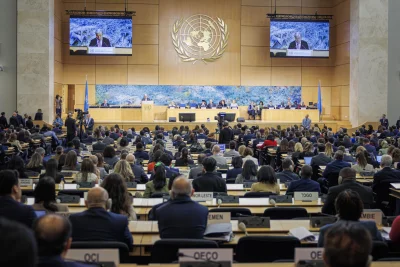
The U.N. Human Rights Council adopted a resolution condemning North Korea’s human rights violations during a session in Geneva Monday. The Council’s 61st session opened on Feb. 23, as seen in this file photo. File Photo by Valentin Flauraud/EPA

SEOUL, March 31 (UPI) — The United Nations Human Rights Council adopted a resolution condemning North Korea’s human rights violations, with South Korea joining 49 other countries as a co-sponsor despite speculation it might withhold support as it seeks to improve relations with Pyongyang.

The resolution was adopted by consensus at the Council’s 61st regular session Monday in Geneva. It expresses “deep concern about the systematic, widespread and gross human rights violations in the Democratic People’s Republic of Korea [and] the pervasive culture of impunity and lack of accountability for such violations.”

The measure urges Pyongyang to undertake sweeping reforms, including dismantling political prison camps, ending forced labor and ensuring freedom of expression and movement.

The Council has adopted a North Korean human rights resolution every year since 2003.

South Korea had reportedly weighed opting out of co-sponsorship this year, as the administration of President Lee Jae Myung pursues renewed engagement with the North and seeks to ease tensions on the Korean Peninsula.

However, Seoul ultimately decided to join as a co-sponsor “following in-depth consultations among relevant government agencies,” Foreign Ministry spokesman Park Il said at a press briefing Tuesday.

He pointed to the resolution’s references to humanitarian issues such as abductions and reunions for separated families, as well as language supporting dialogue and engagement.

“It was by taking all these aspects into account that we decided to participate as a co-sponsor,” Park said.

South Korea also backed a similar U.N. resolution at the General Assembly in November. Seoul had co-sponsored such measures from 2008 through 2018, but stepped back during a period of inter-Korean detente between 2019 and 2022 under then-President Moon Jae-in.

The latest resolution comes as Seoul weighs how to balance engagement with Pyongyang against pressure to address its human rights record.

President Lee has taken conciliatory steps since taking office in June, including restricting activist groups from sending propaganda leaflets across the border.

Last week, Human Rights Watch and more than two dozen organizations and individuals urged Lee’s government to continue supporting the resolution, warning in an open letter that recent policy moves “signal a troubling shift away from support for the victims of the North Korean government repression.”

“Sustainable peace on the Korean Peninsula cannot be achieved by excluding human rights,” the letter said. “Dialogue and engagement need to go hand in hand with the protection of human rights and accountability.”

North Korea has long rejected such resolutions as hostile acts, accusing the United Nations and Western countries of using human rights as a pretext to undermine its government.

Speaking at a session ahead of the vote Monday, North Korea’s deputy permanent representative to the United Nations in Geneva, Kang Myong Chol, said Pyongyang “categorically rejects” the measure.

“We condemn it as a falsified document motivated by ulterior political objectives of undermining the dignity of my country and discrediting its ideology and system,” Kang said.

A recent report by the U.N. special rapporteur found that the country’s human rights situation has “shown no improvement” over the past decade and in many cases has worsened, despite limited engagement with international mechanisms.

The report cited persistent restrictions on movement, expanded surveillance and the continued use of forced labor, as well as growing difficulty for citizens attempting to leave the country.

The resolution was adopted without participation from the United States, which withdrew from the Human Rights Council after President Donald Trump signed an executive order ending U.S. membership in February 2025.

Source link

Israel says four soldiers killed as army pushes deeper into south Lebanon | Israel attacks Lebanon News

Hezbollah attempts to make Lebanon ground invasion ‘costly’ for Israeli army as it continues its advance.

The Israeli military has said four soldiers were killed in combat in southern Lebanon, where its forces are clashing with Hezbollah fighters after launching a ground invasion of the country.

An army statement on Tuesday named three soldiers from the same battalion who “fell during combat”. In a separate statement, it said another soldier had been killed in the same incident and two others wounded, without naming them.

Recommended Stories

list of 3 itemsend of list

Ten Israeli soldiers have been reported killed since fighting between Israel and Hezbollah flared up on March 2, following a United States-Israeli joint attack on Iran. More than 1,200 people have been killed in Israeli attacks on Lebanon, according to the Lebanese Ministry of Public Health, and more than a million displaced.

This comes a day after the United Nations Interim Force in Lebanon (UNIFIL) said two peacekeepers were killed “when an explosion of unknown origin destroyed their vehicle” near the southern Lebanese village of Bani Haiyyan. Another peacekeeper was killed by a projectile on Sunday near the southern Lebanese village of Aadchit el-Qsair.

Israeli Prime Minister Benjamin Netanyahu on Monday ordered the military to expand its invasion in southern Lebanon, pushing deeper to extend what he calls a “buffer zone” reaching the Litani River.

Israel’s far-right ministers have urged Netanyahu to annex southern Lebanon, as the military destroys bridges and homes to cut the area off from the rest of the country.

Al Jazeera’s Lebanon correspondent Zeina Khodr said Monday night marked a new escalation as Israel opened a new front in Lebanon’s Bekaa Valley, targeting roads that link towns known to be Hezbollah strongholds and strategic supply lines for the group.

“In the past weeks, [the Israeli army] hit bridges over the Litani, now they are trying to isolate the west Bekaa from southern Lebanon,” Khodr said, reporting from Beirut.

“Hezbollah Secretary-General Naim Qassem made it very clear they know the imbalance of power. They are not going to be able to stop this invasion, and the Israeli army will most likely reach until the Litani River, but they will not make it easy for them to consolidate control,” she continued.

“What Hezbollah is trying to do is make this a costly war for Israel.”

The escalation in Lebanon comes amid the ongoing US-Israel war on Iran, which has killed more than 1,340 people since February 28.

The Israel Hayom newspaper on Monday reported that Netanyahu told senior US officials that any future agreement between the US and Tehran would not stop Israel’s war in Lebanon.

Israel’s far-right Minister of Finance Bezalel Smotrich last week said in an Israeli radio interview that the war in Lebanon “needs to end with a different reality entirely”, which includes a “change of Israel’s borders”.

Source link

What can nations do to make up for the ongoing energy shortfall? | US-Israel war on Iran

The Middle East conflict has cut off 20 percent of the world’s fuel supply. Countries are scrambling for alternatives.

The disruption in the Strait of Hormuz has cut access to one-fifth of the world’s oil and gas supply, leaving many countries scrambling for alternatives.

So what can they rely on to make up for the shortfall in a quick time?

Many Asian countries are turning to coal, reopening shuttered plants and expanding production.

Policymakers say immediate energy needs supplant environmental concerns.

Others are hoping to turn to renewables. Solar power is now the cheapest form of electricity in many parts of the world. But renewables, especially wind, have faced hostility from the Trump administration.

Source link