struggle

Dodgers struggle at the plate and suffer first loss of season

From Maddie Lee: A fastball up and off the plate to Guardians left-handed hitter Steven Kwan was an inauspicious beginning to Dodgers right-hander Roki Sasaki’s season debut.

The arm-side miss fell in line with a persistent spring-training pattern for Sasaki, who struggled with command from his first Cactus League start through his Freeway Series appearance last week.

Over the course of a seven-pitch strikeout, however, Sasaki adjusted — something he failed to do during game action this spring.

“I actually didn’t have confidence at all before this game started,” Sasaki said through an interpreter Monday. “But I was just focusing on doing what I can control.”

Go beyond the scoreboard

Get the latest on L.A.’s teams in the daily Sports Report newsletter.

In the Dodgers’ 4-2 loss Monday, Sasaki’s first start of the season was something of a best-case scenario. He held the Guardians to one run and four hits in four-plus innings. And the biggest difference from his spring training struggles was he issued just two walks.

The Dodgers squandered the effort with a lack of offense, in their first loss of the season.

Sasaki will have more to prove against stronger offenses than Cleveland’s. But his performance at least suggested that the Dodgers’ faith in him wasn’t misplaced.

“We know he can do it here, and especially now that his velocity is back to closer to where it used to be,” Dodgers general manager Brandon Gomes said last week. “I feel like he puts us in a great position to win.”

Continue reading here

Dodgers-Guardians box score

MLB scores

MLB standings

LeBron James gets his 125th triple-double

Lakers star LeBron James, left, stands next to his son and Lakers guard Bronny James at Crypto.com Arena.

Lakers star LeBron James, left, stands next to his son and Lakers guard Bronny James before a win over the Washington Wizards on Monday at Crypto.com Arena.

(Robert Gauthier / Los Angeles Times)

From Broderick Turner: The Lakers followed the lead of their oldest member, the triple-double producing LeBron James, in dispatching the Wizards 120-101 at Crypto.com Arena on Monday night.

Two days off between games left James looking spry, with lob dunks and dunks on the fast break contributing to his 21 points, 12 assists and 10 rebounds. James was eight for 16 from the field in notching his third triple-double of the season and the 125th of his 23-year NBA career, ranking him fifth all time.

At 41 years and 90 days old, James once again became the oldest player in league history to record a triple-double, passing his previous mark (41 years, 79 days).

“I mean, I’ve had moments more this year and last year that I’ve enjoyed more in the moment,” James said. “It’s pretty cool to know that I’m at this point in my career (and) I’m still able to do those things, man. It’s super dope. It’s super humbling. And I just try to put the work in and continue to put the work in and those are the results of it.”

Continue reading here

Lakers-Wizards box score

NBA scores

NBA standings

UCLA has some homework before Final Four

UCLA guard Kiki Rice dribbles under pressure from Texas guard Rori Harmon on Nov. 26 in Las Vegas.

UCLA guard Kiki Rice dribbles under pressure from Texas guard Rori Harmon on Nov. 26 in Las Vegas.

(Ian Maule / Getty Images)

From Marisa Ingemi: UCLA finally knows who it will face in the Final Four in Phoenix this week.

A day after taking down No. 3-seed Duke in the Elite Eight, the Bruins learned on Monday they will face fellow No. 1-seed Texas on Friday, the only team to beat them all season.

Texas (35-3) defeated UCLA 76-65 on Nov. 26, when Rori Harmon put up a game-high 26 points on nine-of-15 shooting from the floor.

Since their Final Four debut ended with a 34-point loss to UConn last season, the Bruins have been on a mission to prove themselves. They faced their first adversity of the tournament during Sunday’s win over Duke when they trailed at the half, and now they’ll get a true test against the Longhorns.

Continue reading here

NCAA women’s basketball bracket

Sean McVay hopes Puka Nacua will learn from incidents

Rams wide receiver Puka Nacua warms up before a wild-card playoff game against the Carolina Panthers.

Rams wide receiver Puka Nacua warms up before a wild-card playoff game against the Carolina Panthers in January.

(Eric Thayer / Los Angeles Times)

From Gary Klein: Rams coach Sean McVay could not help repeating himself when asked about star receiver Puka Nacua.

“I trust this kid’s heart,” McVay said three times Monday at the NFL owners meetings.

But do the Rams trust Nacua, who has been at the center of several off-the-field situations, enough to break the bank with a massive extension?

Last week, a woman filed a civil lawsuit against Nacua, alleging that on New Year’s Eve he made an antisemitic statement during a group dinner and later bit her shoulder. Nacua’s attorney told The Times before the lawsuit was filed that Nacua “denies these allegations in the strongest possible terms,” and that Nacua would “pursue all available legal remedies in response to these false and damaging statements.”

Continue reading here

How to buy tickets for L.A. 2028 Olympics

Dr. Dre and Snoop Dogg perform at the Los Angeles 2028 Olympic Games handover celebration in Long Beach.

Dr. Dre and Snoop Dogg perform at the Los Angeles 2028 Olympic Games handover celebration in Long Beach in August 2024.

(Emma McIntyre / Getty Images for LA28)

From Thuc Nhi Nguyen: There’s still more than two years remaining before the Olympics return to L.A., but fans can lock in their seats this week when tickets officially go on sale.

The virtual ticket box opens April 2 for locals in Southern California and Oklahoma. LA28 is planning to make 14 million tickets available for the Games, which would break the record for total tickets sold set by Paris 2024. The L.A. Games already attracted a record number of ticket registrations, topping 5 million fans from 197 countries and territories for the first drop.

Continue reading here

Angels fall to Cubs for third straight loss

From The Associated Press: Edward Cabrera pitched six shutout innings, Ian Happ hit a solo homer and the Chicago Cubs beat the Angels 7-2 on Monday night.

Cabrera gave up one hit and walked one in his Chicago debut, delighting the crowd of 36,702 on a picturesque night at Wrigley Field. The 6-foot-5 right-hander was acquired in a January trade with Miami.

Carson Kelly and Moisés Ballesteros each drove in two runs for the Cubs (2-2) in the opener of a three-game series.

Continue reading here

Angels-Cubs box score

Ducks lose in overtime to Toronto

From the Associated Press: John Tavares redirected a shot from Morgan Rielly into the net with five seconds left in overtime to lift the Toronto Maple Leafs to a 5-4 come-from-behind victory over the Ducks in a fight-marred game Monday night.

The Leafs overcame a 3-1 deficit with three goals in the third period, including Rielly’s snap shot from the high slot that beat Ducks goalie Ville Husso stick-side to give Toronto a 4-3 lead with three minutes left in regulation.

But Leo Carlsson, who hobbled to the locker room after taking a hard hit and falling to the ice in the first minute of the third, gathered a loose puck near the left circle and flicked a shot past Toronto goalie Anthony Stolarz to make it 4-4 with 1:39 left.

Tavares added a first-period goal, and Stolarz stopped 28 of 32 shots for Toronto, which took the ice about 1½ hours after general manager Brad Treliving was fired near the end of his third season, with the Maple Leafs on the verge of being eliminated from the playoffs for the first time in a decade.

Continue reading here

Ducks-Maple Leafs box score

NHL scores

NHL standings

Las Vegas to host another Super Bowl

From the Associated Press: The Super Bowl will return to Las Vegas in 2029 for the second time after NFL owners voted Monday to award the nation’s gambling and entertainment capital the big game.

Las Vegas getting the Super Bowl back seemed only like a matter of time after Kansas City defeated San Francisco 25-22 in overtime at Allegiant Stadium in February 2024.

Commissioner Roger Goodell all but gave the return his blessing after the first Super Bowl in a city the league long shunned because of concerns about legalized sports betting.

Continue reading here

Former USC star Joey Browner dies

Joey Browner wears a purple blazer and speaks at a podium on a football field next to a framed Vikings jersey with his name

Former Minnesota Vikings safety Joey Browner talks during his induction ceremony to the team’s ring of honor on Oct. 27, 2013, in Minneapolis.

(Jim Mone / Associated Press)

From Chuck Schilken: Joey Browner, a star defensive back at USC and a six-time NFL Pro Bowl selection, has died. He was 65.

“The Vikings are mourning the loss of Ring of Honor member Joey Browner,” the team said Sunday in a statement. “Browner will be deeply missed by former coaches and teammates, as well as many others he impacted throughout his life.”

The Vikings added in a separate post: “He helped define what it is to be an NFL safety.”

No cause of death was given. In August, former Minnesota quarterback Tommy Kramer organized a fundraiser for Browner, who Kramer said was “battling through some serious health issues.”

Continue reading here

This day in sports history

1923 — The Ottawa Senators of the NHL completes a two-game sweep of the WCHL’s Edmonton Eskimos with a 1-0 victory to win the Stanley Cup for the third time in four years. Harry “Punch” Broadbent scores the goal.

1931 — Notre Dame football coach Knute Rockne and seven others die in a plane crash in a wheat field near Bazaar, Kansas. During his 13 years at Notre Dame, the 43-year-old coach, led the “Fighting Irish” to 105 victories, 12 losses, five ties and three national championships.

1968 — The American League’s new franchise in Seattle chooses Pilots as its nickname.

1973 — The Philadelphia Flyers tie an NHL record for most goals in one period, scoring eight goals in the second period of a 10-2 win over the New York Islanders.

1973 — Ken Norton scores a stunning upset by winning a 12-round split decision over Muhammad Ali to win the NABF heavyweight title. Norton, a 5-1 underdog, breaks Ali’s jaw in the first round.

1975 — UCLA beats Kentucky 92-85 for its 10th NCAA basketball title under head coach John Wooden. Wooden finishes with a 620-147 career record after announcing his retirement two days earlier.

1976 — Cleveland Cavaliers beat Jazz to clinch club’s first ever NBA playoff berth.

1980 — Larry Holmes scores a TKO in the eighth round over Leroy Jones to retain his WBC heavyweight title in Las Vegas.

1980 — Mike Weaver knocks out John Tate in the 15th round to win the WBA heavyweight title in Knoxville, Tenn.

1982 — NBA and NBAPA reach 4-year agreement on return for minimum & maximum payrolls, the first of its kind in team sports.

1984 — Mike Bossy becomes first player in NHL history to record 7 straight 50 goal seasons.

1985 — Old Dominion beats Georgia in the 4th NCAAW National Championship.

1986 — Freshman center Pervis Ellison hits two free throws with 27 seconds left to seal Louisville’s 72-69 victory over Duke in the NCAA basketball championship.

1990 — 20-year old C Joe Sakic becomes the youngest player in NHL history to score 100 points in a season

1991 — Tennessee edges Virginia 70-67 in overtime for its third NCAA women’s basketball title. It’s the first overtime in the NCAA’s 10-year history.

1991 — Amy Alcott wins the Dinah Shore golf tournament with a record eight-shot victory over Dottie Mochrie.

1994 — Chicago White Sox assigns former NBA superstar Michael Jordan to the Birmingham Barons of Class AA Southern League.

1995 — Major league baseball players end their strike.

1997 — Martina Hingis becomes the youngest No. 1 player in tennis history. The 16-year-old Swiss sensation, who claimed her fifth title of 1997 at the Lipton Championships on March 29, supplants Steffi Graf in the WTA Tour rankings.

1998 — Expansion clubs, Tampa Bay Devil Rays and Arizona Diamondbacks both suffer losses in their MLB debuts.

2002 — UConn women’s basketball team beat Oklahoma, 82-70; Huskies conclude perfect season (39-0).

2002 — Andre Agassi wins his 700th career match and captures his second straight Key Biscayne Title.

2005 — Tarence Kinsey hits a 3-pointer with 1.3 seconds left to lift South Carolina to a 60-57 victory over Saint Joseph’s for the NIT championship.

2012 — Ray Whitney passes 1,000 career points with a goal and assist in Phoenix’s 4-0 victory over Anaheim.

2013 — In one of the biggest upsets in the history of the NCAA women’s tournament, sixth-seeded Louisville stuns defending national champion Baylor in the regional semifinals, 82-81. It’s the end of a remarkable college career for Baylor’s Brittney Griner, a record-setting 6-foot-8 post player who ended up as the second-highest scoring player in NCAA history.

2013 — Pete Weber ties Earl Anthony by winning his 10th major Professional Bowlers Association title with a 224-179 win over Australian Jason Belmonte in the Tournament of Champions.

2017 — UConn’s record 111-game winning streak comes to a startling end when Mississippi State pulls off perhaps the biggest upset in women’s basketball history, shocking the Huskies 66-64 on Morgan William’s overtime buzzer beater in the national semifinals.

2018 — Anthony Joshua beats Joseph Parker by unanimous decision to become a three-belt world heavyweight boxing champion. Joshua adds Parker’s WBO belt to his WBA and IBF titles, and moves within one belt of becoming the first undisputed champion since Lennox Lewis in 2000.

Compiled by the Associated Press

Until next time…

That concludes today’s newsletter. If you have any feedback, ideas for improvement or things you’d like to see, email me at houston.mitchell@latimes.com. To get this newsletter in your inbox, click here.


Source link

A view of America from a train as airports struggle during the shutdown

There’s something melodic about watching the sun rise over a rural stillness broken only by the rhythms of steel wheels on tracks. Or so we tell ourselves.

In this case, being aboard a train at all owed more to politics than poetry.

Congress and President Trump were mired in their latest budget stalemate, one rooted in his immigration crackdown and the tactics of federal forces he has sent to U.S. cities. But this impasse has upended a foundational constant of American life today: easy air travel.

In Atlanta, my hometown airport, cheerfully marketed as the world’s busiest, had descended into organized chaos. Unpaid federal employees called out from work, leaving a diminished security staff to screen travelers frustrated by hours-long waits in line. I wanted to get to Washington for the NCAA basketball tournament. So I eliminated the risk of a missed flight and booked the train overnight and into game day across a 650-mile route.

In this fraught moment in U.S. politics, I slowed down and thought about things we take for granted. Who ever ponders the conveniences of that 20th century innovation, the airplane, that makes 21st century hustle possible? We book and board. An unconscious, first-world flex of modernity. It’s even rarer to grapple with the inconvenience.

My decision had taken me further back, to the 19th century and another defining innovation: the long-distance train.

A 14½-hour weekend train ride is time aplenty to appreciate how completely politics, economics, social strife and fights over identity and belonging have always affected the order of our lives, including how, when and where we move around in these United States. But Amtrak’s Crescent also allowed me to see the expanse of our collective experience.

I traversed the urban, suburban and rural breadth of East Coast America. I learned how other travelers came aboard. And in that, I found the portrait of people, past and present, who refuse to be as paralyzed as some of their elected leaders.

Convenience on the railways

There is little glamour late night in a crowded Amtrak station. Children are up past bedtime and tended by frazzled parents. Older adults struggle with luggage and stairs.

Airports are not red-carpet affairs either, of course. But there is a certain cache to Delta’s Atlanta-Washington flights. They typically take about two hours gate to gate. They often are slotted at a midpoint gate of the concourse nearest the main terminal. That is almost certainly a nod to members of Congress who use it, but who have lost some airline perks during this extended partial shutdown — which as of Sunday is the longest government shutdown in U.S. history.

In normal circumstances I can get from my front porch to Capitol Hill or downtown in as little as 4½ hours. Security lines these days could at least double my overall air travel time.

The train is still longer, and time is money, we are taught. But certainty has value, too, even if it means an 11:29 p.m. departure. And at the Amtrak station, there were no standstill lines, no Transportation Security Administration agents, no ICE agents as stand-ins.

Passengers who arrived mere minutes before departure made it on board and found seats quickly — assigned in boarding order, not predetermined zones that yield jammed aisles. There’s no in-seat service or satellite TV. But even coach seats, the lowest Amtrak tier, are as spacious as airline first-class — and there is Wi-Fi, so it’s not the 19th century or even 20th century after all.

On board, I heard one crew member joke, “I’m no TSA agent.”

The pathways of history

As a boy in rural Alabama, I counted train cars and wondered where they were headed. I’ve since read diary entries and letters from my grandmother and her sisters recounting World War II-era weekend trips to Atlanta.

The South’s largest city has a historical hook too. Originally named “Terminus,” Atlanta developed in the antebellum era as a critical intersection of north-south and east-west rail routes. That is what drew Gen. William Tecumseh Sherman for one of the Civil War’s seminal campaigns that helped defeat the Confederacy.

A century after the Civil War, Delta chose Atlanta for its headquarters rather than Birmingham, Ala., which was the larger city as of the 1960 census. The company’s decision was tied up in tax breaks for the airline, named for its crop duster origins in the Mississippi Delta region. According to some interpretations, Delta’s decision was made easier because of the more overt racism of Alabama’s and Birmingham’s leaders as they defended Jim Crow — a code that, among other acts, allowed states to segregate the passenger trains that predated Amtrak.

On this night, I heard many languages and accents, notable given the role that immigrant labor played in building the U.S. rail system and especially striking now with immigration — legal and illegal — at the forefront in Washington, my destination. I saw faces that reflected U.S. pluralism, a different mix from what my grandmother and aunts would have seen a lifetime ago.

The array of voices celebrated the freedom and ease of rail travel. So did Agatha Grimes and her friends after they boarded in Greensboro, N.C., as part of a long weekend trip to celebrate her 62nd birthday.

“I got stuck in the Atlanta airport last week,” Grimes said, as her group laughed together in the dining car. “It’s just nuts.”

Beretta Nunnally, a self-described “train veteran” who organized their trip, said, “There’s no worry about parking. No checking bags. You come to the station, you get where you‘re going, and you come home.”

An era for planes, trains and automobiles

Still, that is not as easy in the United States as it once was.

Just as politics, economics and subsidies helped expand U.S. railroads, those factors diminished the network as auto manufacturers, oil companies, road builders and, finally, airline manufacturers and airlines commanded favor from politicians and attention from consumers.

Riding hours across rural areas, I noticed the junkyards where kudzu and chain-link fencing framed rows of rusted automobiles. I saw the farmland and equipment that helps feed cities and the rest of the nation. I awoke to see the night lights of office towers in Charlotte, N.C., and its NFL stadium. I saw vibrant county seats — and I thought of countless other towns like them that are not thriving as they sit disconnected from passenger rail and far from the Eisenhower-era interstate system that we crossed multiple times on our way.

In each setting, voters — conservatives, liberals, the extremes and betweens — have chosen their representatives, senators and a president who now set the nation’s course.

When I arrived in Washington, I paused to enjoy Union Station’s grand hall and its Beaux Arts appeal, and I lamented how much splendor has been lost because so many striking U.S. terminals have been razed. I stepped outside and looked up at the Capitol dome.

While I had slept, the Senate managed a bipartisan deal to fund all of the Department of Homeland Security except immigration enforcement. As I continued northward, House Republican leaders rejected it. The stalemate continued.

The president, however, took executive action to pay TSA workers, and their paychecks may resume within days, though long airport lines may continue awhile longer.

I was a weary traveler but renewed citizen. I had a game to get to. And the train rolled on.

Barrow writes for the Associated Press.

Source link

Living in the dark: Gaza’s struggle for electricity | Israel-Palestine conflict News

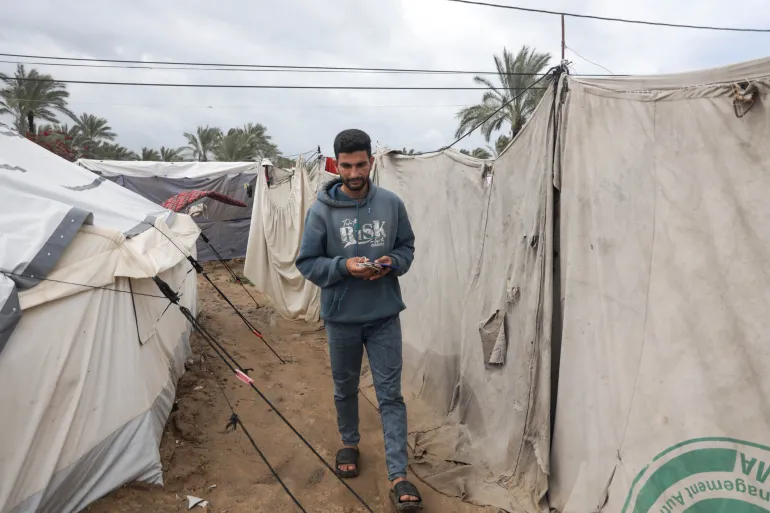
Deir el-Balah, Gaza Strip – Every morning, Abdel Karim Salman begins his routine by heading out carrying his own phone and his wife’s phone, both completely drained of charge. He walks to a nearby charging point to plug them in and recharge them again.

Throughout the night, Abdel Karim relies entirely on the torches from the phones to light the inside of the tent he lives in with his family in central Gaza’s Deir el-Balah.

Recommended Stories

list of 3 itemsend of list

Abdel Karim, 28, a former civil engineer at the Beit Lahiya municipality in northern Gaza, was displaced to Deir el-Balah a year and a half ago with his wife and two children, along with about  30 members of his extended family.

His family home was completely destroyed on October 9, 2023, in the first few days of Israel’s genocidal war on Gaza.

Abdel Karim and his family have been on a difficult journey of displacement since then, with little in the way of normality, and in particular, a regular source of electricity for a bulb in his tent.

So he looks for alternatives to light up the structure, namely the phones, despite the rapid battery drain caused by keeping the torch function on.

“I charge my phone and my wife’s phone, and we use them for lighting at night, especially since my children are under five years old and they get scared if they wake up in the dark,” he says.

Abdel Karim says that the suffering caused by electricity shortages in Gaza is one of the largest “silent” forms of suffering that receives little attention.

For Abdel Karim, the charging process itself has turned into a daily, exhausting burden.

He walks between 150 and 200 metres every day to reach a charging point, paying between two and four shekels ($0.65 to $1.30) per charging session, twice a day.

“That means about eight to 10 shekels ($2.55 to $3.20) per day just for charging phones,” Abdel Karim explains, equivalent to approximately 270 to 300 shekels ($86 to $95) per month, a large amount given the lack of income among displaced families in Gaza amid the territory’s war-driven economic crisis.

“Many days and nights we sleep in darkness inside our tent. When we can’t charge the phones, they turn off, and we are unable to recharge them.”

Abdel Karim Salman heads daily to the charging station to charge his phone and his wife’s phone, which they use as a source of light in their tent throughout the night [Abdelhakim Abu Riash/ Al Jazeera]
Abdel Karim Salman heads daily to the charging station to charge his phone and his wife’s phone, which they use as a source of light in their tent throughout the night [Abdelhakim Abu Riash/Al Jazeera]

Few options

With municipality-supplied electricity absent for two years in Gaza, several temporary alternatives have emerged, such as solar-powered lamps, but they remain unaffordable for most residents, having increased tenfold to about 300 shekels ($95) during the war.

As for solar energy systems, they are even more expensive, reaching $420 per panel, and with the additional cost of a battery – about $1,200 – and an inverter. All these items are also scarce due to severe Israeli restrictions on their entry into the Gaza Strip since the beginning of the war.

For Abdel Karim, who lost his job soon after the war began, those sums are out of his reach.

Among the alternative solutions introduced during the war are private generator-based electricity systems operating on diesel fuel.

However, those are also unaffordable for many, and their services have fluctuated due to irregular fuel supplies through the crossings.

And so, with most options simply too expensive, that leaves many in Gaza in the same boat as Abdel Karim.

The impact of the power cuts is not limited to lighting or charging, but extends to every detail of daily life, especially for families with children.

“There is no refrigerator, no washing machine … even baby milk cannot be stored for more than two or three hours,” Abdel Karim explains, as he remembers his previous life, when his home was filled with electrical appliances and reliable power.

“The phone charging socket used to be right beside my bed. I could plug it in whenever I wanted. Today, that has become a dream inside this tent,” Abdel Karim adds.

He also says his children have been psychologically affected, especially his eldest son, due to the lack of any means of electronic entertainment or distraction from his grim surroundings.

“There is no TV or screen. He keeps asking for the phone all the time just to calm down, but that also needs charging. Everything is dependent on electricity.”

According to Abdel Karim, his suffering is not an exception. He believes almost all of the people in Gaza are living the same reality, noting that even families in nearby camps who tried to pool resources to buy energy systems have been unable to afford them.

“We hope God brings relief … because we are truly left without any solutions, as if we were abandoned in the desert.”

Abdel Karim Salman, his wife and his two children
Abdel Karim Salman lives with his wife and two children in a tent [Abdelhakim Abu Riash/Al Jazeera]

Longstanding problem

On October 7, 2023, Hamas launched an attack on southern Israel, and Israel then began its war on Gaza.

More than two years on, Gaza has been decimated by Israeli attacks – on top of the more than 75,000 Palestinians killed.

But even before the war, Gaza faced daily rolling blackouts due to limited power imports from Israel and fuel shortages.

Israel, despite withdrawing its illegal settlements from Gaza in 2005, continued to control access into and out of the Palestinian enclave, and repeatedly attacked it.

And so, even in normal conditions, most households only received a few hours of electricity per day, relying on a fragile mix of imported supply and Gaza’s one power plant.

The situation escalated sharply after October 7, when Israel declared a “complete siege” on Gaza, cutting electricity supply and blocking fuel imports.

Within days, Gaza’s power plant shut down due to fuel depletion, and by October 11, 2023, the territory entered a full electricity blackout, according to United Nations agencies.

With no fuel entering and transmission lines cut, homes, hospitals, water systems and communication networks lost reliable access to power, shifting to limited and increasingly unsustainable generator use.

Since then, Gaza’s electricity infrastructure has continued to deteriorate due to both fuel shortages and widespread physical destruction of the grid. Generators remain the primary alternative but are severely constrained by fuel scarcity, affecting essential services such as healthcare, water production and telecommunications.

During the time between 2025 and 2026, Gaza’s power system is widely described as effectively non-functional, with electricity access fragmented, inconsistent and largely dependent on emergency solutions rather than a stable grid.

An opportunity

The severe electricity crisis has created an indirect source of income for Jamal Musbah, 50, who runs a mobile phone charging station powered by solar energy and a generator line.

Before the war, Jamal worked as a farmer and owned two agricultural plots on the eastern borders of Deir el-Balah. Today, they have been bulldozed and fall under Israeli control.

His charging station has instead become his main source of income, supporting his eight children.

“I had an energy system consisting of six panels, batteries, and a device, which I used for pumping water and irrigating the remaining land around my house before the war,” Jamal says to Al Jazeera.

As an alternative income source after the war and the electricity blackout in Gaza, Jamal repurposed his solar system to provide basic phone charging services to residents, though this came with major challenges.

“The demand for charging was extremely high, and my batteries were exhausted within the first months, as electricity became very scarce at home,” he adds.

However, things worsened when a neighbouring house was targeted, destroying four of his six solar panels, significantly reducing his capacity and income.

At the beginning of the service, Jamal also offered food refrigeration services alongside phone and battery charging, but after the damage and battery depletion, he had to stop those services.

“We used to charge about 100 to 200 phones daily. Now we only manage 50 to 60 at most due to reduced efficiency of the solar panels,” Jamal says, attributing this also to weather conditions, clouds and the winter season, when solar efficiency drops significantly.

“In winter, you look for alternatives to solar panels and turn to generators that barely work … the electricity crisis makes you feel like you are running in a never-ending cycle of suffering.”

His charging station now operates with a small system of two panels and one battery.

People from nearby areas, including university students and displaced families, rely on it due to a lack of alternatives and the inability to afford generator-based electricity subscriptions.

“My sons are university graduates and earn their living from this station. We charge 1 to 2 shekels per phone.”

Even though Jamal is able to make some money out of the crisis, he ultimately faces the same hardships as others in Gaza do.

“Economic hardship has affected all of us … even basic services like phone charging have become a heavy burden. There are no local solutions to this crisis.”

“The only real and lasting solution is the official restoration of electricity to the Gaza Strip.”

Source link

Amid ruins, Palestinians struggle to preserve Gaza’s historic markets | Israel-Palestine conflict News

Khan Younis, Gaza Strip – Historic landmarks often withstand centuries of volatile change, but when rockets and missiles fall, even the most enduring stones become fragile.

For generations of families in Gaza’s southern city of Khan Younis, the Grain Market was the first stop when they went shopping.

Recommended Stories

list of 3 itemsend of list

Reaching it meant walking past the historic Barquq Castle, a centuries-old structure dating back to 1387 and the very foundation of Khan Younis.

But for residents, the castle was more than an old monument; it was a familiar landmark marking the entrance to one of the city’s liveliest commercial spaces.

The aromatic scent of spices and dried herbs would accompany any walk towards the Grain Market.

But that was before Israel’s genocidal war on Gaza began. Israeli attacks inflicted heavy damage on the Grain Market and the Barquq Castle. The market has now been reduced to shattered alleys, with dust and heavy silence filling the air.

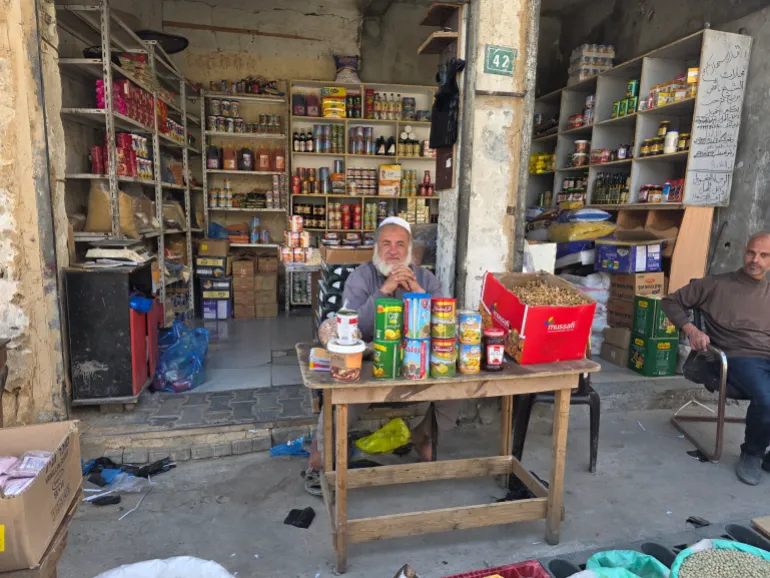
Sitting in his store along a row of damaged old shops, 60-year-old Nahed Barbakh, one of the city’s oldest and most well-known traders of staple food supplies, spent decades watching customers stream through the market. Now, only a handful pass by his shop.

“I’ve been in this spot for decades, day in and day out, watching people bring life to this place,” Nahed said. “Look at it now – it’s empty. These days, there shouldn’t even be space to walk because of the crowds preparing for Eid.”

He paused before gesturing towards the nearby castle.

“We always felt the weight of history here because we are so close to Barquq Castle. Now that history and life itself have been struck by the occupation.”

But Israeli fire did not take into account the market’s historic status. The Grain Market, long considered the economic heart of Khan Younis, was also among the first sites of destruction during the second month of Israel’s genocidal war on Gaza. More than two years of Israeli bombardment and repeated waves of displacement have left the market unrecognisable.

“The occupation killed many of our friends who worked here,” Nahed said quietly. “Those who survived have been financially broken. That’s why you see most of these shops are still closed.”

He pointed to some shelves behind him.

“My shop used to be fully stocked with goods at its high capacity. We even had extra warehouses to supply what people needed, especially during the busiest seasons.”

Before he could finish his sentence, a deafening blast interrupted him — the sound of an Israeli tank fire.

“And this is the biggest reason people are afraid to return,” Nahed said abruptly. “The yellow line is only a few hundred metres away from this street. At any moment, bullets can reach here.”

The yellow line is the name given to the demarcation line behind which Israeli forces withdrew as part of the first phase of October’s ceasefire agreement. It effectively divides Gaza into two, and Palestinians have repeatedly been shot for approaching it.

The yellow line has divided Khan Younis, dramatically reshaping the city’s geography. Israel has repeatedly shifted the line, moving it deeper into Gaza.

The Grain Market, once firmly at the centre of urban life, now sits close to the yellow line.

What used to be the city’s commercial heart has effectively turned into its edge, where people hesitate to walk, leaving the revival of daily commerce life a distant prospect.

Nahed Barbakh, 60, shop owner and trader, sits at a table in front of his store
Nahed Barbakh, a 60-year-old shop owner and trader, sits at a table in front of his store [Ahmed al-Najjar/Al Jazeera]

Centuries of endurance

The Grain Market traces its origins to the late 14th century, when the Mamluk ruler Younis al-Nawruzi established Khan Younis in 1387 as a strategic stop along the trade route linking Egypt and the Levant.

Built as an extension of the Barquq Castle, which functioned as a caravanserai for travelling merchants, the market became a central commercial hub where traders and travellers exchanged goods, moving between Africa, the Levant and beyond.

The Grain Market occupies roughly 2,400sq metres (25,830sq feet). Its single-floor shops line a central street running east to west, intersected by narrow alleys branching towards smaller courtyards. The buildings preserve elements of their original construction, including sandstone walls and traditional binding materials that have survived centuries of repairs and modifications.

Over time, the market evolved into the primary commercial centre of Khan Younis, adapting to modern commerce while retaining its historic character.

But today, many of its shops stand damaged or shuttered.

According to Gaza’s Ministry of Tourism and Antiquities, the market is now among more than 200 heritage sites damaged in attacks by Israeli forces across the Gaza Strip since October 2023.

At the southern end of the Grain Market, where rows of vegetable stalls once overflowed with fresh produce, only one makeshift stand has opened.

Om Saed al-Farra, a local, stepped cautiously towards the stall, inspecting the small piles of vegetables laid out on a wooden crate. The expression on her face reflected more than surprise; it was disbelief at what the market had become.

“The market is deplorable now,” she said. “There used to be many stalls here and many choices for people.”

She gestured towards the empty stretch of the market’s vegetable section, once one of its busiest corners.

“These days were once filled with extensive joyful preparations for Eid, when families crowded the market to shop for food and essentials,” al-Farra said. “Now the market feels unusually gloomy, its stalls largely empty and its familiar vibrance gone. Everything is limited. Even if you have money, there are hardly any places left here for us to buy from.”

Rows of damaged and closed shops in the market
Rows of damaged and closed shops in Khan Younis’s Grain Market [Ahmed al-Najjar/Al Jazeera]

Economic collapse under fire

Although parts of the market’s infrastructure remain physically standing, many traders have not returned.

According to Khan Younis Mayor Alaa el-Din al-Batta, the Grain Market was once one of the city’s most vital economic lifelines.

“Just as it once connected continents, even under blockade, it continued to connect people across Gaza,” al-Batta said. “It holds a deep place in the memory of our residents. But once again, the occupation has brought destruction, targeting both our history and a critical lifeline for the people.”

For nearly two decades, Israel has controlled Gaza’s land crossings, airspace and coastline under a strict blockade. Since the genocide began in October 2023, restrictions have tightened further, pushing businesses and trade to collapse.

In a narrow western alley where scattered stones cover the ground, two cloaks hung outside a small shop. Inside, 57-year-old tailor Mohammad Abdul Ghafour leaned over his sewing machine, carefully stitching a torn shirt.

His shop was the only one open in the grey alley.

“I’ve been here since childhood,” Abdul Ghafour said. “My father opened this shop in 1956, and I grew up learning the profession right here in the market.”

Israel’s bombardment not only destroyed the place where he worked; it also killed dozens of his family members.

“On December 7, 2023, Israel committed a horrific massacre against my family,” he said. “I lost my father, my brothers, and more than 30 relatives.”

Burying his family members was only the beginning of the long, painful separation from the market and his shop.

“We were forced into displacement more than 12 times. I had many chances to leave as two of my children live in Europe,” Abdul Ghafour said. “But all I could think about was returning to my shop.”

When Israeli forces withdrew to the yellow line, he came back alone.

“I cleaned the street by myself. And if I had to do it again, I would. Whoever loves his land never abandons it,” he said. “I charge my batteries for my machine and come every day. My return encouraged some residents to come back too. But people still need shelter, water, and basic services before more families return.”

Resident Mohammad Shahwan stood in Nahed’s shop checking a list of items he hoped to buy.

“We left the crowded al-Mawasi as soon as we could to return to our damaged home,” he said, referring to the stretch of coastal Khan Younis that thousands of Palestinians have been forcibly displaced to. “But the number of residents here is still very small because of the destruction and lack of services.”

Still, Mohammad Shahwan said he was relieved to find the shop open at all.

“For the first time in two years, we’ll make traditional Eid biscuits,” he said, holding the list of ingredients. “The last two Eids were dark for my family after we lost my 17-year-old son, Salama. He and his aunt were killed by an Israeli strike.”

He could have bought the now-expensive supplies elsewhere, he said, but returning to the Grain Market carried its own meaning. “I wanted to buy them from here, just like we always did.”

Mohammad Abdul Ghafour, 57, Palestinian tailor.
Mohammad Abdul Ghafour, 57, a Palestinian tailor in Khan Younis [Ahmed al-Najjar/Al Jazeera]

Waiting for restoration

According to Mayor al-Batta, restoring the historic market will require a major reconstruction effort.

“The Grain Market needs a comprehensive restoration process to function again,” he said. “So far, our work has only been limited to clearing rubble and delivering limited water supplies for returning residents.”

The rebuilding process will require specialised materials and expert restoration work to preserve what is left of the historic structure. Municipal workers have already collected leftover stones from the ruins in the hope that they can one day be used in rebuilding parts of the market.

But reconstruction remains impossible under current conditions.

“More than five months have passed since the ceasefire began, yet not a single bag of cement has entered Gaza,” al-Batta said.

“We want to restore our historic identity and revive life for our people. But neither can happen while Israeli restrictions and violations continue.”

Source link

Hugo Chávez: Truth as a Form of Struggle

Chávez never shied away from self-criticism and taking responsibility for his actions. (Archive)

In these times when it is once again fashionable to accuse Commander Chávez of mistakes, whether real or imagined. As we mark 13 years since his untimely death on March 5, 2013, I would like to highlight the value of truth in his political actions. Truth was manifest in the responsibility he assumed for his actions; the consistency between his words and deeds; the acknowledgment of his own mistakes, when it is easier for most people to point out the mistakes of others; and his sincere efforts to correct them. To the above, I would add that when he had to make tactical and strategic shifts in the course initially set, Chávez always had the political honesty to explain in detail why he was doing so, and he courageously took responsibility for them before the people.

There are countless examples which can be found in many of his speeches. I will mention just a few. Beginning with the day of his introduction to the Venezuelan people, February 4, 1992: “Unfortunately, for now, the objectives we set for ourselves were not achieved in the capital city, that is, we here in Caracas did not manage to control power… And I, before the country and before you, take responsibility…” Then in the streets and in the 1998 election campaign: “Let’s go to the Constituent Assembly,” and on February 2, 1999, in what would be his first act of government, he signed the decree calling for the constituent process, and we went to the Constituent Assembly.

In April 2002, he surrendered to the coup leaders, without thinking about saving his own “skin”: “I am an imprisoned president; you decide what to do with me.” After his release, with a cross in his hand, he stated that “it was necessary for all sectors of the country to make a greater effort, with all the goodwill we can muster, to be able to live together in peace, accepting the rules of the game.”

In 2005, he called for the Bolivarian Revolution to take on a socialist character. In the 2006 election campaign, he said, “Let’s go for socialism!” and explained in detail why this strategic shift was necessary. He outlined the characteristics of our socialism, 21st-century Bolivarian socialism, which, as he insisted until his last public words, had to be “essentially democratic” or it would not be socialism at all.

In the elections of December 6, 2006, Commander Chávez obtained the highest number of votes and was re-elected. In December 2007, while awaiting the results of the referendum on constitutional reform and hearing reports of a close count, he called a meeting of the party leadership in Miraflores. I said to him at that meeting: “President, let’s wait for the final count, and if we lost, we lost, but if we won, we won.” He replied with a sharp look: “I don’t want a victory like that, let’s go out and acknowledge defeat now.” And that’s what he did.

In September 2010, we won a majority in the National Assembly. Without a doubt, it was a resounding political victory. But Chávez identified a warning sign: in quantitative terms, the difference in votes between Chavismo and the opposition was minimal. Once again, he assumed political responsibility. In January 2011, he published the “Strategic Lines of Political Action,” a deeply self-critical document.

Late May 2011, he told me: “Elías, I feel like something is wrong with me.” June 2011, after undergoing the necessary tests, on national television: “Cancer cells have been detected in my body.” Easter Week 2012, during a mass in Barinas, broadcast live: “We must be aware that I have an illness that limits my life… Christ, give me your cross.”

On the night of December 8, 2012, in a public address, he raised the possibility of not continuing among us and explained in detail the constitutional procedures that would have to be followed if he were to be permanently incapacitated. That day, once again, he decided to tell us the truth, no matter how hard it was:

Some colleagues told me it wasn’t necessary, or have said in recent hours that it wasn’t necessary to say this. In truth, I could have said almost everything I said tonight from Havana… But I believe that the most important thing, what my soul, my heart, and my conscience tell me, the most important thing… has been this, Nicolás. The most important thing.

“The most important thing”: telling the truth, explaining the reality to the people, the decision he had made, and the steps that needed to be taken.

But that political honesty was not just an individual value. It was the political conviction that the people formed a collective wisdom, a conscious body that knew how to understand and draw its own conclusions about situations. That is why he was so careful to keep them informed at all times.

I once heard him say: “There are those who say that you shouldn’t speak plainly to the people, because then the adversary will seize on that truth and manipulate it against you.” That, Chávez said, is to think that the people are mentally eunuchs. The people understand, more often than not, more than some leaders. For Chávez, speaking the truth was always a decisive show of trust and respect for the people.

And “most importantly,” it was also to make clear for posterity his conviction about the democratic path of the revolution he had led:

In all circumstances, we must guarantee the progress of the Bolivarian Revolution, the victorious progress of this revolution, building the new democracy that is here mandated by the people in the Constituent Assembly; building the Venezuelan path to socialism, with broad participation and ample freedom, which are being demonstrated once again in this gubernatorial election campaign, with candidates here and candidates there. Freedom, complete freedom.

With the power of truth, the truth of his project and his life, Chávez managed to accumulate immense political strength based on the moral autoritas he gained by never peddling falsehoods or shirking his responsibilities, much less in defeat or when he made mistakes. That same moral authority comes not only from consistency between words and deeds, but also from trying to act despite difficult circumstances as well as from recognizing and explaining when and why it is not possible to achieve a certain goal. I stand by that way of doing politics. With Chávez forever!

The views expressed in this article are the author’s own and do not necessarily reflect those of the Venezuelanalysis editorial staff.

Translated by Venezuelanalysis.

Source: CEDES

Source link

Anne-Marie sparks concern with alarming post as she brands herself a ‘wreck’ and admits ’emotional’ parenting struggle

SINGER Anne-Marie has sparked concern after branding herself a “wreck” in a new social media message.

The star tweeted a lengthy message in which she also suggested people “wouldn’t care” about her “emotional” struggles.

Anne-Marie has sparked worry online after branding herself a “wreck” in a new social media postCredit: Splash
The performer insisted no one would ‘care’ about her emotional strugglesCredit: Instagram/annemarie
The concerning tweet sparked plenty of fan reactionCredit: X

Anne-Marie, 34, took to X earlier today to share the rare personal message in which she also addressed her parenting struggles and ‘mum-guilt’ amid attempts to revive her fledgling music career.

The star began by writing: “Feeling emotional today. Sorry I been distant.

“Not sure if you care but I do. I’m working really hard to get this right.”

Her concerning post continued as she addressed her compromising work-life balance.

TOUGH TIME

Anne-Marie says she felt ‘mad’ & like a ‘bad mum’ but was scared to ask for help


CIAO OLD ME

Anne-Marie promises ‘spicy’ new album and reveals star she turns to for advice

The Ciao Adios singer penned: “Still figuring out how to be a good mum AND write the best album you’ve heard from me. It’s intense.

“I want to post, but I look and feel like a wreck most of the time.”

She added: “I know you don’t care about that though hahah.

“I miss you all so much and hope you are feeling as happy as you can be.”

Anne-Marie signed off her message by posting: “A cuddle is needed.”

The mum-of-two’s post sparked worry among her fans as many rushed to check in on the performer and insist they “do care” after her troubling words.

One said to her: “Anne marie you never ever need to apologise for being distant. You’re balancing being a mum, being human, and creating something beautiful for all of us that’s a lot for anyone.”

Another echoed: “We all care about you so much. You prioritise yourself, your health and your family.”

Another alarmed fan penned: “I’m proud of you. Speaking out is already so brave.”

Before a fourth went on to comment: “You didn’t have to force yourself, we care about it and care about you. Take care yourself and kids love u.”

Anne-Marie welcomed her first child with rapper husband Slowthai in February 2024 months before he faced a trial relating to charges of rape.

Her partner faced a criminal trial later that year whilst she was pregnant with their second child.

The mum-of-two has faced personal struggles and career setbacks in recent yearsCredit: Getty
She is a mum-of-two with rapper husband SlowthaiCredit: Instagram @annemarie
The star hinted at intense mum guilt in her new messageCredit: Instagram

Slowthai was ultimately found not guilty of the crimes.

The couple’s second child was born in April last year.

The singer has been attempting to head back to the top of the charts after her latest single released failed to make a dent on the singles charts.

Her latest single, Depressed, managed to reach number 41 – a far cry from her top ten streak of hits eight years ago.

A collaboration with Aitch, also released last year, also failed to chart.

Speaking to The Sun last year, she affirmed her plans to continue working on her fourth album despite recent setbacks.

She told us: “Next year there will be new music.

“I think I need to switch it up a bit… Will I be rapping? Who knows.

“I am definitely switching it up.

“I need to make it exciting again, you know.

“I can’t just come back as the same Anne Marie I have been for ten years.

“I am going to do a little spice.”

The singer is hoping to revive her music career this year after disappointing chart positionsCredit: Getty

Source link