review

‘Forbidden Fruits’ review: Mall-based witches shop, slay, cast spells

It’s clear that “Forbidden Fruits” director and co-writer Meredith Alloway has marinated in plenty of ’90s teen movies and the kitschy pop-culture ephemera of that era. Her directorial debut, written with Lily Houghton and based on Houghton’s play “Of the woman came the beginning of sin and through her we all die,” is essentially a synthesis of “The Craft,” “Mean Girls” and “Clueless,” about a coven of catty witches who work at a boutique in a Texas mall.

But in “Forbidden Fruits,” it’s hard to shake the feeling that Alloway’s movie knowledge is just that — easily identifiable iconography without much innovation or depth.

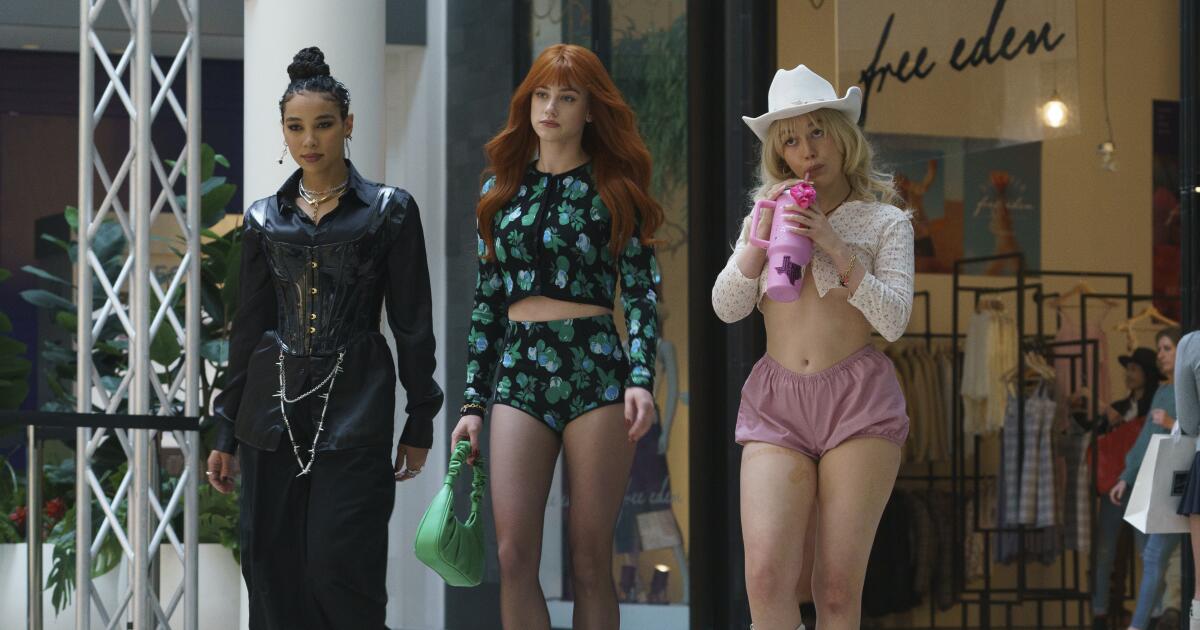
Our clique comes storming down the mall food court in that classic slow-motion strut, letting us know right away what we’re in for. They’re known as the Fruits because they all happen to be named after them. The leader, Apple (Lili Reinhart), operates in the controlling mode of Regina George or Cher Horowitz; her lackeys are alt queen Fig (Alexandra Shipp) and blond bimbo Cherry (Victoria Pedretti). When they realize that a cute pretzel purveyor is named Pumpkin (Lola Tung), they quickly bring her into their circle as a fourth, seemingly only because her name fits the theme.

Apple runs her high-femme coven out of their store Free Eden with an emphasis on iconic women: The girls confess to their martyr Marilyn Monroe in a dressing room and practice dark magic with their panties and a silver cowboy boot. In the interest of helping each other “shine,” Apple also takes a page from Ann Lee and the Shakers — sex and boys are banned and communication is highly controlled.

It’s only when Pumpkin starts uncovering some of the coven’s secrets, including the existence of a former member named Pickle (Emma Chamberlain), that their controversial personal histories involving hexes, poison, fires and hidden boyfriends come to light, and the situation spirals out of control (literally — the climax happens during a tornado).

Alloway and cinematographer Karim Hussain craft a distinctive and unique aesthetic, a gauzy, highly artificial look that underlines the winky referential tone, but one that also lends “Forbidden Fruits” a strangely dreamlike quality that doesn’t always work for the genre.

While the actors, particularly Reinhart and Pedretti, are locked in with the tone and Reinhart delivers the fierceness required of such a role, the pace of “Forbidden Fruits” is at odds with the performers. The film is weirdly slow and sleepy and at least 20 minutes too long. The convoluted story, peppered with various twists, lacks momentum.

A stronger hand in the edit could have resulted in something more dynamic and engaging, but the plotting is mushy and then rushed. For a witchy horror thriller, it’s heavier on psychological violence than actual scares, and a third-act bloodbath and big reveal can’t save it when we finally get there.

The film’s theatrical provenance reveals itself in long monologues in the Marilyn confessional room and Pedretti delivers one that reveals the depth beyond Cherry’s ditzy exterior. We can see Houghton’s play in these moments, but then Alloway’s cheeky pop sensibility intervenes, the arch artificiality and ironic tone draining the emotional impact.

“Forbidden Fruits” can’t reconcile all of its influences and just ends up as a collection of references and high style without much staying power — it’s essentially the fast fashion of girly pop horror.

Katie Walsh is a Tribune News Service film critic.

‘Forbidden Fruits’

Rated: R, for strong violent content/gore, sexual content, nudity, language and brief drug use

Running time: 1 hour, 43 minutes

Playing: Opens Friday, March 27 in wide release

Source link

‘Kim’s Convenience’ review: Back onstage with sitcom warmth intact

“Kim’s Convenience” may not win points for originality, but originality isn’t really the point of an immigrant family drama meant to be instantly, one might say universally, recognizable.

The play, which opened Tuesday at the Ahmanson Theatre, was a runaway hit at the 2011 Toronto Fringe Festival. That success led to a larger production at Toronto’s Soulpepper Theatre that brought more attention to the show, paving the way for runs off-Broadway, in London’s West End and Washington, D.C.

But the show’s familiarity has another source. “Kim’s Convenience,” which was turned into a sitcom for Canada’s CBC, found an international audience on Netflix.

The story is set in Toronto, and the Kim family (owners of the titular convenience store) is of Korean background. But immigrants from Ireland, Italy, Latin America, India and Eastern Europe and their more assimilated children won’t have any problems relating to the generational conflicts at the heart of this gentle comedy.

Author Ins Choi, who once played the role of the prodigal son, has matured into the part of Appa, the patriarch who left Korea with his wife, Umma (Esther Chung), to start a new life in Canada. He opened a 7-Eleven-style shop, which he once considered calling 7-12, and has been living above the store with his family in what has been an all-hands operation.

Appa made sacrifices to give his son and daughter a better life — and he’s more than happy to tick off a list of what everyone owes him. He’s a mostly benevolent tyrant, but his crotchety side can get ugly and he’s not always in control of his temper. His son Jung (Ryan Jinn) ran away at 16, absconding with money from the store safe, after one of Appa’s flare-ups sent him to the hospital.

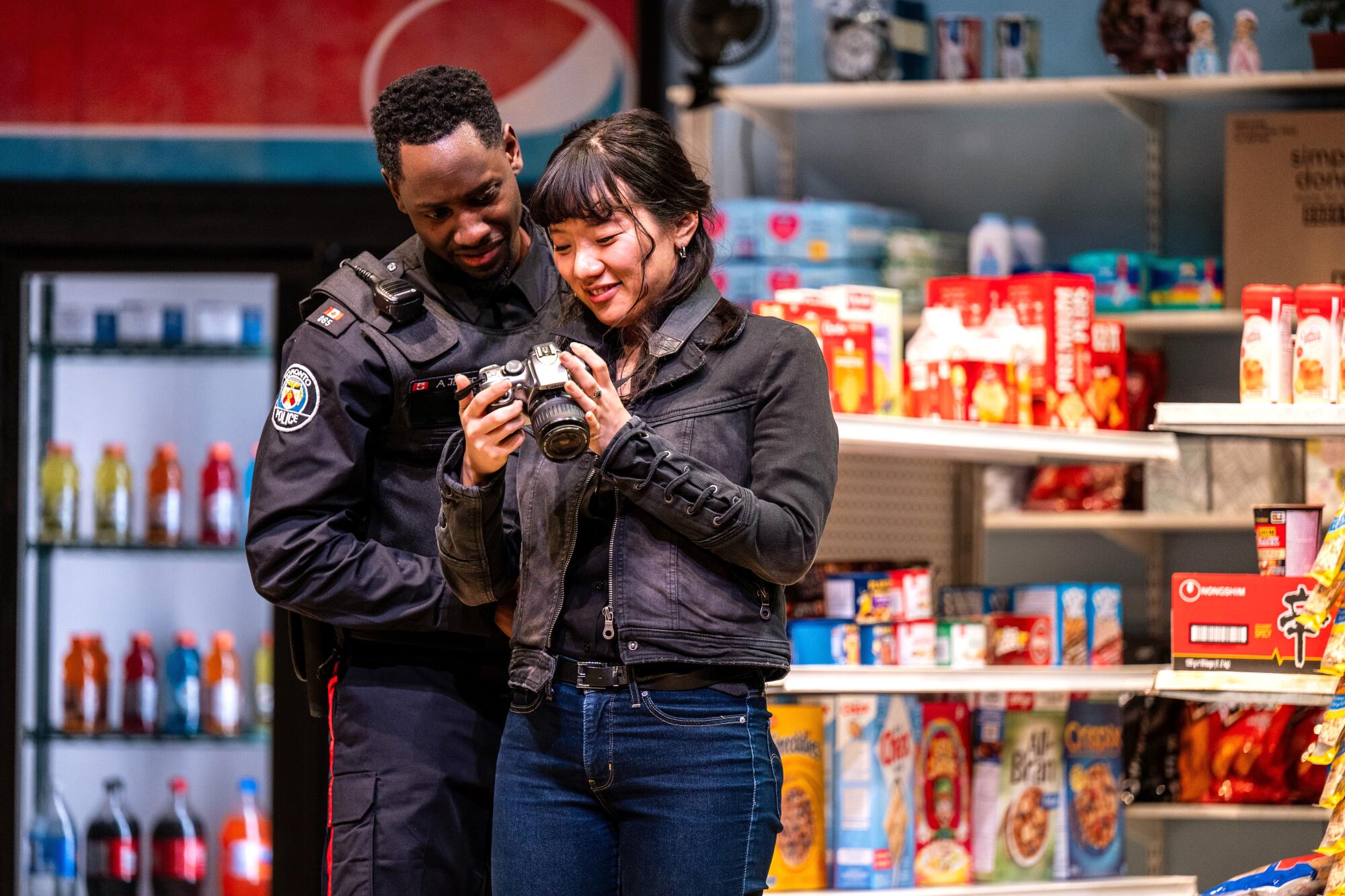
Janet (Kelly Seo), Appa’s 30-year-old unmarried daughter, bears the brunt of being the adult child who remained at home. She still works at the store, though her true calling is photography. Her father considers this just a hobby, a weekend recreation that shouldn’t interfere with her taking over the store one day. But she has other ideas for her future.

Change is coming whether Appa likes it or not. A Walmart is heading to the area, and with this news comes an unexpected offer for the shop that would allow him to comfortably retire. But selling the store is tantamount to discarding his story.

Brandon McKnight, left, and Kelly Seo in "Kim's Convenience."

Brandon McKnight, left, and Kelly Seo in “Kim’s Convenience.”

(Dahlia Katz)

He explains this to Janet, hoping that she’ll continue his legacy. But she’s put her life on hold for too long. Both her parents never let her forget that she still doesn’t have a husband. But how can she get married when her father subjects any man she dates to the third degree?

Alex (Brandon McKnight), the police officer who answers the 911 call Appa had Janet place to report a Japanese car parked illegally by the store (he still hasn’t forgiven Japan for its invasion of Korea), turns out to be a childhood friend of Jung’s — and someone Janet used to have a crush on. The sparks between them are obvious, and Appa, the soul of indiscretion, can’t help meddling in his overbearing way.

Choi isn’t averse to shtick, if the result is an explosion of audience laughter. One comic gimmick involves Appa’s superhuman grip that can subdue even the mightiest of men. A shoplifter (also played by McKnight, who portrays all the customers and passersby) learns the hard way that Appa is not to be underestimated.

Esther Chung, left, and Ins Choi in "Kim's Convenience" at the Ahmanson.

Esther Chung, left, and Ins Choi in “Kim’s Convenience” at the Ahmanson.

(Dahlia Katz)

The scene involves an unsavory routine on how to recognize a shoplifter. Janet challenges Appa’s racist assumptions, but father knows best and no one can convince him otherwise. Janet can’t win with him, but don’t count Appa’s daughter out.

Or his son, for that matter. Jung, who had a stint in rehab, hasn’t had an easy path in life, but he’s stayed in touch with his mother and eventually he and his dad will have their dramatically inevitable reckoning. There’s something determinedly hopeful about “Kim’s Convenience,” which like the store it’s named after, wants its patrons to leave satisfied.

The cast members, under the direction of Weyni Mengesha, all deserve high customer ratings. Choi’s Appa is impossible to stay mad at even when he’s said or done something unforgivable. He doesn’t mean to offend, though other people’s feelings are a luxury he has never been able to afford.

Still, his paternal bluntness is not without its infuriating charm, as when he informs his headstrong daughter, “You have to understand, now is desperation time for you. Sudden death, overtime, penalty kick shoot out. Expiration date is over. Take over store is only choice you having.”

Esther Chung and Ryan Jinn in "Kim's Convenience" at the Ahmanson.

Esther Chung and Ryan Jinn in “Kim’s Convenience” at the Ahmanson.

(Dahlia Katz)

Seo’s Janet is as feisty as she is loyal, making it easy to root for her and her quickly budding romance with McKnight’s worthy Alex. Chung’s Umma doesn’t take up a lot of room in the play, but her maternal presence registers sharply nonetheless. Jinn endows Jung with hidden dimensions of pain and regret.

But the most vivid performance might in fact be the convenience store itself, brought to fluorescent, sanitized, colorful life by scenic designer Joanna Yu and lighting designer Wen-Ling Liao. Nicole Eun-Ju Bell’s video and projection designs subtly transpose the setting when, for instance, Umma meets up with her son at church. The production seems right at home at the Ahmanson, a function of both the broad sitcom-friendly style and the warm Korean American reception that was audible at Tuesday’s opening.

“Kim’s Convenience” has an eager-to-please TV sensibility that can seem formulaic at times. But representation, particularly these days, can be a radical act, and there’s something heartening at the sight of the Kim family enjoying their turn in the mainstream spotlight.

‘Kim’s Convenience’

Where: Ahmanson Theatre, 135 N. Grand Ave., L.A.

When: 7:30 p.m. Tuesdays-Thursdays, 8 p.m. Fridays, 2 and 8 p.m. Saturdays, 1 and 7 p.m. Sundays. Ends April 19

Tickets: Start at $40.25

Contact: (213) 628-2772 or centertheatregroup.org

Running time: 1 hour, 20 minutes (no intermission)

Source link

‘The AI Doc: Or How I Became an Apocaloptimist’ review: Lacks needed nuance

p]:text-cms-story-body-color-text clearfix”>

AI is coming. AI is here. AI is a bubble. AI is the future we want. AI is the end. AI is the path to a better us (at least the ones who survive it).

A big topic, this artificial intelligence, with a lot of different ways to think about it. To grapple with AI is a worthy endeavor for any filmmaker. (And by grapple, I don’t mean asking AI to make the film for you.)

Daniel Roher, the man behind the Oscar-winning “Navalny,” has, along with co-director Charlie Tyrell, attempted a nonfiction primer of sorts on the biggest technological, societal and existential challenge of our time with “The AI Doc: Or How I Became an Apocaloptimist,” a title boasting a hybrid coinage Roher picks up from one of his interviewed experts — one of too many, it turns out. “The AI Doc” is a well-intentioned but aggravating soup of information and opinion that wants to move at the speed of machine thought.

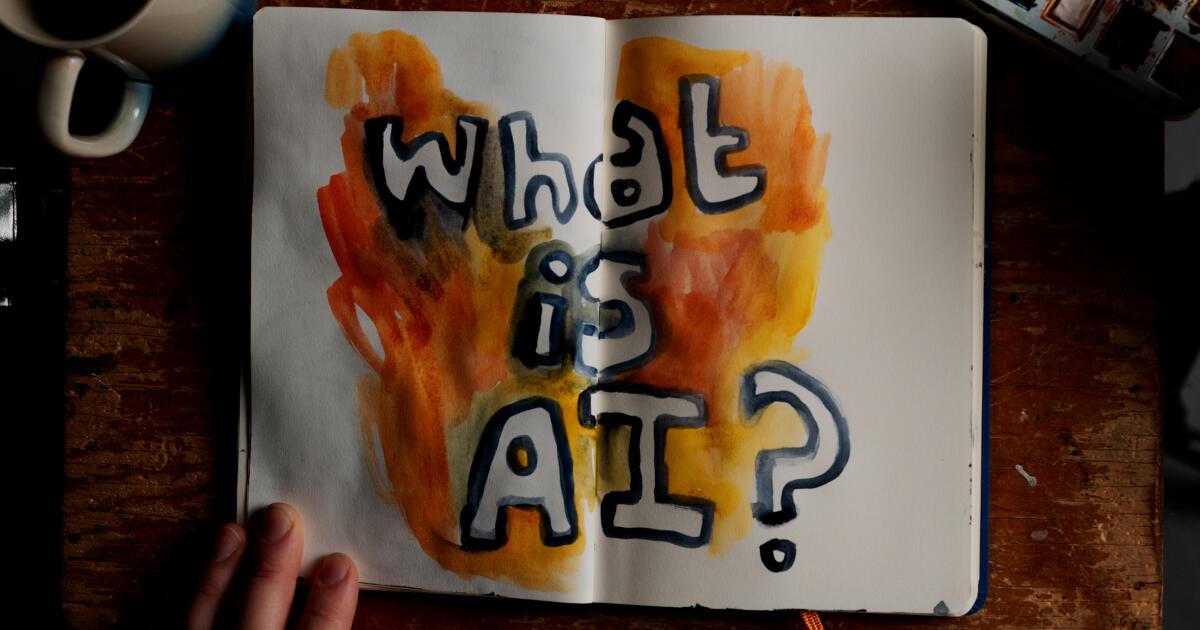
Roher’s approach is understandable for a mainstream doc. He assumes many of us are tech-competent, anxious and confused as to what AI even is to begin with. In his pursuit of answers, Roher employs a cloying framework: his loving wife occasionally narrating as if this were a storybook and Roher the protagonist of a scary adventure. The fable construct extends to a frenetic visual scheme of handmade art and animation that interrupts our absorption process as if we were kids needing stimulation between all the talking heads.

As for the AI itself, the experts — a mix of tech founders (such as Sam Altman and Anthropic’s Amodei siblings), historians, scientists and assorted champions and skeptics — come to Roher’s home, because he wants to foreground a key question as an expectant father: Should he be bringing a child into this world?

Perhaps more urgently, should Roher have made an AI doc that treats us like children? First, he parades all the safety doomers, seeming to believe their warnings that an unfeeling superintelligence is upon us and we can’t trust it. Then, sufficiently disturbed, he hauls in the AI cheerleaders, a suspiciously positive gang who can envision only medical miracles and grindless lives in which we’re all full-time artists.

Only then, after this simplistic setup where platitudes reign, do we get the section in which the subject is treated like the brave (and grave) new world it is: geopolitically fraught, economically tenuous and a playground for billionaires.

Why couldn’t the complexity have been the dialogue from the beginning, instead of the play-dumb cartoon “The AI Doc” feels like for so long? Maybe Roher believes this is what our increasingly gullible, truth-challenged citizenry needs from an explanatory doc: a flashy, kindhearted reminder that we’re the change we need to be.

But if you thirst for a sober-minded investigation into this ominous tool — one with an approach that treats you like the intelligent being you are — you’ll have to wait for AI doc 2.0.

‘The AI Doc: Or How I Became an Apocaloptimist’

Rated: PG-13 for language

Running time: 1 hour, 44 minutes

Playing: Opens Friday, March 27 in limited release

Source link

‘Dead Lover’ review: A wildly creative feminist plunge into goth territory

p]:text-cms-story-body-color-text clearfix”>

“I want to lick your stink … I want to taste your foulness … I want to shower in your rot … I want to feast in your fetid funk.”

Have more romantic sweet nothings ever graced the screen? Scripted by Grace Glowicki and Ben Petrie (partners in life and in filmmaking), these words of seduction are music to the ears of a lonely Gravedigger (Glowicki), who has been formulating a perfume to cover up her corpse-like stench. What she discovers is that the right one will love her exactly the way she smells, learning that she’s not so pheromonally challenged after all.

Glowicki’s sophomore feature “Dead Lover,” sometimes presented in “Stink-O-Vision,” is one of those entirely singular freakouts that we can thank Telefilm Canada for subsidizing (see also: the Cronenberg family oeuvre, Matt Johnson’s current “Nirvanna the Band the Show the Movie” and many more).

She co-writes, directs and stars in this highly stylized, wonderfully DIY handmade project, beautifully designed with gruesomely gothic sets by production designer Becca Morrin and art director Ashley Devereux. The blend of intentional artifice paired with deep emotion calls to mind other Canadian auteurs like Guy Maddin and Matthew Rankin (“The Twentieth Century”), but Glowicki’s film also exists within another lineage: the feminist Frankenstein film.

The film opens with a quote from Mary Shelley: “There is something at work in my soul which I do not understand.” Her 1818 novel “Frankenstein: or, the Modern Prometheus” has always been a feminist text (despite Guillermo del Toro’s more bro-ey adaptation), grappling with the terrifying power of creating life — and how close that is to death. Feminist filmmakers have drawn out these inherent themes from the book, the most recent and loudest example being Maggie Gyllenhaal’s “The Bride!” But “Dead Lover” hews closer to Laura Moss’ modern medical take, “birth/rebirth,” and even more closely to Zelda Williams’ cute, poppy “Lisa Frankenstein,” in which a young seamstress stitches up a reanimated boyfriend.

Our Gravedigger speaks to us, and to the moon, about her heart’s desire in charming cockney rhyming slang. Her hopes are rather simple and conventional: one true lifelong love and a family. After much rejection, she finally finds her Lover (Petrie) in the cemetery, saving him from a ferocious beast while he mourns his late opera-singer sister (Leah Doz). After the pair consummate their fragrant lust, the Gravedigger is ready to settle down right away.

In order to make her dreams come true, Lover travels to Europe for fertility treatments, where he drowns on a ship, the only thing left of him a finger, delivered to her by fishermen. Our enterprising Gravedigger, a true woman of science, engineers a lizard elixir and regenerates the finger into a long tentacle that eventually demands a body. What better choice than his own sister? But when her wild new Creature (Doz) comes to life, all hell breaks loose, summoning the sister’s jealous, grief-stricken Widower (Lowen Morrow) into an unfortunate love triangle (or square?).

Glowicki is a terrific filmmaker, marshaling her tiny troupe to execute this unique project. Petrie, Doz and Morrow play multiple roles, including a gossipy Greek chorus and the band of merry fisherman (truly an astonishing array of Canadian accent work on display). Her commitment to her singular vision never wavers, but as an actor, Glowicki is truly astonishing. Caked in Halloween makeup and lit with an array of colored gels, Glowicki summons something primal, pure and deeply moving about the lengths one will go to for love, a screech from the depths of her gut.

With a dream-pop soundtrack by U.S. Girls that would be at home in an episode of “Twin Peaks,” “Dead Lover,” in all its stinky, sexy, queer and grotesque glory, is one of the grossest and loveliest films about love I’ve ever seen. This one’s for the horny, hopeless goth inside all of us.

‘Dead Lover’

Not rated

Running time: 1 hour, 25 minutes

Playing: Opens Friday, March 27 at Laemmle Glendale

Source link

‘Palestine ’36’ review: Anti-colonialist drama has timely ripples

An uprising typically has a long parentage and, if effective enough, can leave behind many like-minded descendants. Such is the bracing air that Palestinian filmmaker Annemarie Jacir breathes into her historical drama “Palestine ’36” as she dramatizes the 1936-1939 Arab Revolt against occupying Britain’s increasingly punitive, underhanded rule, offering up a multifaceted rebellion tale with plenty of contemporary resonance.

That being said, Jacir’s fourth feature — packed as it is with storylines — could stand a bit more context and fewer of the expositional traps that big-cast sagas easily fall into. But the key element that grounds Jacir’s version of an old-fashioned epic (and helps it withstand its faults) is that we’re seeing a place rarely depicted with such sweep, detail and scope outside of biblical epics. It’s as if a long-disused history book’s pages have finally been opened, dust giving way to color and purpose.

Some of that breadth is seen at the beginning in some astonishing newsreel footage from the era, which segues into Jacir’s establishing story threads. We meet village-born Yusuf (newcomer Karim Daoud Anaya), an ambitious young man who moves restlessly between bustling Jerusalem, where he works for a wealthy, British-friendly Palestinian businessman (Dhafer L’Abidine) and his journalist wife (Yasmine Al Massri), and his rural home where villagers are routinely targeted by British authorities. If it isn’t vicious Capt. Wingate (Robert Aramayo) violently rooting out rebels and putting locals in pens, it’s outwardly friendly officials like the secretary who oversees new policies kinder to the increasing numbers of Jewish settlers than to those who have been farming the hills for ages.

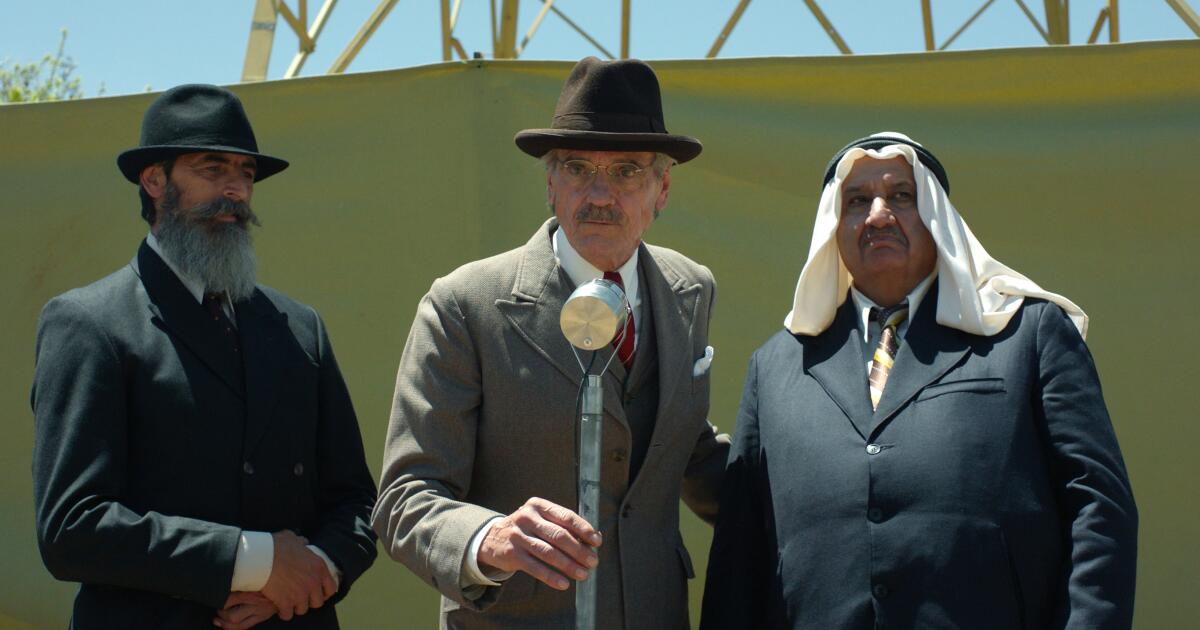
The split widens when a labor strike becomes an armed revolt, with Jacir gamely tracking the hardening or shifting loyalties of both her peasant and well-to-do characters. The British, represented at the top by the casually imperious High Commissioner Wauchope (a perfectly cast Jeremy Irons), are decidedly the villains here as a colonial force quick to brutalize Palestinians for speaking up for themselves. Still, by forgoing any Jewish characters when there was already a burgeoning transplanted minority — all we see is a kibbutz being erected in the far distance — seems like too careful an avoidance of contextual reality.

As “Palestine ’36” eventually sacrifices focus on the many characters it has, one wishes Jacir had had the luxury of a classic epic’s standard third hour to build that complexity into a vivid resistance narrative. Wanting more from this material, though, feels better than not getting the opportunity to see it at all. As overdue tales of history go, “Palestine ‘36” (currently one of the last films with access to its real-world locations) is certainly more of a blunt instrument than a novelistic endeavor. But its broad strokes and rooted passions easily earn their place, and deserve to inspire more such stories.

‘Palestine ’36’

In Arabic and English, with subtitles

Not rated

Running time: 1 hour, 59 minutes

Playing: Opens Friday, March 27 at Laemmle Royal and Laemmle NoHo 7

Source link

‘Bait’ review: Riz Ahmed’s marvelous comedy centered around James Bond

Riz Ahmed has created and stars in a marvelous new series, “Bait,” premiering Wednesday on Prime Video. There are no worms in it, though viral video plays a part, and fame — the pursuit of which is a subject — is a lure.

But what’s in a name? A comedy by any other name would be as funny — if it was funny, and this one very much is, in a way that’s crazy and serious and human, built around a character in crisis who refuses to believe his life is out of control and is so invested in putting up a front that he’s begun to believe his own lies. Almost. It’s a series in which hallucinations, dreams, magical realism and memories, which punctuate and interfere with the “normal” business of the story, all amount the same thing, and in which the style of the filming shifts with the action.

Ahmad plays Shah Latif, a British Pakistani actor, who, owing to the exertions of his faithful, often frustrated agent, Felicia (Weruche Opia), is improbably auditioning to be the next James Bond. But he repeatedly forgets his line when his scene partner, a girl with a gun, asks, “Tell me, when it’s just you all alone, how do you live with yourself? Do you even know who you are?” establishing a theme. (The line he can’t recall: “I don’t live with myself, I live with whoever you need me to be.” Spies and actors!)

Leaving the audition, he contrives to be photographed by one of the paparazzi lurking outside, sniffing for a Bond scoop; his picture is published, which creates a stir and some racist blowback, culminating in a package thrown through the front window of his parents’ home. (It is not a window that opens.) What’s inside the package I’ll leave for you to discover, but it will play a part through the rest of the show.

The recurring question of who will be the next James Bond generates a lot of pop cultural heat in our world; just type “next James Bond” into your search engine of choice. At one point, you may recall, Idris Elba was regularly bruited as a potential 007, which occasioned enough anti-Black reaction that he officially took himself out of the unofficial running. It may have been on Ahmed’s mind here — Shah claims high purpose for his Bondean aspirations, that he wants “to show them that this too is what British looks like.”

On the one hand, Shah has had enough of a career to have been made into a “limited edition collectible action figure,” starred in a well-regarded but underseen small film, played “the translator in ‘Homeland’ series seven” and earned a rising star award from some French festival; on the other, he is, professionally speaking, no Idris Elba — not a nobody, but not too many rungs above it. (He’s not Dev Patel, either, with whom he’s repeatedly confused.)

At the top of the second episode, Shah is seemingly being interviewed on a podcast, “Sir Chatwick Stewart, with me, Sir Patrick Stewart” — played by the man himself, whom we hear but never see — about his ambitions, though it’s soon clear that Stewart is a mental projection, an inner critic and inquisitor. He’ll stick around through the series, offering barbed commentary and something like support: “If I humiliate you, it’s to save you from the bigger humiliation of remaining as you are.”

As a protagonist continually getting in his own way, Shah is a classic sort of comic character. He creates opportunities only to squander them; finds himself voiceless after forcing himself onstage at a black-tie gala or in an underground club (he was once a politically provocative MC). After a newsworthy mishap, his agent advises him to lie low, which is impossible for him to do; there is no itch he won’t scratch, and no good advice he’ll actually follow. Apart from a rival actor (Himesh Patel) he’s a protagonist without antagonists, excepting himself. He’s insufficiently grateful to the people he owes, and insufficiently apologetic to those he’s wronged.

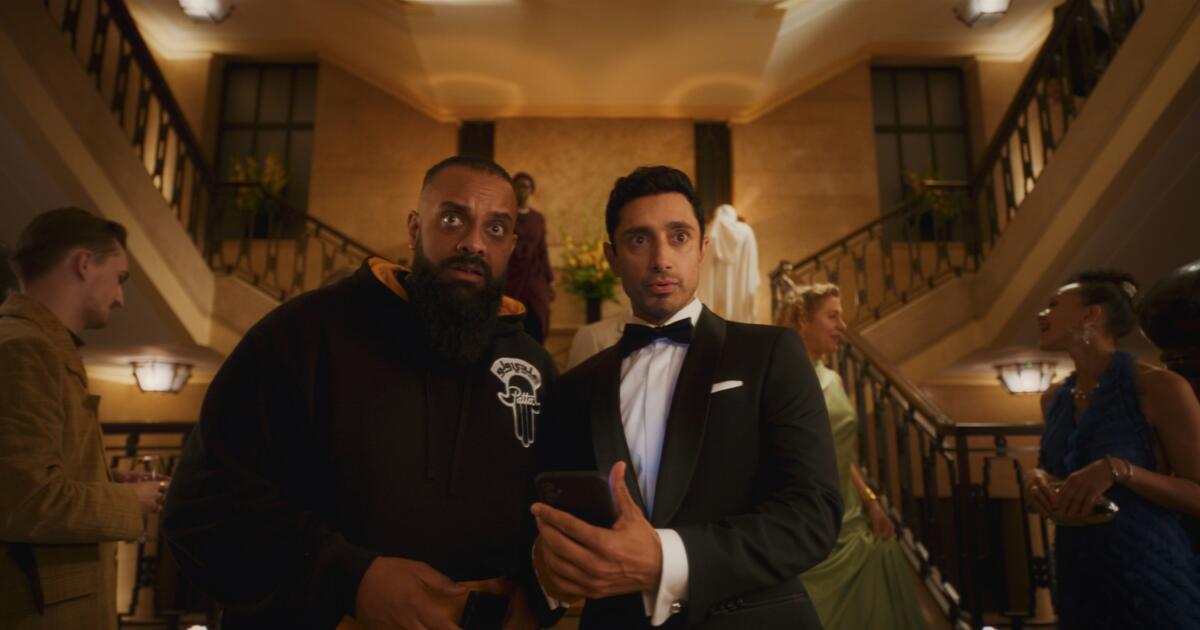
Shah’s self-involvement will be challenged by ex-girlfriend Yasmin (Ritu Arya), encountered first by accident, then sought out — a writer, she has published an op-ed headlined, “No, Shah Latif, We Don’t Need a Brown Bond” — in which she accuses him of “exchanging his political art for vanilla distraction.” His family, whom he neglects to visit for months, includes warm-hearted cousin Zulfi (Guz Khan), who has started a Muslim ride share company; a no-nonsense sister (Aasiya Shah) — the name of her character is rendered as “Q” on IMDb and elsewhere, but in the series itself she’s called Ainy — doting mother Tahira (Sheeba Chaddha); and his skeptical father, Parvez (Sajid Hasan), who has not been keeping his doctor appointments and asks Shah, “What do you even do? I watch TV all day — you’re never on it.”

Appropriate to a character who lives for being onscreen, “Bait” plays with the language of film — gritty procedural, a burst of Bollywood, romantic comedy — though not necessarily to the usual ends. Frame-filling titles identify the London neighborhoods where the action takes place — Wembley, Kentish Town, Brick Lane, Ladbroke Grove — as Paris, Moscow and Mexico City might appear in an international thriller. The series is at once satirical and celebratory; “Bait” feels abundant, both in its presentation of a culture, which has the ring of documentary truth, and as a beautifully realized work of art.

Bond can wait.

Source link

Democrats call for review of Paramount’s Middle Eastern financial backers

Democratic lawmakers are demanding scrutiny into Paramount Skydance’s financial backers amid rising concerns about potential foreign influence of U.S. media properties.

In a letter this week to Federal Communications Commission Chairman Brendan Carr, seven U.S. senators criticized Carr’s suggestion that Paramount’s $111-billion bid for Warner Bros. Discovery, backed by billionaire Larry Ellison and his family, was on a fast track to receive FCC approval with scant oversight.

Such complicated mergers typically receive an intense government review. The proposed merger would combine two legendary film studios, dozens of cable channels, HBO, CBS and two major news organizations, CNN and CBS News.

Ellison and his son, David, who chairs Paramount, are friendly with President Trump, who has long agitated for changes at CNN, which is slated to be absorbed by Paramount.

The company has said it expects to complete the deal by the end of September.

The Democrats expressed concerns that the fix may be in. Trump’s Justice Department has been reviewing whether the merger would violate U.S. antitrust laws, but a key deadline passed last month without comment from the department’s antitrust regulators.

Also at issue is the Middle Eastern money the Ellison family has been expecting to pull off Paramount’s leveraged buyout of its larger entertainment company rival. The acquisition would leave the combined company with nearly $80 billion in debt.

Late last year, Paramount disclosed that it had lined up $24 billion from wealth funds representing the royal families of Saudi Arabia, Qatar and Abu Dhabi, who would then become equity partners in the combined company.

Paramount has described the funds as largely passive investors, saying the royal families would not have input into corporate decision-making. They also would not control seats on the Paramount-Warner board.

Congressional Democrats previously have warned about potential national security concerns. The senators, led by Cory Booker (D-N.J.) and Chuck Schumer (D-N.Y.), remain concerned, particularly because the transaction will help shape the future of Hollywood production and the direction of key news outlets, including CNN, which maintains a strong presence around the world.

Members of the party have called on Carr to conduct “a full and independent” analysis of the foreign ownership interests before signing off on the merger. The FCC could play an important role, they said, because the tie-up includes Paramount-owned CBS, which holds FCC broadcast station licenses.

Paramount declined to comment. FCC officials did not respond to a request for comment.

Booker and Schumer pointed to Carr’s comments at an industry conference in Spain earlier this month. During an appearance at the Mobile World Congress, Carr suggested the Paramount-Warner deal could be swiftly approved because the foreign investment would warrant only a “very quick, almost pro forma review,” Carr reportedly said.

The FCC has a duty to examine foreign ownership, the lawmakers said, referencing the U.S. Communications Act, which forbids owners from outside the U.S. from holding more than 25% of the equity or voting interests in an entity that maintains an FCC license.

The lawmakers mentioned the FCC’s move earlier this year to tighten its foreign ownership framework to bolster transparency.

Paramount has not yet disclosed its final list of equity partners.

The company previously disclosed its proposed partners in Securities & Exchange Commission filings. However, last month, the composition of the Paramount-Warner deal changed when Larry Ellison agreed to fully guarantee the $45.7-billion in equity needed to finance the $31-a-share buyout of Warner investors.

Before Ellison stepped up, Warner board members had expressed concerns about Paramount’s financing. The tech billionaire’s increased involvement helped carry the Paramount deal over the finish line. Netflix bowed out Feb. 26, ceding the prize to Paramount.

Still, Paramount is expected to line up billions of dollars from outside investors.

It would be significant if Saudi Arabia’s Public Investment Fund, the Qatar Investment Authority and Abu Dhabi’s L’imad Holding Co., contributed $24 billion to the deal, the Democrats wrote.

“This is not incidental capital, it represents roughly one-fifth of the total transaction value,” Booker and the others wrote. “And it is not clear that this will be the only foreign investment.”

Initially, Paramount included Chinese technology company Tencent Holdings as a minority investor, but Paramount later removed Tencent from the investor pool due to concerns about its problematic status — it has been blacklisted by the U.S. Department of Defense.

Bloomberg News reported earlier this month that Tencent might return to the fold.

“This constellation of foreign investment from China and from Gulf States, with complex and sometimes competing relationships with the United States, demands rigorous, not perfunctory review,” Booker and the others wrote.

The letter also was signed by Sens. Dick Durbin (D-Ill.), Elizabeth Warren (D-Mass.), Richard Blumenthal (D-Conn.), Sheldon Whitehouse (D-R.I.) and Mazie K. Hirono (D-Hawaii).

They keyed in on the role of Saudi Arabia’s sovereign wealth fund, saying it was controlled by Crown Prince Mohammed bin Salman “whom the U.S. intelligence community concluded ordered the murder of Washington Post journalist Jamal Khashoggi in 2018.”

The proposed $24-billion investment would give “these governments a significant financial stake in the future content, licensing, and strategic decisions of a combined entity that includes some of the most-watched news and entertainment networks in America.”

It is also unclear whether the current tensions in the Middle East over the Iran war will have an impact on Paramount’s investor syndicate.

Trump’s son-in-law Jared Kushner, a proposed Paramount investor, also withdrew late last year.

Paramount shares held steady at $9.17. The company’s stock is down 31% since Feb. 27, when the company prevailed in the Warner auction.

Source link

‘SNL UK’ review: Tina Fey kicks off British version of sketch show

After 50 years of being practically synonymous with New York City, “Saturday Night Live” has opened the door to London with “Saturday Night Live UK,” following in the steps of “Law & Order UK” and possibly nothing else. Of all the cities in the world that might conceivably replicate the spirit of the NBC original, the British capital, with its urban dynamism, media concentration and 20,000 comedians, feels like the obvious, and perhaps only, choice. (“Saturday Night Live Italia” might prove me wrong, if that day ever comes.) And, of course, we’ve been in a reciprocal comedy arrangement with Britain — or at least we have been nicking their ideas for shows — for years.

The show premiered in the U.K. this past Saturday on Sky One and NOW, and began streaming stateside Sunday on Peacock, with our own Tina Fey as the first guest host. (“It’s an absolute honor and kind of historic,” she said to studio audience. “Guys, I am the youngest person to ever host ‘SNL UK!’”)

As a “Saturday Night Live” star, writer and head writer; and the co-creator of “30 Rock” — her show about a sketch show set in the very same building as “SNL” — they couldn’t have appointed a better ambassador. Lorne Michaels doubtless has her on speed dial.

Here’s the short review: In the course of a single episode, “SNL UK” managed to feel very much like its parent show — which is to say, some of it worked well and some of it worked less well, but very little of it didn’t work at all. There were sketches that ran too long, or ended weakly, but were generally redeemed by a young(ish), confident 11-member cast that made the most of them. Some will already be recognizable to British viewers. Many have had notable, or anyway noticed, careers in stand-up; in the sort of stand-up that amounts to theater; in straight theater (including Shakespeare, naturally) and/or in television and film. Fey promised to “stay out of their way as much as possible,” but she came to play, and appeared in most every sketch.

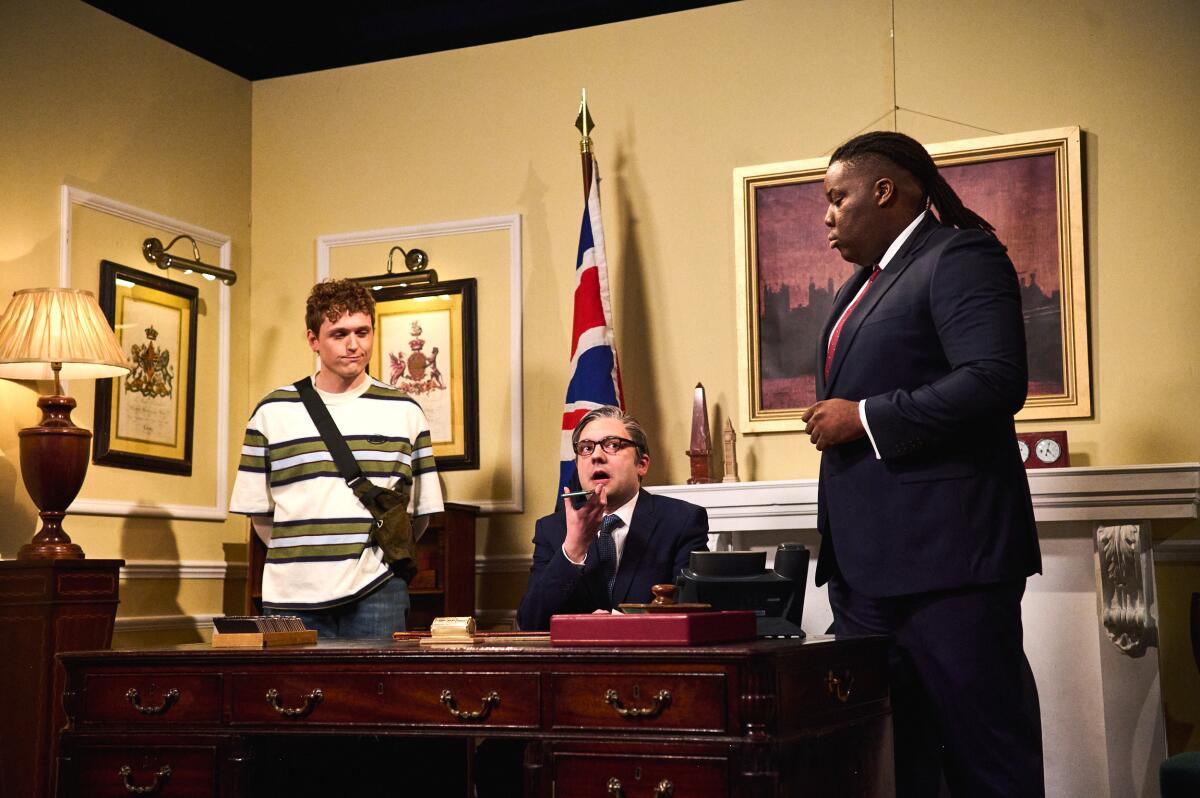
The evening followed established protocol. Cold open. (Prime Minister Keir Starmer, played by George Fouracres, is afraid to tell President Trump, whom he regards as a sort of bad boyfriend, that he’ll send no more ships to the Strait of Hormuz: “I know how badly you want to start World War III, and that’s great. You absolutely do that but we can’t be part of it.”) Hammed Animashaun and Jack Shep accompanied Fouracres in the sketch and shared the glory of shouting, “Live from London, it’s ‘Saturday Night!’” They would continue to dominate the episode.

Two men flank a man sitting at a desk speaking into a cell phone.

Jack Shep, George Fouracres and Hammed Animashaun in the “SNL UK” cold open, set at 10 Downing Street, in the prime minister’s office.

(NBCUniversal)

Next: Opening credits featuring the cast members out and about in the city. Monologue, with guest appearances from Nicola Coughlan, Michael Cera and Graham Norton. (The set is very much in the style of various American iterations over the years, clock included, with the band onstage.) Film bits and sketches. Musical guest. (Wet Leg, surly.) “Weekend Update.” More skits. Musical guest returns. More comedy. Whole cast onstage at the end, ready to party.

Among other things: A Shakespeare skit found the Bard (Fouracres again) returning to Stratford from London between plays, each time more affected, beginning with an earring and finishing with an electric scooter, sunglasses and a bag of ketamine. A Paddington Bear immersive experience, with an actual bear, turns bloody, recalling Dan Aykroyd’s 1978 classic Julia Child sketch. As a bra salesperson giving an ego boost to Fey‘s customer, Emma Sidi was funnier than the sketch she was in. (It did include a cameo by Regé-Jean Page, from “Bridgerton.”) In another, David Attenborough (Fouracres again, again), using “Jurassic Park” technology, hosts a “last supper” featuring great dead Britons including Winston Churchill, Isaac Newton, Agatha Christie (Fey), “Freddie Mercury, from Queen, Elizabeth the First, from being the Queen,” and Shep’s Princess Diana, pulling focus at Attenborough’s right shoulder; all they manage to discuss is how many starters to get for the table. It had the added bonus of getting the entire cast, and guest host, onstage.

The film bits were first-rate. (Not being live has its advantages.) One advertised an anti-aging cream — Undérage, with a soft “g” — “that works so well everyone will think your man is a nonce.” (That is, a pedophile.) “My skin looks so fresh,” says a happy customer, “my husband can’t go anywhere without being hunted by right-wing pedophile-catching militias.” “My husband lost his record deal and, some, but not all of his fans.” Another concerned a sort of command center where workers labored “to make the internet as bad as we can possibly get it.”

There are, to be sure, tonal differences to British and American comedy; just compare the respective versions of “The Office,” or “Ghosts,” or “Doc Martin” with its domestic remake, “Best Medicine”; the former tends to be darker, more cutting, more absurd. (A “Weekend Update” joke about the former Prince Andrew’s new home, Marsh Fair, “of course named after the nearby marsh where his body will be found.”) Despite that, and the old saw that Britain and America are two countries separated by a common language, the show translated well transatlantically. Apart from some local topical and cultural references, and an occasional unfamiliar word whose meaning was in any case obvious from context, and some swearing, most of it could have been played with few adjustments by the American cast.

“While we may not agree with everything America does,” Fouracres’ prime minister says at the end of the cold open, “we can still be civil and embrace their wonderful, unproblematic culture.” Back at you, buddy!

The season has been extended to eight episodes from the originally ordered six. (Riz Ahmed and Jamie Dornan are scheduled to host.) Why not 10?

Source link

Review: Inside the night Jo Koy and Fluffy made comedy history at SoFi Stadium

Comedians Jo Koy and Gabriel “Fluffy” Iglesias are used to delivering big laughs on large stages. But in the world of major L.A. venues, there’s big, there’s massive, and then there’s SoFi Stadium.

The show starring both comedians was billed as a record-breaking feat for stand-up when they sold out the 70,000-seater. Though the pressure to fill up the stadium was off, it still remained to be seen how the two comics would make their most dedicated fans laugh from more than a football field away. By that criteria, Saturday night was definitely a win.

Kicking off the early portion of the show at 7 p.m., fans were already filling the seats as opening acts from Iglesias’ camp, including Matt Golightly, Joey Guila, Alfred Robles, Martin Moreno (who celebrated his 58th birthday on stage) and ventriloquist funnyman Jeff Dunham got the crowd warmed up for about an hour before Iglesias took the stage first.

 Jo Koy and Fluffy onstage at SoFi Stadium in Inglewood

Comedians Jo Koy and Fluffy perform Saturday at SoFi Stadium.

(Christina House / Los Angeles Times)

It was almost 8 p.m. when Iglesias emerged following a video skit playing on the jumbo screens and the stadium’s massive halo scoreboard with his funny misadventures of a routine doughnut run at Randy’s Donuts that turned into the plot of “Sons of Anarchy” spinoff “Mayans M.C.” featuring lead actors Emilio Rivera, a.k.a. Miguel Golindo, and Clayton Cardenas, known for playing Angel Reyes. Reyes caused the first major eruption of noise in the crowd by pressing a detonation device that triggered columns of smoke that filled the stage as Fluffy made his entrance in a white flat cap and custom Los Angeles button-up to greet the sold-out stadium.

“Thank you for being here, all I have to say is we did it!” Iglesias proclaimed as the crowd cheered.

Pointing and waving to fans in the nosebleeds, he took time to embrace the moment that topped his previous triumph of performing at Dodger Stadium.

Fluffy takes the stage at SoFi Stadium in Inglewood.

Fluffy takes the stage at SoFi Stadium in Inglewood.

(Christina House / Los Angeles Times)

Though the stage couldn’t have been bigger, both comedians used their ability to make a large event feel intimate by drawing the crowd in through storytelling and making them feel like they were part of a conversation. Iglesias set the tone of his set right away by telling us about the chisme (a.k.a. salacious gossip) surrounding his newly married stepson that weaved into stories about his travels all over the world including his controversial stop at the Riyadh Comedy Festival.

Iglesias also took a pause to relate one other historic fact about the two stadiums in L.A. he’s now been able to sell out.

Santino Villalovos of Tracy, California, shows his Fluffy tattoo during the Jo Koy and Fluffy show at SoFi Stadium

Santino Villalovos of Tracy, Calif., shows his Fluffy tattoo during the Jo Koy and Fluffy show at SoFi Stadium.

(Christina House / Los Angeles Times)

“The two biggest shows in comedy were Dodger Stadium and SoFi Stadium. … And what did they both have in common? They both featured a Mexican,” he said.

Even though he thought about retiring as a comedian after filling up Dodger Stadium (twice) to film his special “Stadium Fluffy,” Iglesias said the SoFi show inspired him to keep pushing himself. And alongside Koy he knew they could do it.

Fans react to special guest Jamie Foxx during Jo Koy's performance at SoFi Stadium in Inglewood on Saturday.

Fans react to special guest Jamie Foxx during Jo Koy’s performance at SoFi Stadium in Inglewood on Saturday.

(Christina House / Los Angeles Times)

“Jo I know you’re in the back, thank you for trusting me man, we did it brother. And I’ll say it in front of an entire stadium, love you. Things like this for me is a huge deal because it inspired me and gave me another reason to keep doing what I love to do. And tomorrow I’m gonna be in the same situation I was after Dodger Stadium — what am I gonna do now? But until then I’m enjoy the hell outta tonight and I still have more stories to share with you.”

Fluffy’s most controversial (and true) bit of the night was breaking the news to his fans that his name is mentioned in the Epstein files, which sent collective shock through the stands.

“I’ve never been to the island, I’ve never been on the plane and I have never met Jeffrey Epstein,” he clarified.

Fans light up SoFi Stadium during Fluffy's set on Saturday

Fans light up SoFi Stadium during Fluffy’s set on Saturday.

(Christina House / Los Angeles Times)

The comedian said that according to reports in the Epstein files, the late convicted pedophile apparently tried to buy tickets to his show at an Improv in West Palm Beach, Fla., in 2014 but was told by his assistant via email that both his shows were sold out.

“Jeffrey Epstein, one of the most diabolical human beings to ever walk the face of the earth. Had the ability to connect with politicians, with influencers, with celebrities. He put people in very compromising positions. He got people on planes. He put people on islands. He was involved in trafficking. He was able to accomplish all these evil, crazy things, but at the end of the day, he still couldn’t get tickets to see my show,” Iglesias said.

Jo Koy reveals himself with the Jabbawockeez at SoFi Stadium.

Jo Koy reveals himself with the Jabbawockeez at SoFi Stadium.

(Christina House / Los Angeles Times)

After a brief intermission, things transitioned to Jo Koy’s portion of the show featuring warm-up sets from TikTok skitmaster King Bach and longtime friend and stand-up star Tiffany Haddish, who came to the stage looking ready for the red carpet with a flowing silk dress, hair blowing in the man-made wind to deliver her brand of high-energy stories about becoming a real estate tycoon in South-Central.

When it was Koy’s turn to enter the stadium, he slipped in undercover, dressed as one of the Jabbawockeez — the legendary masked hip-hop dance troupe that danced onstage to a medley of West Coast hip-hop dressed in red with acrobatic swagger. At the end of a brief routine, Koy unmasked himself as one of the dancers, eliciting cheers from the crowd as his son helped him change onstage into his regular attire, Dodgers hat and a jean jacket.

Jo Koy performs at SoFi Stadium in Inglewood on Saturday

Jo Koy performs at SoFi Stadium in Inglewood on Saturday.

(Christina House / Los Angeles Times)

Always a man of the people, his set also reminded us that he’s also a man of the pets, specifically dogs, launching into a long bit that felt worthy of a slightly more adult version of a Pixar movie. But beyond jokes and stories, Koy kept coming back to the idea that laughter, more than fame, marketing or money, is what helped the comedians’ big plans for SoFi come together.

“This place is full, all the way to the top, people laughing and having a good time. I know there’s a lotta s— going happening in the world right now but guess what, we don’t wanna hear it right now. We came to have a good f— time. I’m not here to debate s—, everybody’s in here, everything they said wasn’t supposed to happen happened. Look around, every f— color of the rainbow is in SoFi Stadium tonight.”

 Jamie Foxx, left, sings with Jo Koy at SoFi Stadium

Jamie Foxx, left, sings with Jo Koy at SoFi Stadium.

(Christina House / Los Angeles Times)

The vibe of the set was all about escaping the problems of everyday life. For most of the night that was taken care of by comedy. And sometimes that escapism was aided by the power of R&B. Twice during the night Koy shocked the crowd with special guest sing-alongs, first with Babyface coming out to serenade the crowd with a brief yet un-relenting hit fest he wrote and/or sang including “Can We Talk,” the ‘90s hit he wrote for Tevin Campbell, and the Boyz II Men anthems “I’ll Make Love to You” and “End of the Road.”

The second surprise came courtesy of Jamie Foxx, who popped out in shades and 10-gallon hat to sing the Ray Charles homage-driven hook of Kanye West’s “Gold Digger.”

Aside from any historic accolades, Saturday night was the culmination of a show that was a year in the making and a victory lap for the careers of two comics who’ve been in the game for decades. It was also a moment where comedy’s past met its stadium-size future in the L.A. comedy world. Though it’s hard to say when the next big comedian will have enough fans to fill a stadium in L.A., Saturday didn’t feel like it was the last time comedy fans will show up to fill SoFi for a pair of comedians who put in the work to make themselves a team worth rooting for.

Source link

Michael Vaughan: Brendon McCullum and Rob Key lucky to avoid sack after ECB review of England’s Ashes

Key was also a guest on the the TMS programme and he said England will make changes in the way they approach selection.

There had been a perception that the England Test team felt like a ‘closed shop’, particularly to players in county cricket who did not fit the aggressive Bazball style.

Key said the introduction of a “county insight group” to offer input into selection will attempt to formally rebuild relations with stakeholders, including directors of cricket, in the domestic game.

The 46-year-old former Kent captain also said England’s selection policy will become more cut-throat compared to the past when certain players have almost appeared undroppable.

“We’ve overvalued loyalty and overvalued having a settled team,” Key said.

“We thought what we wanted to do is make sure we have a team that is settled out there [in Australia], that we go out there and we’re not giving debuts to opening batters [during the Ashes] and stuff like that.

“But what that does is it creates an environment where there’s not enough consequence. We need to be more ruthless with our selection.”

McCullum is due to return to work towards the end of May as England gear up for a Test series against his native New Zealand which starts at Lord’s on 4 June.

However, Vaughan felt it would have been worthwhile McCullum spending time on the circuit during the early rounds of the County Championship – for good PR if nothing else.

“I’m a bit disappointed that he’s not coming a bit earlier,” Vaughan said.

“I think at this stage, when you’re trying to win back the fans, trying to win back a little bit of the game, if I was Brendon McCullum, I’d come a few weeks earlier, get seen around the counties.

“I’d go and talk to a few coaches, go and speak to a few umpires, get seen out and about just for the optics. Because at this stage he needs the fans, and he needs the game to kind of get behind his philosophy a little bit more.”

You can watch the full TMS debate over the post-Ashes review on BBC iPlayer or download it as a podcast.

Source link

‘The Comeback’ Season 3 review: Lisa Kudrow tackles AI in TV

Like the mythical city of Brigadoon, Lisa Kudrow’s “The Comeback” has returned to television after many years away, with the difference that time has not stood still for its inhabitants, older in a changing world that values them less and which they navigate with less assurance.

Kudrow, who created and writes the series with Michael Patrick King, was in her youth a player in the twilight of network-dominated television, cast in a smart, influential show with wide, multigenerational appeal; in a quantitative sense, at least, everything would be downhill from there, as the medium transformed and transformed again. “The Comeback” premiered in 2005, just a year after the end of “Friends”; the first season addressed the rise of reality TV, and the next season, in 2014, riffed on dark, streaming “prestige” television.

The new (and final) season, which is both timely and speculative, addresses the impact of artificial intelligence on the medium and the industry, hinting at a dystopian future; this gives it a moral, even political component, not to say a sense of urgency. Not surprisingly, “The Comeback,” as a thing made by humans, comes down firmly on their side — it’s a manifesto at times — even as it acknowledges, uncomfortably, that computer-produced content might be “good enough.”

Once again, Kudrow plays Valerie Cherish, who, at 60 — the phrase “of a certain age” repeats throughout the series — still qualifies as a working actor. But she’s been pushed into the further reaches of the profession: Her two-season cozy mystery series, “Mrs. Hatt” (“part-time gardener, solves crime, husband is an ex-police chief”), is on no one’s radar but her own, having shown on Epix. A day’s work on a “no-budget” film is even less rewarding than she had imagined; she lasted all of two episodes on “The Traitors.” Paddling hard to stay current, to improve her brand, she bumbles through a podcast, “Cherish the Time,” without any idea what to do with that time; employs a social media person, Patience (Ella Stiller), with no discernible impact; and posts pictures of herself holding products in hopes of “future collabs.”

Still, she is not poor. Valerie and husband Mark (Damian Young), have moved from Brentwood to a condominium with a view in the (real life) Sierra Towers, overlooking the Sunset Strip, opening the latest “new chapter” in their lives, though just what that chapter for them is hard to say. Mark has lost his job in finance — “You told a joke at work at a time when jokes were illegal,” Valerie says, trying to cheer him, “no one cares now” — but left on a golden parachute; now he builds his day around pickleball. A potential role in a reality show, “Finance Dudes,” isn’t working out to anyone’s satisfaction. He’s on the verge of a three-quarter-life crisis.

When her self-promoting manager/publicist Billy (Dan Bucatinsky) comes to her waving an offer for a new series, for a new network, in which she’ll star, Valerie is more than intrigued, if taken aback when he tells her that it’s being written by AI. (He isn’t supposed to know.) Network head Brandon (Andrew Scott, as blandly discomfiting as his Moriarty on “Sherlock”) assures her that it is “within the Writers Guild agreement,” but that it is also a secret — which will account for a lot of comedy going forward, secrets and lies being the very stuff of the form. “AI is really extraordinary,” he tells Valerie. “After all, it picked you.”

It’s also created a wholly generic multicamera sitcom, “How’s That?,” in which Valerie’s character, Beth, as she describes it, “runs a cute, charming old New England B&B with the help of her hunk nephew, Bo — so Beth and Bo, B&B.” (“Viewers want a break from the complicated confusing storylines of all these dark streaming shows,” says a network exec.) Her eager supporting cast has no idea that the series is being written by anything other than its human faces, unhappily married couple Josh (John Early) and Mary (Abbi Jacobson). Josh, who thinks of himself as “the voice of women of a certain age,” is precious about the jokes he manages to get into the script; Mary couldn’t care less. Untalented writing assistant Marco (Tony Macht) only wants “to get, like, a really nice house.” The AI, meanwhile, is personified to the cast and crew, who know nothing about it, as someone named “Al,” who “works remotely.”

One by one, the old company is introduced into the new season, Valerie finds Jane (Laura Silverman), her former documentarian, working as a cashier at Trader Joe’s, having tired of scuffling as a filmmaker, “begging people to care about the things that I cared about.” When Valerie lets it slip that her new series is AI-generated — “but don’t tell anyone ‘cause that’s a secret” — Jane is inspired to pick up her camera again. Lance Barber will eventually rejoin as screenwriter Paulie G., Valerie’s old nemesis. Robert Michael Morris, who played Mickey, Valerie’s hairdresser and best friend, in earlier seasons, passed away in 2017; Jack O’Brien, as Tommy, occupies a version of that space here.

Valerie may be only moderately successful, but she isn’t a hack. She has an Emmy for “Seeing Red,” the drama at the center of Season 2. She pushes back against the costumer (Benito Skinner) who wants to put her in a caftan. She knows her craft and is nominally proud of belonging to a union. She’s not a diva, but she has her pride. And that she is loyal, even when it does her no good, makes her easy to like. Thrust half-wittingly onto this cutting edge — being the first in an AI comedy, Mark tells her, “is like saying, ‘I was the first one to eat an arm in the Donner Party’” — she is wholly sympathetic, and, eventually, as things bend toward horror in a last-act revelation, a hero.

Though the subject is serious, the approach this time is light and farcical. Partially abandoning the documentary aesthetic of its predecessors — the first season had the look of amateur video, and the second of guerrilla filmmaking — much of this season is shot as a conventional, non-meta television show, allowing us access to private conversations and meetings without having to account for Jane and her crew, or requiring the players to act as if they’re being watched. Paradoxically, without pretending to reality, it makes some things more real.

Playing himself, director James Burrows, whom Valerie convinces to helm her pilot, notes that the jokes AI writes might come fast but are never better than obvious. “Surprising only comes from a group of writers huddled in a corner beating themselves up to beat out a better show,” he says. And just as Valerie is not a character an algorithm could produce, Kudrow is not an actor a machine could ever imagine. She’s no Tilly Norwood, or Tilly Norwood at 60, or Tilly Norwood with quirks applied. There’s no one like her— other than her — for the learning machines to scrape.

You should never settle for “good enough” when better, or best, is available. But that choice is on you.
Source link

Wimbledon: Video review technology introduced for 2026 tournament

A review will also be allowed at the end of a point if a player feels his opponent may be guilty of hindrance.

Daniil Medvedev used the review system against Jack Draper in Indian Wells last week, after the British player briefly stretched his arms out wide during a rally to signal his belief that a Medvedev forehand was long.

Umpire Aurelie Tourte watched a replay on her tablet and ruled Draper was guilty of hindrance – of making either an action or a noise to disturb an opponent – and awarded the Russian the point.

Draper admitted it was a difficult situation for the umpire, but thought Medvedev had “played the rules quite well” and did not believe his gesture had been enough to distract him.

The US Open has been using video reviews since 2023, and the Australian Open since 2025.

It is becoming more common on the women’s WTA Tour and by next season the men’s ATP Tour will have video reviews in place at all of its events.

Another change at Wimbledon this year will be the addition of visual indicators on scoreboards to complement the audio calls produced by ELC.

Spectators have sometimes been unsure whether a ball was in or out – and at the Australian Open this year, the net posts flashed red to give the crowd a visual cue whenever a ball was out.

With exactly 100 days to go until the start of The Championships, the AELTC has also announced that capacity at the qualifying competition in Roehampton will increase from 3,500 to 4,000 each day.

Source link

Sheriff asks federal agency to review L.A. jails after inmate deaths

Sheriff Robert Luna has asked the National Institute of Corrections to examine conditions and practices at Los Angeles County jails, a request made after 10 inmates died in jail custody in less than three months.

The request comes amid growing concern over conditions inside county lockups. In September, California Atty. Gen. Rob Bonta sued the Sheriff’s Department over what he called “unsafe and unconstitutional conditions at county jails.”

Luna has also faced questions from the Sheriff Civilian Oversight Commission over health conditions, health access, drug use, and other factors that have led to in-custody deaths.

Now, the Sheriff’s Department is asking the National Institute of Corrections to conduct a comprehensive review of county jails in an effort to reduce the number of deaths, Luna told The Times.

“I want someone to come in and review from top to bottom,” Luna said.

Specifics on when the review would begin, and what it would entail, have not yet been set, but Luna said the aim is to get an outside, “unbiased view.”

Officials with the National Institute of Corrections referred questions to the federal Bureau of Prisons, its parent agency, which did not respond to a request for comment.

The National Institute of Corrections provides state, local and federal resources and guidance.

The agency, according to its site, provides “on site technical assistance” to jail administrators, and also helps to identify “gaps in policy and practice.”

The review, Luna said, would entail “everything we’re doing from policy, procedure, facilities, to make sure we’re not missing anything,” Luna said.

Inmate deaths have raised concerns among top sheriff officials and agencies charged with overseeing sheriff operations. The department saw 46 in-custody deaths in 2025, a steep increase from the 32 reported in 2024.

In-custody deaths are reviewed by the Office of Inspector General and the U.S. Department of Justice.

Bonta’s lawsuit against the Sheriff’s Department, filed in September 2025, alleged inmates were being “forced to live in filthy cells with broken and overflowing toilets, infestations of rats and roaches, and no clean water for drinking or bathing.”

In a statement, Bonta’s office alleged that a lack of access to healthcare in the jails, and conditions inside, contributed to a “shocking rate of preventable in-custody deaths, such as suicides.”

In a previous interview, Luna referred to the spate of death at the start of the year as a “kick in the groin.”

Efforts to reduce deaths are challenging partly because the inmate population inside the jails has been increasingly older, and ill, Luna said, with many of them suffering from drug addiction or long-term conditions.

About 82% of those in custody disclosed at least one medical or mental health issue when booked, officials said.

According to department data, half of the 46 inmate deaths recorded in 2025 were listed as natural. Autopsy results to determine the causes of death are still pending in this year’s cases.

Luna has pointed to changes that have already been made as efforts to improve conditions, including deploying body-worn cameras at the Inmate Reception Center, Men’s Central Jail and Twin Towers Correctional Facility.

The department has also opened a remodeled mental health assessment area at the Inmate Reception Center, the primary intake and release point for county inmates near Men’s Central Jail.

Source link

Atty. Gen. Pam Bondi subpoenaed to answer questions from Congress about the Epstein files

Atty. Gen. Pam Bondi was subpoenaed Tuesday to answer questions from Congress about the Justice Department’s sex trafficking investigation of Jeffrey Epstein and the agency’s handling of millions of files related to the disgraced financier.

Bondi was ordered to appear for a deposition on April 14 by the Committee on Oversight and Government Reform after a vote earlier this month that five Republicans supported.

The Justice Department’s failure to fend off the subpoena from the Republican-led committee underscores widespread discontent among President Trump’s own base over Bondi’s management of the review and release of a trove of documents from the criminal investigation into Epstein.

“The Committee has questions regarding the Department of Justice’s handling of the investigation into Jeffrey Epstein and his associates and its compliance with the Epstein Files Transparency Act,” Rep. James Comer, the Republican chairman, said in a letter to Bondi.

“As Attorney General, you are directly responsible for overseeing the Department’s collection, review, and determinations regarding the release of files pursuant to the Epstein Files Transparency Act, and the Committee therefore believes that you possess valuable insight into these efforts,” he wrote.

The department on Tuesday called the subpoena “completely unnecessary.” Bondi and Deputy Atty. Gen. Todd Blanche were expected to provide a private briefing Wednesday to members of the committee.

“Lawmakers have been invited to view the unredacted files for themselves at the Department of Justice, and the Attorney General has always made herself available to speak directly with members of Congress,” the department said in a statement. The agency said it looks forward to “continuing to provide policymakers with the facts.”

The Trump administration has faced constant political headaches since the rollout of the files began in December, with critics accusing the department of hiding certain documents and over-redacting files. In other cases, victims have slammed the department for sloppy redactions that revealed their sensitive information.

The Justice Department has fiercely defended its handling of the Epstein files, saying it worked as quickly and diligently as possible to review and release millions of documents required under the law. The department has denied any accusations that it used redactions to protect certain people or improperly withheld certain materials. And it has said it immediately worked to fix any redaction errors raised by victims.

Richer writes for the Associated Press.

Source link

Center Parcs family holiday review: my kids swapped tablets for bikes and we all loved it

From bike hire to spa escapes and lodge stays, this Center Parcs review shares everything families need to know about the popular UK break

Center Parcs had been on our radar for some time; a getaway promising relaxation without the hassle of airports. However, I hadn’t anticipated just how much the experience would focus on unwinding and quality family time.

The absolute highlight for the children was cycling everywhere. We collected our bikes on site (though, if you have room you can also bring your own) and it quickly became our primary mode of transport – and some of the most unforgettable moments of our stay.

Not a mobile phone or tablet in sight. Without even trying, we slipped into a slower pace, chatting as we pedalled, pausing for snacks and savouring our time together.

Even sporadic rain didn’t dampen our spirits.

READ MORE: I visited Pureseoul’s K-beauty store and found hidden gems – it’s heaven for the skincare obsessed!’

Family time and adult time

Center Parcs is designed with families in mind, but it’s easy to carve out some adult time. I managed to escape to the Aqua Sana Forest Spa, a world away from the hustle and bustle of the village.

The treetop sauna was my standout spot, and a full body massage was the reset I didn’t realise I needed.

But what I adored was the balance. There’s an endless array of activities to keep children entertained – including the Subtropical Swimming Paradise, with indoor and outdoor pools, and rapids.

But there are also tranquil spaces to unwind without missing out on family time. In the Sports Cafe, for example, we could sneak in the Arsenal game, whilst the kids amused themselves on arcades.

Where we stayed

The lodge played a significant role in how relaxed the break felt. Luxuriating in one of the newly refurbished Grand Forest lodges, it’s clear they’re designed with families in mind.

In the kitchen, everything was designed to make cooking a breeze, with ample worktop space and storage. I realise it’s not everyone’s cup of tea (and there are plenty of other options on site if you’d rather not cook at all) but we relish cooking as a family, so having a clear, user-friendly space to do it in made a world of difference – instead of one of us being cooped up in the kitchen whilst the rest of the clan were enjoying themselves.

After action-packed days, it was lovely to cook together and settle down for an evening of board games or a film, whilst ducks would come and tap on the patio doors, much to my daughter’s sheer joy.

All the best things to eat

We stayed for three nights and cooked twice in the lodge, keeping evenings chilled and costs low (Stock up on supermarket essentials before you arrive; there’s a shop on site for extras, but it’s a bit steep).

For our dining out experience, we booked The Dozing Duck – an absolute treat. It boasts shuffleboard tables so the four of us divided into teams for some friendly rivalry.

Book ahead on the app where you plan your stay.

How to book a Centre Parcs break

Two-bedroom Grand Forest Lodge from £799 for a Mon-to-Fri stay. Three-bedroom Woodland Premium Lodge also from £799 – ideal for larger families who need a bit more space.

Breaks run Mon to Fri, or Fri to Mon. Book at centerparcs.co.uk.

Source link

‘Reminders of Him’ review: An ex-convict wants her kid and a kiss

You can’t help rooting for Colleen Hoover heroines, bless their bruised hearts. The bestselling novelist specializes in women who have been kicked around by life. She’s the new name brand of tragic romance, picking up where Nicholas Sparks’ terminal diseases left off.

“Reminders of Him,” directed by Vanessa Caswill, is the third film based on a Hoover book in three years and the first that the author herself has adapted alongside co-screenwriter Lauren Levine. Like the others, its lead suffers heartily before falling in love with a hunk. The previous two, “It Ends With Us” and “Regretting You,” were about, respectively, domestic abuse and adultery. “Reminders” adds more tarnish to the poor dear: She’s an ex-convict who served six years for killing her boyfriend in a DUI.

Finally freed from prison, Kenna (Maika Monroe) has returned to Laramie, Wyo., the hometown of her dead lover, Scotty (Rudy Pankow). From what we see of Scotty in flashbacks, he was a buoyant blond goofball — exactly the kind of guy that the apparently friendless and family-less Kenna would have clung to like a life preserver. But she’s not here to lay flowers at his grave. In a salty touch, the first thing Kenna does is remove his roadside cross, claiming he hated memorial shrines.

But Kenna is desperate to meet their 5-year-old daughter, Diem (Zoe Kosovic), who was born months into her incarceration. The girl’s name comes from carpe diem, as in Kenna’s vow to seize the child she never got to hold, but the script has the restraint not to make a big standing-on-a-desk speech about that. Nevertheless, the kid’s grandparents, Grace and Patrick (Lauren Graham and Bradley Whitford), who never liked Kenna to begin with, consider a restraining order in fear that Kenna might actually kidnap Diem.

The stakes are plain: Can Kenna prove herself worthy to be Diem’s mother? Her only tentative ally is Scotty’s childhood friend, Ledger (Tyriq Withers), who thinks she’s hot and intriguing until he realizes who she is. Then he wants Kenna gone too.

Caswill sets the mood with a shot of a snow-capped mountain range, fitting for a movie that proceeds at a glacial pace. (The book moves faster, with Kenna and Ledger hooking up immediately and then discovering their unfortunate connection.)

The first stretch of the movie is strong, with Kenna, who is too broke for a car or even a phone, hoofing it around town in search of any job willing to hire a broke girl with a criminal record. A grocery store manager sends her away coldly after nattering on in corporate-speak about the importance of treating people with respect — an exchange that feels so real it gives you the shivers — but his beleaguered assistant, Amy (country singer Lainey Wilson in her promising, but brief, film debut), steps in and treats Kenna like a person. “What’s your trauma?” Amy asks her and somehow Wilson delivers that line with a lilt that keeps it from sounding corny.

These female strangers share a moment of such sincere human connection that I would have happily watched a dozen more scenes of the two women leaning on each other while they endure their hard-luck lives. Alas, these nice detours don’t last long; the movie has a preordained higher parental purpose that’s bigger than anything else onscreen, from the Wyoming skies to the bond between Kenna and Ledger that’s the main reason an audience has bothered to come.

Where this is all going is as unavoidable as the fact that Scotty died on what seems to be only road in and out of town. As the title declares, there are traces of him everywhere, including Diem’s giggle.

To get anywhere with the film, you have to settle into the idea that Kenna and Ledger must slowly build trust in each other while spending most of the baggy running time talking about a little girl who is rarely around. (When Kosovic is, she’s charming.) Cinematographer Tim Ives snatches his rare opportunities to shoot the beautiful scenery, but most of the pair’s encounters take place in or near Ledger’s orange pickup truck, a totem from the book. Visually, these car chats get stagnant. At least Monroe and Withers generate decent chemistry, eyes shiny and gleaming as they try their hardest to put gas in this love story’s tank.

Ledger calls Kenna “the saddest girl in the world.” True, but the glumness of said world is central to Hoover’s zeitgeisty appeal — a point she underlines a few beats later, Kenna insisting that the radio only ever plays depressing songs. To prove her wrong, Ledger flips it on anyway and to his dismay, it plays one bummer after another, station after station, until finally, the two of them share a much-needed laugh. (Meanwhile, Tom Howe’s acoustic country score is adamantly winsome, even intercut with Coldplay covers.)

Hoover is a strong world-builder. When she writes about small towns with shuttered bookstores or dive bars with fetid pots of coffee, you feel that she truly knows these places and has made a principled choice to set her hard-earned happy endings there. Caswill gets it, keying into credible, lived-in details, like Kenna’s tiny glance at the price tag on a stuffed animal that she’s considering for Diem.

Monroe’s Kenna couldn’t be farther from the cliché romantic diva, usually a high-heeled glamazon who runs a cupcake boutique. Even her hair really does look like she fixed it in the squalid bathroom of the only apartment she can afford. The complex is called Paradise, an on-the-nose irony. The owner (Jennifer Robertson) cuts Kenna a deal if she promises to take a free kitten. (I never saw Kenna get a litter box, but the kitten’s pretty cute.)

Ledger is the fantasy: a former NFL player whose hobbies include babysitting Diem, wearing tight shirts and building himself a hilltop dream cabin that will someday belong in Architectural Digest. (He owns that dive bar but the cast stays Mormon-sober.) Withers, a former wide receiver at Florida State University, also played a football jock in the gorgeously made but narratively screwy horror film “Him,” and it’s a treat to see an actor who moves like a genuine athlete and has that “Yes, coach” politeness that comes from being humbled in a locker room. You don’t totally buy his character exists in reality, but Withers believes in it enough to get the job done.

Another Paradise tenant, Lady Diana (Monika Myers), a headstrong teenager with Down syndrome, is the closest thing the film has to comic relief. Bursting into Kenna’s quarters seemingly at will, she raids her near-empty fridge while bluntly shouldering much of the exposition. “Why are you so poor?” Lady Diana asks, following that up by wondering, “Why are you so sad?”

“Reminders of Him” could use a little more swooning, a little less of the endless middle stretch of driving and talking, interrupted by wet sprints through thunderstorms. The rain pours down so often that you can’t help but snort when the film cuts to Whitford’s granddad angrily watering his lawn.

Eventually, even the film itself seems over all of the dilly-dallying. It takes a narrative shortcut to wrap things up, leaving behind not much other than a few worthwhile scenes: Kenna and Scotty’s meet-cute at a dollar store, her and Ledger pushing through their morning-after guilt, and a powerful moment shortly after Diem’s birth when a fellow inmate gives her a friendly but stern pep talk that sums up everything this film takes nearly two hours to say.

‘Reminders of Him’

Rated: PG-13, for sexual content, strong language, drug content, some violent content, and brief partial nudity

Running time: 1 hour, 54 minutes

Playing: Opens Friday, March 13 in wide release.

Source link

‘Every Brilliant Thing’ review: The interactive Daniel Radcliffe

What makes life worth living? For hard-core “Harry Potter” fans with money to burn, it might be getting Broadway tickets to interact fleetingly with Daniel Radcliffe in “Every Brilliant Thing,” an ingenious and touching solo performance piece written by Duncan Macmillan with Jonny Donahoe on the subject of suicide — or more precisely, on the ordinary joys that militate against such a drastic step.

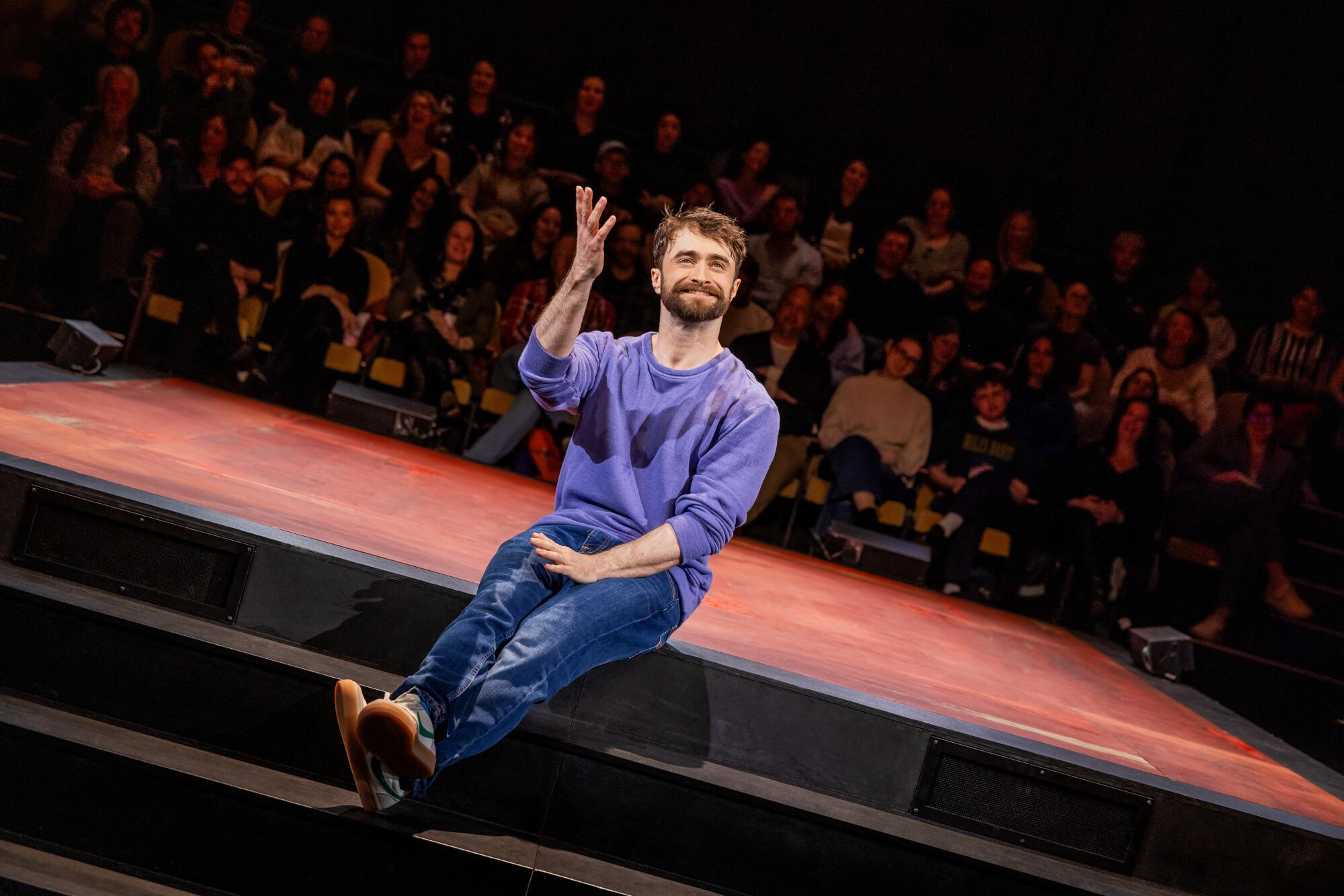
Radcliffe was breathlessly scampering up and down the aisles of the Hudson Theatre before the show began, enlisting audience members to be participants in the play. Having seen “Every Brilliant Thing” twice before, once at the Edye (the black box at Santa Monica’s BroadStage) starring Donahoe in 2017 and once at the Geffen Playhouse’s intimate Audrey Skirball Kenis Theater starring Daniel K. Isaac in 2023, I knew exactly what he was up to.

The play revolves around a list that the narrator began at the tender age of 7 after his mother first attempted suicide. While she was still in the hospital, he started compiling, as much for her benefit as for his own, sources of everyday happiness.

Ice cream, water fights, kind people who aren’t weird and don’t smell unusual. These items are given a number, and audience members assigned a particular “brilliant thing” are expected to shout out their entry when their number is called.

The list gradually grows in complexity as the narrator gets older. Miss Piggy, spaghetti bolognese and wearing a cape give way to more sophisticated pleasures, such as the way Ray Charles sings the word “You” in the song “Drown in My Own Tears” or the satisfaction in writing about yourself in the second person.

Music plays a prominent role in “Every Brilliant Thing,” which was adapted from a monologue/short story Macmillan wrote called “Sleeve Notes.” The narrator’s terribly British father takes refuge from the emotional storms of his household by listening to jazz records in his office. John Coltrane, Cab Calloway, Bill Evans, Nina Simone are favorite artists, and the narrator can tell his father’s mood simply by the record he’s decided to play.

The production, directed by Jeremy Herrin and Macmillan, involves every level of the Hudson Theatre. I assumed I would be safe, occupying an aisle seat in the murderously expensive prime orchestra during a press performance attended by critics. But I wasn’t flashing a pad as my colleague across the aisle from me was doing to ward off any intrusions. And just before the show was about to start, Radcliffe was suddenly kneeling beside my seat asking if the person I was sitting with was my partner.

I told him that we weren’t a couple, just friends, and that I would be the worst person he could possibly ask to perform anything. But Radcliffe wasn’t so easily put off. “Let’s just say that you’re an older couple who have been together for some time,” he whispered. “And all you have to do is hand me this box of juice and candy bar when I refer to the older couple.”

OK, what harm could there be? Little did I know that “older couple” was to become “old couple,” a term that seemed to be repeated incessantly, at least to my Gen X ears not yet accustomed to scurrilous millennial attacks! I composed myself by pretending that we were in the world of anti-realism. But in truth, I would like to be the kind of person who would offer an anxious kid in a hospital waiting room a juice box and a candy bar, so maybe the casting wasn’t so far-fetched after all.

Daniel Radcliffe in the Broadway production of "Every Brilliant Thing."

Daniel Radcliffe in the Broadway production of “Every Brilliant Thing.”

(Matthew Murphy)

A theatergoer was called upon to play the vet who euthanized the narrator’s childhood pet, a dog named Indiana Bones that was symbolized by a coat someone volunteered from the audience. It was the boy’s first experience of death, a difficult concept for a young mind but an important precursor for a boy not given the luxury of existential innocence.

Other audience members, particularly those seated on the stage, played much more elaborate roles. One man, first invited to serve as a stand-in for the narrator’s father, was asked instead to play the boy. He was given one word to say in reply — “Why?” — as his father tries to explain the reason his mother is in the hospital. This same enlisted actor was later called upon to play the dad giving a toast at his son’s wedding, one of the rare occasions when he was able to summon language for the kind of deep feeling he would normally only be able to express through his records.

One kind and patient spectator conscripted to play the school counselor had to remove her shoe to improvise a sock puppet, one of the tools of her empathetic practice. Another audience member sensitively played Sam, the narrator’s love of his life, a relationship that reveals the long-term toll of being raised by a parent suffering from suicidal depression.

Radcliffe’s audience wrangling was as intuitively sharp as his deeply felt performance. He has the comfort of a good retail politician, who’s not afraid of making direct contact with crowds. Two-time Tony winner Donna Murphy, in the house at the reviewed performance, gamely went along when Radcliffe briefly enlisted her luminous services.

Obviously, Radcliffe is the main reason “Every Brilliant Thing” is on Broadway. The show, which began at Britain’s Ludlow Fringe Festival in 2013, is a gossamer piece, a 70-minute curio best experienced in close quarters without the high expectations and ludicrous prices of New York’s turbo-charged commercial theater. The Hudson Theatre lends a mega-church vibe to the proceedings, but the spirits of theatergoers are nonetheless moved.

A scruffy-faced Radcliffe, twinkling accessible geniality in jeans and a sweatshirt, zips up and down the cavernous theater as though waging a one-man campaign against the isolation epidemic. There’s no denying that Harry Potter has matured into an assured stage actor. His Tony-winning performance in “Merrily We Roll Along” should have put to rest any doubts, but the glare of his fame can still obscure his serious chops.

Sincere yet never smarmy, ironic without ever being cynical, well-groomed though far from swank, he’s a more glamorous version of the character than the one originated by Donahoe, the British comedian with an everyman demeanor whose portrayal seemed so genuine at the Edye that I mistakenly thought that the play was his personal story.

Donahoe’s performance was filmed for HBO, but “Every Brilliant Thing” is meant to be experienced in a theater. The whole point of the show is to transform the audience into an impromptu ensemble, a group of strangers emotionally united through the story of one young man’s intimate knowledge of suicide, a subject that Albert Camus called the “one truly serious philosophical problem.”

I’m of two minds about “Every Brilliant Thing.” I was moved once again by the piece, but I’m grateful I didn’t have to wreak havoc on my credit card to pay for my seats. I love the interactive, gentle humanity of the play, but I was also acutely aware of how the work has been commodified. I applaud Radcliffe’s willingness to carve an independent path as an actor, but I might have been more impressed by his adventurousness had he decided to perform in a pocket venue that didn’t have the tiers of pricing I associate with airlines.

Yet launching a conversation around mental health with an audience magnet as powerful as Radcliffe is on balance an excellent thing. And Radcliffe’s compassionate portrayal of a survivor recognizing that he’s not out of the woods just because he made it into adulthood is one of those things that makes a theater lover just a little more appreciative of the humanity at the center of this art form.

Source link

Rangers & Celtic react to Old Firm fan disorder as SFA launch independent review

Rangers say “all parties must be prepared to have their actions and decision-making subjected to proper scrutiny”, with Celtic referencing “serious concerns” raised by supporters about pre-match access arrangements.

The Ibrox club have called for the review to be “thorough and wide-ranging” and to “include the broader context” around the match, from initial decisions on ticket allocation through to the post-match incidents.

Their statement adds: “The disorder that occurred on Sunday was unacceptable and we condemn it unequivocally. Safety must always come first in football, for supporters, players and everyone working in and around the game.

“There are now a number of serious issues which require proper examination. For that reason, we agree that there should be a fully independent review into the events surrounding the match.”

Rangers have vowed to represent the club and their supporters “robustly” but say they will take action – “including the potential withdrawal of ticketing privileges and stadium bans” – against anyone identified and convicted.

The club also say they are “appalled” to discover graffiti mocking the Ibrox disaster, which claimed the lives of 66 supporters in January 1971.

They add: “To desecrate their memory is vile. It is cowardly. It is shameful. This is not football rivalry and it is not banter. It is the abuse of a tragedy that claimed 66 lives.”

Meanwhile, Celtic say they are awaiting a response from the Green Brigade regarding safety and security measures – as required by the police and Glasgow City Council’s Safety Advisory Group – to allow the club “to advocate re-entry” of the banned fan group to Celtic Park.

Source link

Senators seek review of Trump administration handling of Epstein files

March 11 (UPI) — A bipartisan group of senators penned a letter to the Government Accountability Office on Wednesday calling for an investigation into the Justice Department over its handling of the Jeffrey Epstein files release.

The letter accuses the Justice Department of noncompliance with the Epstein Files Transparency Act, the bipartisan law overwhelmingly passed by both chambers of Congress last year. The lawmakers shared concern that the department has still not released all of the files it is required to by the law, despite a December deadline.

Sens. Dick Durbin, D-Ill., Ben Ray Lujan, D-N.M., Jeff Merkley, D-Ore., and Lisa Murkowski, R-Alaska, signed the letter. They also shared concerns about the files that have been released, including victims’ names not being redacted and alleged coconspirators’ names being redacted.

The Government Accountability Office is an independent and nonpartisan agency in the legislative branch. Its purpose is to operate as a watchdog over the federal government, with the authority to investigate and perform audits.

“Contrary to Congress’s explicit directive to protect victims, these records included email addresses and nude photos in which the names and faces of publicly-identified and non-public victims could be identified,” the letter said. “But when it came to information identifying powerful business and political figures who are alleged coconspirators or material witnesses, DOJ appears to have heavily redacted those.”

The senators are requesting that Comptroller General Orice Williams Brown reviews the department’s process it used to review, redact and release the files. They specify that they want the Government Accountability Office to investigate whether the release of the files “has serve to cover up child sexual abuse.”

The Epstein files have continued to be a source of contention between lawmakers and the Trump administration more than two months after the Justice Department was required by law to release the files.

Lawmakers have pushed for answers about the delayed and mistake-filled release from Attorney General Pam Bondi, leading to fiery exchanges in a House Judiciary Committee hearing last month.

The House Oversight Committee issued a subpoena for Bondi’s testimony last week. Five Republicans joined all of the Democrats in the committee in voting for the subpoena.

“This horrific scandal is one where powerful, wealthy men groomed, abused, and raped young women, men, and children,” the letter from the senators reads. “It is critical to understand what led to DOJ’s failure to redact the victims; information and re-victimize those individuals while violating the Epstein Files Transparency Act in its redactions of information related to their alleged abusers.”

Source link

‘undertone’ review: This podcast is sponsored by evil

Everyone’s getting into podcasts — even demons.

“undertone,” a muted, personal and static microbudget horror debut by Ian Tuason, takes place in the writer-director’s actual childhood home where he tended to both of his parents before they died. Both hospice and inspiration, it’s a stifling place decorated with floral wallpaper and crucifixes. The pain and exhaustion and grief are so real and oppressive, the camera never dares set a foot outside.

Upstairs, Evy (Nina Kiri), watches over her own terminally ill mother (Michèle Duquet). Tuason funneled his emotional gloom into this movie; Evy co-hosts a horror podcast with her overseas best friend Justin (voiced by Adam DiMarco). “This is the only thing keeping me sane right now,” she says. They’re words she’ll regret within the week.

Kiri and DiMarco have the comfortable, convincing chemistry of two old pals who have done a show for a while. One snippet seems to be an episode on Elisa Lam, the real-life tourist found dead in the rooftop water tank of Los Angeles’ Cecil Hotel. There’s also a reference to a website with a red-faced ghoul who hypnotizes victims into cutting off their ears. The latter may be Tuason seeding his idea for a sequel.

Here the central story is that Justin, who lives in London, has received an email with 10 audio files recorded by a couple named Mike and Jessa (Jeff Yung and Keana Lyn Bastidas) who are trying to understand what she’s saying in her sleep. The sender is unknown. (Possibly an evil spirit hoping for the exposure of a mattress ad?) Justin, the believer, is instantly alarmed by how these eerie tapes escalate from cute banter to ghostly crying babies and backward incantations. Evy is the skeptic who dismisses the noises as either an online hoax or bad plumbing.

Due to the time zone differential, Evy and Justin record their show just before he heads out to work in the morning, which for her is 3 a.m. Most of the movie takes place in that witching-hour window, an airlessly silent time where an at-home podcaster doesn’t worry about being interrupted by a leaf blower, an ice cream truck or a dog. Sound-designed by David Gertsman, “undertone” is so quiet that a tea kettle sounds like a fire alarm. Story-wise, it’s equally inert. One of the biggest action shots in the first hour comes when — eek! — a sink turns on.

I’d love to understand why horror films that I find excruciatingly dull give others the heebie-jeebies. My working theory is that they tap into audiences with a preexisting suspicion that the world is wicked — they prove paranoia to be well-founded. My mental default is that the world is neutral-good, and that may be why I prefer movies with active villains scaring me out of my complacency. I spent “Paranormal Activity” and “Skinamarink” restlessly admiring the production design; here, my main thrill came from the soundscape, like when a vibrating cellphone made my chair rattle like it was a tractor, or a noise that can only be described as death-rattle ASMR.

When Evy slips her on headphones, she’s so focused making sense of the latest scary tape, playing it forward, reversed and slowed-down, that she’s oblivious to the bumps in the night in her own house, upstairs near her comatose mother’s bedroom. I suspect Tuason deeply relates to Evy, to the disassociation of living with death every day, and uses her resistance to explore denial. She refuses to admit that the supernatural is real, even as she repeatedly takes a break to steady herself and, as she puts it, “get back into character.” Her stifled panic makes it obvious that fear is taking over.

The screenplay also has a passing reference to Evy’s useless, off-screen boyfriend Darren (voiced by Ryan Turner). Their miserable dynamic is compelling but overall comes off like a plot point Tuason stuffed in his pocket and never got around to using. Our one peek into it comes when Darren phones Evy to pressure her to ditch her mom and come to a party. He claims he’s throwing a kegger to cheer her up. (A frozen lasagna on the doorstep would be better, dude.)

Evy does reluctantly leave the house — we don’t follow her there — and that one moment says as much about crossed-signals communication as anything else in the movie. It’s bullseye-accurate about how isolating it is to lose a parent earlier than your peers.

The film is so committed to its rigors — the two-person cast, the glacial camera pivots, the moody lighting — that it teeters on the line of becoming monotonous. When Tuason eases up a bit, say in a scene in which Evy pops on a sleep podcast that begins by describing a babbling brook and rapidly becomes a nightmare tale of bobbing corpses, he finally shows you that he has the potential for range.

But “undertone” is rooted in that slow-and-still horror discipline that holds its breath waiting for something to happen. It requires the audience to bring their own bad vibes to shots of religious icons on the wall and long takes of Evy clacking on her laptop, unaware of a flickering light behind her. (Rumor is Tuason has already signed on to shoot the next “Paranormal Activity” sequel.)

Mostly it puts the audience in the position of watching a protagonist so passive that chunks of the running time are watching her sit at a table waiting for Justin to look up things for her on Wikipedia. Like amateur detectives, we learn alongside them as they click around pages about Sumerian devils, Catholic saints and the origin of the nursery rhymes “London Bridge” and “Baa, Baa, Black Sheep.”

As visuals go, “undertone” is so far removed from anything resembling the cinematic experience that I left with a fresh appreciation for campfire storytelling. At least then the listener gets to use their own imagination. But production designer Mercedes Coyle does dig up two satisfyingly creepy props: one, an antique speaking doll, the other, a small white statue that appears to be the Virgin Mary until we get a better look at her mouth, deformed by a hungry scream.

Despite my quibbles with how her character reacts when things really go awry, Kiri’s Evy has a clarity of purpose that holds our attention despite not having that much to do. In her strongest sequence, she and Justin take a few live callers on their podcast, some of whom bear bad news about Mike and Jessa, and another who phones up in the middle of a crisis that’s too big for these self-positioned experts to handle. Real violence is coming and these armchair ghosthunters are totally out of their depth. Yes, everyone is into podcasts. Maybe they shouldn’t be.

‘undertone’

Rated: Rated R, for language

Running time: 1 hour, 34 minutes

Playing: Opens Friday, Mar. 13 in wide release

Source link

‘Rooster’ review: Steve Carell leads a gentle father-daughter comedy

In “Rooster,” a genial comedy premiering Sunday on HBO, Steve Carell, comfortable as an uncomfortable person, plays Greg Russo, the author of a best-selling series of books whose hero is named Rooster. He has come to leafy, fictional Ludlow College to give a reading, but also because it’s where his daughter, Katie (Charly Clive) teaches art history, and because it’s all over school that her husband, Archie (Phil Dunster), a history professor, has left her for Sunny (Lauren Tsai), a graduate student in neuroscience. He’s a concerned father.

“They are light; they are fun. The characters that you like have sex, the ones you don’t get shot in the face,” Greg tells poetry professor Dylan (Danielle Deadwyler) of the “beach read” books he writes, as she ushers him to an auditorium. Unlike his fictional alter ego, Greg is by his own account a self-conscious introvert, heightened by the fact that his ex-wife, Elizabeth (Connie Britton) — “a philanthropist, a pioneer in corporate gender equality and an accomplished CEO” whose name adorns the school’s new student center — left him five years earlier and he never moved on. Additionally, Greg likes nuts and cocoa, can toss a penny into a jar from across a room, and played minor league hockey, which will put him back on skates here.

College president Walter Mann (John C. McGinley) decides it would be “a feather in his cap” to hire a reluctant Greg, “a best-selling author that the parents have actually heard of,” as an artist-in-residence — a deal he makes impossible to refuse by agreeing to keep Katie on staff after she accidentally burns down Archie’s house. (She was only trying to burn his first edition of “War & Peace.”) It’s a role quite like the one McGinley played/plays on “Scrubs,” but more politic and better dressed, when dressed — he takes meetings in his backyard sauna.

And they’re off.

A woman in a beanie, sweater and dark coat smiles and walks next to a man holding a hot cocoa in his raised hand.

Poetry professor Dylan (Danielle Deadwyler) and author Greg (Steve Carell) become colleagues when Greg is named artist-in-residence.

(Katrina Marcinowski / HBO)

The series was created by Bill Lawrence (“Ted Lasso,” “Shrinking,” “Scrubs,” “Bad Monkey”) and frequent collaborator Matt Tarses, and as men of at least a certain age, the view is slanted from experience back toward innocence; students play a secondary, though not insignificant role in the story. There are some pro forma jokes about the sensitivities of the young, with Greg getting into not-very-hot water over misunderstood references to “white whale” and the Bangles’ “Walk Like an Egyptian.” (“Liberal arts college used to be havens for free thought, Greg,” says Walt. “When did you and I become the bad guys?”) Not that the olds are reliably smart about life — the ways in which they’re not power the series — but they have a better notion of where they’re stupid.

“No one must be humiliated,” Greg says to Archie, quoting Chekhov, as Archie goes off to talk to Katie. (The quote is in the animated opening titles as well, so you can take it as important.) But no one here is out to humiliate anyone, which is nasty and unkind and not at all the sort of humor Lawrence trades in. Of course, characters will be put into embarrassing positions, or embarrass themselves, embarrassment being the root of all comedy, or near enough. (There’s a good bit of slapstick knitted in.) And though we’re told that “there are real villains lurking around this place,” niceness reigns — at least through the six episodes, of 10, available to review — with the possible exception of Alan Ruck as the dean of English. (“There’s no way she wrote all these poems,” he says of Emily Dickinson.)

Though there are couples, and ex-couples and new couples, one doesn’t necessarily feel invested in their getting together, or staying together, or getting back together. Indeed, as in other Lawrence projects — which typically feature divorced or separated characters — romance is a sort of side dish, less the issue than whether people are managing to treat one another well. We knew Ted Lasso wasn’t going to get his wife back, but it wasn’t the point (nor was winning games, really); kindness was what mattered. Greg’s possibly pre-romantic friendship with Dylan is no more significant than his cross-generational friendship with a group of goofball students (led by Maximo Solas as Tommy); they treat each other as peers, while knowing they aren’t. He teaches them that peanut butter can make celery better, and they teach him that he’s cooler than he thinks.

Katie, who says she still loves Archie — who says he still loves her — will also call him “a run-of-the-mill narcissistic a— who sometimes smells like wildflowers.” (As for Sunny, practical and deadpan — that no one gets her jokes is a running joke — not even Archie can see what she sees in him, a problem you might have as well, but, as is true of most everyone here, we’re not meant to merely write him off. Funny secondary characters, who get some of the best business, notably include Rory Scovel as a cop who can’t keep track of his gun, Robby Hoffman as Sunny’s intense, anti-Archie roommate and Annie Mumolo (co-writer of “Bridesmaids”) as Walt’s arch assistant.

Old-but-not-that-old-fashioned, “Rooster” has a tinge of Gen X nostalgia, underscored by the ’80s college radio classics that line the soundtrack. (R.E.M.’s Michael Stipe co-wrote and sings the series’ theme, and Greg, drunk and in a mood, will kill a party getting the DJ to play “Everybody Hurts.” Directed by Jonathan Krisel (“Portlandia,” “Baskets”), it’s low stakes, soft-edged, humane, basically gentle, a little fantastic, a little farcical, well cast and well played in every instance — qualities I happen to like, and maybe you do, too.

Source link