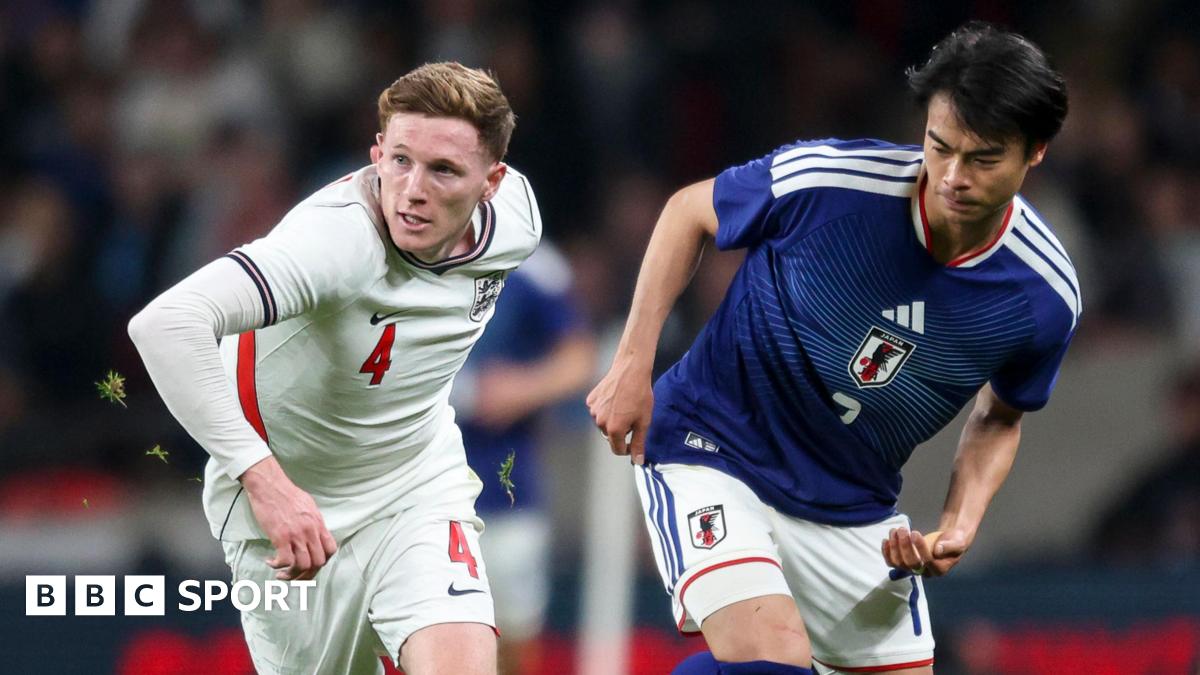
Jordan Pickford: Japan’s opening goal was the first time Pickford had conceded for England in 922 minutes. He had to produce a smart save in the second half to keep the hosts in the game. 6
Ben White: Beaten once early on but showed the consistency he has done for Arsenal after that. A constant hard-working presence down the right-hand side. One particularly good overlapping run in the first half. 6
Ezri Konsa: In with a big chance of starting the first game at the World Cup. One crucial block to deny Ayase Ueda with the shot hitting the bar and going over. 6
Marc Guehi: Given the armband by Tuchel for the first time. A couple of shaky moments early on but after that as dependable as ever. 6
Nico O’Reilly: Another important game for O’Reilly as he makes the left-back position his own before the summer. He showed his ability on the ball and moved into midfield whenever he could. 7
Kobbie Mainoo: A bright start and some nice footwork when moving the ball around midfield. Beaten a couple of times on Japan attacks when trying to defend. 6
Elliot Anderson: A certain starter at the World Cup. Assured in midfield, provided a drive to England’s play and tried to make things happen. One of the better performers on the night and clipped the crossbar with a good effort. 7
Cole Palmer: The Chelsea attacker was given the nod as the number 10 over Phil Foden who played as a false nine. There was always a sense that something could happen when Palmer was on the ball. However, he was caught on the ball and punished for Japan’s opener. Came off just before the hour mark. 6
Morgan Rogers: Started on the right wing and asked to provide a threat through the middle with no natural striker in the starting line-up. Not his best position but did the job that was asked of him. 6
Anthony Gordon: Put in another energetic performance with lots of hard work but not many moments to threaten the Japan defence. 5
Phil Foden: The Man City forward started as a false nine as Tuchel looks for a position for him in England’s squad. It was not a good night for Foden who will be worried about his place on the plane for the World Cup. Replaced in the 59th minute. 5
Welcome back to this week’s Lakers newsletter, where the vibes are immaculate.
The Lakers have won 15 of their last 17 games. LeBron James continues to set NBA records, most recently tying the all-time mark for wins in the regular season and playoffs with Monday’s win over Washington. Jaxson Hayes hasn’t missed a three-point shot all year. The fans who chanted “We want Bronny!” have gotten their wish.
With seven games remaining in the regular season, we turn our focus to a different cheer.
MVP! MVP!
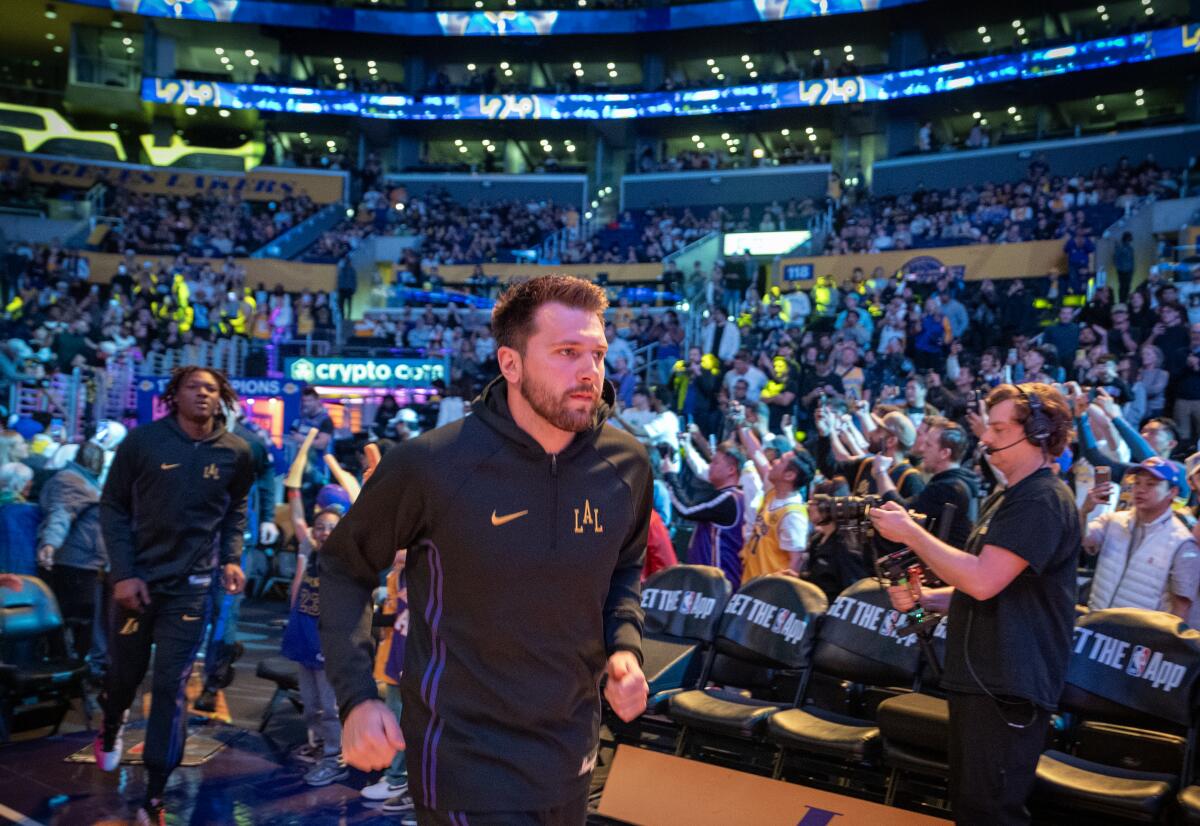
Lakers star Luka Doncic runs onto the court before a game against the Minnesota Timberwolves on March 10 at Crypto.com Arena.
(Allen J. Schaben / Los Angeles Times)
The familiar chant rang out in arenas from L.A. to Miami to Indianapolis. Luka Doncic’s campaign was powerful enough to sway even opposing crowds that showered him with shouts of “MVP.”
With Doncic on a historic season-ending heater, the most valuable player discussion suddenly got piping hot with two weeks left in the season. The NBA’s leading scorer surged back into the race with gaudy numbers over the month of March: 37.2 points, 8.2 rebounds and 7.1 assists per game; 12 straight 30-point games; a 24-hour stretch with 100 points; and the first 60-point performance by a Laker since Kobe Bryant in his final game.
The most important number from March: 14 wins. Approaching the playoffs, the Lakers (49-26) are one of the hottest teams in the league, powered by Doncic’s brilliance.
All things Lakers, all the time.
Get all the Lakers news you need in Thuc Nhi Nguyen’s weekly newsletter.
By continuing, you agree to our Terms of Service, which include arbitration and a class action waiver. You agree that we and our third-party vendors may collect and use your information, including through cookies, pixels and similar technologies, for the purposes set forth in our Privacy Policy such as personalizing your experience and ads.
“If we continue to finish the season the way we’re playing right now, and he continues to play that way, to me, he is the MVP,” Lakers coach JJ Redick said.
Doncic leads the league in scoring (33.7) and is just a hair off from the career-high 33.9 points per game he averaged when he finished third in MVP voting in 2024. Compared to the other top three MVP candidates — Shai Gilgeous-Alexander, Nikola Jokic and Victor Wembanyama — Doncic’s traditional stats paint a competitive picture. He has the second-most assists of the quartet behind Jokic and the third-most rebounds.
Among guards who have played more than 11 games, Doncic ranks third in rebounds per game at 7.8, and his 7.2 defensive rebounds per game is the most of anyone at his position. Doncic’s defense gets picked apart, but he also has a career-best 102 steals. He’s the only player averaging 30 or more points this season with 100 or more steals.
“He’s the engine that’s driving all of our winning,” Redick said.
Advanced statistics have Doncic a tier below his rivals. Doncic’s net rating of plus-4 is a distant fourth among the top contenders and pales in comparison to Wembanyama’s plus-17.3.
Breaking down the MVP race
Jokic appeared to be on his way to winning his fourth MVP before the Nuggets star missed a month with a knee injury. By leading the Oklahoma City Thunder to the best record in the league, Gilgeous-Alexander appeared to be in pole position to win his second consecutive MVP.
Doncic and Wembanyama are making a late charge. The Spurs see the Lakers’ 14-2 record in March and raise them a 25-2 mark since Feb. 1. They won their 10 consecutive game Monday. While Doncic was serving a suspension for technical foul accumulation, Wembanyama scored 41 points with 16 rebounds, four assists and three blocks against the Chicago Bulls.
The MVP chants in Frost Bank Arena are just as loud as anywhere in the league.
All fore one
Lakers guard Austin Reaves shoots a free throw during a win over the Washington Wizards on Monday at Crypto.com Arena.
(Robert Gauthier / Los Angeles Times)
Of all the NBA markets, L.A. presents unique challenges to team building. When Redick played for the Clippers, teammates scattered immediately after practice with hopes of beating traffic on the way home. Redick knew he wasn’t going to drive hours from his home in Manhattan Beach to visit Chris Paul in Calabasas.
But for the Lakers, a round of golf is worth a drive on the 405.
“Finding tee times, being with each other for four hours where you can shoot the proverbial S-H-I-whatever and not have to be in a high pressure moment or on a team bus and kind of be away from the facility,” Redick said, “I think it’s great.”
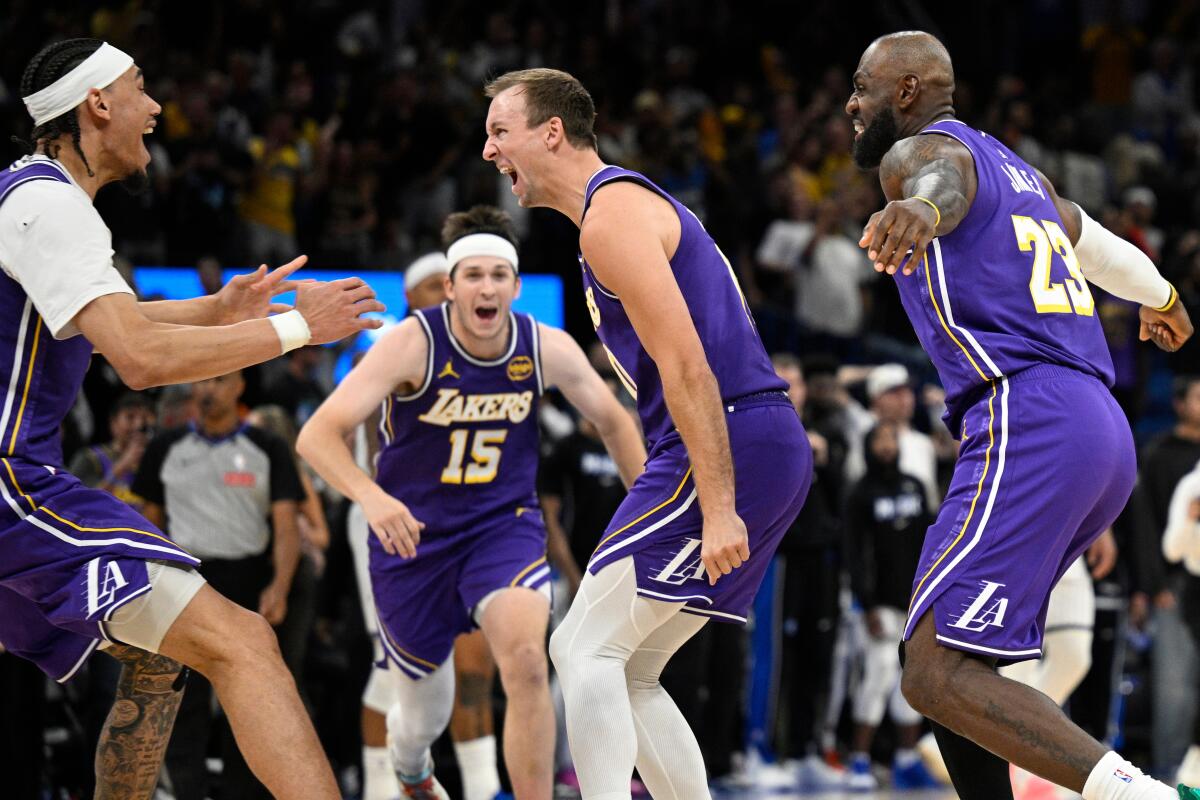
Golf is the Lakers’ latest bonding activity that’s helped keep the vibes high through the most successful stretch of the season. The Lakers have been intentional with team-building activities in Redick’s second year at the helm. All players and coaches made autobiographical powerpoint presentations to the team during the preseason. Jake LaRavia and assistant coach Beau Levesque won the team-wide pickleball tournament in November. Players and coaches arrange golf outings between games on long road trips. One day after hitting the winning shot in Orlando, newest teammate Luke Kennard got in on the golf action in a scramble match with players facing coaches.
“They had AR,” Redick said sheepishly, “so we can all guess the result of that one.”
Austin Reaves is the leader in the clubhouse. He remembered when teammates gave him grief about his love of golf, which he picked up at 17 and almost immediately excelled at. Seeing his teammates embrace the game “actually means a lot to me,” Reaves said.
“I’m glad that they are addicted,” he added with a satisfied smile.
After the COVID-19 bubble, Redick noticed an uptick in golf’s popularity around the league. Even the Lakers have a handful of players who suddenly decided to start during the last year. Doncic is the most recent convert. He bragged that he beat Reaves on one hole when they played in Indianapolis. Reaves, who got a double bogey compared to Doncic’s bogey, said he let his teammate win.
“It’s a confidence thing,” Reaves said. “We needed him to be at his best at 7 o’clock tonight.”
Doncic scored 43 points against Indianapolis the day after the golf outing.
On tap
Cleveland’s Jarrett Allen shoots between Detroit’s Cade Cunningham, left, and forward Tobias Harris on March 3.
(Sue Ogrocki / Associated Press)
Tuesday vs. Cleveland (47-28), 7:30 p.m. PDT
Center Jarrett Allen returned last week from a 10-game absence, but missed Cleveland’s game on Monday in Utah as he managed right knee tendinitis. Missing the first game of a back-to-back indicates that he’ll likely be available against the Lakers.
Thursday at Oklahoma City (60-16), 6:30 p.m. PDT
The Thunder have won 15 of their last 16 games with the only loss coming against Boston. This game and next week’s rematch at Crypto.com Arena could be critical in the MVP race between Gilgeous-Alexander and Doncic.
Sunday at Dallas (24-51), 4:30 p.m. PDT
Since the trade heard ‘round the league, Doncic has averaged 33 points, nine rebounds and 10 assists in four games against his former team. It’s his highest scoring average against any Western Conference opponent.
Status report
Marcus Smart (right ankle contusion)
Smart remains day-to-day with an ankle injury he sustained against Orlando. He has missed four games.
Adou Thiero (left knee soreness)
The rookie forward landed back on the injury report after playing two minutes in the Lakers’ loss to Detroit. Redick said Thiero was held out for precautionary reasons after his knee didn’t react well to playing in a G League game then playing in Detroit two days later. Thiero previously missed six weeks with a right medial collateral ligament sprain and underwent surgery on his left knee in college, which kept him sidelined at the beginning of the season.
Favorite thing I ate this week
(Thuc Nhi Nguyen / Los Angeles Times)
I have had Ramen Nagi on my list for literal years because former USC center Brett Neilon — who grew up in Tokyo — recommended it. I have changed beats three times since then but never forgot what he said was his favorite ramen place in L.A. The red king, which is a spicy version of their pork broth ramen, was worth the years of anticipation. Every bowl is customizable so I loved getting to add thick ramen noodles.
The Final Four in men’s and women’s basketball is scheduled for this weekend, and Southern California has two players to root for who were high school graduates from the area.
McDonald’s All-American Brayden Burries, a freshman at Arizona from Eastvale Roosevelt, has been a key player in the Wildcats’ season, averaging 16.1 points.
Gabriela Jaquez has helped the UCLA’s women’s team reach the Final Four, averaging 13 points a game for the 35-1 Bruins.
The men’s semifinals and final are Saturday and Monday at Lucas Oil Stadium in Indianapolis.
The women’s semifinals and final are Friday and Sunday at the Mortgage Matchup Center in Phoenix.
This is a daily look at the positive happenings in high school sports. To submit any news, please email eric.sondheimer@latimes.com.
Within the first 72 hours of a 26-day game, “Survivor 50,” featuring 24 veteran players, had already delivered feuding, anguish and heartbreak. Legendary rivals Ozzy Lusth and Benjamin “Coach” Wade appeared to bury the hatchet, only for their conflict to reignite soon after. Kyle Fraser was forced out due to injury, and Jenna Lewis-Dougherty, who competed in both the show’s inaugural season and “All-Stars,” was the first person voted out after more than two decades away from the game.
Yet there were also moments of nostalgia, connection and excitement as returning players arrived on the beach, grateful to be part of the show’s landmark 50th season.
This raw display of humanity has kept the show’s torch burning for over 25 years. “‘Survivor’ is built on a timeless idea because human nature doesn’t change,” says Jeff Probst, the host, executive producer and showrunner of the reality competition series. “It’s essentially behavioral psychology in the wild.”
Back in Fiji’s Mamanuca Islands for “Survivor 50: In the Hands of Fans,” the show has added a novel element. Fans were given a say in key decisions, voting online to shape production and game mechanics, from choosing tribe colors to requiring castaways to earn rice and supplies instead of receiving them at the start.
“What a great twist,” says Wade in an interview over Zoom. “‘In the Hands of Fans’ transforms the game. Instead of it being, ‘They are playing,’ it’s ‘We are playing.’”
Though he was disappointed to be deprived of staples upon his arrival, he smiles and says that if he were watching at home rather than competing, he also would have wanted players to start with nothing.
Singer-songwriter and “Survivor” superfan Zac Brown coooked and performed for contestants on the show.(Robert Voets/CBS)
“Survivor” has also leaned into its famous fan base this season, bringing in self-proclaimed superfans, including Grammy-winning singer-songwriter Zac Brown — who appeared in Episode 4 as a reward for a winning tribe for whom he spearfishes, cooks and performs. The show also nods to Billie Eilish via the Billie Eilish Boomerang Idol featured in the season premiere. The game piece was handpicked by the Oscar- and Grammy-winning pop star — whose 2022 song “TV” references “Survivor” — and accompanied by a letter in which she outlined its instructions.
But Mike White, creator of “The White Lotus,” represents the show’s most intertwined cultural crossover. He drew inspiration for his hit HBO series from “Survivor” and cast several former tribemates in cameos. “Survivor 50” also features “The White Lotus” Easter eggs.
Returning to the franchise for the first time since he finished as runner-up in 2018, in the Season 50 premiere he says, tearfully, “There are times in ‘White Lotus’ where I’m so fried … it’s a 129-day shoot, but I look back on my ‘Survivor’ experience, and I’m like, ‘Dude, I did that and I can do this.’” Yet White’s hard-won resilience couldn’t protect him from being voted out in a blindside in Episode 4, proving that fame offers no immunity.
And that is the point. At its core, “Survivor” is about watching people from all walks of life dropped into a remote, unforgiving landscape where they must outwit, outplay and outlast one another for a $1 million prize — hungry, exhausted and sore, roasting in the blazing sun or shivering through rainstorms, and enduring grueling physical competitions. They must cooperate with the very people they’re competing against. And as alliances form and fracture, each day grows more fraught.
Former “Survivor” contestants Mike White, left, and Quintavius “Q” Burdette in Season 50.
(Robert Voets/CBS)
“It’s very simple but very deep,” Probst says. “The goal is not to get voted out, but the strategy in achieving that goal is infinite, so the game’s easy to understand, but it’s impossible to master. That’s why it’s so much fun to watch. You’re constantly asking yourself, ‘What would I do?’”
It’s one thing to ask from the comfort of home, but another to live it out, and on national television to boot, says Wade. Coach “When you step on that beach, the stakes are so much higher,” he explains. “Nobody really thinks about the million dollars. They’re thinking about surviving, not getting voted off.”
“Most people would be able to do it,” he continues. “But what you’d realize is what happens to your character and your facade when you’re deprived of everything — food, comfort, reaching out to your friends and having a support system that you know and trust. When you strip all of that away, this stops being a game, and your character will be forged, revealed or shattered.”
A four-time player, Season 23 runner-up and 2015 Survivor Hall of Fame inductee, Coach is one of the show’s most legendary figures. Known as the Dragon Slayer, he’s often shown meditating, praying, waxing philosophical, and pontificating on nobility, integrity and honor. His grandiose persona rubbed many the wrong way early on, earning him a villain label.
Reflecting on his legacy, Wade partly blames the edit but acknowledges he often took himself too seriously, was arrogant, and tried too hard to be larger than life, yet he stresses his authenticity. “The way I look, dress and talk — I’m polarizing,” he says. “That’s who I am in my real life, so that’s who I am out there.”
Probst affirms that what you see is what you get. “Coach shows up authentically every day,” he says. “He wears his mythology on his sleeve and has it tattooed on his body. When he pulls back his hair into a ponytail and quotes Magellan, that’s Coach: ‘I’m the guy with quotes about war and victory and fearlessness and courage. That’s actually who I am.’”
This season, Wade calls himself “Coach 4.0,” but Probst remains skeptical. “Every time he plays, Coach refers to himself as the new version of Coach,” Probst says. “But the minute he starts talking, everybody thinks the same thing: ‘Coach, you may have some more maturity and life experiences now that you’re married and have kids, but you’re exactly the same.’”
That’s not a critique of Coach. After observing more than 750 players over 25 years, Probst believes, “We are capable of much more than we think we are, and simultaneously, at our core, we generally are who we are. It doesn’t mean you can’t change or become a better version of yourself, but you’re going to have some core instincts.”
Benjamin “Coach” Wade in “Survivor 50.” (Robert Voets/CBS)
Coach in 2011’s “Survivor: South Pacific,” the show’s 23rd season. (Monty Brinton/CBS)
The show’s unflinching exploration of human nature traces back to visionary British television producer Charlie Parsons. He conceived the social experiment based on a combination of his curiosity about people, the influence of “Lord of the Flies” and “Robinson Crusoe,” and his boarding school experience.
“It was an all-boys school and quite a competitive place, so there was an element of survival in that,” Parsons says over Zoom. “It wasn’t a bad experience, but if you’re 13 and you’ve never lived away from home before, it can be quite a wrench to live for a month at a time away from your parents. On one occasion I called my parents and said, ‘Will you rescue me?’ And they didn’t.”
In 1988, Parsons turned his concept into “The Castaways,” a three-part documentary for a magazine-style television program he was showrunning.
Several years later, he was approached by Disney’s Buena Vista Productions to make an American version of a successful British morning show he created. When that didn’t pan out, he pitched what would eventually become “Survivor,” developing it with Buena Vista in hopes of selling it to ABC.
But, he says, the radical concept didn’t fit neatly into existing TV genres, and the network balked. “It’s difficult to imagine, but back in the ‘90s this idea of reality TV basically didn’t exist,” Parsons says. “Television was reasonably siloed … ABC took a long time deciding because they could see that there was something about it, but in the end they passed.”
In 1997, however, the concept found immediate success in Sweden with “Expedition Robinson,” leading to expansion in more Scandinavian countries.
The leap to America required a new alliance. During Parsons’ development process with Buena Vista, he’d met fellow British TV producer Mark Burnett at a party in Los Angeles where he’d told him about the reality competition format he was building. Burnett then called every six months pressing to produce it until Parsons finally agreed to grant him the American licensing rights.
“Mark had an incredible energy and presence, which meant that he could go and sell the s— out of it,” Parsons says. “He could persuade the networks to take a risk on something risky.”
Even so, as Burnett relayed in a comprehensive 2010 Television Academy interview, he faced a difficult pitching process. But after every major network passed, he re-approached CBS, where then-CEO and President Les Moonves was game to try original programming during summertime when reruns caused dwindling viewership. But when Moonves commissioned a pilot, Burnett said a stand-alone episode was too costly and couldn’t capture the show’s slow-burn endgame.
Instead, he proposed a sponsorship model built on integrating products into the game, pitching the value of a castaway using a branded cellphone to call home, or the desperation for a slice of pizza and a beer. After Burnett secured corporate sponsors, Moonves greenlighted “Survivor.”
Though firmly embedded in the culture today, “Survivor” was revolutionary when it debuted May 31, 2000, quickly becoming a cultural phenomenon. The Season 1 finale averaged 51.7 million viewers, surpassing both the Academy Awards and Grammys that year. Time magazine featured Lewis-Dougherty on its late June 2000 cover, and “The Late Show With David Letterman” featured a “Survivor”-themed Top 10 list presented by the show’s 16 castaways.
From its exotic location to the now-iconic buffs, “Survivor” established a world all its own, complete with a unique lexicon of immunity challenges, tribal council and Probst’s signature catchphrase, “The tribe has spoken.” As the enduring face of the show, Probst is central to its legacy, earning four Emmys for his role as host.
But even Probst’s survival wasn’t guaranteed. About 15 years ago, the relentless travel and schedule left him so depleted that he briefly quit the show. A few months of rest, however, allowed him to reevaluate. “It really was, ‘I don’t know if I have anything left in my tank to bring to the game.’ That might be what partly influenced Mark to make me showrunner even faster,” Probst says. “I needed to be more of a storyteller on this show.”
The cast of “Survivor” Season 1, standing from left: Ramona Gray, Dirk Been, Gretchen Cordy, Richard Hatch, Sonja Christopher, Susan Hawk, Kelly Wiglesworth, Sean Kenniff, B.B. Andersen and Rudy Boesch. Seated from left: Gervase Peterson, Jenna Lewis, Joel Klug, Stacey Stillman, Greg Buis and Colleen Haskell.
(Monty Brinton/CBS)
He’s quick to note the show’s collaborative ethos, however. “The term ‘showrunner’ is pretty misleading at this point. We make this as a team,” Probst says. Under his stewardship, “Survivor” is more cinematic, reimagined through the lens of Joseph Campbell’s “The Hero’s Journey,” and family friendly. Probst also notes the necessity of continually evolving game design, creating unexpected twists and advantages to keep players on edge and never knowing whom to trust.
The pandemic brought changes as well. With production shut down amid a world in turmoil, Probst felt “Survivor” needed more levity. When filming resumed, due to the 14-day quarantine requirement, back-to-back seasons were shot and the format was shortened from 39 days to 26. The faster-paced “New Era” that began with Season 41 also coincided with CBS’s 2020 diversity mandate requiring at least 50% of the cast to be nonwhite, and Probst dropped his longtime catchphrase “Come on in, guys” in favor of more inclusive language.
By Season 45, in keeping with Probst’s narrative-driven vision, the previously hourlong episodes expanded to 90 minutes.
Television habits have also changed since viewers once dissected tribal council proceedings at the office the next morning. Streaming breathed new life into “Survivor,” with younger viewers discovering it during the pandemic, while its cross-generational appeal keeps it a broadcast powerhouse. The Season 50 premiere drew 9.1 million viewers across live broadcast and delayed streaming, and in the weeks leading up to the launch, viewers revisited older seasons, boosting streaming numbers ahead of the anniversary.
According to Mitch Graham, CBS executive vice president of alternative programming, “Survivor” ranks No. 1 in the coveted 18 to 49 demographic, and the Season 50 launch generated the biggest social media engagement in the franchise’s history.
Even as the reality TV landscape has grown crowded, Probst remains unfazed. “It’s a show like no other,” he says. “It’s adventure, survival, strategy, interpersonal relationships, social politics. … This multi-layered storytelling gives it durability because any given week you have no idea what you’re going to watch.”
Meanwhile, as Season 50 continues to unfold, no one knows who will be crowned “Sole Survivor” on May 20 in Los Angeles, the show’s first live finale since 2019. But rest assured, by then they’ll have revealed exactly who they are.
Darius Garland added 15 points and 11 assists and Derrick Jones Jr. 13 points for the Clippers, who made 45 of 77 shots (58.4%).
Gary Trent Jr. had a season-high 36 points to pace Milwaukee, which had only eight players available. Taurean Prince added 18 points and AJ Green scored 15 for the Bucks, who have lost 10 of their last 12 games.
The Bucks stayed close early, trailing 29-25 after one quarter with Trent scoring 11 points, including sinking three of five from three-point range.
The Clippers began to pull away in the second, holding a 57-46 lead at the half after leading by as many as 16. Leonard had 15 first-half points.
Brook Lopez, a member of the Bucks’ 2021 NBA championship team, was honored with a video tribute in his first visit back to Milwaukee. He was whistled for a technical foul as the teams were headed to the locker room at halftime.
The Clippers outscored Milwaukee 39-28 in the third and extended its lead to as many as 24 points in the fourth before the Bucks pulled within 11 in the late stages.
Sloppy play hurt Milwaukee, which committed 22 turnovers leading to 33 Clippers points.
Giannis Antetokounmpo sat out a seventh consecutive game for Milwaukee with a left knee hyperextension and bone bruise. The two-time MVP has played in a career-low 36 games this season.
The Bucks also were missing Kevin Porter Jr. (right knee), Bobby Portis (left wrist sprain), Kyle Kuzma (Achilles tendinopathy), Ryan Rollins (left hip flexor), Myles Turner (right knee), Gary Harris (personal reasons) and Thanasis Antetokounmpo (left calf).
Green and Ousmane Dieng fouled out in the fourth, leaving the Bucks with six available players to finish the game.
Up next for the Clippers: vs. the Portland Trail Blazers at Intuit Dome on Tuesday.
Three weeks into spring practice, USC football coaches are making one thing clear: 95% of their best will not be accepted or tolerated. Wednesday’s practice started with some of the players doing up-downs after forgetting equipment.
“It was a good message from some of our staff and leaders in terms of the approach that we need to have every day that we come out here,” Trojans coach Lincoln Riley said.
A sentiment that was shared by junior defensive tackle Jide Abasiri: “We just have to be better prepared.”
After the hiccup, Riley said the team responded well and it was back to business.
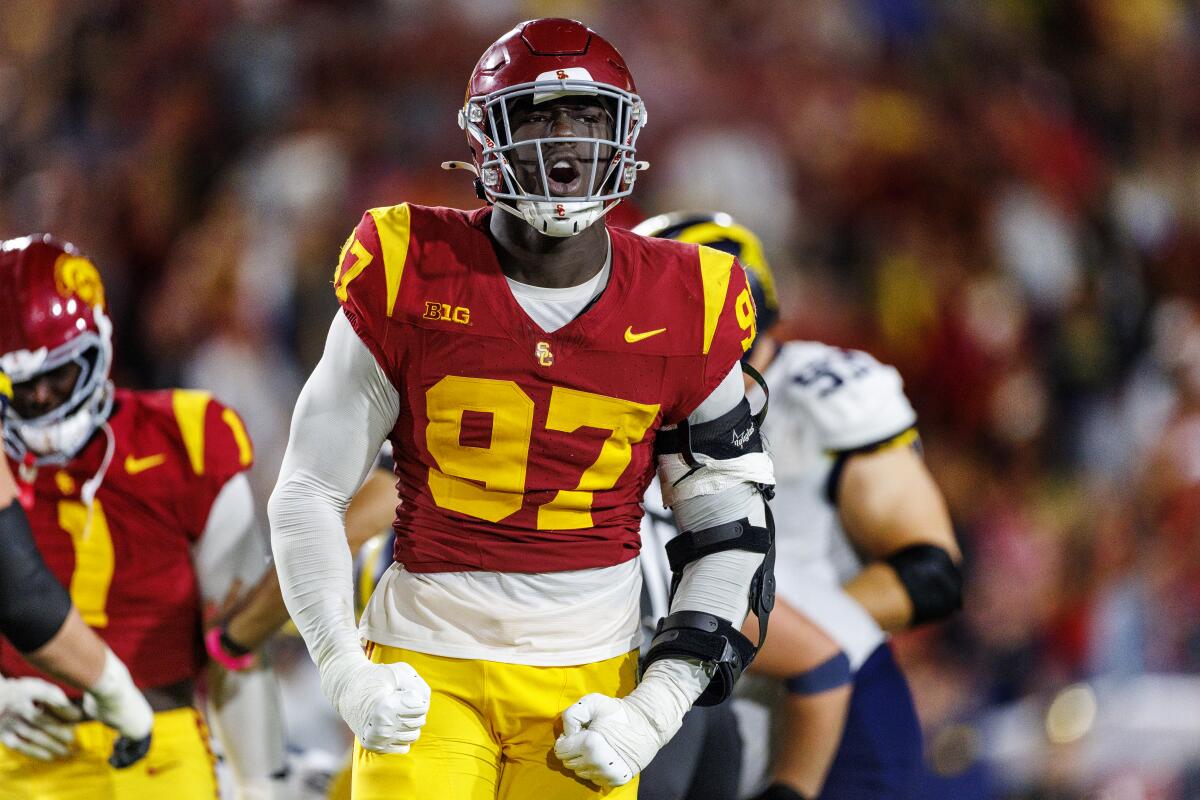
USC defensive tackle Jide Abasiri (97) is pushing himself to be a more vocal leader as a the Trojans help young players get acclimated to the program.
(Gina Ferazzi/Los Angeles Times)
After a spirited day on the field on Tuesday following a one-week spring break, Wednesday’s practice was scripted with the intent to cause stress and create discomfort — stacking multiple two-minute drills after a 6 a.m. team meeting. The goal is to build a no-excuses program.
“It’s invaluable time, invaluable reps,” Riley said. “Coming out and working plays and the techniques, great. When you start putting those guys in real-life situations and you make it really difficult on them, you really start to see who rises up and they’re great teaching moments for these guys and for the team in terms of what we want to be and what we want them to be.”
Regardless of the mental challenges Riley applied, the Trojans’ morale remains positive as players compete for spots in the lineup. The energy of the team comes from within, Riley said.
“It allows us as a staff to really hone in on pushing these guys, and coaching and critiquing and correcting,” Riley said. “And they’re taking it well.”
Attention to detail has always been important at USC, but Abasiri said this year there is an extra emphasis being placed on play-specific details. The staff has implemented drills that focus on a player’s specific movement or job during various plays.
Entering his third season with the Trojans, Abasiri said he felt like he needed to be a team leader. USC landed the No. 1 class in the nation for the first time since 2006. With so many new young players joining spring practice and a limited number of Trojans with three years of experience, Abasiri felt it was his job to lead.
“Just being an older guy, I feel like it’s important for me to … help them just come along,” Abasiri said.
So far, his advice has been to “just have fun with it.”
“I mean, obviously, stay on top of everything and all your stuff, but I feel like people get so stressed and so caught up in what they’re doing that they forget that this is supposed to be enjoyable,” Abasiri said.
The coaching staff, meanwhile, is balancing teaching schemes and the playbook.
“You have to be able to do both at this level,” Riley said. “The new guys that came in did have a pretty good foundation. A lot of them came from really good programs. A lot of them had a pretty good working football knowledge to where when we got started with them, it wasn’t like you felt like you were starting from literal square one.”
Return game is still unsettled
USC is still working to identify its top kickoff and punt return options.
“We haven’t done a lot of live returns yet,” Riley said. “We’re just trying to figure out who really fields the ball well, who understands it, who makes decisions and honestly, the returners, they’re showing us a lot of what they can do just in the offensive and defensive periods.”
The coaching staff has a pretty good idea who some of the best players in that position are, but at the moment, they just want to develop the skills, from a return standpoint.
For Nareg Kopooshian, the basketball coach at AGBU High in Canoga Park, there’s a big summer ahead. He’s going to be the head coach for the U16 Armenian national team in the FIBA U16 EuroBasket competition July 4-12 in Yerevan.
It’s the first time Armenia is hosting the event.
Los Angeles has the largest Armenian community in the United States with as many as 700,000 people.
Players selected for the training camp in Armenia include Anthony Sarkesian (Chaminade), Anthony Karayan (Village Christian), Ethan Kazanjian (AGBU), Edward Gemjian (La Canada) and Jivan Dorian (AGBU).
This is a daily look at the positive happenings in high school sports. To submit any news, please email eric.sondheimer@latimes.com.
The Major League Baseball Players Assn. is arguably the strongest union in the United States whose members include some of the most conservative athletes in professional sports. The owners of Major League Baseball’s 30 teams, who made their wealth through the workings of free enterprise capitalism, want to limit what players can be paid. This apparent political and philosophical irony will most likely lead to a shutdown of baseball at the end of this season.
Wednesday is opening day for the 162-game major league season. The 2025 season ended Nov. 1 with an 11-inning Dodgers victory over the Toronto Blue Jays in what was one of the most mesmerizing World Series ever. Last season, the Dodgers attracted more than 4 million fans for the first time. The Dodgers weren’t alone. More than 71 million fans attended major league games — the third straight season of growth. Over the last decade, league revenue has increased 33%.
And yet, despite all this good news about the health of baseball’s finances, team owners have threatened to lock the players out — essentially an ownership strike — at the end of this season over terms of a new collective bargaining agreement soon to be negotiated with the players union.
Major League Baseball, unlike the NFL, the NBA and the NHL, does not have a hard salary cap that limits what teams can spend on players. This is the key issue for the 30 team owners and Commissioner Rob Manfred, who argues that the system is “broken.” Small-market teams can’t effectively compete, Manfred insists, with economic behemoths like the Dodgers and Yankees. But over the past 10 seasons, 14 teams have made it to the World Series, so the league is not dominated by only a few big spenders.
Major leaguers and fans have weathered five player strikes and four owner lockouts since 1972. The 1994-95 strike lasted 232 days, canceling more than 900 games, including the World Series. Unlike in the NFL, where top players like San Francisco 49ers quarterback Joe Montana crossed a picket line during the 1987 NFL Players Assn. strike, unionized baseball players have remained united. So far, no star players have been strikebreakers in baseball. Both Paul Skenes of the Pittsburgh Pirates and Tarik Skubal of the Detroit Tigers — the 2025 Cy Young Award winners for their respective leagues — also serve in players union leadership roles.
A recent report analyzing major league ballplayers’ political affiliation found that among those who live in states that allow public access to voter registration records, nearly 54% of the players were Republicans compared with 8% Democrats. Why does a rightward-leaning membership retain such strong union loyalties?
For Miami Marlins pitcher Pete Fairbanks, who is also a member of the players union leadership, it comes down to recognizing that they stand on the shoulders of players who challenged the baseball establishment.
“If you look at the history of the union, we’ve had a foundation set for us,” Fairbanks said. “They fought for players’ rights and for the general betterment of the whole and it’s the job of the veteran players to pass that history on to the younger players.”
Marvin Miller, a former Steelworkers Union leader, revolutionized the players’ union and baseball when he led the association from 1966 to 1982. He told the New York Times in 1999 that he was “irked” that many players did not know that it was the union that made their enormous salaries and benefits, arbitration and free agency possible. “When you don’t know your history, you tend to relive it,” Miller said.
Miller, who died in 2012, was a labor history buff who realized that highly skilled workers often developed elaborate ethical codes that promoted solidarity with other employees.
Bruce Meyer, the current executive director of the players association, puts the union’s fractious history with the owners at the center of his communications with players. He spent weeks talking with union members during spring training in Florida and Arizona, emphasizing the importance of unity in the ranks. “The bottom line is that our players have always been of the view that they are fighting not just for themselves but for their teammates and for the players that come after them,” Meyer said.
Manfred’s strategy as commissioner of Major League Baseball has been to talk directly with the players himself, especially the lower-earning younger players who he claims are being shortchanged. He argues that “10% of our players make 72% of the money,” numbers that Meyer disputes.
The commissioner is essentially telling players that their union has engaged in malpractice, losing touch with its own members while the economics of baseball changed around them. Meyer regards Manfred’s attempt to divide players as “standard management-labor tactics.”
Top agent Scott Boras said that, unlike in the NFL, baseball’s open salary system works for players because “your talent allows you to earn what you can earn without taking money from anybody else’s pocket.”
Paradoxically, the union has embraced the principles of Adam Smith: Let the free market work. No one forced the Dodgers to pay Shohei Ohtani $700 million. Good for Ohtani, great for Dodger fans. And this year, the Japanese clothing retailer Uniqlo will be a field sponsor at Dodger Stadium. The owners, who embrace team revenue sharing and luxury taxes and demand restrictions on salary competition, sound like socialists.
When labor-management disputes interrupt baseball, many fans undoubtedly feel like they are victims of a squabble between “millionaires and billionaires.” Ryan Long, a 26-year-old minor league pitcher in the Baltimore Orioles system and a union leader, thinks the players association should try to understand how regular working people feel about a potential lockout. “Whether it’s people selling hot dogs at stadiums or cleaning rooms at local hotels, the union should help in whatever way it can for other workers who may be hurt if baseball shuts down,” he said.
In late February at the Yankees spring training field in Tampa, I spoke with season ticket holder Richard Barnitt, who wore a shirt designed like a baseball, looking like he could be scuffed up and pitched. “There has to be some kind of cap because the Dodgers and the New York Mets had unlimited money,” he said. Another fan, Carlos Rodriquez, an airplane mechanic living in Tampa, disagreed. “I don’t think a salary cap would be fair to the players,” he said. “The players association does magical work for those guys.”
If locked out, the players are going to want support from fans, to whom a salary cap might sound reasonable. Owners will do what owners do: maximize profits and franchise values. The players union should find ways to show the fans they are not forgotten.
During a previous owners lockout, the association created a million-dollar fund to help pay the bills of stadium concession workers who were thrown out of work. They can do the same again, letting fans know that they understand that most Americans struggle paycheck to paycheck. And maybe Ohtani can chip in a couple hundred bucks — like former Dodger Mike Piazza did decades ago — for each home run.
Kelly Candaele produced the documentary “A League of Their Own,” about his mother’s years playing in the All-American Girls Professional Baseball League.
The Astros had been a mainstay atop the AL West for eight years — claiming seven division titles during that time — but now the division appears to be under new management.
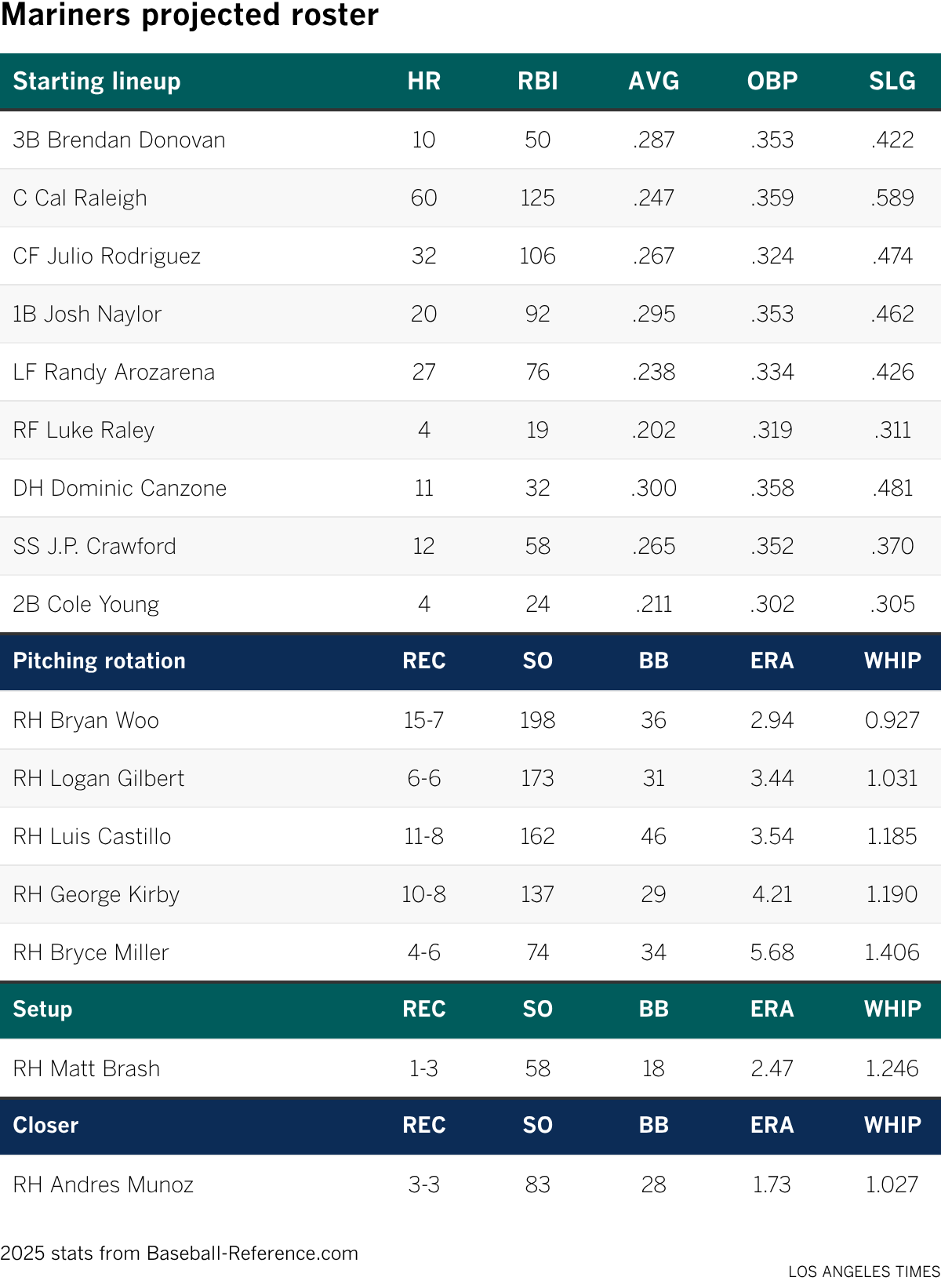
Last season, the upstart Mariners finally broke through after years of promise, winning 90 games and claiming their first division crown since 2001. This season, the club hopes to take the next step forward and reach the World Series for the first time in franchise history. Seattle locked up cleanup man Josh Naylor to a five-year, $92.5-million contract, solidifying their lineup. The M’s also traded for super utilityman Brendan Donovan, who, as a member of the St. Louis Cardinals, was named an All-Star for the first time in his career last season.
The Astros, in their third year under manager Joe Espada, are hoping to return to the top of the division. They’ll have their work cut out for them, with just seven players remaining from the Astros’ 2022 World Series team.
Even after a pair of mediocre seasons, the Rangers remained aggressive this winter, making a pair of blockbuster trades, acquiring frontline starter MacKenzie Gore from the Nationals and outfielder Brandon Nimmo from the Mets. Ex-Marlins manager Skip Schumaker will take the reins from four-time World Series champion Bruce Bochy, who did not return as the club’s skipper.
Entering their second season playing in Sacramento, the Athletics grabbed veteran Jeff McNeil from the New York Mets in a trade, while locking up promising youngsters Tyler Soderstrom and Jacob Wilson to long-term extensions. The Angels installed rookie manager Kurt Suzuki, replacing Ron Washington.
1 | Seattle Mariners
2025 | 90-72, 1st in West
Last year in playoffs | 2025
After bidding farewell to Eugenio Suárez and Jorge Polanco, the Mariners are betting on young infielders Cole Young and Colt Emerson. Newcomer Brendan Donovan should provide a nice spark to the M’s lineup. 26-year-old Bryan Woo emerged as the club’s ace last season while George Kirby missed the first two months with shoulder inflammation and was never quite right. A healthy Kirby could make a huge difference this season for an already formidable M’s rotation.
2 | Houston Astros
2025 | 87-75, 2nd in West
Last year in playoffs | 2024
Even after an offseason in which the Astros lost stars Kyle Tucker, Alex Bregman and Justin Verlander, the team still led the West for most of the season in 2025. One player to watch will be second-year outfielder Cam Smith, who the Astros acquired as the centerpiece of the Tucker trade. It was a tale of two seasons for Smith, who dazzled with a .297/.357/.443 slash line through his first 75 big league games, but hit a snag over his next 59 games, slashing just .153/.248/.232.
3 | Athletics
2025 | 76-86, 4th in West
Last year in playoffs | 2020
Two years after losing 112 games, the A’s showed encouraging progress in their first season in Sacramento. First baseman Nick Kurtz ran away with AL rookie of the year honors, winning the award unanimously, with shortstop Jacob Wilson placing second. Between Kurtz (36), catcher Shea Langeliers (31), designated hitter Brent Rooker (30), left fielder Tyler Soderstrom (25) and right fielder Lawrence Butler (21), the A’s had five players hit for 20 or more homers last season.
4 | Texas Rangers
2025 | 81-81, 3rd in West
Last year in playoffs | 2023
The Rangers have posted just one winning season over the last 10 years, and it came in 2023, the same year that the club won its first-ever World Series. In order for new manager Skip Schumaker to return the Rangers to form, he’s going to need his position players to bounce back in a big way. Freshly-acquired MacKenzie Gore should add length to the Rangers’ rotation, while former Vanderbilt teammates Jack Leiter and Kumar Rocker will have an opportunity to establish themselves as formidable major league starters.
5 | Angels
2025 | 72-90, 5th in West
Last year in playoffs | 2014
The Angels upped their win total by nine games from 2024 to 2025, and the club could continue to progress in its first season under rookie manager Kurt Suzuki. General manager Perry Minasian enters the final year of his contract, after the Angels failed to post a winning record in each of his first six seasons.
Welcome back to this week’s Lakers newsletter, where we are remembering that all good things must come to an end.
The Lakers’ longest winning streak since the 2019-20 season ended in Detroit on Monday much in the same fashion that it was built. The Lakers announced themselves as a legitimate playoff threat by piling up thrilling, clutch time wins. Another team’s clutch time win snapped the Lakers’ nine-game streak. Win or lose, the Lakers are finding new lessons in every one of the close games.
All things Lakers, all the time.
Get all the Lakers news you need in Thuc Nhi Nguyen’s weekly newsletter.
By continuing, you agree to our Terms of Service, which include arbitration and a class action waiver. You agree that we and our third-party vendors may collect and use your information, including through cookies, pixels and similar technologies, for the purposes set forth in our Privacy Policy such as personalizing your experience and ads.
Bend but don’t break
Luke Kennard, second from right, celebrates after his winning basket.
(Phelan M. Ebenhack / Associated Press)
The missed shots. The missed calls. Every missed opportunity against the Orlando Magic could have been a moment for the Lakers to “let go of the rope,” Austin Reaves said.
But why didn’t they?
“I think it’s just …” Reaves said, pausing to find the right word after the Lakers rallied from down five points with 50 seconds left to win by one.
“Belief.”
We thought the Lakers’ early season clutch success might have been a mirage against bad teams. But through the most difficult stretch of the season — nine of 11 games against teams with winning records including seven against teams .600 or better — the late-game execution has remained largely on point.
The Lakers (46-26) still have a league-leading 22-7 record in games within five points in the last five minutes. The Lakers are 6-2 in clutch games in March. Before the loss to Detroit, their 82-point clutch time defensive rating this month is an astronomical improvement from their overall 115.7 points allowed per 100 possessions.
They have played the fewest number of clutch minutes this season, in part because they kept getting blown out earlier this season. Their first 12 losses were all by 10 or more points. Those losses tipped the team’s point differential into the red despite their overwhelming winning record. They were signs that the Lakers bent and immediately broke.
Just as much as the clutch wins, coach JJ Redick looks at recent close losses — the last four came by a combined 14 points against Orlando, Phoenix, Denver and Detroit — as signs of progress.
“Our resolve and resilience — you need to be connected to do that as a team, not just individually,” Redick said. “I think where we were earlier in the year, all of us, probably the coaching staff included, was like, ‘When things go bad, you revert back to your means of self preservation, whatever that may look like for each individual.’ … We’re bending multiple times in a game, and we’re staying the course and trusting each other.”
The Lakers have two of the best individual stars to trust in key situations.
Luka Doncic put on a clutch clinic in Houston: Within five consecutive offensive possessions, Doncic hit a pirouetting step-back three, split a double team with a behind-the-back dribble to throw a no-look lob to Rui Hachimura, spun through another trap for a second alley-oop to LeBron James and nailed the dagger three. The dazzling display elicited roars from his teammates.
Some of James’ recent clutch highlights haven’t been as loud but are just as significant: His Superman dive to save a loose ball against Denver, the forced turnover that gave the Lakers the last possession against the Magic and the hard cut to the basket that drew two defenders to leave Luke Kennard wide open for the game-winning shot. The Lakers never doubted.
“We got Hall of Fame players,” Reaves said, “guys with a lot of talent that compete at the highest level, and when you got that, no game’s ever over.”
LeBron James rewrites another narrative
LeBron James looks for a pass during a game against Sacramento earlier this month.
(Ronaldo Bolanos/Los Angeles Times)
After 23 years of hearing every compliment and every criticism imaginable, James is still smiling through it all. Because through chatter that the Lakers are better without their 22-time All-Star who is making $52.6 million this season, James offered this interview equivalent of a one-handed dunk:
“It sells papers a lot easier and clippings and podcasts if you say ‘LeBron, that their team is better off without him,’ ” James said after he had a triple-double in the Lakers’ win over the Miami Heat during his NBA-record 1,612th regular-season game. “A lot of people will try to, like, view it, so I get it. But they’re absolutely wrong.”
James then scrunched his face into a sarcastic, close-eyed smile.
The Lakers started their winning streak without James, but they couldn’t have continued it if he hadn’t returned in this fashion.
Since missing three games with elbow and hip injuries, James has starred in his new role as possibly most dangerous third option ever. The NBA’s all-time leading scorer’s usage rate dropped from 28.2% in his first 44 games of the season to 21.3% across the six games before Detroit. Before this season, his usage rate has never been lower than 27.6% for an entire year.
But Redick said the team knows it’s at its best when James has the third-highest usage rate. More important, James is playing like he knows that too.
James was held scoreless in the first half against Detroit for just the third time in his career. Redick praised James for his “selfless” play against the Pistons. He finished a rebound short of a triple-double: 12 points, 10 assists and nine rebounds.
“It’s the role that I’m playing for the ball club,” James said. “In order for us to win ball games, it’s the role that I’m playing.”
James is taking three fewer shots a game in the last seven games compared to his season average and averaging a quiet 18 points and 6.1 assists per game. But he has been exceptionally efficient: 58% shooting from the field and he still leads the league with 5.7 fastbreak points per game. Reaves said he sometimes forgets that he’s throwing lobs to a 41-year-old.
“I’m going, I’m going to kill you one day on accident just throwing the ball like I forget that you’re 41,” Reaves said he told James. “I’m still throwing it to 35-[year-old] LeBron.”
On tap
Wednesday at Pacers (16-56), 4 p.m. PDT
The Lakers’ six-game trip ends in Indianapolis with the Pacers, who just snapped the NBA’s longest losing streak Monday. They had lost 16 consecutive games before knocking off the Magic, but still have the worst record in the league. Ivica Zubac is out for the rest of the season after the former Clippers big man fractured his rib.
Friday vs. Nets (17-55), 7:30 p.m. PDT
Michael Porter Jr. is averaging a career-best 24.2 points, 7.1 rebounds and three assists. That’s basically all there is to know about the Nets.
Monday at Wizards (16-55), 7 p.m. PDT
The Wizards’ 16-game losing streak is now the longest in the NBA after the Pacers’ recent win. Anthony Davis was traded to the Wizards from Dallas in February but remains sidelined because of a finger injury. Fellow midseason acquisition Trae Young (quad) is also expected to miss the game.
Status report
Rui Hachimura (right calf soreness)
Hachimura is day-to-day after he got hit in the calf against Miami. The injury bothered Hachimura enough that he went back to the locker room late against Orlando. He got imaging and “it was clean,” Redick said.
Marcus Smart (right ankle soreness)
Smart injured his ankle against Orlando when forward Goga Bitadze fell on the Lakers guard. Smart also has some lingering right hip soreness from another fall during that game, but is day-to-day, Redick said.
Maxi Kleber (lumbar back strain)
Kleber joined the team on the trip in Detroit after missing seven games. During his rehab process, Kleber participated in a practice with the South Bay Lakers last week.
Favorite thing I ate this week
The gumbo at Fixins in downtown Detroit.
(Thuc Nhi Nguyen / Los Angeles Times)
With the weather difference from Orlando to Detroit, I landed in the Midwest in desperate need of comfort food. I fed my soul at Fixins in downtown Detroit, filling up on their gumbo. The hearty stew had chicken and sausage (with an option to add shrimp) and was served over rice with a cornbread muffin. On a chilly Midwest day, it healed me. There’s a Fixins location in L.A. too, so expect to find me there the next time I need my Southern food fix.
It is now three years since Brooks emotionally returned to the Premier League in March 2023, when he came off the bench to applause from all four sides of the ground at Aston Villa.
There was a loan spell with Southampton before re-establishing himself at the Vitality, earning a new four-year deal a few months back.
“I thought he was Bournemouth’s best player in pre-season and he carried that on when the season started,” adds Mepham, with Brooks now remarkably looking like he’s never been away rather than missed almost two years of top-flight football.
“There have never been any question marks around his ability, the only concerns have been about his fitness, but his running data in games was a lot higher than before.”
It would have to be, given the style of Bournemouth’s approach under Andoni Iraola, both the Cherries and Craig Bellamy’s Wales sharing an intensity to the way they want to play.
There is an effectiveness too. Brooks is fifth highest in the Premier League for expected assists averaged over 90 minutes, and in the top ten for carries with the ball that result in a chance.
“I think he’s really stepped up,” says former Bournemouth and Wales Under 21 defender Joe Partington, part of the BBC Solent team that regularly cover the Cherries.
“You can see the influence he has on and off the pitch – he’s been captain and you don’t get that if the manager doesn’t have real faith in what you can do as a player.
“I think it would have been natural for people to wonder if he would reach the levels again, but he’s done that and when you think about it, it’s incredible.”
A sentiment agreed with wonderment by Kieffer Moore, another former Bournemouth team-mate who also shared Wales’ Euro 2020 dressing room with Brooks.
“He’s gone from strength to strength – remarkable, really, given what his body and mind have been through,” says the Wrexham striker.
In less than two months, six UCLA women’s basketball players might be working out with WNBA teams. The draft is April 13, a week after the NCAA national championship game, and the season starts less than a month later.
One of the most consequential pieces of the new WNBA collective bargaining agreement for current college players, including the UCLA super senior class, is expanded rosters.
Not only are two new teams — Portland and Toronto — entering the WNBA this season and adding 24 roster spots, but the new CBA will allow each team to have 12 traditional roster spots and two developmental player spots.
The new developmental players will get housing assistance and can practice and travel with their respective WNBA squads.
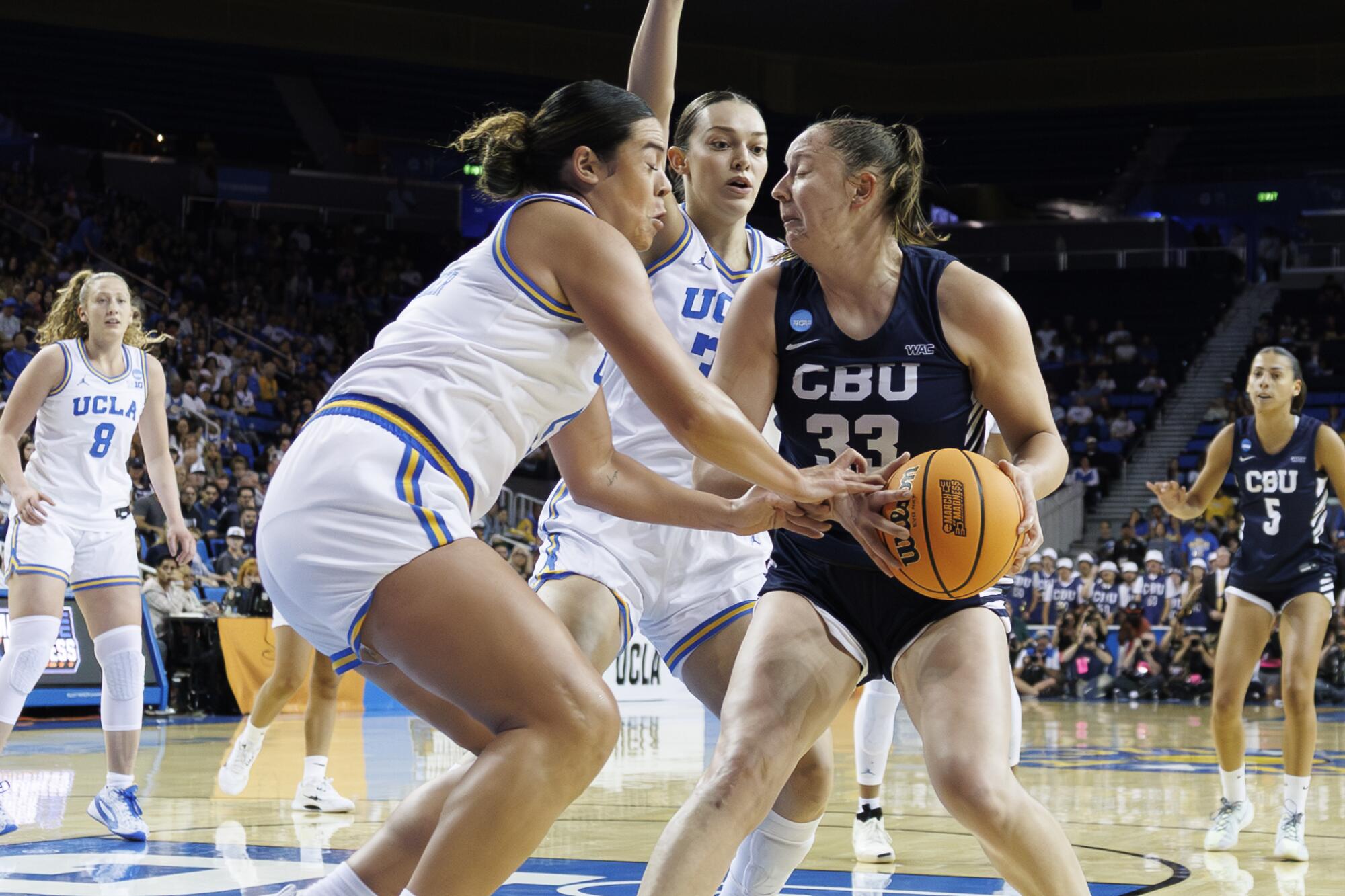
UCLA’s Charlisse Leger-Walker, left, and Angela Dugalic, back, swarm California Baptist forward Grace Schmidt during an NCAA tournament game at Pauley Pavilion on Saturday.
(Gina Ferazzi / Los Angeles Times)
Across the country during the NCAA tournament, players and coaches have noted how much the new WNBA CBA changes the future for the next generation of players.
South Carolina coach Dawn Staley noted to reporters last week that it’s one of the first times many women’s basketball players will be able to accumulate generational wealth. And they can do so without necessarily having to play in other leagues around the world during the WNBA offseason.
“The WNBA will make you make a choice because you have to be on time in training camp.” Staley said. “It’s worth it now. It’s worth it to actually have your body recover and just play in the WNBA season.”
Last season, just 20 rookies made rosters out of training camp. The fight for those spots might get more competitive for some young players now that the league offers higher salaries and some high-end international players might find it more worthwhile to sign in the WNBA.
Teams are now required to roster 12 players, compared with the option to have 11 instead of 12 under the previous CBA, which allowed franchises to spend more on top players and have less of a cap hit by triming their roster size.
But likely, more players who otherwise wouldn’t have gotten looks or would have been cut during past training camps will now have a realistic shot a developmental player spot.
“I just feel a lot of pride,” said UCLA sixth-year forward Angela Dugalic. “Because of them, I’m able to have a lot of things that they maybe weren’t able to have at the start of their career. And some of them, like, they’re either at the end of their career or they’re even finished right now, they’re still fighting for us.”
Kneepkens or Leger-Walker (though she was recovering from an ACL injury) would have been WNBA draft-eligible after last season. Their rookie salaries would have been around $70,000, depending on where they were selected. This year, the rookie minimum will be $270,000, and top picks, which Betts and Rice are projected to be, will make as much as $500,000.
“Just like the growth we’re even experiencing now in college, we have so many people before us to thank that. [They] fought for better exposure and TV rights … fought for Title IX and resources to be allocated appropriately,” UCLA coach Cori Close said. “I think it’s similar right now in terms of the CBA. We need to really thank the people in that room that fought hard.”
UCLA guard Kiki Rice dribbles up the floor under pressure from California Baptist guard Filipa Barros Saturday at Pauley Pavilion.
(Gina Ferazzi / Los Angeles Times)
UCLA players are understandably locked in on the NCAA tournament, but they haven’t ignored an important moment.
“I think it’s awesome for women’s basketball and the progress going forward,” Leger-Walker said. “I love that we have players who are willing to advocate and really stand on what they believe in. We’re making steps forward.”
Where they all fit on individual teams or in respective mock drafts will all be more clear after free agency begins in the week ahead of the draft. Around 80% of the league are free agents, so there are going to be plenty of new-look teams.
UCLA players will soon get a chance to join those roster makeovers under working conditions past players never enjoyed.
“I’m just grateful for all the women who fought for what they’ve earned,” Kneepkens said. “That’s just super cool for anyone that’s a WNBA fan and anyone that’s part of it. They made this happen.”
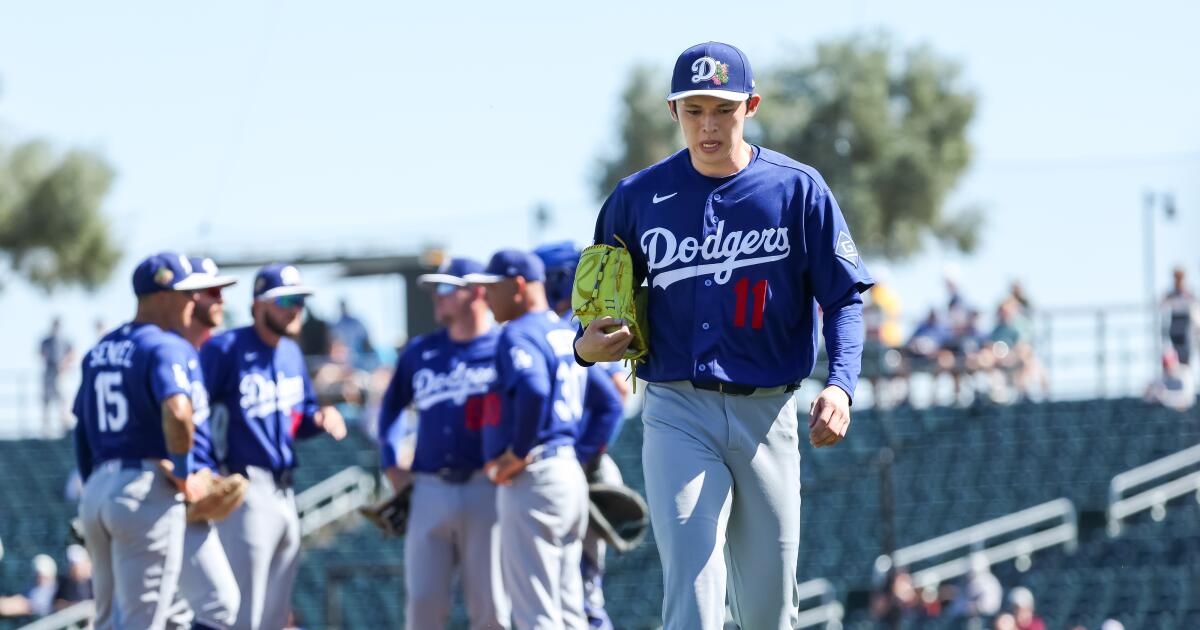
PHOENIX — By the time Dodgers right-hander Roki Sasaki reached the blue backdrop set up in the Surprise Stadium interview room, he’d diagnosed the issue.
“I think it’s because of the two-seamer,” Sasaki said through an interpreter. “It kind of caused my forearm to pronate a little more. Also my arm slot was a little down.”
Those arm-side misses had, after three straight walks, prompted manager Dave Roberts to temporarily pull Sasaki from his most recent spring training appearance. But even though that start, marred by a wild third inning, brought Sasaki’s Cactus League ERA to 13.50, he’ll enter his Freeway Series start Monday with a spot in the regular-season rotation already secured.
Roberts has repeatedly made that point clear.
However, when asked directly if Sasaki was one of the Dodgers’ 13 best pitchers right now, Roberts gave an indirect answer: “He is going to start the season in the rotation.”
Answering why the organization has been so bullish on the decision requires zooming out.
“As we look out two, three, four, five, six years, it is imperative for us to integrate talented young players under our roster,” president of baseball operations Andrew Friedman said during an interview with The Times last week. “And that requires patience. And we have to have that even with the insanely high expectations we have.
“We have to be able to balance those two things, or there are a lot of cautionary tales of large-revenue teams who have had a run of success, and then they fall off the cliff.”
Sasaki, 24, is one of those young players the Dodgers are counting on to bridge the gap.
When Sasaki was posted by Nippon Professional Baseball’s Chiba Lotte Marines before last season, upward of 20 teams expressed their interest in the young phenom who was coming to the United States through amateur international free agency.
In his debut season, he produced a 4.72 ERA through eight starts — before an injury the Dodgers described as a right shoulder impingement sidelined him for much of the rest of the season. When Sasaki returned, it was as a reliever, a role he thrived in through the postseason.
Sasaki enters Year 2 with just 47 major-league innings under his belt, including the regular season and playoffs.
“On top of all those other things that you’re adapting to and learning, you’re also learning a new ball,” Friedman said. “Roki could really command his fastball in Japan, and right now it hasn’t been as good. So how much of that is the ball, how much of it is mindset, how much of it is delivery just getting out of whack? All of those are fair questions, but I think it speaks to, we have to have a level of grace with this and work with him to continue his development.
“Because we’ve seen it at an extremely high level, and now it’s on all of us to help him get back to that.”
NPB baseballs are slightly smaller, tackier and have higher seams than MLB baseballs. Players making the transition to MLB also have to adjust to a different strike zone, style of play and the off-the-field challenges of living in a foreign country.
The season before Sasaki signed with the Dodgers, his future teammate Yoshinobu Yamamoto and the Cubs’ Shota Imanaga set the bar high with relatively smooth transitions. But they were also coming over at later stages in their careers.
“We’re very mindful that this guy is essentially two years, three years behind Yamamoto,” Roberts said, “as far as on the progression side, the development side.”
Sasaki has shown he can be effective out of the bullpen, but pigeonholing him in a relief role at this stage of his career would be a disservice to him and the organization.
The Dodgers have identified the addition of the two-seamer as a development that could help Sasaki stick as a major-league starter.
“It’s our job as coaches to get a player to understand the value of having a ball bear in and get in on right-hand hitters to keep them off the outside part of the plate,” Roberts said. “There’s a little bit of trying to pronate too much — trying to make the ball move, versus trusting his grip and his throw. But that’s a coach’s responsibility to [figure out,] how do we get him there, along with him feeling comfortable.”
The Dodgers have decided that, at least for now, the best setting for that growth is the major leagues. Across the industry, there’s an understanding that the gap between Triple-A and the big leagues is bigger than ever. That makes evaluating players in Triple-A all the more difficult.
“He’s not close to a finished product,” Roberts said. “But he’s 24. … You could look at a team that would potentially sign a veteran, turnkey starter, but we’ve got to get him to cut his teeth and deal with some things. That’s part of the growth.”
Coaching high school basketball since the 1979-80 season and being the second-winningest coach in state history with 1,127 victories, Mike LeDuc is one of those old-school coaches who likes to push his players forward and fade into the background when team success comes.
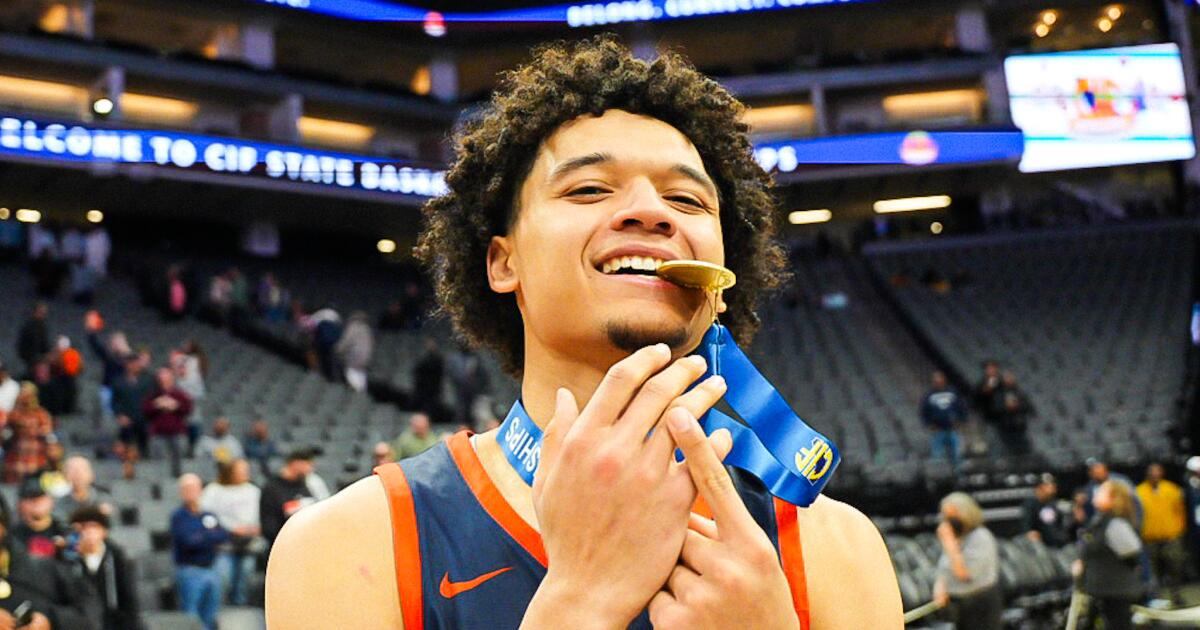
This season at Damien, LeDuc can take a bow for guiding the Spartans to the state Division I championship with little size but a group of players who loved to shoot threes, never stopped hustling on defense and executed close to perfection on the biggest stage at Golden 1 Center and during his team’s playoff run.
For turning a group of players he fondly called “overachievers” into champions, LeDuc is The Times’ boys’ basketball coach of the year.
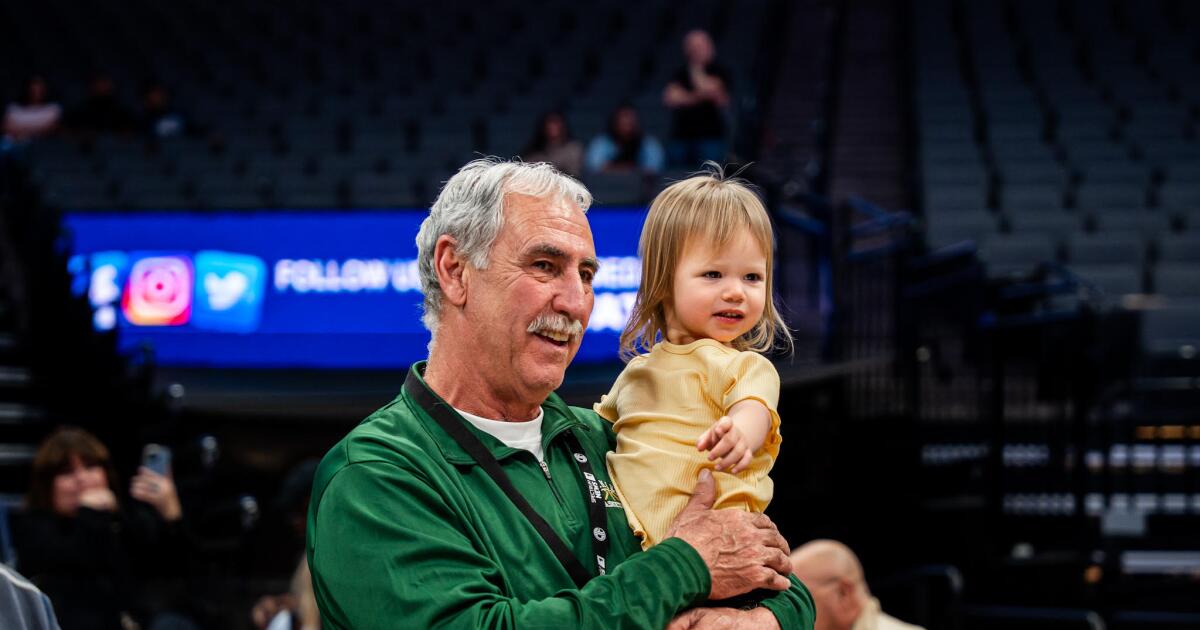
Through his many years of coaching at Damien and previously at Glendora, he’s mentored such outstanding players as Tracy Murray, Casey Jacobsen and Cameron Murray. Now Cameron’s sophomore son, CJ, plays for Damien. It’s a full circle moment for LeDuc, who was holding his granddaughter at the awards ceremony in Sacramento.
As the years go by and the game keeps changing, LeDuc continues to adapt, adjust and power on.
LeDuc‘s answer is, “Basketball is a real simple game. It’s a game of repetition and if you do it over and over, you expect it to be done perfectly.”
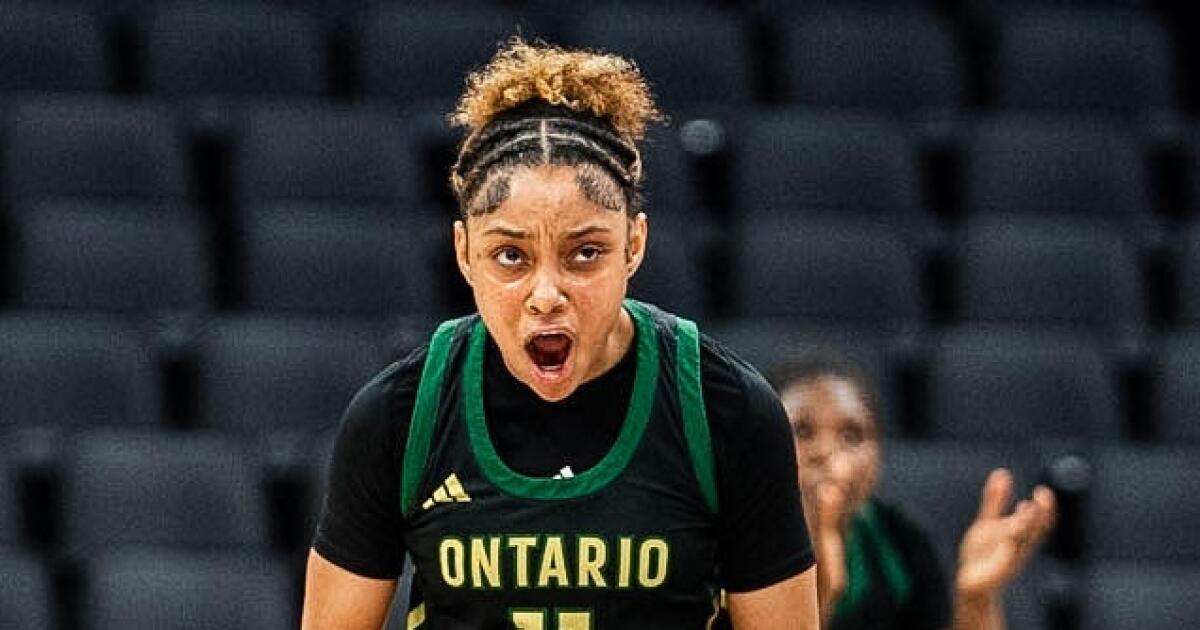
Kaleena Smith averaged 31 points, seven assists and four steals a game this season while playing for the No. 1 program in the Southland, but her expanded leadership role is what earns her the honor of The Times’ girls’ basketball player of the year.
The 5-foot-6 junior point guard marshaled Ontario Christian to the CIF state championships in Sacramento for the first time in the program’s history and along the way her voice spoke almost as loudly as her game — surprising for someone who is not talkative by nature.
“Her numbers speak for themselves but the biggest difference in Kaleena this season has been her leadership,” Knights coach Aundre Cummings, said. “She’s always coming to practice first and leaving last, which teammates respect, but also knowing when to speak up.”
Smith has been nicknamed “Special K” for her talent and charisma, traits that make her one of the top national recruits in the class of 2027. She is garnering attention from multiple college programs. USC women’s coach Lindsay Gottlieb was even on hand to witness Smith score 23 points and contribute six assists in the Southern California regional semifinals against Etiwanda on March 8 and the state championship game against Archbishop Mitty at Golden 1 Center in Sacramento.
“I’m being more vocal, yes, because I’m gonna have to do that in college,” said Smith, who spent countless hours refining her mid-range jumper this winter. “As captain it’s one of my responsibilities.”
One hundred games into her high school career, Smith is living up to the hype thrust upon her when she was named MaxPreps’ national freshman of the Year in 2024. She passed the 2,000-point plateau when she scored 51 points against Esperanza in November.
Smith paced Ontario Christian to the Southern Section Open Division title as a sophomore and although the Knights were denied a repeat (she had 30 points and five assists in a finals defeat to Sierra Canyon) her stats are better in every significant category. Intertwined with her competitive spirit and winning mindset is the maturity and confidence of an upperclassman.
“Her leadership is what stands out,” sophomore teammate Tatianna Griffin said. “She’s a very quiet person. I’m not sure it comes naturally or not but when she says something we listen.”
Griffin’s own game has blossomed because of Smith’s willingness to give her the ball in clutch situations, and Smith has been a mentor to freshman Chloe Jenkins, who led the team in rebounds (11.3 per game).
Adding leadership to her basketball IQ, court vision, defense, quickness, shooting, passing and dribbling has made Smith a complete player, one who is poised for a senior season worth talking about.
When you’re already an All-American in high school and several new players show up perhaps as talented as you, the challenge is developing chemistry and seeing who’s going to remain humble and unselfish for the good of the team.
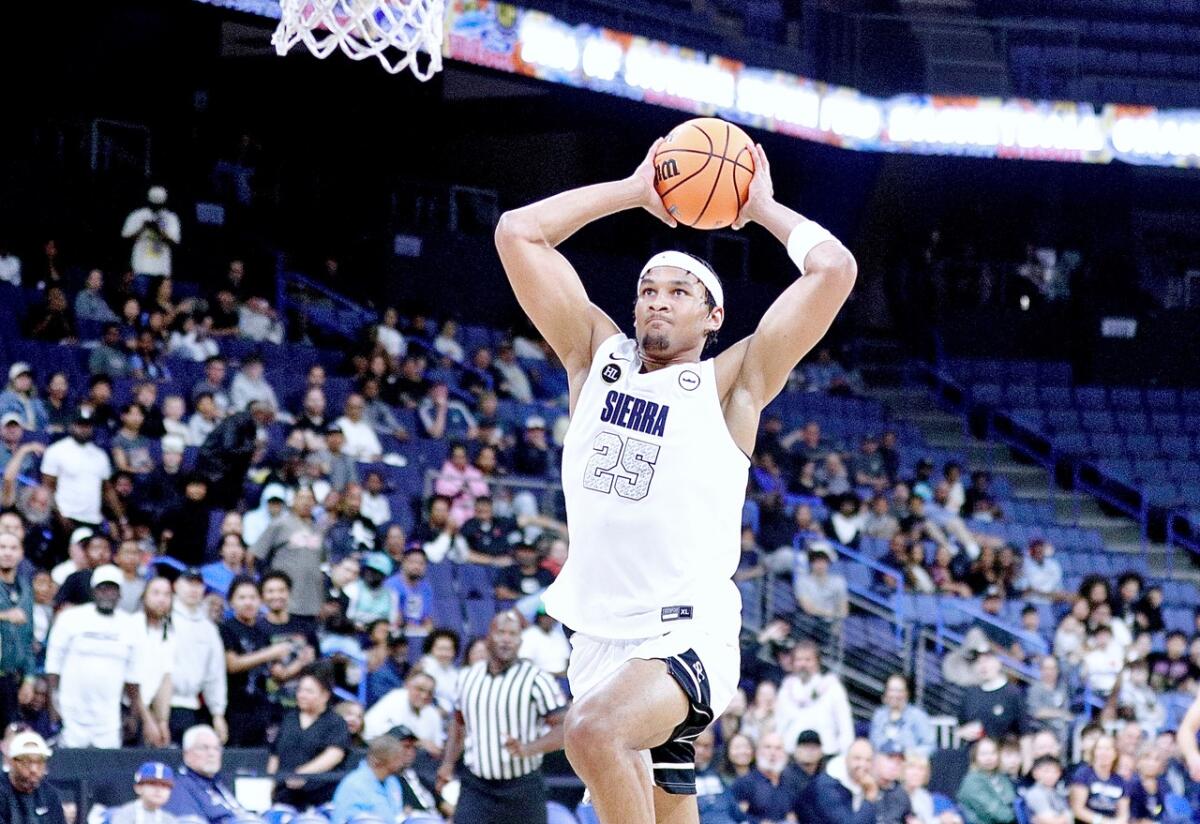
Maxi Adams, Sierra Canyon’s 6-foot-8 senior, was the big man on campus until another All-American, Brandon McCoy, showed up this season, along with Brannon Martinsen, a former Trinity League player of the year. Not only did Adams welcome them, he adjusted his game and changed his role.
“Anything for the win,” he said. “Trust the coach’s game plan.”
Maxi Adams of Sierra Canyon rises to deliver a dunk against Harvard-Westlake in Open Division championship game.
(Steve Galluzzo)
Adams continued to contribute as a scorer, rebounder and defender, and when the games got much more important in the playoffs, he asserted himself and delivered, such as a 26-point performance in the Southern Section Open Division final.
The North Carolina-bound Adams has been selected The Times’ boys basketball player of the year for the 2025-26 season.
Sierra Canyon went 30-1 and won the Southern Section Open Division championship and state Open Division title even though Adams was injured in the first quarter of the state final. He averaged 16 points and 7.2 rebounds with 10 double doubles.
“He’s a great player,” said Harvard-Westlake coach David Rebibo, whose team lost three times to Sierra Canyon.
Adams’ development of his skills and maturity over his four years of high school, first at Narbonne, then Gardena Serra and his final two seasons at Sierra Canyon, have been impressive. He went from being uncomfortable as a freshman to being versatile, confident and a leader as a senior.
His willingness to embrace the changes at Sierra Canyon this season were key.
“It wasn’t hard,” he said. “We played well together and spent a lot of time together. At the next level, you’re going to have to be able to play with great players. I just carry that forward.”
His older brother, Marcus, was a standout at Narbonne and played this past season at Arizona State after previously being at Cal State Northridge. For Maxi to handle things this season with his brother far away showed he’s ready to embark on his own journey in college basketball.
As for his mentality, Adams said, “We come to work every single time. We put in the time.”
Back in 2022 when the Adams brothers played together at Narbonne. Marcus and Maxi. They’ve become pretty good basketball players, Marcus at Arizona State, Maxi at Sierra Canyon then on to North Carolina. pic.twitter.com/l6NhXwKIPL
On a night when my family watched Austin Reaves pull off the miraculous intentional missed free throw put-back basket on the way to a thrilling Laker overtime win against the Denver Nuggets, we talked more about the newest Lakers super fan on the way home. Kudos to Bill Plaschke for recognizing and capturing the power of 6-year-old Jackson Tuyay’s passionate cheering that helped ignite the laid-back crowd and inspire the Lakers to a huge comeback win. As a lifelong Laker fan since the same age as Jackson it was so awesome to see such innocent and authentic passion for the Lakers. In an arena full of stars in the stands and on the court it was the voice of a 6-year-old that reminded us how awesome it is to be a Lakers fan for life!
Paul Stapleton Los Angeles
To quote Jackson Tuyay, “Yeaaaaah!” It looks like the Lakers can play some defense and beat the better teams after all.
Vaughn Hardenberg Westwood
The Los Angeles Times welcomes expressions of all views. Letters should be brief and become the property of The Times. They may be edited and republished in any format. Each must include a valid mailing address and telephone number. Pseudonyms will not be used.
PHOENIX — Dodgers president of baseball operations Andrew Friedman went into the offseason expecting outfielder Kyle Tucker to sign elsewhere.
Sure, Friedman was confident in what the Dodgers could provide on and off the field to the 29-year-old four-time All-Star. And Tucker was a rare hitter who could actually elevate an already star-powered Dodgers lineup. But with the team unwilling to offer a super long-term deal, their chances at landing the best free-agent hitter available this past offseason felt “incredibly low.”
“I can’t remember a time where a player has taken a shorter-term, higher-AAV deal when they’ve had an actual long-term contract on the table,” Friedman said Wednesday.
The Dodgers, however, had already pulled off a bigger surprise when closer Edwin Díaz chose them over returning to the Mets this past December.
The team’s pitch, which included a conversation with the Dodgers’ director of family programs Patricia Romero, discussions about preparation and player resources, and a championship track record, helped land both top-tier free agents.
Of course it didn’t hurt that though Tucker’s contract was only four years, it was worth $240 million. Taking deferrals into account, the net-present day value set an MLB record at about $57 million per year.
The Dodgers’ aggressive offseason, coming off consecutive World Series titles, once again makes them the favorite entering the 2026 season.
They wrap up their Cactus League schedule this week, as World Baseball Classic participants trickle back into camp, and baseball operations leadership make final opening day roster decisions.
Before Friedman headed back to Los Angeles, he spoke with The Times on a range of topics. Here’s part of that conversion, edited for length and clarity.
Q: When it comes to the WBC, there’s variance on how supportive teams are. You have Shohei Ohtani participating as a position player, Yoshinobu Yamamoto pitching after an extra-short offseason, Kiké Hernández supporting Puerto Rico in person while rehabbing. How have you landed in being highly flexible?
Friedman: Obviously everything is case by case. But in a vacuum, we are incredibly supportive of the World Baseball Classic and what it does for our game worldwide. We saw it in ‘23, we saw it this past year, with just how important this is to the players, the staff, the fans — and just how exciting it is for baseball.
So that part’s easy. Now you layer on our situation, us trying to win a World Series. For position players, it’s easier to justify. For pitchers, it’s way harder. Throwing at that intensity in March is really, really challenging. And so we feel like our role is to work with each of our players and have conversations and share our thoughts, listen to their thoughts, and then answers kind of fall out of that.
Q: It’s such a cliche to say you can never have too much pitching, but with this group, are you close?
Friedman: I’ve learned my lesson to never say that we have enough pitching. But I do feel like we are breaking camp with the most talented one through 20 arms — which gets at, obviously, who we’ll break with, and then depth behind it — that we’ve ever had.
Q: Between Díaz, who’s part of that equation, and Tucker, you signed two players this offseason who you didn’t necessarily expect to land. What does that say about this organization and what you’ve done the last few years?
Friedman: Our biggest, most overarching goal is to be a destination spot, where our own players don’t want to leave, where players on other teams are looking longingly, because we feel like championships fall out of that. By having the right environment, having the right culture, that helps your star players want to stay, it helps in the recruitment of others. So we’re way better at it today than we were five years ago. But it’s like a living organism that we have to continue to foster and nurture and develop. And we hope we’re way better at it five years from now.
Q: On that note, the Dodgers are very much caught in the middle of CBA posturing with the current agreement expiring this year. You hear a lot of players saying the Dodgers are doing it the right way and other teams could be doing something similar. On the other hand, the league appears to be floating a salary cap, and plenty of fans are accusing the Dodgers of “ruining baseball.” What’s it been like to see those conflicting narratives?
Friedman: Obviously see it, come across it, hear it quite a bit. But we’re just not that focused on it. We’re a really healthy organization, and the partnership we have with our fans is our guiding light. And we’re doing everything we can to put a team out there that our fans really connect with, and that they feel that partnership with all that they pour into us, and don’t really think about it in any other terms.
And so obviously, there’s a lot of narratives that get extrapolated from that. But our sole focus is on ourselves and the partnership we have with our fans and the rest of it to us, it’s kind of just noise.
Q: You guys raised the bar years ago to, “We’re going to be in the postseason every year.” But there were clear frustrations from the fan base when that wasn’t consistently leading to championships. Is it fair to say that this continued push is almost a response to that frustration?
Friedman: Each year we’ve poured everything we have into winning. And in October, you need a really talented roster, and you need some good fortune. And there’s years where we haven’t been as talented as we wanted to be, whether it’s injuries or lack of performance. There’s years we’ve had really bad fortune, there’s years we’ve had good fortune. And a lot of that is the game, and it’s what I both love and hate about it.
I wouldn’t say our mindset is all that different. But obviously, when you’re in a moment in time with an incredibly talented roster, I think the mindset is, ‘Don’t sit back on your heels, be aggressive, and don’t be nonchalant about the opportunity that we have in front of us.’ And so it’s more the idea of pressing an advantage and being aggressive on that front.
Q: I’m sure when you were pursuing Ohtani, you looked into the revenue ramifications of signing him. Has this been about what you expected? Has it exceeded your expectations?
Friedman: Oh, it’s far exceeded. I don’t think the human brain could have comprehended it correctly. It’s been a perfect storm on a lot of levels, and something that has definitely far exceeded our expectations.”
Q: A three-peat seems to be the goal. Is there such a thing as a successful season without winning a championship, or has this team gotten to a point where you really have to win a World Series in order to claim success?
Friedman: Everything for us, all of our energy and focus, is on doing everything we can to win a championship this year. And our first goal is to win the division and be in position to have a bye. Last year, we added to the degree of difficulty [by winning the division but having to play in the wild-card round] in a way that I’d like to avoid this year.
So that’s the first goal. And then obviously that puts you in the best position to accomplish our ultimate goal, which is winning a World Series. So that’s what all of our energy and focus is on.
And, obviously, if we win the World Series this year, it will be a three-peat. But it’s not how my brain processes it. We’ve won back-to-back, and those are in the bank. And now it’s, do everything we can to win this year, and it’s its own unique, disparate year.
Then the Professional Women’s Hockey League was born in 2023 following many players defecting from the National Women’s Hockey League to form the Professional Women’s Hockey Players Assn., then merging with the Premier Hockey Federation until a historic bargaining agreement.
The National Women’s Soccer League announced a new CBA in the summer of 2024 that included giving players agency on where they are traded and abolishing expansion and collegiate drafts.
That momentum put considerable pressure on WNBA negotiations. Could the players set a new benchmark for future contract negotiations across women’s pro sports leagues?
The Sky’s Angel Reese and the Fever’s Caitlin Clark shake hands before a game at Gainbridge Fieldhouse on May 17.
(Gregory Shamus / Getty Images)
The WNBA’s CBA was a flashpoint because of the boom in popularity in supporting women’s sports, with players such as Caitlin Clark and Angel Reese becoming household names. Last season, the WNBA made enough revenue to trigger revenue-sharing for the first time and this season marks the start the league’s new 11-year, $2.2-billion media rights deal.
Unlike in the NBA, where players get around 50% of the league’s revenue before expenses, the WNBA’s first revenue-sharing kicked in only after the league hit a benchmark determined by a formula of revenue targets, which had been difficult to achieve since the start of the deal was the 2020 COVID season played in front of empty stands.
The WNBA broke its single-season attendance record in 2025. As league interest grew, so did the tension between the league and the players’ union.
Many viewed this negotiating cycle as an opportunity to pounce on the increased visibility, and in a lot of ways, the union did. Players are going to be paid significantly more and they got a win in revenue sharing, earning 20% of the league’s revenue before expenses — a big jump from the previous 9% share.
The average player salary before revenue-share payments will be around $584,000.
But was it as much as they should have gotten?
Tamika Tremaglio, former NBPA executive director and advisor to the WNBPA during the 2020 CBA negotiations, said observers were less concerned about the start of training camps looming on April 19 and more focused on whether negotiations would end with a stable deal that would hold for the length of the agreement as market conditions evolve. Increased salaries are always celebrated, but both sides agreeing to a new revenue sharing model was a consequential step forward for players.
“The real story is the revenue share,” Tremaglio said. “At the end of the day, that’s what is going to drive the future.”
The fallout from the new deal will take months or years to fully understand. Free agents will be able to begin signing with teams in April, and since 80% of the players are eligible for free agency, there will be higher figures being floated around than ever.
A’ja Wilson and her Las Vegas Aces teammates celebrate while holding the 2025 WNBA championship trophy.
(Chris Coduto / Getty Images)
That might affect what talent comes to the league, too.
“More European players might come into the league,” a WNBA team consultant not authorized to speak about the league publicly told The Times. “Now that the money is better, that might knock out several college players in the draft.”
There are some WNBA-level players who have stayed in Europe due to restrictive prioritization rules that force players to participate in all WNBA practices and games even if they conflicted with international league obligations. Many WNBA players compete in international leagues during the offseason and prefer the option to keep playing in lucrative foreign leagues if there is an overlap with the WNBA season.
While the new rules for international play in the WNBA CBA are not yet clear, compensation changes could open the door for more players to choose to prioritize the league.
The general consensus among people operating within the WNBA is relief that a deal is in place.
“It’s huge,” one player agent told The Times. “They made big strides. This is important for women’s basketball.
Sparks players Dearica Hamby, Rickea Jackson, Azura Stevens, Kelsey Plum and Julie Allemand talk during a game against the New York Liberty at Crypto.com Arena on Aug. 12.
(Katelyn Mulcahy / Getty Images)
“Anytime both sides don’t get everything they want,” the agent added, “that’s a good deal.”
That agent also noted that this CBA will set the precedent for the next negotiations to continue to raise the revenue-sharing if the league continues to make more money.
Under the new CBA, the 20% revenue-sharing is tied to the league’s gross revenue, a significantly different number than the net revenue, which is calculated after all expenses are taken into account. The players were fighting for a percentage of the gross revenue, even if it is a smaller percentage than the net revenue the league offered because it is guaranteed.
The NBA first reached 53% of gross revenue in their CBA in 1983 and has stayed around that number ever since.
“If it was net, you’d have all these other expenses and you sort of lose control of the actual expenses,” Tremaglio said. “You have no control from the perspective of where the players are. But now, you don’t even have to go look at the minutia of auditing every single expense line item. That’s what makes such a difference.”
More details around the CBA, including player housing, expansion draft format and roster spots, will become clearer as the deal reaches ratification.
For now, even if 20% revenue sharing is less than the 40% the players first proposed, the deal represents a significant, stable increase in player compensation.
“This will impact women’s sport globally, not just the game of basketball,” Tremaglio said. “This will impact everything, soccer, everything.”
Seattle Storm forward Nneka Ogwumike (3), president of the WNBA players’ union, said for the first time, player salaries will be tied to a meaningful share of league revenue.
(Lindsey Wasson / Associated Press)
The league and players association have not made the terms public yet, but the salary cap will start at $7 million, up from $1.5 million in 2025, and the supermax will start at $1.4 million, up from $249,244 in 2025, a person with knowledge of negotiations not authorized to discuss them publicly told The Times. ESPN was the first to report the figures.
The total salary cap will jump by around 4.64 times the previous amount. The super maximum salary will be elevated by 5.61 times the previous amount. It means the top players will be eligible for larger raises than the league’s middle class.
The average salary will be $600,000, a bump from the previous average of $120,000, and the minimum salary will be more than $300,000, up from $66,079.
“For the first time, player salaries are tied to a truly meaningful share of league revenue, driving exponential growth in the salary cap, increasing average compensation beyond half a million dollars and raising the standard across facilities, staffing and support,” union president Nneka Ogwumike told reporters.
The main sticking point during negotiations was revenue sharing, and that number will be around 20% for the entirety of the multi-year deal. The league had previously offered 15.5%, a source told The Times, and players went down from their 40% ask to around 26% at the end of February, and then reached the agreement around 20% on Wednesday morning. The Athletic first reported the shift in revenue sharing figures.
Players had been negotiating for a percentage of overall revenue without factoring in expenses while the WNBA was seeking sharing tied to net revenue, mirroring the NBA’s structure that deducts expenses before sharing 50% of profits. The players secured a gross revenue deal, which gives them a cut of WNBA revenue without factoring in expenses, a person with knowledge of the deal not authorized to discuss it publicly told The Times.
“This deal is going to be transformational, and you’ll see all the details hopefully soon,” WNBPA vice president Breanna Stewart told reporters on Wednesday. “But it’s gonna build and help create a system where everybody is getting exactly what they deserve and more from on the court and off the court aspects.”
MIAMI — The victors erupted onto the field and into multiple dogpiles. Some wore national flags around their shoulders. Within minutes, the Venezuelans wore T-shirts that read: “The Best Baseball in the World.”
The players from the United States watched from their dugout. Within minutes, they trudged back onto the field so a silver medal could be draped around their necks. Not every player wore the medal all the way back to the dugout.
You can say all you want about how the World Baseball Classic has matured into a must-see event for fans and a must-play event for the game’s elite players. You can salute Venezuela for a spirited and thrilling victory, and the Venezuelan fans for nine innings of joyful delirium.
But you also can say this: A U.S. team billed as featuring a killer lineup could not hit, and the U.S. could not use its best pitcher because the San Diego Padres said so. The result: For the second consecutive World Baseball Classic, the U.S. lost the championship by a 3-2 score.
U.S. captain Aaron Judge looks across the field after striking out against Velezuela at the World Baseball Classic Tuesday.
(Lynne Sladky / Associated Press)
“I’m not OK with winning silver,” Bryce Harper said. “I don’t want to win silver.
“I want to win gold, just like anybody else. But, at the end of the night, they did it, they won, all the congratulations to them. They fought hard. I’ve got nothing but respect for them.”
By the time the eighth inning rolled around, the mighty U.S. offense had not gotten a runner into scoring position on Tuesday, and had gone scoreless for 18 of its previous 19 innings. With two out in the eighth, and Venezuela up 2-0, Bobby Witt Jr. walked, and Harper followed with a 432-foot home run, so monstrous that Venezuelan pitcher Andres Machado could only watch the flight of the ball and smile.
Harper stood and watched too, then he flipped his bat toward the dugout. At third base, he stopped to give a salute, then spotted the cameraman trailing him around the bases and pointed to the American flag on his left sleeve.
“Just enjoying the moment,” Harper said. “Super grateful for it.”
With the game tied 2-2 entering the ninth, the pitcher trotting in from the U.S. bullpen should have been Mason Miller, who had not given up a hit in the WBC and struck out 10 of the 14 batters he had faced.
Before the game, U.S. manager Mark DeRosa had said Miller would be available. After the game, DeRosa said he and Miller’s employers, the Padres, had agreed Miller would only be used to protect a lead.
Once the game entered the ninth, Miller would not be able to protect a lead, since the U.S. was the home team and there could be no save situation for him. DeRosa nonetheless declined to use Miller.
“Honoring the Padres,” DeRosa said.
This is not on DeRosa, but that is nonsense. If a closer cannot be used three times in five days — with another week to ease into the regular season by throwing bullpens or in structured B games, or taking a few days off, or whatever — then he should stay home.
Venezuela scored the winning run in the ninth off Garrett Whitlock, on a walk, stolen base and RBI double by Eugenio Suárez.
In its final five WBC games — after routs of Brazil and Britain — the U.S. scored more than five runs once, with a two-run win, a two-run loss, a two-run win, a one-run win, and a one-run loss. In the semifinal and final, the U.S. combined to bat .159 and strike out 25 times, and every run came on a home run.
That — not any attempt at small ball — is American baseball. And the U.S. was outslugged by six other teams, including Australia and Italy. For glory, as the U.S. team hoodies said.
“A lot of pop ups, a lot of just-missed pitches,” U.S. captain Aaron Judge said. “I wouldn’t say we tensed up. We just didn’t execute when we needed to.”
Said DeRosa: “I mean, surprised because of the names at the back of the jersey, but not surprised because of where they’re at in spring training.
“Yeah, that’s my answer. I really don’t have a rhyme or reason to why. I just think you’re either hot or not in a seven-game blast like this.”
American Bryce Harper celebrates at home plate with teammates after hitting a two-run home run during the World Baseball Classic Tuesday in Miami.
(Lynne Sladky / Associated Press)
The WBC absolutely was a blast. The Venezuelan fans delivered concert-level noise all night long, without needing a silly stadium host or scoreboard command to do so. The WBC allowed fans to bring in 16 “permissible instruments,” including bongos, cowbells, maracas and trumpets.
“There’s bands playing,” Judge said. “There’s chants going on. You don’t usually hear that too much in the World Series games. That’s amazing. So much fun.”
More Americans watched the U.S.-Dominican Republic semifinal than watched last year’s NBA All-Star Game, according to Fox. The championship game almost certainly will have drawn more viewers than at least one game of last year’s NBA Finals.
In the 10 minutes I spent along the concourse before Tuesday’s game, I counted fans wearing the jerseys of many national teams and 17 MLB teams, plus the late and greatly beloved Montreal Expos. Japan did not qualify for the final four, but I nonetheless counted 11 fans in Japan jerseys with Shohei Ohtani’s name on the back. The advertisers believed too: DeRosa spoke in front of a banner displaying the logo of nine corporate sponsors, eight of them Japanese.
After such a lively event, can these players get fired up to go back to spring training, and then for the grind of a 162-game season?
“I’m always fired up for the Yankees, but I’m still pissed about this,” Judge said.
“I’m looking forward to the next time we get a chance to throw on the red, white and blue and take care of business.”
That would be the 2028 Olympics in Los Angeles, where Dave Roberts has expressed interest in managing Team USA at Dodger Stadium. The major leaguers are almost certainly coming, even if the details are still being worked out.
MIAMI — Venezuela won the World Baseball Classic for the first time, rebounding from a blown eighth-inning lead to beat the United States 3-2 Tuesday night on Eugenio Suárez’s tiebreaking double in the ninth.
Maikel Garcia’s third-inning sacrifice fly and Wilyer Abreu’s fifth-inning homer off rookie Nolan McLean built a 2-0 lead before a roaring pro-Latin America crowd. Meanwhile, left-hander Eduardo Rodríguez and lights-out relievers limited the Americans to two hits through the seventh.
Bobby Witt Jr. walked with two outs in the eighth and Bryce Harper drove the second straight changeup from Andrés Machado over the center-field fence for a two-run homer that tied it. Harper slowly trotted around the bases and took time at third to salute coach Dino Ebel.
Luis Arraez walked against Garrett Whitlock starting the ninth. Pinch-runner Javier Sanoja stole second just ahead of catcher Will Smith’s throw and came home when Suárez doubled to the left-center gap. Suárez spread his arms wide and pointed to the sky at second base while teammates streamed from the dugout to greet Sanoja at the plate.
Daniel Palencia struck out two in a perfect bottom half to finish a three-hitter and get his third save of the WBC, striking out Roman Anthony to end the game. Venezuelans ran onto the infield to celebrate as the Americans stared while leaning on their dugout railing.
“Nobody believed in Venezuela but now we win the championship,” Suárez said. “This is a celebration for all the Venezuelan country.”
Despite a heralded roster of stars led by Aaron Judge, Harper and Paul Skenes, the U.S. lost its second straight final of baseball’s premier international event and remained without a title since 2017.
Venezuela celebrates its victory.
(Lynne Sladky / Associated Press)
Judge was 0 for 4 with three strikeouts in the championship game and hit .222 with five RBIs in the tournament, while Harper batted .214 with three RBIs and Alex Bregman .143 with four RBIs. The U.S. scored nine runs in the three knockout-round games while batting .188.
Ahead of a matchup with political overtones, players and coaches avoided discussing the government turmoil between the nations, heightened when the U.S. military captured Venezuela President Nicolás Maduro in January. The sellout crowd of 36,190 at LoanDepot Park was heavily pro-Venezuela, with some booing American players during the introductions.
Venezuela became the second Latin American nation to win the WBC, after the Dominican Republic in 2013. The U.S. took the title in 2017 and lost the 2023 final to three-time champion Japan on this same field.
While the U.S., Japan and the Dominican Republic got much of the attention ahead of the sixth edition of the 20-nation event, Venezuela’s success was not that surprising. Sixty-three players born in Venezuela appeared on Major League Baseball opening-day rosters last year, second-most from outside the U.S. behind the Dominican Republic’s 100.
Venezuela went ahead in the third inning against McLean, getting the start because Tarik Skubal and the Detroit Tigers decided the two-time Cy Young Award winner would make only a first-round appearance.
Salvador Perez sliced a first-pitch single and Ronald Acuña Jr. walked with one out. The runners advanced when McLean bounced a curveball, and Garcia followed with a sac fly to center.
Abreu doubled the lead when he drove a fastball 414 feet to center. His helmet fell off when he rounded second and he hopped in excitement as he neared the plate, where he was greeted by a line of teammates.
Rodriguez gave up one hit in 4 1/3 innings before Venezuela turned to its bullpen.
U.S. players had arrived at LoanDepot Park in game-worn U.S. Olympic hockey jerseys coordinated by outfielder Pete Crow-Armstrong and Jack Hughes, who scored the gold medal-winning goal against Canada last month.
In a darkened ballpark filled by fans wearing wristbands with festive blinking lights, Judge and Arraez led the teams down the foul lines for the introductions while carrying their nation’s flags.