europe

Russian tanker reaches Cuba amid critical energy shortage | Oil and Gas News

A Russian tanker has delivered enough fuel to meet Cuba’s energy needs for up to 10 days, following a three-month blockade.

A Russia-flagged tanker carrying 730,000 barrels of oil has docked in Cuba, marking the first time in three months that an oil tanker has reached the island nation.

The administration of United States President Donald Trump allowed the Anatoly Kolodkin to proceed despite an ongoing US energy blockade. The Aframax tanker entered the Bay of Matanzas – the country’s largest supertanker and fuel storage port – on Tuesday at daybreak.

Recommended Stories

list of 4 itemsend of list

The vessel, under US sanctions, entered Cuban territorial waters late on Sunday, not far from the US Navy base at Guantanamo Bay. The United States said it was allowing the tanker to deliver fuel for humanitarian reasons.

The Anatoly Kolodkin entered the Bay of Matanzas under clear skies and light winds at sunrise. Much of the nearby city – and the majority of Cuba – was without power when the tanker arrived at the port area.

Cuba has not received an oil tanker in three months, according to President Miguel Diaz-Canel, exacerbating an energy crisis that has led to seemingly endless blackouts across the country of 10 million people and brought hospitals, public transportation, and farm production to the brink of collapse.

Cubans, including Energy and Mines Minister Vicente de la O Levy, cheered the ship’s arrival. A shortage of petroleum has exacerbated a deep economic crisis, leaving the population mired in long blackouts and facing severe shortages of food and medicine.

“Our gratitude to the Government and People of Russia for all the support we are receiving. A valuable shipment that arrives amidst the complex energy situation we are facing,” de la O Levy wrote on X.

The fuel, if delivered, would give Cuba’s communist-run government breathing room amid growing pressure from the Trump administration, which has promised change in Cuba.

It will take days before the crude on board the Anatoly Kolodkin can be processed domestically and turned into motor fuel and refined products, such as diesel and fuel oil for power generation.

The ship is carrying Russian Urals, a medium sour crude, which is a good fit for Cuba’s ageing refineries.

Cuba produces barely 40 percent of its required fuel and relies on imports to sustain its energy grid. Experts say the anticipated shipment could produce about 180,000 barrels of diesel, enough to feed Cuba’s daily demand for nine or 10 days.

Cuba used to receive most of its oil from Venezuela, but those shipments have been halted ever since the US attacked the South American country and abducted its leader, Nicolas Maduro, in early January.

Source link

Trump attacks NATO allies as pressure mounts over Strait of Hormuz | Donald Trump News

US President Donald Trump has released a series of posts attacking NATO countries including France, Spain and the UK over their role in securing the Strait of Hormuz. Al Jazeera’s Alan Fisher explains what Trump’s latest criticism of US allies means.

Source link

UK accused of ‘intimidation tactics’ against bailed pro-Palestine activists | Israel-Palestine conflict News

London, United Kingdom – Civil rights groups and Palestine solidarity campaigners are accusing the United Kingdom of “intimidation tactics” after two young pro-Palestinian activists were recently arrested while on bail.

On Monday, 21-year-old Qesser Zuhrah was detained after sharing a social media post calling on people to take “direct action”.

Recommended Stories

list of 4 itemsend of list

Masked officers handcuffed Zuhrah at her home in Watford at dawn. Just a month ago, she was released on bail following 15 months in prison awaiting trial, during which she participated in a lengthy hunger strike.

Four days earlier, on Thursday, plainclothes police officers in south London also arrested Audrey Corno, 23, accusing her of tampering with her electronic tag in breach of bail conditions – a charge she denies.

“They just grabbed me,” Corno told Al Jazeera. “I broke down into tears. This was a complete shock and very re-traumatising.”

She was told that a month earlier, her tag had been offline for 20 minutes.

The police surprised her as they emerged from “an undercover car” that was parked “right outside my home address”, Corno said.

“I don’t know how long they had been waiting there for. I was just back from a walk with my friends,” she said. “I would have no idea how to tamper with my tag for it to stop working and then work again.”

Before their latest arrests, both Zuhrah and Corno were imprisoned over their alleged participation in separate raids on military hardware manufacturers in 2024 that were claimed by Palestine Action, the direct action group whose stated mission is to target companies associated with the Israeli war machine.

Although the High Court ruled in February that the UK’s ban on Palestine Action as a “terrorist” organisation was unlawful, it is still illegal to show support for the group as the government prepares for an appeal due to take place later this month.

‘Charges in connection with social media post’

Counterterrorism police on Monday said that Zuhrah’s latest charge was “encouraging or assisting” the commission of an offence, “namely criminal damage”.

“The charges are in connection with posts made on social media,” the force said.

Zuhrah was granted bail again on Tuesday. She is due to appear in court on April 17.

She is a member of the so-called “Filton 24” collective, accused of breaking into a weapons factory in Filton, Bristol belonging to Elbit Systems UK, a subsidiary of Israel’s largest weapons manufacturer, in August 2024.

In Corno’s latest case, she was also released hours after being arrested for a second time.

Naila Ahmed, head of campaigns at CAGE International, said, Zuhrah’s “rearrest” is a continuation of the “active repression” targeting pro-Palestine activists across the UK.

“These laws were not misapplied or stretched beyond their intent – they were designed precisely to criminalise political speech and dissent, and that is exactly what they are doing here,” she said. “Terrorism legislation should be abolished in its entirety. It has never been a tool of public protection – it is and has always been a tool of political control, used to police those who challenge state power and silence those who speak out against injustice.”

Corno was previously accused of offences related to a June 2024 break-in at the Wooburn Green, Buckinghamshire facility of GRiD Defence Systems, which Palestine Action said supplies the Israeli military – a charge denied by the company.

She believes officials are using “intimidation tactics” because several charges against Palestine Action-linked activists have been dropped and dozens of them have been released on bail. All Filton 24 activists, for example, have been acquitted of aggravated burglary, and 23 have been freed from prison.

“This is a reaction to the acquittals and zero convictions in the Filton 24 case so far,” Corno said. “Take direct action” is not a contentious thing to say, she argued.

“Direct actionists who either are released on bail as they should be, or found not guilty, are still being heavily surveilled and heavily repressed by the state as a reminder, that although the public may find us not guilty, the state does.”

Last week, Zuhrah and other Filton 24 defendants spoke about alleged prison mistreatment and said they were planning to take legal action over medical neglect.

Campaigners supporting the group said, “We believe this is a coordinated campaign by the state to retaliate [after failing] to secure a single conviction at the first trial of the Filton 24. There is no doubt that this arrest was politically motivated, as it is unprecedented to charge people under the Serious Crime Act”.

The detentions come at a time of increasing friction between the police and Britain’s significant Palestine solidarity movement – and ahead of a march that could bring new tensions.

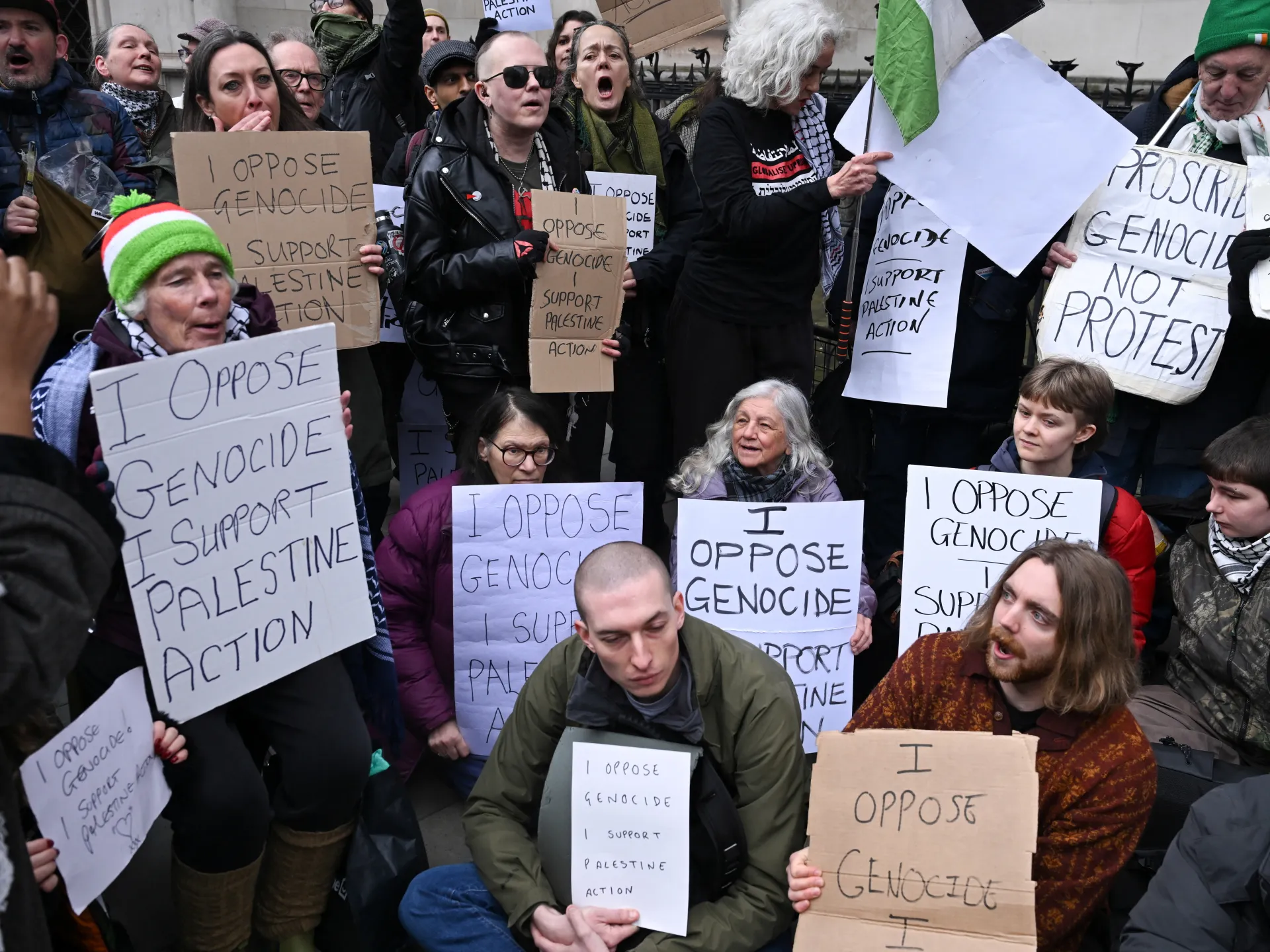
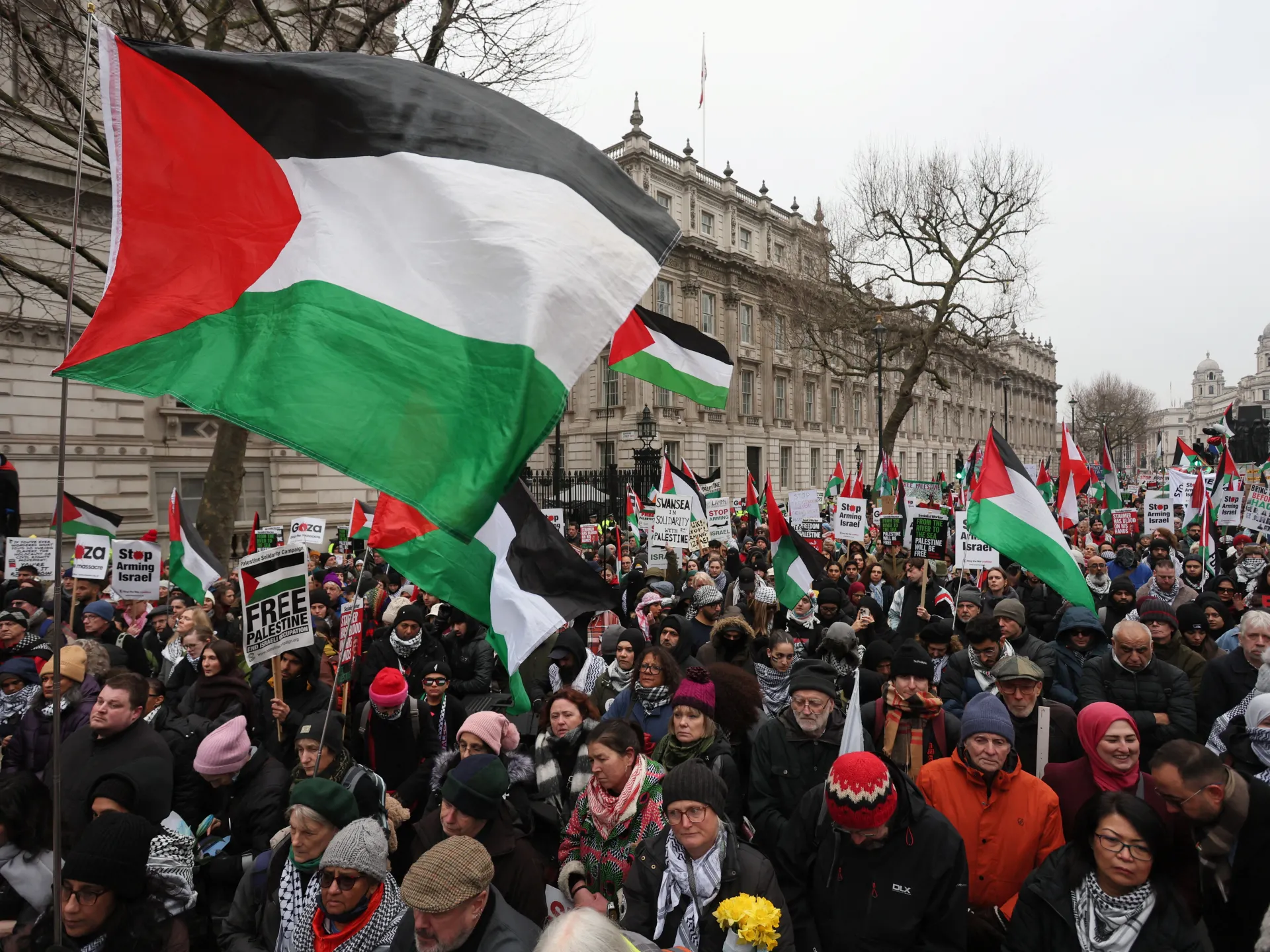
On Saturday, crowds of protesters are expected to gather again in London to demonstrate their support for Palestine Action as the genocide in Gaza continues. To date, thousands of peaceful protesters have been arrested for signs reading: “I oppose genocide, I support Palestine Action”.

While London’s Met Police refrained from detaining protesters following the High Court’s ruling, the force recently reversed that policy, meaning mass arrests are once again likely.

Meanwhile, a court is expected on Wednesday to rule in the case of Palestine Solidarity Campaign’s Ben Jamal and Stop the War Coalition’s Chris Nineham, who are accused of breaching protest restrictions in January 2025.

Since Israel’s onslaught on Gaza began in October 2023, tens of thousands of Britons have rallied in support of Palestine.

According to YouGov polling, one in three Britons has “no sympathy at all for the Israeli side in the conflict” after Israel killed more than 72,000 people in two years and decimated the Gaza Strip.

The government, led by Labour leader Keir Starmer, has long been accused of cracking down on pro-Palestine solidarity because of a wave of arrests during demonstrations and due to its proscription of Palestine Action.

Human Rights Watch has said that its research found a “disproportionate targeting of certain groups, including climate change activists and Palestine protesters, undermining the right to protest freely and without fear of harassment”.

Source link

The attack on the right to protest in the UK is not just about Palestine | Protests

On April 1, a British court is set to rule in an important trial that could define the limits of mass protest in Britain. Ben Jamal, director of the Palestine Solidarity Campaign, and Chris Nineham, vice chair of Stop the War Coalition, were both charged with breaching the Public Order Act 1986 for organising a pro-Palestine demonstration in London on January 18, 2025, on which the police had imposed conditions.

Last week, Judge Daniel Sternberg refused to dismiss the case, despite evidence provided by defence barrister Mark Summers that protesters did not break the conditions, nor had any intention to do so. The trial is seen as yet another indication of the rapidly shrinking space for the free expression of dissent in Britain.

Politicised policing

The proceedings in the trial against Jamal and Nineham have revealed the extraordinarily close relationship between the Metropolitan Police and Zionist groups. This includes the police accepting recommendations from these groups about the Palestine movement’s demonstration routes.

In negotiations between protest leaders and the police ahead of the January 18 demonstration, the police had agreed in principle to a demonstration forming up outside the BBC headquarters in central London, which is close to the Central Synagogue. Protesters had assembled there before and were keen to do so again in order to highlight the BBC’s pro-Israel bias.

During the trial, it was revealed that police commander Adam Slonecki received a letter from the Jewish Leadership Council (JLC), which threatened a judicial review if he failed to impose conditions on the protest. Slonecki had also had a series of meetings with various pro-Israeli groups after receiving the letter.

On December 20, he met with protest organisers and explained – without offering evidence or mentioning the meetings that had taken place – that the demonstrations were producing a “cumulative impact” in the form of serious disruption to the Jewish way of life, and that protesters were to be banned from marching in the vicinity of the BBC.

Ultimately, the police allowed only a static protest on January 18, at Whitehall. In a carefully worded speech on the day, Jamal announced from the stage that a small delegation of protesters would walk towards the BBC to lay flowers in memory of those killed in Gaza. If prevented, they would lay the flowers at the feet of the police and disperse. The police allege that Jamal’s speech constituted incitement to breach the conditions.

In fact, as protesters waited for the police to decide where the flowers could be laid, Nineham was violently arrested.

The defence argued that the police were unduly influenced by pro-Israeli pressure in the run-up to the demonstration and failed to facilitate the right to protest. That the police commander did not make any effort to meet with sections of the Jewish community that are pro-Palestine validates the suggestion of police bias.

Growing restrictions on protest

The trial of Jamal and Nineham should be seen within the context of growing efforts by successive British governments to limit the rights to freedom of expression and assembly.

In 2022, the British Parliament approved the Police, Crime, Sentencing and Courts Act, which expanded police powers to impose conditions based on the location and size of protests, and noise levels. It has been considered an affront to civil liberties, in part because it follows a logic that relies on police perception of risk rather than actual harm.

In 2023, the Conservatives introduced amendments to strengthen Public Order Act 1986, which remains the primary legislation for policing protests in the country. Public Order Act 2023 provides police with greater powers to prevent protests that are deemed disruptive – with vague definitions of what constitutes disruption – and includes pre-emptive restrictions around freedoms of assembly and association.

Both acts are widely criticised for having a chilling effect on people seeking to exercise the legitimate democratic right to protest.

Also in 2023, then-Home Secretary Suella Braverman attempted to push through regulations to lower the threshold for what is considered “serious disruption”, but this was struck down by the Court of Appeal in 2025, which ruled that the government had exceeded its powers.

Now the Labour government – in lockstep with the Conservatives – is seeking to further expand police discretion over the regulation of protest through the Crime and Policing Bill, one element of which is managing “cumulative impact”.

Over 100 MPs have expressed opposition to it, in addition to campaigning groups, because it would restrict protests based on frequency, not behaviour, and make protests more conditional and subject to police discretion.

In parallel, the government is trying to push through a bill that would cut in half the number of trials that go to jury. If this legislation passes, fewer protest-related cases may reach juries, reducing resistance to unpopular laws.

This is on top of the amendments made last year to The Terrorism Act 2000 to proscribe Palestine Action, making it a criminal offence to belong to or support the organisation, punishable by up to 14 years in prison. These came after a group of Palestine Action activists – known as the Filton 24 – broke into the Elbit Systems drone factory in Bristol to protest Israel’s genocide in Gaza. They were arrested and held on remand, many for over 18 months.

Although they were recently cleared of the most serious charges, and the organisation was successful in pleading for a judicial review that ruled that the home secretary’s decision to proscribe Palestine Action as a “terrorist” organisation was unlawful, the police have already made 2,700 arrests and will continue arrests pending the outcome of an appeal.

Already, one of the Filton 24, Qesser Zuhrah, was rearrested on March 30 for a social media post calling for “direct action”.

Cumulative impact

The imposition of tougher legislation was introduced in response to climate protesters and anti-monarchy protesters. Now it is being reinforced over Palestine protest. But it is clear that it won’t stop there.

If implemented, the proposed legislation around cumulative impact could be used against any group of people exercising democratic rights, whether trade unionists or anti-war campaigners, curbing their ability to organise freely.

It could also serve to reinforce division in society, as measures are increasingly deployed at police discretion. Recently, for example, the police have not given protest organisers permission to march on their proposed route for the annual Nakba Day demonstration on May 16, while they have granted Tommy Robinson, a notorious fascist, the whole of central London to do its far-right march.

Whatever the outcome of Jamal and Nineham’s trial on April 1, there needs to be a society-wide mobilisation to defend the rights to free speech and assembly. This is no longer just about the Palestinian cause, but about British democracy.

The views expressed in this article are the author’s own and do not necessarily reflect Al Jazeera’s editorial stance.

Source link

3 places in Europe where you can visit and avoid new Entry Exit travel system

These stunning destinations are exempt from the new system launching in April.

Following months of preparation, the new Entry/Exit System (EES) will finally be implemented across the Schengen area from April 10.

The new EES will require all non-EU nationals travelling to 29 European countries to register their biometric data, such as a facial scan and fingerprints, rather than receiving a traditional passport stamp. Numerous popular holiday destinations including Portugal, Italy and Spain will be impacted by the new system.

However, there are 14 countries (15 including the UK) outside the Schengen Area and therefore not implementing the new travel system.

Laura Evans-Fisk, head of digital and engagement at eurochange, anticipates a surge in travellers heading to non-Schengen countries as a consequence, reports the Express.

She said: “The introduction of this new border control system may be off-putting to some people who want to book last-minute trips this Easter, especially those who like to keep travel as fuss-free as possible.

“I think we should expect to see an increase in Brits travelling to countries that are exempt from the legislation over the next few months – including the Easter and summer holidays.”

For those looking to sidestep the hassle and make their travels a little more straightforward, Laura has identified three fantastic holiday destinations that will be unaffected by the EES, meaning British tourists can explore freely without the need to provide biometric data.

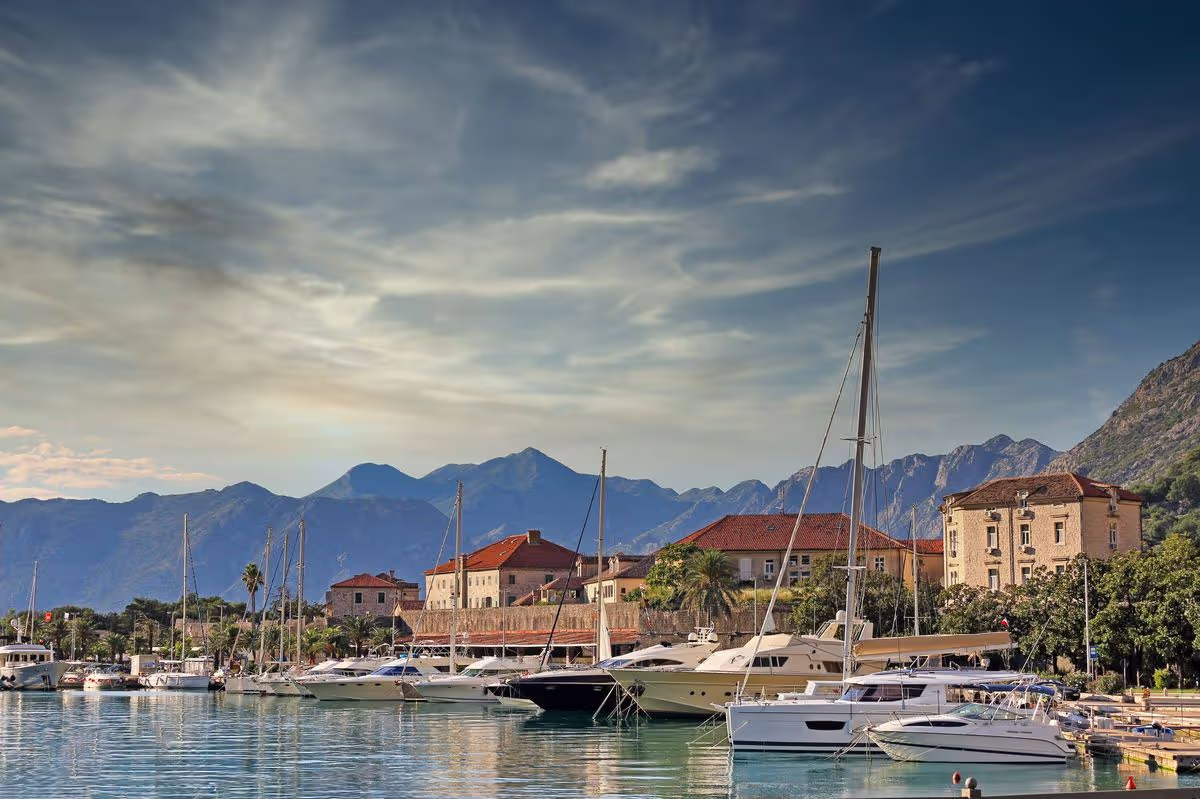
Kotor, Montenegro

She explained: “Montenegro is quickly becoming one of the most popular up-and-coming destinations in Europe. A less crowded alternative to Croatia, it offers similar quaint towns, gorgeous beaches and a stunning coastline, but it is around 20-30% cheaper.”

For instance, accommodation in Montenegro begins at £23 per person per night, while a three-course meal will cost you £31.78.

Kotor sits on the coast, boasting stunning beaches and a relaxed atmosphere, ideal for unwinding. Laura remarked: “This is a great spot if you’re after a chilled, slow-paced holiday, without having to pay huge prices.”

Tirana, Albania

This vibrant capital city is brimming with culture and a food lover’s dream destination. Laura noted: “One of the best ways to explore is by taking a stroll through the streets, following the eccentric street art, graffiti and murals.

“Remember to order Albanian favourites, Fërgesë Gjize (baked cheese with peppers) and Trilece (a tasty pie made with sponge cake and three different kinds of milk) for dessert.”

Sarajevo, Bosnia

Laura said: “It is one of the only places where you can visit a Mosque, a Catholic church, an Eastern Orthodox church and a synagogue in one place.

“Tucked inside a long, thin valley and surrounded by forested mountains, the city has a picture-perfect backdrop. Its broad mix of cultural influences means its architecture is also absolutely beautiful, and its restaurant scene is an eclectic mix of Turkish and Bosnian-inspired offerings.

“And, with prices averaging just £30 per person for a three-course meal, your money really does go far here.”

Source link

The new £379million attraction dedicated to chocolate opening in Europe with rides and hotels

A HUGE new multi-million attraction based on chocolate is opening in Europe.

Maison Cailler, in Broc, Switzerland, is the home to Switzerland’s oldest chocolate brand as well as being a museum.

The redesigned future Parc Cailler is expected to attract over a million visitorsCredit: Urban Project
The historic chocolate factory site is being transformed into a 30,000 m² tourist parkCredit: Urban Project
New hotels and rides are part of the plans

And it has has revealed plans for a whole load of new experiences to expand the land.

One of the largest additions are the Cocoa Bean Greenhouses, which will have real cocoa trees for guests to learn about the processes of making of chocolate.

A new tasting hall and shop will become the Emporium, while a flying theatre like ride will let guests go on virtual flights throughout Switzerland.

Original parts of the factory dating back to 1898 are also being restored, with plans to open to the public for the first time as “chocolate theatres”.

MAKE WAY

Popular UK theme park to demolish much-loved ride – with plans for new attraction


TOP SPOT

I’ve been to the UK attraction named among the best places to visit in the world

And the current Atelier du Chocolate workshop is trippling in size to cope with the current demand.

Set to cost CHF400million (£379million), works could start this year with plans to open by 2030.

All of the new additions will turn the experience into a one-hour experience as long as six hours.

It hopes to more than double tourist numbers, from the current 500,000 to 1.2million a year.

Other plans include a new gondola connecting the attraction to the parking area, as well as new hotels.

President of the Gruyère-Chocolat Association behind the attraction, Olivier Quillet, emphasized that it wasn’t a theme park as they “wont have rollercoasters“.

Instead, he said: “We want to showcase the expertise, tradition, and heritage.

“From the moment they enter, visitors will be immersed in chocolate; they can taste it and watch it being crafted by master chocolatiers.”

Also in Switzerland is a Wonka-style chocolate attraction with a 30ft chocolate fountain.

In the mean time, here’s how to find the world’s oldest chocolate shop – and its easy to get to from the UK.

And of course there is the iconic Cadbury’s World, right in the UK.

Gondolas and flying theatres will be added
It hopes to open by 2030Credit: Urban Project

Source link

European city with 6 of the best restaurants and the biggest theme park — not Paris

The city has seen a huge influx of new restaurants open in the first few months of 2026. From street food to Michelin-starred dining, there’s something for every foodie

Some people travel for culture, some for sandy beaches and sunshine, and others for culinary experiences. If you’re passionate about discovering exceptional dining spots, there’s one overlooked destination that deserves a place on your bucket list.

In the first months of the year, this Swedish destination has welcomed 20 new eateries to complement its already celebrated Michelin-starred establishments. Beyond its thriving food scene, this city also boasts a theme park, a warm café culture and genuinely beautiful streets perfect for exploring.

This remarkable city is Gothenburg, Sweden’s second-largest urban centre. Frequently overshadowed by its better-known counterparts Stockholm or Malmö, it absolutely shouldn’t be.

The city boasts five restaurants with a single Michelin star and one holding two stars. These establishments serve everything from Japanese cuisine to spectacular seafood dishes.

If you’re prepared to splash out on a truly memorable dining experience, the two-starred establishment Signum must feature on your itinerary.

The menu concentrates on seafood and fish complemented with produce grown in the on-site gardens.

All the ingredients are from Scandinavia, and a meal here will comprise 18 exquisitely crafted courses, all featuring seasonal produce.

If you’re the type who prefers to meander through the city, sampling local delicacies along the way, then you should schedule your visit for May.

Gothenburg is set to transform its iconic 19th-century fish market into a brand new seafood festival. The entire building, including its floating outdoor terrace, will be converted into a seafood extravaganza, with top-notch vendors showcasing their offerings, reports the Express.

Also launching in May is Vassen Market, a sprawling 6,500 square metre waterfront haven featuring street food, cocktails, live music, art pop-ups and even skateboarding.

Constructed entirely from recycled containers and encircled by verdant pocket parks, it’s the ultimate spot for a leisurely weekend stroll.

Later in the year, the Slakthuset district will play host to a three-day neighbourhood festival brimming with music, food and local beverages. Scheduled for July, this event perfectly encapsulates the relaxed community spirit of the city.

For those who prefer thrill rides over wine tasting, Gothenburg’s Liseberg is a must-visit. Opened in 1923, this theme park is the largest in Scandinavia and draws visitors from far and wide.

Boasting 42 attractions, there’s something to suit everyone’s tastes, promising an exhilarating day out. Just remember to don your most comfortable walking shoes, as the park spans a whopping 42 acres.

Source link

Russia’s FSB orders British diplomat’s expulsion, UK rejects ‘intimidation’ | News

Russia’s intelligence agency accuses the second secretary at the British Embassy in Moscow of espionage.

Russia’s Federal Security Service (FSB) has ordered a British diplomat to leave the country within two weeks over allegations of economic espionage, which the United Kingdom rejected as “unacceptable” amid tensions over Russia’s war on Ukraine.

The FSB, the main successor to the Soviet-era KGB, on Monday said its counterintelligence officers had expelled Albertus Gerhardus Janse van Rensburg, the second secretary at the British Embassy in Moscow.

Recommended Stories

list of 3 itemsend of list

“The FSB ⁠uncovered signs that the diplomat was carrying out intelligence and subversive activities that threaten the security of the Russian Federation,” the agency said.

It added that the diplomat had attempted to “obtain sensitive information during informal meetings with Russian experts in the field of economics”.

“In order to avoid negative ⁠consequences, including criminal liability, the FSB of Russia recommends that compatriots refrain from holding meetings ⁠with British diplomats,” it said.

The Russian Ministry of Foreign Affairs said it had delivered a protest to Britain’s charge d’affaires over the alleged spy.

The British ⁠Foreign Office responded by saying that Russia’s accusations against ⁠its diplomats were “completely unacceptable” and that it would ⁠not tolerate “intimidation” of ⁠its ⁠embassy staff or their families.

Russia-UK discord

Russia has claimed British intelligence launched espionage activities at a level unseen since the depths of the Cold War to sow discord within the country, and it has long complained that its own diplomats are routinely harassed in key Western capitals.

The UK, ‌which supports Ukraine with money and weapons, sees Russia as its biggest immediate threat and accuses its intelligence of mounting cyberattacks, killings and sabotage campaigns across the Western world.

Since Russia launched its full-scale military invasion of Ukraine on February 24, 2022, Russian authorities have sought to suppress opposition to the war while aiming to rally support for the war among Russian citizens.

Last week, Russia declared the teacher and main protagonist of the Oscar-winning documentary Mr Nobody Against Putin a “foreign agent“. Pavel Talankin spent two years documenting pro-war propaganda at a school in the Chelyabinsk region in west-central Russia while working as the school’s videographer.

Source link

Syria’s al-Sharaa visits Germany to talk reconstruction, return of refugees | News

President Ahmed al-Sharaa is on his first trip to Germany since ousting Syria’s longtime leader Bashar al-Assad in late 2024.

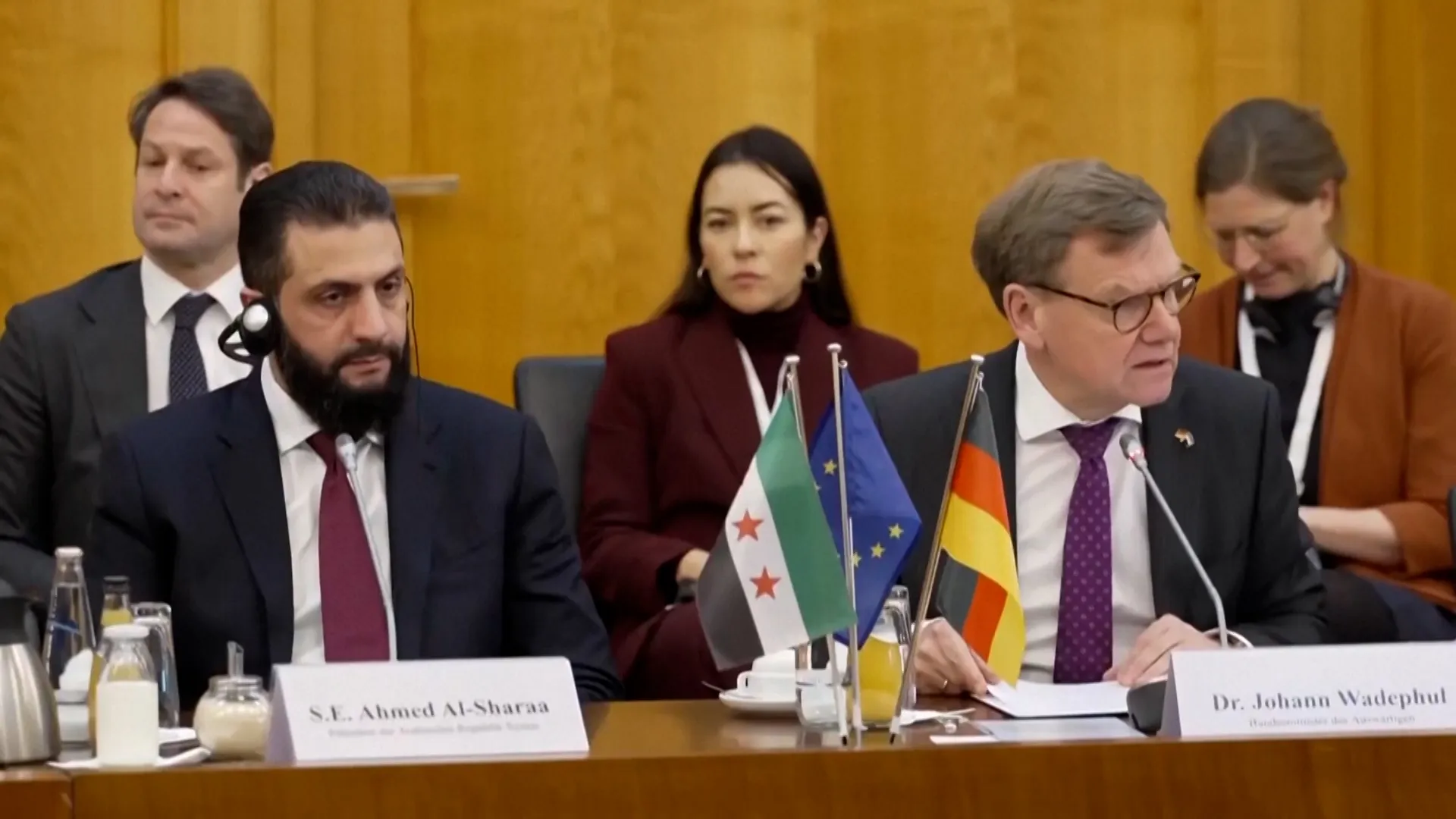
Interim Syrian President Ahmed al-Sharaa has been received by German President Frank-Walter Steinmeier in Berlin before talks with Chancellor Friedrich Merz on rebuilding his country and the return of refugees.

“Our interest is in seeing Syria rebuilt as a stable and prosperous nation, including with the help of the many, many Syrians who came here to Germany and Europe during the civil war and found refuge here,” government spokesman Stefan Kornelius said before Monday’s talks.

Recommended Stories

list of 2 itemsend of list

Speaking at a Federal Foreign Office forum in Berlin on Monday, al-Sharaa said: “We want to put this difficult time behind us and now catch up with the rest of the world.”

He pointed to investment opportunities in Syria’s energy, transport and tourism sectors, describing his homeland as diverse and with “a great wealth of people”.

“We stand with Syria,” German Foreign Minister Johann Wadephul said, pledging to support reconstruction efforts. “The Syrians deserve a chance, and we want to help ensure that this opportunity is well utilised.”

Al-Sharaa also suggested that he would like to see some of the Syrians who fled to Germany return to help with its reconstruction.

“These are Syrians who have studied at German universities, acquired German expertise and are now working in German companies,” he said. “Through investments in Syria, they can then bring this expertise back to Syria.”

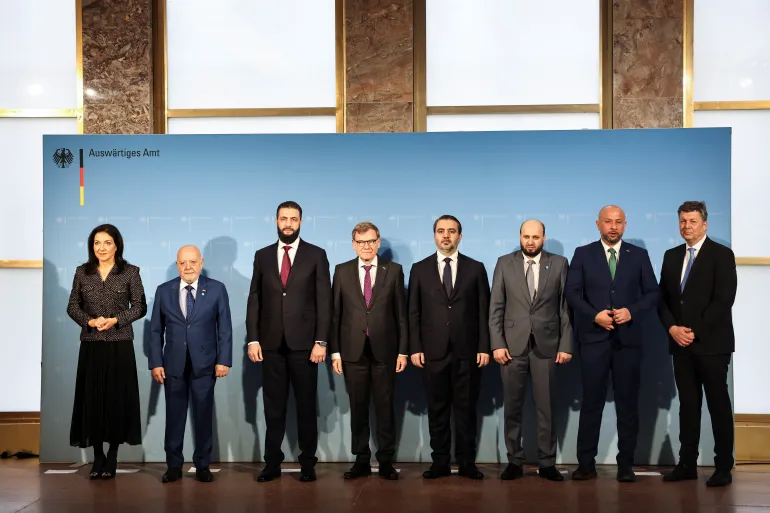
Syrian President Ahmed al-Sharaa and German Foreign Minister, Johann Wadephul, pose for a family photo with Syrian Minister of Emergency and Disaster Management, Raed al-Saleh, Member of the Executive Board of the Federation of German Industries, Wolfgang Niedermark, Syrian Foreign Minister, Asaad Hassan al-Shaibani, Syrian Economy Minister, Mohammad Nidal al-Shaar, Syrian Energy Minister, Mohammed Al-Bashir and German Economy and Energy Minister, Katherina Reiche, in Berlin, Germany, March 30, 2026. REUTERS/Nadja Wohlleben
Al-Sharaa, third from left, makes his first visit to Germany since leading opposition fighters to oust Syrian President Bashar al-Assad in December 2024 [Nadja Wohlleben/Reuters]

Al-Sharaa was initially planning to visit Germany in January, but the trip was postponed as he sought to end fighting between Syrian government forces and the Kurdish-led Syrian Democratic Forces in the country’s north.

Refugee issue

A demonstration against the plan to send refugees back to Syria has been registered in Berlin on Monday under the slogan “No deportation deals with human rights abusers”.

About one million Syrians fled their war-torn country for Germany in recent years, many of them arriving at the peak of the influx in 2015-2016 to escape the war.

The conservative Merz, who took power in May, has stepped up a drive to limit irregular immigration as he seeks to counter the rise of the far-right Alternative for Germany party.

Merz said last year that with Syria’s war over, Syrians now have “no grounds for asylum in Germany”.

The government in December resumed deportations to Syria although only a handful of cases have gone ahead so far.

Merz also said he assumed many Syrians would return home voluntarily, drawing criticism from campaign groups who cited continued instability and rights abuses in Syria.

Source link

I visited the beautiful alternative holiday destination that feels like Europe but with £15 hotel rooms and £1.50 beers

AS Brits frantically try and choose their summer holiday destination this year amid the Middle East crisis, let me sell you a slightly different place to go.

Lima, the capital of Peru, almost feels European, and has much cheaper food, hotels… and booze.

The city of Lima feels European but barely any Brits goCredit: Getty
I visited last year and it became my new favourite destination
Parque del Amor (Love Park) was inspired by BarcelonaCredit: Getty

The seaside city is the second largest desert city in the world (after Cairo) meaning barely any rain, and highs of 27C.

It is often overlooked as a travel destination, especially those heading straight over to Machu Picchu instead.

But despite just spending a few days in Lima myself, it became one of my favourite cities.

First up, safety – most of Peru is still safe to travel to, which includes Lima.

TOP STAYS

Stay in 10 of the best cities in the WORLD from £6 a night


KIDDING AROUND

The best cheap city break for every month that even kids love – from £114pp

And as a young woman, I never felt unsafe while walking around early for a coffee or late at night for a drink.

Our guide told us this huge change in recent years – when it wasn’t so safe – is due to the number of community officers around, who are on hand to help tourists who visit.

When it comes to exploring the city, I was transported to the surf towns of Portugal by the huge surfing community in Lima.

It has some of the best waves in the world, and the sheer number of cyclists with boards on their bike and surf shacks offering lessons was huge.

Then there is the colourful Barranco neighbourhood, named one of the best in the world and known for its colourful street art that is everchanging.

Here is where you’ll feel its Latin American routes, with live music on the streets and bars selling the famous Pisco Sour cocktails.

Time Out said: “It’s long had a bohemian vibe, famously fantastical murals, world-class art galleries, boutique hotels and hopping bars.

“And while it’s lost none of its wild roots, the area is now incubating some of the best restaurants in the world”.

In fact, the city is home to a number of the world’s best restaurants.

Maido was named the no.1 restaurant in the world last year, while I headed to Mayta which often makes the top 40.

I opted out of the tasting menu, but still managed to enjoy a delicious deconstrusted paella, a side and a glass of wine for under £50.

The ‘godfather of modern Peruvian cuisine’ Gastón Acurio told local media: “Lima is a gastronomic destination coveted by kitchen lovers.

“Not only because of its restaurants, which compete equally with Europe, but because behind this recognition there is something deeper — a city that has made its cuisine parallel to everyday life.

“From award-winning restaurants to carts, from ceviche shops to chifas, eating in Lima is one way to travel the entire country in a single day.”

Want to eat on a budget? You can easily get snacks and drinks for under £5 from food stalls.

I managed to find an Emoliente (a sugary hangover drink) as well as a famous pork sandwich and sweet doughnuts called ‘Picarones’ for under a fiver altogether.

Or some restaurants offer the “menú del día” or menu of thte day for not much either.

Usually including a drink, soup and main dish, this can be found for under £4.

Beers can also be found for around £1.50 in local bars as well.

Picarones, a typical Peruvian dessert cost a few poundsCredit: Getty
Barranco was even named one of the world’s coolest neighbourhoodsCredit: Getty

Our favourite loveholidays deals

*If you click on a link in this box, we will earn affiliate revenue.

Belpoint Beach Hotel, Antalya, Turkey

This hotel is surrounded by the forests of the Toros Mountains, giving your outdoor swim a pretty impressive backdrop. With a pool decorated with colourful parasols and a waterslide, this pretty resort also has plenty to do indoors, including a sauna and a Turkish bath to unwind in.

BOOK A BREAK

El Pueblo Tamlelt, Agadir, Morocco

The huge resort has 363 rooms, each with a balcony or terrace overlooking the sea or gardens. All-inclusive food includes three daily meals in the main buffet restaurant, as well as drinks and snacks such as pizza, hot dogs and burgers at the pizzeria snack bar. If you fancy getting out and exploring, the town centre is a 10 minute drive away.

BOOK A BREAK

Terramar Calella, Costa Brava, Spain

Terramar Calella puts you right in the thick of the action, with the sea on one side and the buzzing promenade on the other. Here, days start with sea swims and end with sunset drinks. Platja Gran Calella is the area’s largest beach, and here it’s right on your doorstep.

BOOK A BREAK

Canvas by Mitsis Messonghi, Corfu

This Corfu resort was built for families, buzzing with entertainment and activities. With four adult pools, three kids pools, a mini waterpark and a beach on your doorstep, there’s plenty of spots for you to stretch out on a sun lounger and for the kids to splash around. And as the day winds down to a close, the party starts with mini discos, Greek dancing, lively quiz nights and karaoke.

BOOK A BREAK

Otherwise make sure to try fantastic chocolate and coffee shops, with Lima being one of the top exporters to the rest of the world for both.

Free activities include the Spanish-style Love Park, inspired by Park Güell in Barcelona or the Museum of Art (MALI) on Tuesdays.

And the Historic Centre of Lima has elements of European architecture too, dating between the 16th and 19th centuries.

If you don’t mind sharing a room, you can find hostel beds for as little a £13 a night.

But if not, even hotels can be found for around £33 a night, such as Ibis – so £16.50 each a night when sharing.

The only thing getting in the way of Lima becoming a popular destination with Brits is the getting there.

LATAM previously had direct flights from London Heathrow to Lima but these were suspended back in 2023, with no current plans on when they will return.

Instead, Brits have to fly via Europe so with changes in Madrid, Amsterdam or Paris.

This takes the trip from around 12 hours to 16 hours, and costing around £500 return.

But there is some good news – the new Jorge Chávez International Airport in Lima opened last summer, which is likely to encourage airlines to launch flights.

And airline LEVEL is launching direct flights from Barcelona to Lima from June.

So if you want to visit a unique city with surfing vibes, colourful neighbourhoods and insanely cheap food and drink? Add Lima to your 2026 list.

Being a seaside city, expect lots of surfers tooCredit: Imágenes del Perú
The best way to get to the city is via Madrid, Paris or AmsterdamCredit: Getty

Source link

As Europe seeks to increase deportations, some see signs of Trump-like tactics

The European Union is expanding its powers to track, raid and deport migrants to “return hubs” in third countries in Africa and elsewhere, quietly adopting tactics of the Trump administration that have drawn public criticism across the 27-nation bloc.

The EU continues to tighten migration policies after right-wing parties took power in some countries in 2024. European Commission President Ursula von der Leyen, from the center-right European People’s Party coalition, has said that the new measures will prevent a repeat of the 2015 crisis caused by Syria’s civil war, when about 1 million people arrived to seek asylum.

“We have learned the lessons of the past. And today, we are better equipped,” Von der Leyen has said. The new policies, known as the Pact on Migration and Asylum, go into effect June 12.

Far-right parties in Europe have praised the deportation policies of President Trump and called for the EU to adopt a similar approach. Human rights groups warn that authorities are already illegally blocking migrants at EU borders and hollowing out their legal protections.

Italy provides a model

The EU already spends millions of dollars to deter migrants before they reach its shores, and has supported tens of thousands of Africans returning home, voluntarily or by force.

What’s envisioned now is an expansion of what Italy has created under Prime Minister Giorgia Meloni and her “tough on migration” stance. It operates two migrant detention centers for rejected asylum seekers in Albania. One currently holds at least 90 migrants, said lawmaker Rachele Scarpa, who said that she found people confused and scared during a recent visit.

In addition, Meloni’s Cabinet has approved an anti-immigration package that would allow the navy to halt vessels in international waters for up to six months if they are deemed a threat to public order, return intercepted migrants to countries of origin or third countries and speed up the deportation of foreign nationals convicted of crimes.

An “informal group” of EU nations including Germany, Austria, the Netherlands, Denmark and Greece are pursuing deportation center agreements, said Bernd Parusel, a researcher at the Swedish Institute for European Policy Studies.

Kenya is one country they are speaking with, said Tineke Strik, a Dutch member of the European Parliament. Whether consciously or not, the plan is similar to Trump’s deals with nations like El Salvador to take in deported migrants, she said.

Other countries are exploring similar ideas. Sweden’s migration minister has said the conservative ruling coalition approves setting up hubs outside Europe, especially for Afghan and Syrian asylum seekers.

Competing views

During the recent Winter Olympics in Italy, protests erupted over the deployment of U.S. Immigration and Customs Enforcement agents to provide security to the U.S. delegation. But others in Europe have praised ICE’s actions in Trump’s deportation campaign and called for setting up similar deportation-focused police units.

In 2024, Belgium passed a law allowing the EU border service Frontex to operate in the country, stoking fears among activists that it could join in on raids.

But Frontex’s mandate covers only borders, said spokesperson Chris Borowski, and the current role in voluntary or involuntary returns for the service includes “coordinating flights, helping with travel documents and making sure fundamental rights are respected throughout the process.”

The European Commission has declined requests to take a position on U.S. immigration policies.

In Britain, which left the EU several years ago, the center-left Labor Party government has made curbing unauthorized immigration a key focus.

In February, the Home Office said that almost 60,000 people had been deported since the government was elected in July 2024. It said 9,000 arrests were made of people working without permission in 2025, up by more than half from the year before.

Raids, surveillance and ‘pushbacks’

Under the principle of non-refoulement in EU and international law, a person can’t be returned to a country where they would face persecution.

But European immigration enforcement tactics include so-called pushbacks, where people trying to cross into the EU are forced back across a border without access to asylum procedures.

Authorities in Europe carry out an average of 221 pushbacks a day, according to a February report by a group of humanitarian organizations. More than 80,000 pushbacks were recorded in 2025, the report said, mostly in Italy, Poland, Bulgaria and Latvia.

“Men, women and children — including individuals in critical medical condition — are routinely subjected to beatings, attacks by police dogs, forced stripping, forced river crossings and theft of personal belongings,” according to the report.

European agents are brutalizing migrants just like in the U.S., said Flor Didden, migration policy expert at the Belgian human rights group 11.11.11. Some, like in Greece, even wear masks, as ICE agents typically do.

“The images are shocking and the outrage is justified,” he said of the U.S. “But where is that same moral clarity when European border authorities abuse, rob and let people die?”

Weakening of migrant protections seen

The groups also have recorded an expansion of surveillance technology like drones, thermal cameras and satellites to monitor people on the move.

Other human rights groups warn of a weakening of legal protections.

The EU’s new migration regulations allow for more police raids in private homes and public spaces and more use of surveillance and racial profiling, said a letter to EU institutions in February from 88 nonprofit groups including the Brussels-based Platform for International Cooperation on Undocumented Migrants.

“We cannot be outraged by ICE in the United States while also supporting these practices in Europe,” said the platform’s director, Michele LeVoy.

Olivia Sundberg Diez, EU migration advocate for Amnesty International, said Europe retains more protections for vulnerable migrants than the United States does but shares much of the political momentum toward harsher policies.

“There’s a level of institutions’ and courts’ independence and human rights compliance in Europe that you can’t disregard,” she said. “But the fundamental political impulse is the same, and I worry that the human consequences will be the same.”

McNeil and Zampano write for the Associated Press and reported from Brussels and Rome, respectively. AP writers Elena Becatoros in Athens, Jill Lawless in London, Paolo Santalucia in Rome, Claudia Ciobanu in Warsaw and Kirsten Grieshaber in Berlin contributed to this report.
Source link

Zelenskyy arrives in Jordan to bolster security ties | Russia-Ukraine war News

The Ukrainian leader’s visit comes after Kyiv agreed to cooperate on defence with Qatar, Saudi Arabia and the United Arab Emirates. 

Ukrainian President Volodymyr Zelenskyy has arrived in Jordan as he continues his tour to bolster defence ties in the Gulf amid the ongoing United States and Israeli war on Iran.

Zelenskyy announced his arrival in a post on X on Sunday and stated that an “important meeting” was going to take place.

Recommended Stories

list of 3 itemsend of list

“Today in Jordan. Security is the top priority, and it is important that all partners make the necessary efforts toward it,” Zelenskyy said.

The Ukrainian president has been seeking support from the Gulf states as the Russia-Ukraine war continues, with no end in sight. More than four years since Russia launched a full-scale invasion, Kyiv is struggling to cover its budget deficit and fund domestic weapons production.


Still, Ukraine has intensified retaliatory attacks on Russian infrastructure, including refineries, oil depots and ports, arguing that they were justified targets to sever revenues funding Russia’s offensive.

On Sunday, a drone strike that Ukraine claimed triggered a fire at Russia’s Baltic port of Ust-Luga, which was hit for the second time in several days.

According to the Russian regional governor, Alexander Drozdenko, damage was sustained at the port, the fire is now under control, and there were no casualties from the attack.

He added that 36 drones were destroyed overnight in the region.

But Zelenskyy’s visit comes after Ukraine has agreed to cooperate on defence with Qatar, Saudi Arabia and the United Arab Emirates.

Kyiv’s anti-drone experts have also been deployed to all three countries as Iran targets infrastructure there using drones that Russia has also used during its war with Ukraine.

A senior Ukrainian official told the AFP news agency, on condition of anonymity, that a Ukrainian team is also in Jordan, without elaborating.

In repelling the drones, Ukraine uses a mix of cheap drone interceptors, electronic jamming tools, and anti-aircraft guns.

Source link

ICC states should not ignore judicial experts’ conclusions in Khan’s case | ICC

One week ago, several outlets reported on a consequential development in the disciplinary case regarding the alleged sexual misconduct by the International Criminal Court (ICC) prosecutor, Karim Khan. In a confidential report addressed to the Bureau of the Assembly of States Parties (ASP), the judicial experts tasked with assessing the United Nations probe’s factual findings unanimously concluded that no misconduct or breach of duty by Khan could be established under the legal framework.

It is now for the 21 ICC states represented on the bureau to decide whether to uphold or depart from the panel’s legal conclusion. If the bureau were to find misconduct of a less serious nature, it could impose sanctions on Khan. A finding of serious misconduct would lead to a plenary ASP vote on the possible removal.

A minority of bureau members have reportedly been pushing for the judicial experts’ report to be set aside and for the bureau to substitute its own conclusions for those of the panel. This would be a precarious step. We are concerned that it would undermine the quality of subsequent decisions in Khan’s case and seriously damage the integrity of the ICC’s governance framework. It would also raise serious questions about the state parties’ credibility and their commitment to the rule of law in governing the court.

This position is consistent with our unequivocal belief that there must be zero tolerance for sexual and other forms of workplace abuse in any organisation — public or private — especially those dedicated to international justice and the fight against impunity for the most serious crimes, and that accountability for any such abuse is non-negotiable.

At the same time, particularly in politically sensitive cases, strict adherence to due process, the highest standards of decision-making, and the rule of law is of paramount importance to prevent ill-founded decisions, political interference, and abuse of power. These convictions are not in tension. For us, the ends do not justify the means.

It is true that the bureau is not legally bound by the panel’s conclusions: the experts performed an advisory function, and their report is not formally binding. Their mandate was to assist the bureau in reaching a credible and well-founded decision on the legal assessment of the factual findings reached in the UN investigative report.

The question before the panel was strictly legal. It was to give a legal characterisation of facts established by UN investigators. Factual findings are distinct from the allegations or the evidence on which they are based, and, as far as can be judged from media reports, the panel did not cross that line.

Diplomats should refrain from assuming the role of judicial experts at this stage, particularly now that such judicial expert advice has been issued. As a political body, the bureau initially recognised that it was not well-placed to make this legal determination on its own — understandably so, given the risks of politicisation of the process and the diminished credibility of any outcome. It mandated a nonpolitical, quasi-judicial body — a panel of judicial experts with relevant subject-matter expertise and experience — to carry out that assessment. This was a sound decision.

The integrity of the court and of the Rome Statute system is at stake as never before. Given the seriousness and complexity of this matter, it was appropriate that the legal assessment be entrusted to an independent and impartial body of judicial experts. In politically charged contexts, such bodies are best placed to assist political decision-makers in reaching conclusions that are both well-founded and credible – and, as much as possible, insulated from political influence.

This is precisely what the bureau set out to achieve. It developed a novel procedure to be applied to this case and itself chose and appointed the judicial experts. As revealed by The New York Times, the panel was composed of three highly regarded senior judges with impeccable track records and experience serving on the highest national and international courts. Tasked with the legal analysis of the UN investigators’ factual findings, it did the job it was meant to do – where such findings had been made.

But now that the process has run its course and the panel has reached its conclusions after three months of intensive work, some states and rights advocates are ready to ignore them because they disagree with the result. Why pursue a quasi-judicial process in the first place if its outcome can so readily be dismissed?

We are convinced that, given the current stage and the nature of the process that was adopted to get there, the panel’s report should be accorded due deference by the bureau and taken seriously, not dismissed lightly, by ICC states. Should states substitute their own conclusions, however, the outcome would be even more problematic than if no panel had been established in the first place.

Disregarding the report will create the impression that the panel was only needed to assist states in reaching one specific conclusion. Can the impression be avoided then that the judicial expert panel’s report has lost all value in the eyes of assembly officials and bureau states, who had devised and supported this process, once its conclusions proved unwelcome? The spectre of a show trial looms large.

Furthermore, if states disagree with the panel, one must ask: based on what factual findings and based on whose legal analysis? The bureau would need a very solid foundation to depart from the judicial experts’ conclusions. But it can realistically neither conduct a follow-up investigation to collect additional evidence and analysis of facts to resolve the remaining uncertainties, nor engage in their legal consideration de novo.

In our view, dismissing the judicial expert report and substituting the bureau’s own judgement would be deleterious to the rule of law, due process, and the integrity of the legal determination as to the existence or otherwise of misconduct by Prosecutor Khan. It would also undermine the authority of the judicial panel mechanism now codified in the ICC rules for any such situations in the future.

Political decision-making should not be allowed to replace and displace a legal assessment carried out in accordance with the highest standards of judicial competence, independence and impartiality, which the political body itself insisted on upholding.

The implication that legal form was used merely as a cover for arbitrary power would be hard to escape. We fear that this would plunge the ICC system deeper into an already existing crisis, without offering the relief some may hope for. The ICC states know full well that this is a cost they cannot afford, particularly at this juncture.

The views expressed in this article are the authors’ own and do not necessarily reflect Al Jazeera’s editorial stance.

Source link

Palestine Action supporters arrested as London’s Met Police reverse policy | Israel-Palestine conflict News

Arrests come days after force announced U-turn, saying that despite High Court ruling, ‘terror’ ban remains in place.

London’s Metropolitan Police have arrested 18 supporters of Palestine Action, days after the force promised to resume arrests in a reversal of policy.

The protesters had sat on the steps of New Scotland Yard, the Met’s headquarters, on Saturday, holding signs that read: “I oppose genocide. I support Palestine Action.”

Recommended Stories

list of 3 itemsend of list

Officers made the arrests under “terrorism” legislation.

Following the High Court’s ruling in February that banning Palestine Action as a “terrorist group” was unlawful, the force had said it would adopt a “proportionate approach” and stop arresting the group’s supporters and focus instead on gathering evidence.

But on Wednesday, Deputy Assistant Commissioner James Harman said that since any “impact of that judgement will not take effect until the government’s appeal has been considered, which could take many months”, it would resume arrests. “We must enforce the law as it is at the time, not as it might be at a future date,” he said.

As she was led away by two officers on Saturday, one woman, in footage posted to social media, can be heard saying: “I’m being arrested for holding a cardboard sign, whereas our government feels the need to sell weapons and use our airbases to commit genocide in Palestine.”

Critics say the Met’s U-turn defies the court ruling.

Palestine Action is a direct action campaign group which has targeted weapons manufacturers linked to Israel and an RAF base.

The government proscribed it as a “terrorist organisation” in July 2025, placing it alongside groups including al-Qaeda and Hezbollah. The High Court called the move “disproportionate” and in breach of freedom of expression.

The government was granted a stay pending an appeal, meaning the ban technically remains in force.

Home Secretary Shabana Mahmood, who said she would fight the High Court ruling in the Court of Appeal, said in February that supporting Palestine Action was not the same as supporting the Palestinian cause.

Chief Magistrate Paul Goldspring has since ordered that hundreds of related prosecutions be paused until after that appeal is heard.

Nearly 3,000 people have been arrested for holding signs in support of the group, contributing to a 660 percent rise in UK “terrorism” arrests in the year to September 2025, Defend Our Juries said.

On the day of the High Court ruling, about 150 people held the same placards outside the court and not a single person was arrested.

The scale of the crackdown has drawn sharp international criticism, including from the UN.

When the ban was first imposed, UN Human Rights Chief Volker Turk said it appeared “disproportionate and unnecessary”, warning it risked criminalising the legitimate exercise of free expression.

In January, US Undersecretary for Public Diplomacy Sarah Rogers told the news platform Semafor that “censoring that speech does more harm than good”.

Amnesty International, which intervened in the court case, said thousands had been “arrested for something that should never have been a crime.”

Eight activists linked to the group staged a lengthy hunger strike in prison, with four held on remand for 15 months before being bailed in February. Four others remain imprisoned.

Earlier this week, Al Jazeera reported that released detainees are now pursuing legal action against the prisons over alleged mistreatment.

Defend Our Juries has called a mass sign-holding event, titled Everyone Day, at Trafalgar Square on April 11, as the government’s appeal heads to court.

Saturday’s arrests took place as the rest of the city was filled with demonstrators who came out to march against the far right.

Source link

France opens probe into suspected attack on Bank of America in Paris | Banks News

Interior minister says ‘vigilance at high level’, after police arrest suspect before setting off explosive device outside US bank’s headquarters.

French authorities have opened an investigation into a foiled ⁠attack targeting Bank of America’s Paris headquarters after police detained one suspect who was allegedly attempting to ignite an explosive device outside the building.

In a social media post on Saturday, Interior Minister Laurent Nunez said the swift intervention by police had “thwarted a violent terrorist attack” in the French capital the previous night.

Recommended Stories

list of 3 itemsend of list

French newspaper Le Parisien cited a police source as saying the suspect was arrested at about 3:25am local time (02:25 GMT) outside the bank’s local headquarters in the city’s 8th arrondissement as he tried to light a device consisting of a five-litre (1.3-gallon) container filled with an unidentified liquid and an explosive charge made up of about 650 grams (23 ounces) of powder.

The suspect was taken into custody, while a second individual who was present fled the scene and remains at large. The device was taken to the Paris police’s forensics lab for full analysis.

The National Terrorism Prosecution Office told the Reuters news agency the suspected offences included attempted destruction by fire or other dangerous means in connection with a “terrorist plot”, as well as ⁠the making, possession ⁠and transport of an incendiary or explosive device with intent ⁠to carry out dangerous damage.

The probe ⁠also includes a ⁠charge of participation in a “terrorist” criminal association, covering potential ‌links to accomplices or a broader network, it said.

“Vigilance remains at a very high level,” said Nunez on X, thanking “security and intelligence forces, who are fully mobilised under my authority” in what he called the “current international context”, seemingly with reference to the escalating situation in parts of the Middle East amid the US-Israeli war on Iran.

Earlier in the week, Nunez had said that authorities had stepped up the personal protection of some figures from the Iranian opposition and increased security around sites that risked being targeted, including sites linked to US interests and to the Jewish community.

A spokesperson for Bank of America told Reuters the organisation was “aware of the situation” and “communicating with the authorities”.

Source link

Ukraine’s Zelenskyy signs air defence deals with UAE, Qatar on Gulf tour | News

Kyiv has sought to leverage its expertise in downing Russian drones to help Gulf nations.

Qatar and Ukraine have signed a defence agreement seeking joint expertise on countering threats from missiles and drones, according to Qatar’s Ministry of Defence, as Iran continues attacking its Gulf neighbours.

The agreement was made on Saturday during Ukrainian President Volodymyr Zelenskyy’s visit to Doha, following his stop in the UAE earlier in the day.

Recommended Stories

list of 4 itemsend of list

Earlier on Saturday, Zelenskyy said Ukraine and the United Arab Emirates had also agreed to cooperate on defence, a day after signing a deal with Saudi Arabia during his visit to the kingdom on Thursday.

Kyiv has sought to leverage its expertise in downing Russian drones to help Gulf nations and has deployed anti-drone experts to the three countries Zelenskyy visited during his diplomatic tour.

Tehran insists it is targeting only US assets in the Gulf in retaliation for the US-Israeli war on Iran, but the assaults have upset relations as Gulf nations say civilians are being put at risk.

During the Ukrainian leader’s visit to Doha on Saturday, Deputy Prime Minister and Minister of State for Defence Affairs Sheikh Saoud bin Abdulrahman bin Hassan Al Thani met Ukraine’s Secretary of the National Security and Defence Council (NSDC) Rustem Umerov, and Chief of Staff of the Armed Forces of Ukraine Andrii Hnatov.

“The agreement includes collaboration in technological fields, development of joint investments and the exchange of expertise in countering missiles and unmanned aerial systems,” Qatar’s Defence Ministry said in a statement during Zelenskyy’s visit.

The officials discussed the latest security developments. The defence agreement was signed by Qatari Armed Forces Lieutenant General Jassim bin Mohammed Al Mannai, and on the Ukrainian side by Hnatov, in the presence of the other officials.

“Ukraine is offering a cheap way of countering Iranian drones. Ukraine has been doing that for the past three and a half years because Russia has been firing Shahed drones since September 2023 at least, and it’s been downing them nearly every day,” said Al Jazeera’s Dmitry Medvedenko, reporting from Doha.

“The Gulf has been using Patriot and THAAD missiles primarily so far to down Iranian missiles and drones. Each Patriot missile costs almost $4m, while Ukraine is offering its expertise in downing drones for about $2,000 each.”

Decade-long cooperation

Ukraine has become one of the world’s leading producers of sophisticated, battlefield-proven drone interceptors as Russia has been attacking Kyiv with hundreds of thousands of Iranian drones since the start of its full-scale invasion of the neighbouring country in 2022.

On March 18, Zelenskyy said 201 anti-drone experts had been deployed to the Middle East.

Kyiv has proposed swapping its interceptors for the vastly more expensive air-defence missiles that Gulf countries are using to down Iranian drones. Kyiv says it needs more of them to fend off near-daily Russian missile attacks.

“What we can assume is that Ukraine is primarily interested in funding,” said Medvedenko.

He said that the US-Israeli war on Iran is “costing so many Patriot missiles”, which concerns Ukraine as its stocks will decline.

The Patriots are “a much better solution” for countering Russia’s ballistic missiles, he said.

Source link

Off-duty London police officer filmed ‘intimidating’ Al Jazeera journalists | Freedom of the Press

NewsFeed

An off-duty Metropolitan Police officer was among a group filmed confronting Al Jazeera journalists reporting on a suspected arson attack in north London, the force has confirmed. The incident is raising questions about press freedom.

Source link

Is Europe heading to an energy crisis? | US-Israel war on Iran

Europe is bracing for a supply crunch and a price shock as the Iran conflict drags on.

It diversified energy supplies, built LNG terminals and reduced its dependence on Russia.

Europe thought it had learned its lesson after the war in Ukraine.
But today it’s facing another energy shock.

And this time it may be even worse, as the war in Iran disrupts supply through the Strait of Hormuz.

It’s happening when EU gas reserves are unusually low.

That means Europe will be competing with Asia to fill its storage tanks, which might force the price of LNG even higher.

Electricity bills are climbing.

Industry is under pressure.

Governments are stepping in to cushion the blow.

Source link

Qatari PM and US officials discuss strategic ties amid Iran war | US-Israel war on Iran News

The meeting held in Washington, DC reviewed the ‘close strategic cooperation’ between Doha and Washington, Qatar’s foreign ministry said.

Qatar’s prime minister has held talks with senior US officials in Washington, DC, amid the ongoing US-Israeli war on Iran and fallout across the Gulf.

Sheikh Mohammed bin Abdulrahman bin Jassim Al Thani, who also serves as Qatar’s foreign minister, met US Vice President JD Vance and US Secretary Scott Bessent, Qatar’s Ministry of Foreign Affairs said on Friday.

Recommended Stories

list of 4 itemsend of list

They reviewed ways to strengthen the “close strategic cooperation” between Doha and Washington, “especially the defence partnership in light of the conditions the region is experiencing”, the ministry said.

Both sides stressed “ensuring the sustainability of energy supplies and maintaining the continued flow of liquefied natural gas from the State of Qatar to global markets”, in a way that “supports global energy security”, it added.

Vance hailed the “robust strategic partnership”, praising Qatar’s “active role in promoting regional stability and enhancing global energy security”.

The Gulf has been in a state of heightened tension since February 28, when the US-Israeli war on Iran began, which has killed more than 3,000 people across the region, a vast majority of them in Iran and Lebanon.

Tehran has since launched drone and missile attacks aimed at Israel, as well as Jordan, Iraq, and Gulf states. Iran insists it is targeting US assets in the Gulf, but the region’s leaders have urged Iran to cease attacks as they endanger civilians.

Qatar, earlier this month, said Iranian missile attacks on the Ras Laffan Industrial City, the country’s main gas facility, caused “significant damage”.

The war has created an unprecedented global energy crisis as Iran has effectively closed off the Strait of Hormuz, through which one-fifth of the world’s oil passes.

Meeting with Hegseth

On Thursday, Sheikh Mohammed also held a meeting in Washington with US Secretary of Defense Pete Hegseth, the Foreign Ministry said.

“The meeting took place in Washington on Thursday and focused on ways to support and develop defence and security collaboration amid regional challenges,” it added.

“Both sides stressed the importance of continued coordination and consultation on regional issues to promote security and stability locally and internationally.”

On Wednesday, the Qatari Cabinet renewed its condemnation of Iranian attacks on Qatar and its neighbours, calling for an immediate halt.

Source link