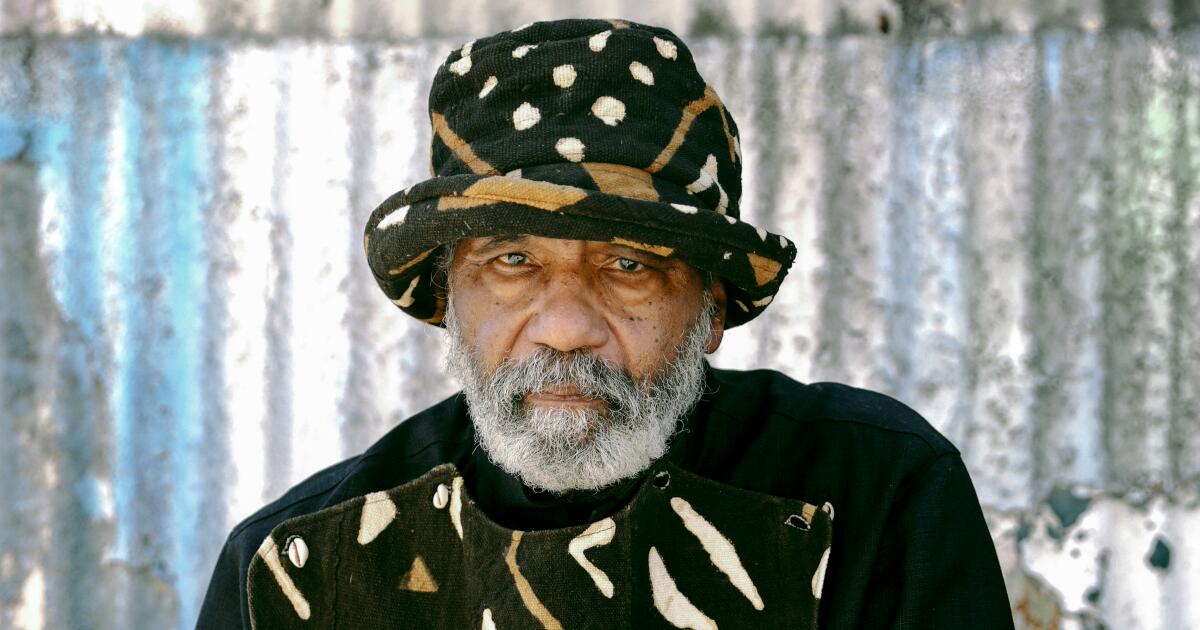
Legendary street artist and activist Shepard Fairey was omnipresent at the High Desert Art Fair, which unfolded in and around Pioneertown over two unseasonably hot days last weekend. Founded more than seven years ago by art dealer Nicholas Fahey and artist manager Candice Lawler, the event has morphed from a few dozen people in Lawler’s living room to a few thousand roaming the dusty, sunny environs of the kitschy Old West town, with ancillary events in Twentynine Palms and Joshua Tree.
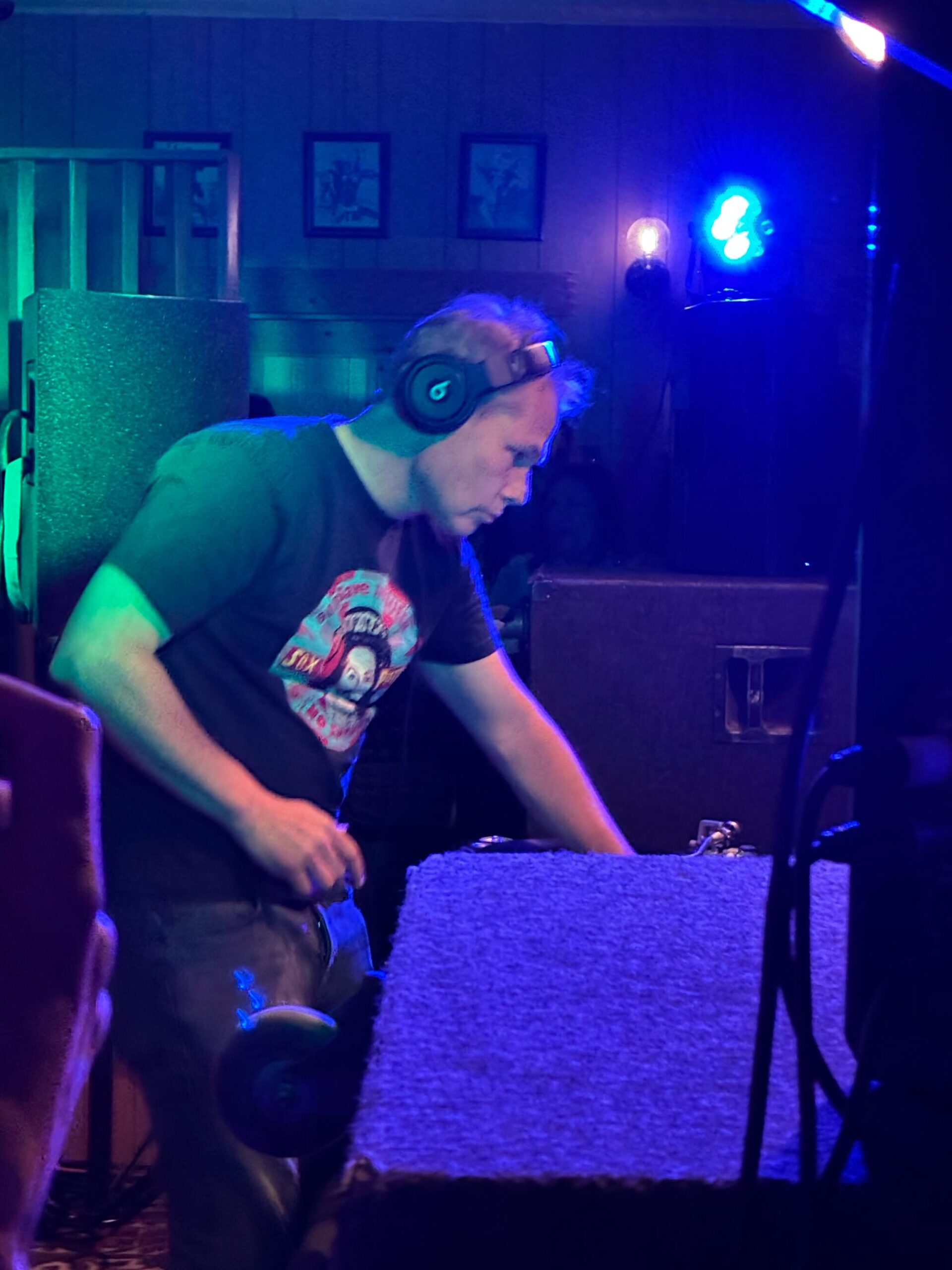
Fairey, who bought a home in the area during the COVID-19 pandemic, DJ’d a spirited opening night party at the Red Dog Saloon — spinning punk, post-punk and new wave hits by Joy Division, Fugazi and Black Flag to a packed house of art fans wearing paint-splattered DIY couture — and he spoke during the weekend’s most anticipated panel alongside Devo frontman and gallery owner Mark Mothersbaugh in a conversation moderated by singer-songwriter Harper Simon, son of folk icon Paul Simon.
Artist Shepard Fairey DJ’d the opening night party of High Desert Art Fair at the Red Dog Saloon in Pioneertown. The set was heavy of punk, post-punk and new wave.
(Jessica Gelt / Los Angeles Times)
Fairey was forthcoming about his opinions on art, politics and technology, drawing applause at one point for saying that using AI in art is not something to be afraid of. His assessment came after he lamented the fact that social media algorithms punish “decency” and reward “flamboyant narcissism and controversy.” He then joked that the “algorithm’s gonna love this. S— is gonna go nuts,” before talking about his recent collaboration with the digital artist known as Beeple who’s notorious in the art world for selling an NFT of his art in 2021 for $69.3 million.
The Red Dog Saloon was packed with art and music fans during the Friday night opening party of the High Desert Art Fair, which drew thousands of people to Pioneertown during the last weekend in March.
(Jessica Gelt / Los Angeles Times)
“He’s either the vanguard of a new way of working, and a maverick, a trailblazer, or he’s the worst thing that’s happened to art ever, or in between, or both, or neither,” Fairey said as the crowd laughed. “That’s totally my opinion.”
During a late-March event held in Fairey’s hometown of Charleston, S.C., Beeple Studios presented “Shepard Fairey: Obey and Resist,” which leveraged AI to help guests create their own Fairey-inspired paintings. During the panel, Fairey called the results “almost idiot-proof.”
He then elaborated on his feelings about AI’s encroachment on the art world, saying that if he were part of the “traditional art world thinking” he wouldn’t dare “go over to the dark side of digital art and AI, because that’s cheating.”
“All those same people a few hundred years ago when Da Vinci was using the camera obscura were like, ‘Get your proportions right, just by eye. Don’t use a cheating tool,’” Fairey said before taking the analogy to cave paintings and noting that those same types of naysayers would’ve been unhappy when it was discovered that horse hairs at the end of a stick were useful for distributing pigment and might have said, “That’s not keeping it real, bro. Use bloody elbow like everyone else.”
Fairey called that type of thinking “idiotic.”
“A tool in service of someone with a genuine vision that bends the tool to their will, rather than having themselves bent to the tool — that’s what creativity is about,” Fairey said.
The conversation about AI art started when Mothersbaugh, who was headlining a music set at Pappy & Harriet’s later that night, admitted that he was “fooling around with AI” and “just making myself laugh, like mutating old Devo photos and videos. It cracks me up. … I don’t know what is ever going to happen with it. Maybe they’ll just always live on my phone and eventually get thrown away or lost or something.”
The stage is set for an experimental music show by the General, featuring the stylings of Devo frontman Mark Mothersbaugh.
(Jessica Gelt / Los Angeles Times)
It’s a rock ‘n’ roll art fair
The idea that AI won’t cannibalize artists and their work on a massive scale is refreshingly utopian, but in many ways so was the fair itself. It takes magical thinking to grow anything in the harsh desert environment, which is why artists have been making the trek for decades. There was a youthful, rock ‘n’ roll vibe to the proceedings that was punk in quality but earnest in its quest to be seen.
Mothersbaugh’s gallery, MutMuz, occupied one of 20 rooms reconfigured as show spaces at the Pioneertown Motel, as did Gross!, a Chinatown gallery founded by former Liars drummer Julian Gross and populated with the work of musicians such as Karen O, O’s costume designer Christian Joy and TV on the Radio’s Tunde Adebimpe.
A work of painted fabric by Karen O‘s costume designer Christian Joy hangs in Gross! Gallery at the Pioneertown Motel during High Desert Art Fair. The gallery is owned by former Liars drummer Julian Gross who features plenty of work by fellow artists.
(Jessica Gelt / Los Angeles Times)
Desert pioneers are key to the spirit of the place
The fair featured tours of a number of the most interesting attractions in the area, including the Noah Purifoy Desert Art Museum of Assemblage Art in Joshua Tree and artist Andrea Zittel’s arts outpost and residency program, High Desert Test Sites.
Old computers are stacked at the center of an installation titled “Carousel” (1996) by Noah Purifoy at the Noah Purifoy Desert Art Museum of Assemblage Art in Joshua Tree.
(Jessica Gelt / Los Angeles Times)
Purifoy’s fantastical assemblages made of found objects and unloved detritus provided the most fitting example of the creative desert mindset. Outsider art in every sense of the word, and laden with scathing political and social commentary, Purifoy’s installations morph and change in the elements. A nonprofit exists to preserve them, but tour guide Teri Rommelmann said preservation efforts aren’t meant to alter the course of nature and time, but rather to save the work from sinking into the sand.
Noah Purifoy’s 2001 installation “White/Colored” is the most frequently vandalized piece in the outdoor Joshua Tree museum dedicated to his work.
(Jessica Gelt / Los Angeles Times)
Another aspect of the preservation work is erasing vandalism, which happened most during the pandemic, and was quite telling in its main target: An installation featuring a water fountain marked “White” next to a toilet affixed with a water fountain mouthpiece and labeled “Colored.”
Noah Purifoy’s sculpture “Ode to Frank Gehry” (2000) stands in the sand as part of the Noah Purifoy Desert Art Museum of Assemblage Art. The piece was once featured in a show at the Los Angeles County Museum of Art, and transporting it can be quite tricky.
(Jessica Gelt / Los Angeles Times)
At High Desert Test Sites, Zittel’s famous A-Z West escape pods are no longer used for camping after the city said the nonprofit would have to attain a commercial camping permit to continue. Nonetheless, the organization’s 80 acres are home to a variety of artist residencies, which use the windswept isolation of the desert to activate dormant ideas. It was just announced that environmental artist Lita Albuquerque will have a residency at the site.
Andrea Zittel’s famous A-Z West escape pods at High Desert Test Sites can no longer be used for camping, but they still dot the nonprofit’s 80 acres of land as an example of the creativity that the desert environment unleashes.
(Jessica Gelt / Los Angeles Times)
The tiled kitchen that artist Andrea Zittel designed for the main residence at High Desert Test Sites, which she lived in for nearly 20 years and can now be rented by artists in residence.
(Jessica Gelt / Los Angeles Times)
Art is everywhere in the desert — and growing
The success of this year’s High Desert Art Fair bodes well for the future of the area as a cultural destination.
Next year will see the return of Desert X, which for the first time will keep its large-scale, site-specific installations up for six months, timed to coincide with other SoCal cultural happenings including the Coachella Valley Music & Arts Festival and Frieze. There are also semi-permanent art installations everywhere in the area, including along driveways and the roadside. This includes a hair salon and museum in Joshua Tree, and the recently opened Reset Hotel in Twentynine Palms features dozens of rooms in retrofitted shipping containers, some with outdoor bathtubs and firepits. The hotel has also carved desert trails in its backyard, with plans to build an art park filled with installations.
The shipping container rooms at the new Reset Hotel in Twentynine Palms feature outdoor living spaces with firepits and bathtubs. Some overlook trails that will lead to a planned art park on the property.
(Jessica Gelt / Los Angeles Times)
An influx of artists, collectors and art fans will surely have an impact on an area that is already wary of gentrification and the rising cost of living that accompanies it. But there will be no stopping progress, only a utopian, Fairey-like hope that those who come will be inspired to keep and nurture the magical qualities of the place.
“Everyone is at least a dormant ballet nerd,” declares 22-year-old Eden Lim, while sitting for an interview in the suburban Dallas studio where she and her sister, Jordan, 24, film and edit their popular YouTube channel “Ballet Reign.”
Judging from the near-universal backlash to Timothée Chalamet’s recent bad-mouthing of ballet, Eden’s summation of the central tenet of their show may be true. With 67,000 subscribers in 166 countries and growing, the Lim sisters are mixing Gen Z humor and exuberance with astounding erudition to bring ballet to a new generation and fire up older, longtime fans.
With episode titles such as “Addictive Ballet Moments to Alter your Brain Chemistry” and promises like “This will increase your lifespan and double your morale,” they are on a mission to ensure that ballet not only survives but thrives.
Share via
Mirthfulness is the Lim sisters’ medium, but their message is serious. During each show, they parse video clips of great performances, often by explaining the history of the piece and giving detailed behind-the-scenes stories. They dissect the most famous pas de deux with trenchant insight and introduce their audience to the greatest dancers, including Natalia Osipova and Roberto Bolle. With signature, irrepressible enthusiasm, the sisters help viewers see precisely what makes the shows and dancers so extraordinary.
Eden, left, and Jordan Lim of YouTube channel “Ballet Reign” trained as professional dancers before deciding to focus on their show full time.
(Larsen & Talbert / For The Times)
A video clip featured in the “Addictive Ballet” episode shows New York City Ballet principal dancer Ashley Bouder launching herself into a jeté so high she seems to leave Earth’s gravity. In midair she manages to turn herself 180 degrees before being caught by her partner, despite her momentum seeming to drift into his arms like a feather blown by a breeze.
While watching the singular feat, Eden exclaims, “Call the news channels! We found a person who can actually levitate!”
Jordan says the goal is to make viewers feel equipped to say, “I understand what’s going on, and I can appreciate it, and I can appreciate that this was done well.”
“Ballet Reign” launched three years ago with modest hopes. The sisters sought a mere toehold in the YouTube universe, aiming for a narrow niche audience of fellow ballet fanatics (“ballet nerds”) ages 16 to 25. To their initial astonishment, they have attracted a far wider viewership spanning all ages, even followers who hitherto had only scant interest in ballet. They have drawn in many young children and older adults, with those 65 and up now their third-largest subscriber group.
The show has rapidly won acclaim from within and outside of the ballet world — perhaps because the depth and breadth of their knowledge makes it hard to shake the suspicion that they secretly are Ivy League professors.
The Lim sisters speak with sophistication about classic ballets and dancers they love — delivering their message through a whimsical show that has attracted fans of all ages.
(Larsen & Talbert / For The Times)
They comment with equal sophistication on ballet steps, choreography, history, musicology and the minute details of costume design. Eclectic references pop out of nowhere — a metaphor from quantum physics, an aside that the flute is the instrument whose sound is closest to a sine wave, that a serinette is an 18th century music box used to teach caged canaries to sing.
Even actual professors laud the show.
Nicolas Krusek routinely shows “Ballet Reign” episodes in his classes for adults on ballet history at Simon Fraser University in Vancouver. Krusek says what makes the show compelling “is the spirit of the videos, just the sense of joyousness and benevolence that they communicate, and a real sense of reverence for the art and the artists.”
John Meehan, a Vassar College professor of ballet and former principal dancer with American Ballet Theatre, calls their episode on Igor Stravinsky’s “The Firebird” ballet “amazing,” adding that it conveys at least as much information in much more palatable form than a “dry” university lecture.
Julie Cronshaw, director of the Highgate Ballet School in London, says even for learned, longtime balletomanes the show opens up a whole new realm of understanding and appreciation. For those weighed down by adult concerns, watching an episode leaves them feeling uplifted.
This is why Jordan believes “Ballet Reign” has attracted a significant older audience — and also because the sisters honor tradition.
“They’re looking at the content and saying, ‘These are pieces that I grew up watching. And these are the dancers that I adored when I was younger,’” Jordan says.
Eden says she hopes “it’s because our content, and the way we deliver it, is able to touch hearts.”
The Lim sisters keep a disciplined schedule, turning out polished, deftly produced episodes 52 weeks a year.
(Larsen & Talbert / For The Times)
The show also benefits from its high production values, with expertly edited clips from performances, clever blurbs of text and quirky cutaways to, say, a pole vaulter as an allusion to how high a dancer jumps.
Episodes generally begin the same way, with the sisters sitting behind a table with an old-fashioned radio-days microphone nicknamed “Mike-elangelo” between them. Eden kicks things off by announcing, “Ladies and gentlemen, this is Ballet Reign.”
A flash of superimposed text identifies them as “*Very certified*, extremely serious ballet experts.”
Jordan and Eden revel in each other’s company, finish each other’s sentences and play off each other with insightful or witty interjections.
“We grew up best friends from the beginning, and that’s never changed,” Jordan says.
They keep a disciplined, grueling schedule, turning out polished, deftly produced episodes 52 weeks a year.
Comments validating their efforts come in frequently. “You really helped me through a dark time,” reads one. Another notes, “I was going through a really difficult life transition and having your videos helped me get through.”
Jordan says, “That’s a sort of impact that I genuinely did not see coming.”
The sisters are openhearted and enjoy revealing ballet’s best-kept secrets, but they have kept a remarkably mysterious online profile. Until now, they have never even disclosed their last names, let alone anything about their background, education or experience.
There is also nearly nothing on the internet, and fans have long wondered about their credentials, including whether they are professional dancers themselves.
On the show the sisters certainly come across as if they were. Surprisingly, the answer is no — with an “almost” caveat.
The oldest of four siblings, Jordan and Eden spent nearly all of their childhood in Ottawa. From the time they were small the sisters beelined toward becoming professional ballet dancers. Jordan says when she was 4 she got up at the crack of dawn every day and put in a VHS tape of a ballet class that her mother, Mary Lim, had bought. With fierce determination, she performed tendus and relevés along with the older students on the tape.
Eden’s ballet fascination quickly followed. Mary says she soon realized she had no choice but to send them to ballet school.
“Obviously, if you look at a 4-year-old doing ballet at 7 a.m. every single day, you’re like, OK, let’s try lessons,” Jordan says.
Eden, left, and Jordan Lim of “Ballet Reign” are the oldest of four siblings and spent nearly all of their childhood in Ottawa before relocating to Texas to pursue their careers.
(Larsen & Talbert / For The Times)
By 2015, the girls needed a better ballet school than was available in Ottawa. Their parents packed up the family and moved to Dallas, where the pair enrolled in the Ballet Academy of Texas. Aside from ballet classes they were entirely homeschooled, but they had plenty of experience dancing in school performances, ballet competitions and with real companies.
Mary says the intent was “to give them an opportunity to move and carve their own path … We wanted them to find their passions.”
The moment the sisters had worked for all their lives arrived in 2020, when the time came to set off around the country — and the world — to audition for ballet companies. But the COVID-19 pandemic hit just as they got started, and almost everything in the ballet world shut down.
Jordan says the hiatus led them to reflect for the first time on whether their lifelong ambition was truly what they wanted. At the same time they groped for a way to put their passion for ballet to temporary use.
For years the sisters had fantasized, half-seriously, about having their own YouTube channel. Eden convinced an initially reluctant Jordan it was time to make the daydream real, and “Ballet Reign” premiered on Dec. 21, 2022.
The sisters say they convinced themselves they were using the show to take “a gap year” while waiting out the pandemic. As the first months passed, and their audience widened and sent glowing feedback, they began to realize they were having a big impact and touching lives. It dawned on them that this wasn’t just an interlude but their calling.
In an agonizing twist, just as the show had gotten underway, Jordan received word she had been accepted by a professional ballet company. She turned down the offer.
“It was one of the hardest decisions I’ve ever had to make,” Jordan says, but in retrospect the right one.
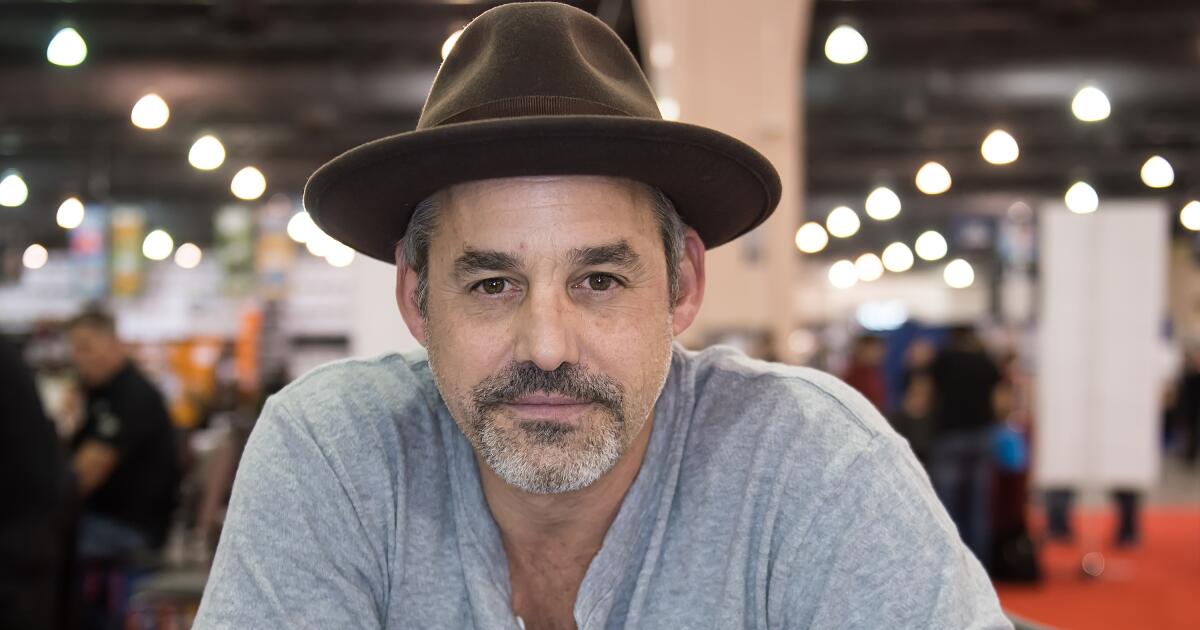
Nicholas Brendon, best known for portraying the loyal, wisecracking Xander Harris in “Buffy the Vampire Slayer,” died Friday from natural causes after dealing with a congenital heart defect and other health issues in recent years. He was 54.
His family shared news of his passing in a statement posted on the actor’s social media accounts. While it’s “no secret Nicholas had struggles in the past,” they said, he was on medication to manage his diagnosis and “optimistic about the future” at the time of his death.
His siblings and parents asked for privacy as they grieve the loss of “a man who lived with intensity, imagination, and heart.”
“He was passionate, sensitive, and endlessly driven to create,” the family stated. “Those who truly knew him understood that his art was one of the purest reflections of who he was.”
Brendon was born in Los Angeles in 1971 and began his acting career in the mid-’90s. He got his big break in 1997 when he was cast as Harris in “Buffy.” Over the show’s seven-season run, Brendon became a central figure, portraying the witty, insecure but dependable “everyman” in the gang’s battles against the forces of darkness.
He starred in his first feature film, “Psycho Beach Party,” in 2000, playing the love interest Starcat in the indie flick that’s now regarded as a cult classic.
After “Buffy” ended in 2003, Brendon continued working in television, making appearances on series such as “Without a Trace,” “Private Practice,” and “Kitchen Confidential.” He also played a recurring role as FBI technical analyst Kevin Lynch on “Criminal Minds.”
In 2022, his family shared that he had been rushed to the hospital because of tachycardia, a condition that makes the heart beat abnormally fast, and had been diagnosed with a congenital heart defect that is common in twins. Brendon has an identical twin brother named Kelly Donovan, who appeared as his stand-in and double in episodes of “Buffy.”
The “Criminal Minds” star also underwent multiple spinal surgeries to manage cauda equina syndrome, a rare condition in which nerve bundles in the lumbar or sacral spine are compressed or not functioning properly. His serious spinal injury was triggered by a fall in 2021, which required emergency surgery to prevent paralysis, his manager Theresa Fortier said in a statement at the time.
In recent years, he developed a love for painting and the arts and enjoyed sharing his emerging talent with family and friends, his family said.
Former Times staff writer Nardine Saad contributed to this report.
This city has everything you need for a great week away, from a long sandy beach to plenty of shops and restaurants, plus family-friendly attractions for days out with the kids in May half term
The beach stretches for over five miles(Image: Getty Images/iStockphoto)
The cheapest destination for a week in the sun has been revealed as budget-conscious Brits look for ways to get away in spring or summer for less.
The figures are based on pricing data for package holidays departing between June 1 and August 31 and were compiled by loveholidays, which offers affordable flight and hotel combinations.
A week at this coastal gem will set you back £230 per person on average, working out at a budget-friendly £33 a night, leading loveholidaysto crown it the most affordable destination for a week away.
Moroccan coastal town Agadir took the top spot thanks to its cheap flight and hotel combinations, and generally inexpensive food, drink, and days out. The main draw of Agadir is its long coastline with golden sands and its clear blue waters have earned it Blue Flag status.
Its beach stretches over five miles, and the sea can be choppy with strong currents, which has made it a popular surfing spot. If you want to swim, then there are some natural pools where you can take a dip when the tide comes in.
Along the beach is a lively promenade, lined with palm trees, and along here you’ll find a huge selection of places to eat, bars, souvenir shops, and places to hire surfboards and water equipment. Many hotels can also be found along this strip, allowing guests easy beach access during their stays.
You can also wander into the modern city centre for lots more restaurant options and a huge range of malls and shopping areas. Many visitors recommend the Marina Shopping Mall on the waterfront, which has international brands and lots of al fresco dining options.
It’s also worth visiting the Souk El Had market for bargains and an excellent way to test your haggling skills. Other than fixed price stores, everything in Morocco can be haggled, and with over 6,000 stalls and shops, you are bound to find something you like among the colourful rugs and textiles that hang from the walls.
Agadir’s centre was destroyed in an earthquake in the 1960s, so many of its historical sites are gone. However, La Médina d’Agadir gives you an idea of what the old city looked like, and it’s a faithful recreation of the traditional market. You’ll see stallholders weaving fabrics and painting ceramics outside their stalls, so you can see how these beautiful items are made. If you’d like to see more of Old Morocco, take a tour of Souss-Massa National Park which includes a visit to a traditional Berber village where people still live in beautiful clay houses.
Agadir is also a great option for May half-term, and with highs of 26C and dry weather, you can enjoy lots of beach and pool days. Take them for a day at Crocopark, a zoo that specialises in all things scaly, from crocodiles to snakes, and you can see these creatures basking in natural desert landscapes.
Agadir Dolphin World is another place families will love. It has regular dolphin shows, and visitors can get up close to these friendly mammals.
If you prefer to book your flight and hotel separately, there are a few airlines to choose from. Ryanair offers flights from Birmingham, London-Stansted, and Leeds Bradford, where fares start from as little as £17 one way. Jet2 and easyJet also fly from several regional airports, and most flights take just under 4 hours.
Have a story you want to share? Email us at webtravel@reachplc.com
From ‘Brigadoon’ to ‘Riverdance’ to Bruce Springsteen to Lily Allen, here’s what we’re most looking froward to from April to June in the Los Angeles area arts scene.
THE UK isn’t short of amazing swimming pools, with some dating back to the Victorian era.
But one in the city centre of London remains relatively unknown – despite a multi-million campaign to reopen it.
Sign up for the Travel newsletter
Thank you!
A swimming pool in London has been raved about as a “hidden treasure”Credit: Everyone ActiveThe pool is part of the Marshall Street Leisure Centre in SohoCredit: AlamyThe pool dates back to the 1930sCredit: Alamy
Marshall Street Baths is built on the grounds of one of London’s oldest bathhouses in 1852.
Also previously called Westminster Public Baths, it was rebuilt to what it looks like now back in 1931.
Even used as a training ground during World War II, it fell into disrepair over the years.
It was forced to close in 1997, before reopening as Nuffield Healthleisure centre in 2010 after a £25million refit.
By day, you’d be forgiven for walking past the newest theater in downtown L.A.
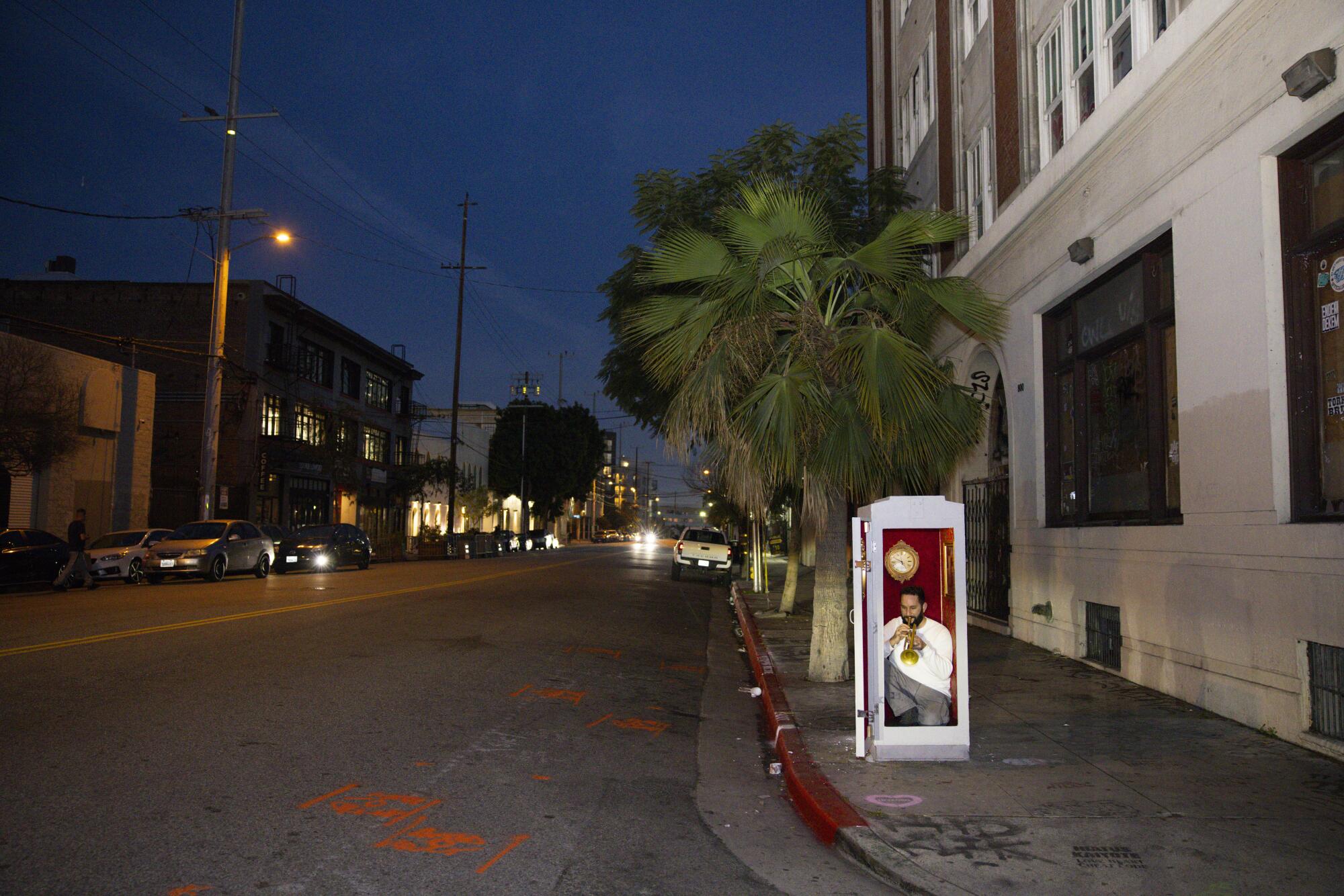
It isn’t hidden in an alley or obscured via a nameless door. No, this performance space is essentially a theater in disguise, as it’s designed to look like an electrical box — a fabrication so real that when artist S.C. Mero was installing it in the Arts District, police stopped her, concerned she was ripping out its copper wire. (There is no copper wire inside this wooden nook.)
Open the door to the theater, and discover a place of urban enchantment, where a red velvet door and crimson wallpaper beckon guests to come closer and sit inside. That is, if they can fit.
With a mirror on its side and a clock in its back, Mero’s creation, about 6 feet tall and 3 feet deep yet smaller on its interior, looks something akin to an intimate, private boudoir — the sort of dressing room that wouldn’t be out of place in one of Broadway’s historic downtown theaters. That’s by design, says Mero, who cites the ornately romanticized vibe and color palette of the Los Angeles Theatre as prime inspiration. Mero, a longtime street artist whose guerrilla art regularly dots the downtown landscape, likes to inject whimsy into her work: a drainage pipe that gives birth, a ball pit for rats or the transformation of a dilapidated building into a “castle.” But there’s just as often some hidden social commentary.
With her Electrical Box Theatre, situated across from the historic American Hotel and sausage restaurant and bar Wurstküche, Mero set out to create an impromptu performance space for the sort of experimental artists who no longer have an outlet in downtown’s galleries or more refined stages. The American Hotel, for instance, subject of 2018 documentary “Tales of the American” and once home to the anything-goes punk rock ethos of Al’s Bar, still stands, but it isn’t lost on Mero that most of the neighborhood’s artist platforms today are softer around the edges.
Ethan Marks inside S.C. Mero’s theater inside a fake electrical box. The guerrilla art piece is near the American Hotel.
“A lot of galleries are for what can sell,” Mero says. “Usually that’s paintings and wall art.”
She dreamed, however, of an anti-establishment place that could feel inviting and erase boundaries between audience and perfomer. “People may be intimidated to get up on a stage or at a coffee shop, but here it’s right on street level.”
It’s already working as intended, says Mero. I visited the box early last week when Mero invited a pair of experimental musicians to perform. Shortly after trumpeter Ethan Marks took to the sidewalk, one of the American Hotel’s current residents leaned out his window and began vocally and jovially mimicking the fragmented and angular notes coming from the instrument. In this moment, “the box,” as Mero casually refers to it, became a true communal stage, a participatory call-and-response pulpit for the neighborhood.
Clown Lars Adams, 38, peers out of S.C. Mero’s theater inside a fake electrical box. Mero modeled the space off of Broadway’s historic theaters.
A few days prior, a rideshare driver noticed a crowd and pulled over to read his poetry. He told Mero it was his first time. The unscripted occurrence, she says, was “one of the best moments I’ve ever experienced in making art.”
“That’s literally what this space is,” Mero says. “It’s for people to try something new or to experiment.”
Marks jumped at the chance to perform for free inside the theater, his brassy freewheeling equally complementing and contrasting the sounds of the intersection. “I was delighted,” he says, when Mero told him about the stage. “There’s so much unexpectedness to it that as an improviser, it really keeps you in the moment.”
A downtown resident for more than a decade, Mero has become something of an advocate for the neighborhood. The area arguably hasn’t returned to its pre-pandemic heights, as many office floors sit empty and a string of high-profile restaurant closures struck the community. Mero’s own gallery at the corner of Spring and Seventh streets shuttered in 2024. Downtown also saw its perception take a hit last year when ICE descended on the city center and national media incorrectly portrayed the hood as a hub of chaos.
Artist S.C. Mero looks into her latest project, a fake electrical box in the Arts District. Mero has long been associated with street art in the neighborhood.
“A lot has changed in the 13 years when I first got down here,” Mero says. “Everybody felt like it was magic, like we were going to be part of this renaissance and L.A. was going to have this epicenter again. Then it descended. A lot of my friends left. But I still see the same beauty in it. The architecture. The history. Downtown is the most populous neighborhood in all of L.A. because it belongs to everybody. It’s everybody’s downtown, whether they love it or not. And I feel we are part of history.”
Art today in downtown ranges from high-end galleries such as Hauser & Wirth to the graffiti-covered towers of Oceanwide Plaza. Gritty spaces, such as Superchief Gallery, have been vocal about struggles to stay afloat. Mero’s art, meanwhile, remains a source of optimism throughout downtown’s streets.
At Pershing Square, for instance, sits her “Spike Cafe,” a mini tropical hideaway atop a parking garage sign where umbrellas and finger food props have become a prettier nesting spot for pigeons. Seen potentially as a vision for beautification, a contrast, for instance, from the nature intrusive barbs that aim to deter wildlife, “Spike Cafe” has become a statement of harmony.
Elsewhere, on the corner of Broadway and Fourth streets, Mero has commandeered a once historic building that’s been burned and left to rot. Mero, in collaboration with fellow street artist Wild Life, has turned the blighted space into a fantastical haven with a knight, a dragon and more — a decaying castle from a bygone era.
“A lot of times people are like, ‘I can’t believe you get away with that!’ But most people haven’t tried to do it, you know?” Mero says. “It can be moved easily. It’s not impeding on anyone. I don’t feel I do anything bad. Not having a permit is just a technicality. I believe what I’m doing is right.”
Musician Jeonghyeon Joo, 31, plays the haegeum outside of S.C. Mero’s latest art project, a theater in a faux electrical box.
After initially posting her electrical box on her social media, Mero says she almost instantly received more than 20 requests to perform at the venue. Two combination locks keep it closed, and Mero will give out the code to those she trusts. “Some people want to come and play their accordion. Another is a tour guide,” Mero says.
Ultimately, it’s an idea, she says, that she’s had for about a decade. “Everything has to come together, right? You have to have enough funds to buy the supplies, and then the skills to to have it come together.”
And while it isn’t designed to be forever, it is bolted to the sidewalk. As for why now was the right time to unleash it, Mero is direct: “I needed the space,” she says.
There are concerns. Perhaps, Mero speculates, someone will change the lock combination, knocking her out of her own creation. And the more attention brought to the box via media interviews means more scrutiny may be placed on it, risking its confiscation by city authorities.
As a street artist, however, Mero has had to embrace impermanence, although she acknowledges it can be a bummer when a piece disappears in a day or two. And unlike a gallerist, she feels an obligation to tweak her work once it’s out in the world. Though her “Spike Cafe” is about a year old, she says she has to “continue to babysit it,” as pigeons aren’t exactly known for their tidiness.
But Mero hopes the box has a life of its own, and considers it a conversation between her, local artists and downtown itself. “I still think we’re part of something special,” Mero says of living and working downtown.
And, at least for now, it’s the neighborhood with arguably the city’s most unique performance venue.
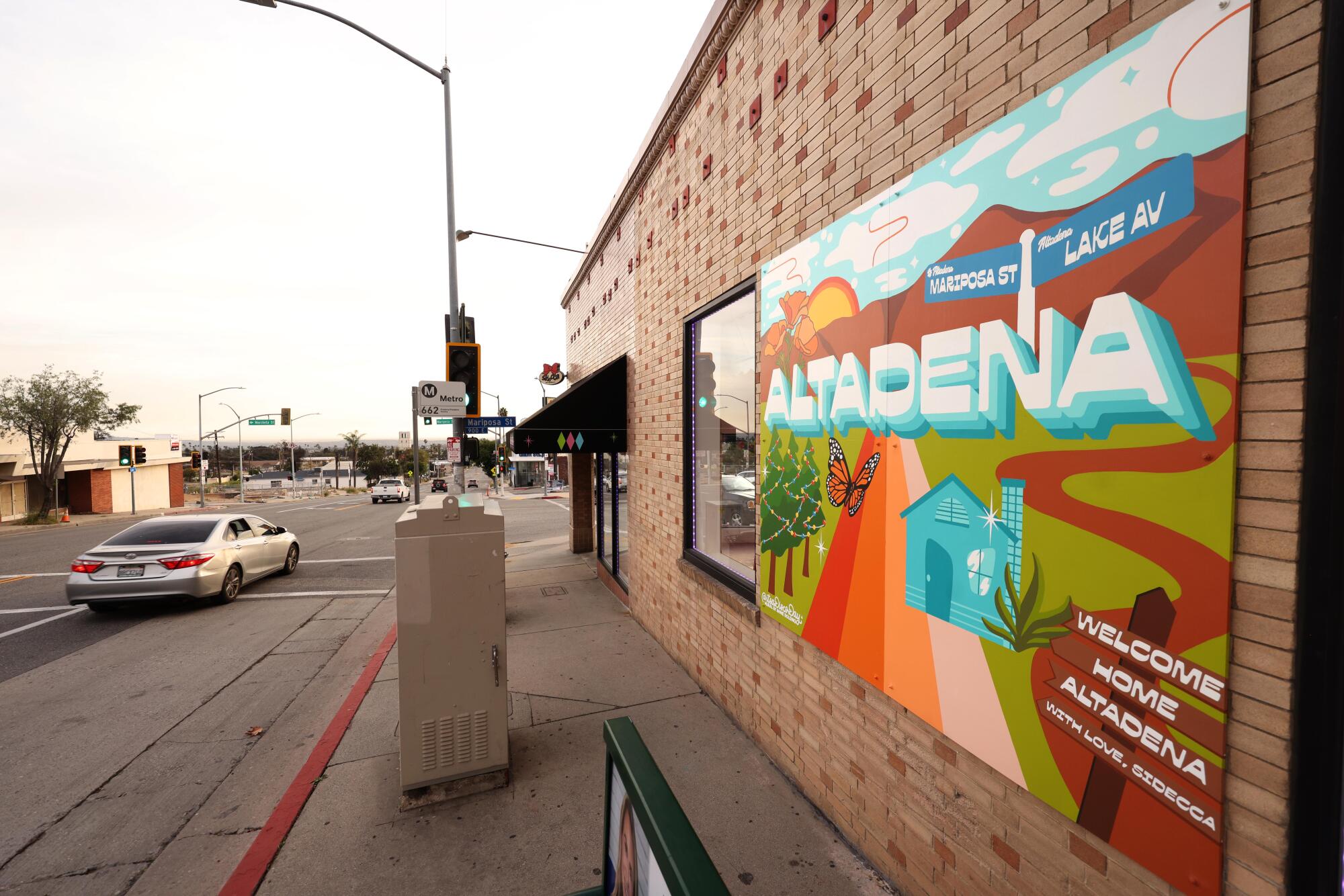
Every time Adriana Molina drives up Lake Avenue to her retro-style women’s clothing shop Sidecca in Altadena, she sees the new outdoor mural she commissioned for the store by muralist and illustrator Annie Bolding. It gives her hope.
“I’m here to stay, and this mural solidified my decision to reopen my business,” said Molina on a recent winter day, sitting next to Bolding inside the boutique. “I grew up in Altadena. The community has motivated me this whole time, and I want them to drive by this mural and smile.”
“ALTADENA.” The word — in big white letters, set against layers of blue — appears toward the top of the mural, on the store’s brick wall facing Lake. Above are the San Gabriel Mountains, painted a deep brown, California poppies and Mariposa Street and Lake Avenue street signs. Below are green grass, a monarch butterfly and Altadena’s Christmas Tree Lane. A bright blue house is on a multicolored striped path in the middle of the mural. Next to it, on a hiking trail, a sign says, “Welcome Home Altadena… With Love, Sidecca.”
For Molina and Bolding, the mural is a personal ode to the Eaton fire-ravaged community — art as a message of optimism and healing.
A car passes by the new Altadena mural on the side of Sidecca apparel shop, which commissioned the piece after fire and floods devastated the community.
(Genaro Molina / Los Angeles Times)
When the fire tore through Altadena in January 2025, Sidecca and a few other stores on the north side of Mariposa Street’s bustling Mariposa Junction survived, while the other half-block of businesses burned to the ground. The fire leveled Bolding’s parents’ house off Lake and the home of one of Molina’s close relatives.
Molina staged pop-ups and sold merchandise online during months of remediation, and officially reopened Sidecca’s doors in November as part of Mariposa Junction’s larger comeback. Then the store suffered another blow: flooding and damage during rainstorms in late December. While Molina prepped to temporarily close her store yet again for renovations, Bolding began work on the mural. She started painting on the one-year anniversary of the fire and finished eight days later.
“On the day I started it, it was so cold and windy, and I was scared being up on the ladder,” said Bolding. “But getting to talk to community members while I was painting was very special. People were excited and honking as they drove by. That night, I drove up to the lot where my parents’ place was, and I stood there and all the feelings flooded back.”
The mural’s origin story is that of two creative women bound by strength and a desire to give back.
Molina, who has worked in the fashion industry for more than 30 years, opened Sidecca’s Altadena spot in 2023, after closing its longtime Pasadena location. Voted Pasadena’s best women’s clothing store five times by Pasadena Weekly, Sidecca sells fun vintage-inspired merchandise and clothes, from ‘50s style dresses to snazzy magnets, tote bags and sunglasses. A big rainbow zips across the top of one of the store’s walls.
A display in Sidecca in 2023, two years before the Eaton fire devastated Altadena.
(Alejandro R. Jimenez)
“A few months after Sidecca opened in Altadena, my mom walked in and saw how colorful it was, and said, ‘This reminds me of my daughter,’ ” Bolding said. “With zero hesitation, my mom said to Adriana, ‘Here’s her Instagram. This is my daughter’s stuff.’ ”
Bolding, who goes by Disco Day Designs, calls herself “a joyful creator who loves to intentionally transform spaces.” Known for the bright murals she creates for brands and shops, Bolding gained attention on social media for a trash bin she painted with palm trees and stripes. She brought it to the 2024 Coachella Valley Music and Arts Festival as part of a contest organized by the festival’s sustainability partner, Global Inheritance.
“I fixated on the trash can,” said Molina. “I looked at Annie’s murals and was like, ‘Oh, she has to do something in here for us.’ ”
“Game recognizes game,” added Bolding, smiling.
Molina wanted to rebrand Sidecca with a new logo, bags and art, and connected with Bolding about that and a possible mural inside the store. “I wanted ‘Sidecca’ painted across a wall as an acronym that stands for style, individuality, diversity, expression, community, culture and art,” she said. “That’s who we are.”
Then came Jan. 7, 2025.
The store was closed all day for a holiday lunch. Then the winds picked up and the flames roared. Molina, who lives with her husband and two children on the Altadena-Pasadena, evacuated with her family to Long Beach and came back days later. She knew the store was OK because she’d seen it — intact — on the news.
“As soon as we could come up to the shop, we went,” Molina said. “There were ashes all over.”
Bolding and her husband were in Palm Springs fixing up an AirBnb they cohost when Bolding got a call from her mom about the fire in Altadena. She urged her mom, dad and younger brother to evacuate. After they did, their home burned down. Her parents now live in a Pasadena apartment.
When Molina started selling Altadena-themed merch on Sidecca’s website, Bolding donated three designs, including one with lively retro daisies. In July, she wrote an email to Molina reviving the idea of a mural, but outside versus inside, as an ode to Altadena.
“It felt like anything I could do to bring joy, let’s go,” said Molina. “And I really wanted a little house in there, and for it to say, ‘Welcome home.’ ”
The mural would be Bolding’s first public piece of art on a main street.
“Lake always felt like the road going home,” she said. “That rainbow road in the mural, leading to the mountains, is so symbolic. Very ‘Wizard of Oz.’ The mountains, their silhouette, have always felt majestic, safe, and why it was so heartbreaking anytime to see them burn. To me, they feel like mother.”
Muralist Annie Bolding stands in front of her new Altadena mural on the side of the Sidecca apparel shop. The work is Bolding’s first piece of public art on a main street.
(Genaro Molina / Los Angeles Times)
Bolding’s joyful daisies decorated the Sidecca tote bag given to customers at November’s reopening, just before December’s intense rainstorms. Water gushed through Sidecca’s ceiling. Molina and her employee Manisa Ianakiev were overwhelmed.
“We were like, ‘Is this really happening?’ ” said Molina. “Then people started bringing tools and towels. It was an example of community.”
Bolding planned to start painting the mural Jan. 4, during the Altadena Forever Run, but rain swept through. After Molina’s landlord installed a plywood base, Bolding started on the mural several days later.
Since then, the shop’s ceiling has been replaced, and Molina is working on trying to replace the floor — while continuing to stage pop-ups and sell merchandise online — before fully reopening the bricks-and-mortar boutique this spring.
“People say, ‘Every time I go into your store, I just get happy. I’m in a better mood,’ ” said Molina. “I get that all the time. And what Annie has done, this mural, is beautiful. It makes me happy.”
Ulysses Jenkins, the pioneering Los Angeles-born video artist whose avant-garde compositions embodied Black experimentalism, has died. He was 79.
Jenkins’ death was confirmed by his alma mater Otis College, where he studied under renowned painter and printmaker Charles White in the late 1970s and returned as an instructor years later. The Los Angeles art and design school shared a statement from the Charles White Archive, which said, “Jenkins had a profound impact on contemporary art and media practices.”
“A trailblazing figure in Black experimental video, he was widely recognized for works that used image, sound, and cultural iconography to examine representation, race, gender, ritual, history, and power,” the statement said.
A self-proclaimed “griot,” Jenkins throughout his decades-spanning career maintained an art practice grounded in the tradition of those West African oral historians who came before him. Through archival documentaries like “The Nomadics” and surrealist murals like “1848: Bandaide,” he leveraged alternative media to challenge Eurocentric representations of Black Americans in popular culture.
He was both an artist and a storyteller who sought to “reassert the history and the culture,” he told The Times in 2022. That year, the Hammer Museum presented Jenkins’ first major retrospective, “Ulysses Jenkins: Without Your Interpretation.”
“Early video art was about the problems with the media that we are still having today: the notions of truth,” Jenkins said. “To that extent, early video art was a construct that was anti-media … a critical analysis of the media that we were viewing every night.”
Born in 1946 to Los Angeles transplants from the South, Jenkins was ambivalent about the city, which offered his parents some refuge from the blatant systemic racism they encountered in their hometowns, but housed an entertainment industry that had long perpetuated anti-Black sentiment.
“What Hollywood represents, especially in my work, is the classic plantation mentality,” Jenkins told The Times in 1986. “Although people aren’t necessarily enslaved by it, people enslave themselves to it because they’re told how fantastic it is to help manifest these illusions for a corporate sponsor.”
Jenkins, who participated in a group of artists committed to spontaneous action called Studio Z, was naturally drawn to video art over Hollywood filmmaking. “I can address any issue and I don’t have to wait for [the studios’] big OK. I thought this was a land of freedom, and video allows me that freedom and opportunity that I can create for myself and at least feel that part of being an American,” he said.
Jenkins went on to deconstruct Hollywood’s vision of the Black diaspora in experimental video compositions including “Mass of Images,” which incorporates clips from D.W. Griffith’s notoriously racist “The Birth of a Nation,” and “Two-Tone Transfer,” which depicts, in Jenkins’ words, a “dreamscape in which the dreamer awakens to a visitation of three minstrels who tell the story of the development of African American stereotypes in the American entertainment industry.”
Jenkins’ legacy is not only artistic but institutional, with the luminary having held teaching appointments at UCSD and UCI, where he co-founded the digital filmmaking minor with fellow Southern California-based artists Bruce Yonemoto and Bryan Jackson.
As artist and educator Suzanne Lacy penned in her social media tribute to Jenkins, which showed him speaking to students at REDCAT in L.A., “he has been an important part of our histories here in Southern California as video and performance artists evolved their practices.”